

a अ – negative prefix a-; not; without
particle · previx · pronoun · substantive masculine · suffix · Word type unspecified
Dictionary sources
AYI dictionary previx · suffix
Cappeller 1891 pronoun · Word type unspecified
Original text · English · pronoun
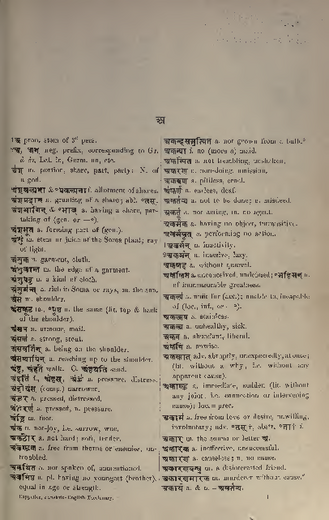
a1 ·pron. stem of 3^d pers.
Original text · English · Word type unspecified
a2 ·an neg. prefix, corresponding to Gr. `a `an, Lat. in, Germ. un, etc.
Monier-Williams 1872 particle · substantive masculine · Word type unspecified
Original text · English · particle
a 2 . a, ind. an interjection of pity (Ah!).

Original text · English · substantive masculine
a 6 . a, as, m., N. of Viṣṇu (especially as the first of the three sounds in the sacred syllable om), also of Brahmā, Śiva, and Vaiśvānara; (am), n. Brahma.
Original text · English · Word type unspecified
a 1 . a, the first letter of the alphabet; the first short vowel inherent in consonants.
Original text · English · Word type unspecified
a 3 . a (before a vowel an), a prefix cor- responding to Gr. ἀ, ἀν Lat. in, Goth. and Germ. un, Eng. in or un, and having a negative or privative or depreciative sense; e. g. eka one, an-eka not one; anta end, an-anta endless; paśyat seeing, a-paśyat not seeing. Sometimes this prefix denotes com- parison. It is occasionally an expletive.
Original text · English · Word type unspecified
a 4 . a, the base of some pronouns and pro- nom. forms; (substituted for idam, in asya, atra, &c.)
Original text · English · Word type unspecified
a 5 . a, the augment prefixed to the root in the formation of the imperfect, aorist, and con- ditional tenses, by some considered as connected with 3. a, and by others as connected with 4. a.
Petersburger 1855 particle · substantive masculine · Word type unspecified
Original text · German · particle
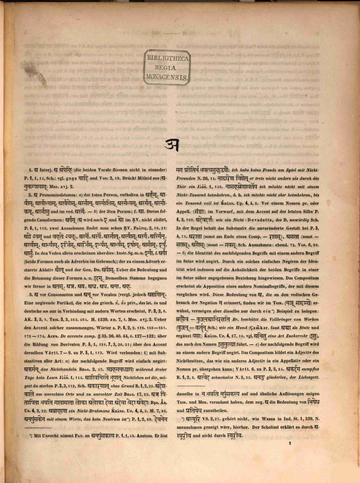
1. a Interj. a apehi (die beiden Vocale fliessen nicht in einander) P. 1,1,14, Sch.; vgl. gaṇa cādi und VOP. 2,19. Drückt Mitleid aus (anukampāyām) MED. avy. 2.
Original text · German · substantive masculine
5. a m. Viṣṇu TRIK. 1,1,29. MED. avy. 2.
Original text · German · substantive masculine
6. a (angeblich von 1. at) m. N. pr. eines Mannes PAT._in_MAHĀBH. lith. Ausg. 1,172,b. — Vgl. 5. i weiter unten.
Original text · German · Word type unspecified
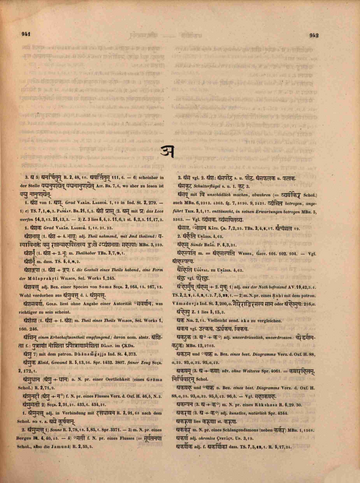
2. a Pronominalstamm: a〉 der 1sten Person, enthalten in ahám, āvā́m, āvā́bhyām, āváyos, asmā́n, asmā́bhis, asmábhyam, asmát, asmā́kam, asmā́su und im ved. asmé. — b〉 der 3ten Person; f. ā. Davon folgende Casusformen: ayám (a wird nach e und o im ṚV. nicht elidirt, P. 6,1,116. zwei Ausnahmen findet man schon ṚV. PRĀTIŚ. 2,19. ṚV. PRĀTIŚ. 2,21: agne 'yam und vahate 'yam), asmaí, asyaí, asmā́t, asyā́s, asyá, asmín, asyā́m, ābhyā́m, ebhís, ābhís, ebhyás, ābhyás, eṣā́m, āsā́m, eṣú, āsú. In den Veden allein erscheinen überdies: Instr. Sg. m.n. enā́, f. ayā́ (beide Formen auch als Adverbia im Gebrauch); der zu einem Adverb erstarrte Ablativ ā́t und der Gen. Du. ayós. Ueber die Bedeutung und die Betonung dieser Formen s. u. idam. Demselben Stamme begegnen wir ferner in atas, atra, atha, adya, adha, anā, aha.
Original text · German · Word type unspecified
3. a vor Consonanten und an vor Vocalen (vergl. jedoch aṛṇin). Eine negirende Partikel, die wie das griech. ἀ, ἀν priv., das lat. in und deutsche un nur in Verbindung mit andern Worten erscheint, P. 2,2,6. AK. 3,5,1. TRIK. 3,3,463. TRIK. 3,3,464. H. 1539. H. an. 7,1. MED. avy. 2. Ueber den Accent solcher zusammenges. Wörter s. P. 6,2,2. P. 6,2,116. P. 6,2,155—P. 6,2,161. P. 6,2,172—P. 6,2,174. AUFR. De accentu comp. § 35. AUFR. De accentu comp. § 36. AUFR. De accentu comp. § 40. AUFR. De accentu comp. § 44,6. AUFR. De accentu comp. § 127—AUFR. De accentu comp. § 132; über die Bildung von Derivaten P. 5,1,121. P. 7,3,30. P. 7,3,31; über den Accent derselben Vārtt. 7—9. zu P. 5,1,119. Wird verbunden: 1〉 mit Substantiven aller Art: a〉 der nachfolgende Begriff wird einfach negirt: akarman das Nichthandeln BHAG. 2,47. tryahamanadhyāyaḥ während dreier Tage kein Lesen YĀJÑ. 1,144. ajīvaniste bhūyāt Nichtleben sei dir, mögest du sterben P. 3,3,112, Sch. akāraṇāt ohne Grund R. 1,2,32. adeśakāle am unrechten Orte und zu unrechter Zeit BHAG. 17,22. atra pitāpitā bhavati mātāmātā lokā alokā devā adevā vedā avedāḥ BṚH. ĀR. UP. 4,3,22. abrāhmaṇa ein Nicht-Brahmane CHĀND. UP. 4,4,5. M. 7,85. anapuṃsakena mit einem Worte, das kein Neutrum ist*⁾ P. 1,2,69. devanena mama prītirna bhavatyasuhṛdgaṇaiḥ ich habe keine Freude am Spiel mit Nicht-Freunden N. 26,14. nādvāreṇa viśet er trete nicht anders als durch die Thür ein YĀJÑ. 1,140. nāsahasreṇāvarteya ich möchte nicht mit einem Nicht-Tausend heimkehren, d. h. ich möchte nicht eher heimkehren, bis ein Tausend voll ist CHĀND. UP. 4,4,5. Vor einem Nomen pr. oder Appell. (saṃjñā) im Vorwurf, mit dem Accent auf der letzten Silbe P. 6,2,159. adevadattáḥ wie ein Nicht-Devadatta, des D. unwürdig Sch. In der Regel behält das Substantiv die unveränderte Gestalt bei P. 5,4,71. arājā (sonst am Ende eines Comp. — rājas), asakhā (sonst — sakhas), (agaus) (sonst — gavas) Sch. Ausnahmen: ebend. 72. VOP. 6,90. *⁾ Mit Unrecht nimmt PAT. an anapuṃsakasya P. 1,1,43. Anstoss. Er löst dasselbe in na bhavati napuṃsakasya auf und ähnliche Auflösungen mögen TRIK. und MED. veranlasst haben, dem neg. a die Bedeutung von niṣedha und pratiṣedha zuzutheilen. — b〉 die Identität des nachfolgenden Begriffs mit einem andern Begriff im Satze wird negirt. Durch ein solches einfaches Negiren der Identität wird indessen auf die Aehnlichkeit der beiden Begriffe in einer im Satze näher angegebenen Beziehung hingewiesen. Das Compositum erscheint als Apposition eines andern Nominalbegriffs, der mit diesem verglichen wird. Diese Bedeutung von a, die an den vedischen Gebrauch der Negation na erinnert, finden wir im TRIK. (nañ sādṛśye) erwähnt, vermögen aber dieselbe nur durch ein*⁾ Beispiel zu belegen: brahmaiva — kurūnaśvābhirakṣati Br. beschützt die Vollbringer von Werken (kurūn = kartṝn Sch.) wie ein Hund (Śaṃkar. fasst aśvā als Stute und ergänzt yathā) CHĀND. UP. 4,17,10. vgl. anikṣu eine Art Zuckerrohr (ikṣu), das auch den Namen ikṣutulyā führt. *⁾ asthūri VS. 2,27. gehört nicht, wie WEBER_in_Ind. St. I, 339, N. anzunehmen geneigt wäre, hierher. Der Scholiast erklärt es durch asthūrīva und nicht durch sthūrīva. — c〉 der nachfolgende Begriff wird an einem andern Begriff negirt. Das Compositum bildet ein Adjectiv des Nichtbesitzes, das wie ein anderes Adjectiv in ein Appellativ oder ein Nomen pr. übergehen kann; Vārtt. 6. zu P. 2,2,24. akardama sumpflos R. 1,2,5. asveda schweisslos N. 5,23. anaṅga gliederlos, der Liebesgott. Bezeichnet das Substantiv einen Theil des Körpers, so geht das Fem. auf ā aus, P. 4,1,57. (akeśā haarlos, Sch.). Der Ton ruht auf der letzten Silbe P. 6,2,172. In den Veden vielfache Ausnahmen, ohne dass eine bestimmte Regel wahrzunehmen wäre. Vor dem Affix ka (abrahmabandhū́ka, avrī́hika) eine abweichende Betonung, P. 6,2,173. P. 6,2,174. Die indischen Lexicographen geben der Negation auch die Bedeutung von wenig (īṣadarthe TRIK. svalpārthe MED. H. an.), weil sie, wie auch in andern Sprachen, bisweilen in übertreibender Weise gebraucht wird. So umschreibt z. B. ŚKDR. akeśa durch 1〉 keśarahita haarlos, 2〉 alpakeśayukta mit wenig Haar versehen, 3〉 apraśastakeśaviśiṣṭa nicht durch schönes Haar ausgezeichnet. — 2〉 mit Adjectiven aller Art: akrūra nicht rauh M. 2,33. ataijasa nicht von Metall M. 6,53. ahastābharaṇopeta nicht mit Handschmuck versehen R. 1,6,9. átīkṣṇa oder atīkṣṇá, áśuci oder aśucí; dieselbe doppelte Betonung haben die Nomina ag. auf tar mit dem Accent auf der ersten Silbe, P. 6,2,161. Vgl. über die Betonung noch P. 6,2,155—P. 6,2,158. P. 6,2,160. Bisweilen verlieren solche Composita ganz die ihnen ursprünglich zukommende Unbestimmtheit des Begriffs, indem durch das Negiren eines bestimmten Begriffes der gerade entgegengesetzte Begriff gemeint wird; so bedeutet z. B. asita nicht weiss geradezu schwarz. Zwei Negationen bejahen: anamitaṃpaca = mitaṃpaca, anasūri CHĀND. UP. 4,3,7. = sūri. — 3〉 mit verschiedenen Pronominibus: asas nicht er, aneṣas nicht dieser P. 6,1,132. Vgl. akasmāt, akiṃcana, akutobhaya, akutrā, akudhryañc. — 4〉 mit Adverbien: amṛṣā in Wahrheit BṚH. ĀR. UP. 3,9,28. asakṛt nicht einmal, öfters. — 5〉 mit Participien aller Art, mit dem Gerundivum und mit dem Infinitiv: māmapaśyan N. 11,12. kiṃ nu me syādidamakurvataḥ was würde wohl mit mir geschehen, wenn ich dieses nicht thäte N. 10,10. ánanna oder ananná P. 6,2,161. Das Partic. praet. pass. verbindet sich mit der verneinten Form desselben Partic. sehr häufig zu einem Compositum, P. 2,1,60. (kṛtākṛtam, bhuktābhuktam, aśitānaśitena jīvati, kliṣṭākliśitena vartate Sch.) akartavyá, akaraṇīyá P. 6,2,160. ádatvā AV. 12,5,19. anavāpya VIŚV. 8,17. anaśituṃ dadhre CHĀND. UP. 4,10,3. nāśakattīvramāyāsamakartum DAŚ. 2,19. veti śakyamavaktum PAT._zu_P. 7,3,70. anyataracchakyamakartum id. zu P. 1,1,62. — 6〉 mit einem Verbum finitum: apacasi tvaṃ jālma du kochst nicht (im Vorwurf), Narr! Vārtt. zu P. 6,3,73. — Man hat die neg. Partikel a mit dem im vorigen Artikel besprochenen Pronominalstamm der 3ten Person identificirt; die indischen Grammatiker dagegen halten a für eine Verstümmelung von na (nañ); s. P. 6,3,73—P. 6,3,77. VOP. 6,9.
Original text · German · Word type unspecified
4. a Augment beim Imperfect, Aorist und Conditionalis. Ist wohl auch auf den unter 2. erwähnten Pronominalstamm der 3ten Person zurückzuführen.
Original text · German · Word type unspecified
3. a 5〉 anarcitum R. 2,48,10. avartitum R. 2,111,6. — 6〉 scheinbar in der Stelle yadyanupaśyet yadyanānupaśyet AIT. BR. 7,6, wo aber zu lesen ist yadyu nānupaśyet.
Original text · German · Word type unspecified
3. a 6〉 aspṛhayānta BHĀG. P. 3,25,37.
Böhtlingk 1879 particle · pronoun · substantive masculine · Word type unspecified
Original text · German · particle
3. *a Interj.
Original text · German · pronoun
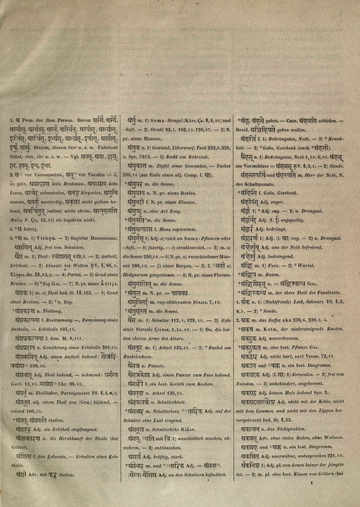
1. a Pron. der 3ten Person. Davon asmaí, asyaí, asmā́t, asyā́s, asyá, asmín, asyā́m, ābhyā́m, ebhís, ābhís, ebhyás, ābhyás, eṣā́m, āsā́m eṣú, āsú Diesem, diesem hier u. s. w. Unbetont Subst. ihm, ihr u. s. w. Vgl. ayam, ayā, idam, ima, iyam, ena, enā.
Original text · German · substantive masculine
4. *a m. — 1〉 Viṣṇu. — 2〉 fingirter Mannsname.
Original text · German · Word type unspecified
2. a˚ vor Consonanten, an˚ vor Vocalen = ἀ, ἀν priv. abrāhmaṇa kein Brahman, anadhyāya kein Lesen, asveda schweisslos, anaṅga körperlos, aśuci unrein, atarha unwürdig, akṛtvā nicht gethan habend, anarcitum (selten) nicht ehren, aspṛhayanti (BHĀG. P. ŚIŚ. 15,33) sie begehren nicht.
Original text · German · Word type unspecified
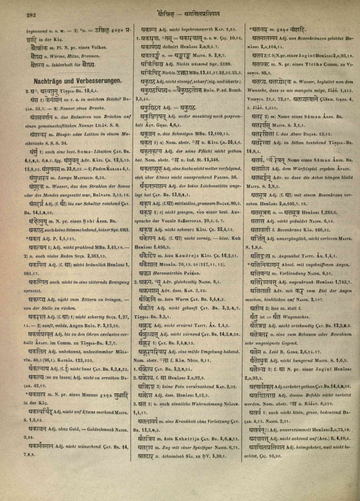
2. a˚ , asvaptum TĀṆḌYA-BR. 10,4,4. [Nachtrag, Band 1]
Original text · German · Word type unspecified
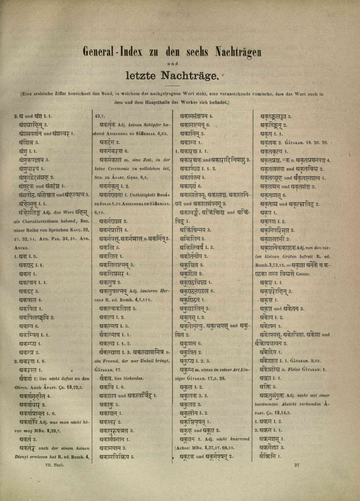
2. a und aṃśa I. 1. [Nachtrag, Band 7]
Apte 1890 particle · substantive masculine
Original text · English · particle · substantive masculine
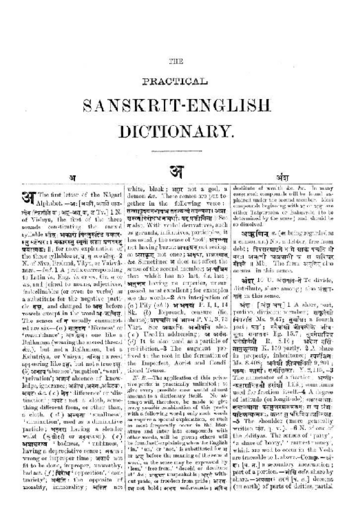
a The first letter of the Nāgarī Alphabet. — aḥ [avati, atati sātatvena tiṣṭhatīti vā; av-at vā, ḍa Tv.] 1 N. of Viṣṇu, the first of the three sounds constituting the sacred syllable om; akāro viṣṇuruddiṣṭa ukārastu maheśvaraḥ . makārastu smṛto brahmā praṇavastu trayātmakaḥ ..; for more explanation of the three syllables a, u, m see om. 2 N. of Śiva, Brahmā, Vāyu, or Vaiśvānara. — ind. 1 A prefix corresponding to Latin in, Eng. in or un, Gr. a or an, and joined to nouns, adjectives, indeclinables (or even to verbs) as a substitute for the negative particle nañ, and changed to an before vowels except in the word a-ṛṇin. The senses of na usually enumerated are six- (a) sādṛśya ‘likeness’ or ‘resemblance’; abrāhmaṇaḥ one like a Brāhmaṇa (wearing the sacred thread &c.), but not a Brāhmaṇa, but a Kṣatriya, or Vaiśya; anikṣu : a reed appearing like ikṣu, but not a true ikṣu. (b) abhāva ‘absence’, ‘negation’, ‘want’, ‘privation’; ajñānaṃ absence of knowledge, ignorance; akrodhaḥ, anaṃgaḥ, akaṃṭakaḥ, aghaṭaḥ &c. (c) bheda ‘difference’ or ‘distinction’; apaṭaḥ not a cloth, something different from, or other than, a cloth. (d) alpatā ‘smallness’, ‘diminution’, used as a diminutive particle; anudarā having a slender waist (kṛśodarī or tanumadhyamā). (e) aprāśastya ‘badness,’ ‘unfitness,’ having a depreciative sense; akālaḥ wrong or improper time; akāryaṃ not fit to be done, improper, unworthy, bad act. (f) virodha ‘opposition’, ‘contrariety’; anītiḥ the opposite of morality, immorality; asita not ([Page 0001-b]) white, black; asura not a god, a demon &c. These senses are put together in the following verse: -tatsādṛśyamabhāvaśca tadanyatvaṃ tadalpatā . aprāśastyaṃ virodhaśca nañarthāḥ ṣaṭ prakīrtitāḥ .. See na also. With verbal derivatives, such as gerunds, infinitives, participles, it has usually the sense of ‘not’; adagdhvā not having burnt: apaśyan not seeing; so asakṛt not once; amṛṣā, akasmāt &c. Sometimes a does not affect the sense of the second member; a-paścima that which has no last, i. e. last; anuttama having no superior, unsurpassed, most excellent; for examples see the words. 2 An interjection of (a) Pity (ah!) a avadyaṃ P. I. 1. 14 Sk. (b) Reproach, censure (fie, shame); apacasi tvaṃ jālma P. VI. 3. 73 Vārt. See akaraṇi, ajīvani also. (c) Used in addressing; a anaṃta. (d) It is also used as a particle of prohibition. 3 The augment prefixed to the root in the formation of the Imperfect, Aorist and Conditional Tenses. N-B. -The application of this privative prefix is practically unlimited; to give every possible case would almost amount to a dictionary itself. No attempt will, therefore, be made to give every possible combination of this prefix with a following word; only such words as require a special explanation, or such as most frequently occur in the literature and enter into compounds, with other words, will be given; others will be found self-explaining when the English ‘in,’ ‘un,’ or ‘not,’ is substituted for a or an before the meaning of the second word, or the sense may be expressed by ‘less,’ ‘free from,’ ‘devoid or destitute of’ &c; akathya unspeakable; adarpa without pride, or freedom from pride; apragalbha not bold; abhaga unfortunate; avitta ([Page 0001-c]) destitute of wealth &c. &c. In many cases such compounds will be found explained under the second member. Most compounds beginning with a or an are either Tatpuruṣa or Bahuvrīhi (to be determined by the sense) and should be so dissolved.
Cappeller 1887 previx · pronoun
Original text · German · previx
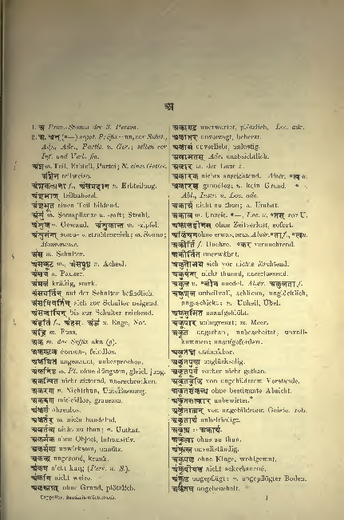
2. a, an (˚—) negat. Präfix -un, vor Subst., Adj., Adv., Partic. u. Ger.; selten vor Inf. und Verb. fin.
Original text · German · pronoun
1. a Pron-Stamm der 3. Person.
Burnouf 1866 previx · Word type unspecified
Original text · French · previx
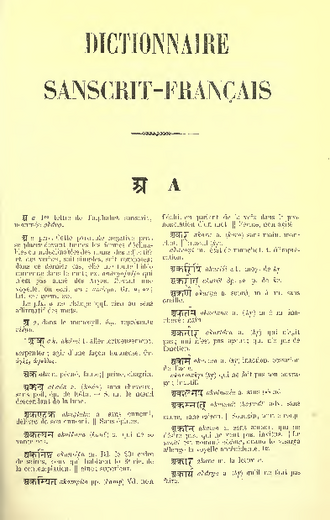
a a priv. Cette particule négative peut se placer devant toutes les formes déclinables ou indéclinables des noms, des adjectifs et des verbes, soit simples, soit composés; dans ce dernier cas, elle nie toute l'idée contenue dans le mot; ex. anāryajuṣṭa qui n'est pas aimé des Aryas. Devant une voyelle, on écrit an: anārya. Gr. α, αν; lat. in; germ. un. Le pfx. a ne change qqf. rien au sens affirmatif des mots.
Original text · French · Word type unspecified
a a 1ʳᵉ lettre de l'alphabet sanscrit, nommée akāra.
Original text · French · Word type unspecified
a a, dans le monosyll. oṃ, représente viṣṇu.
Derived words
More direct derivatives (104)
-
āśaya आशय substantive masculine deposit; repository; latent disposition; abode; dwelling place; seat
Further derivatives (13)
Occurrences in source texts (1152)
DYS 125 occurrences
DYS 1–1*1: Viṣṇu and Nṛsiṃha 2 occurrences
Occurrences through derived words
DYS 2–8: Seeking a Teacher 3 occurrences
Occurrences through derived words
DYS 9–11: Four Yogas 6 occurrences
Occurrences through derived words
DYS 12–14: Mantra Yoga 4 occurrences
Occurrences through derived words
DYS 15–19: Śiva’s Laya 3 occurrences
Occurrences through derived words
DYS 20–26: Practising Laya 7 occurrences
Occurrences through derived words
31 more source pages
DYS 27–31: Survey of Haṭha 4 occurrences
Occurrences through derived words
DYS 32–33: Yama and Niyama 3 occurrences
Occurrences through derived words
DYS 39–42: Practice Matters 4 occurrences
Occurrences through derived words
DYS 43–49: False Yogis 4 occurrences
Occurrences through derived words
DYS 69–72: Avoid and Support 3 occurrences
Occurrences through derived words
DYS 73–78: Kevala Kumbhaka 4 occurrences
Direct occurrences
-
DYS 78 Segment 15
Occurrences through derived words
DYS 79–83: Power and Bhūcarasiddhi 4 occurrences
Occurrences through derived words
DYS 84–86: Preserving Bindu 3 occurrences
Occurrences through derived words
DYS 87–88: Oṃ 3 occurrences
Occurrences through derived words
DYS 89–93: Stages of Development 5 occurrences
Occurrences through derived words
DYS 94–97: Pratyāhāra 2 occurrences
Occurrences through derived words
DYS 98–100: Siddhis 3 occurrences
Occurrences through derived words
DYS 103–105: Students as Obstacle 2 occurrences
Direct occurrences
-
DYS 105 Segment 8
Occurrences through derived words
-
DYS 104 Segment 4
DYS 106–107: Ghaṭa and Paricaya 2 occurrences
Occurrences through derived words
DYS 112–121: Five Elements 6 occurrences
Occurrences through derived words
DYS 125–130: Liberation in Life 3 occurrences
Direct occurrences
-
DYS 127 Segment 7
Occurrences through derived words
DYS 143–145: Mūlabandha 3 occurrences
Occurrences through derived words
DYS 150–153*3: Vajrolī: Secret Teaching 8 occurrences
Occurrences through derived words
DYS 154–167: Vajrolī for the Male Yogi 1 occurrence
Occurrences through derived words
-
DYS 158 Segment 2
DYS 168–179*1: Vajrolī for the Yoginī 12 occurrences
Direct occurrences
-
DYS 178 Segment 11
Occurrences through derived words
DYS 180–183*1: Amarolī and Sahajolī 2 occurrences
Occurrences through derived words
DYS 184–187: Rāja Yoga and Perfection 5 occurrences
Occurrences through derived words
DYS 188: Conclusion of the Instruction 1 occurrence
Occurrences through derived words
-
DYS 188 Segment 6
DYS 189–191: Transmission 4 occurrences
Occurrences through derived words
GoS 46 occurrences
GoS 1–8: Learning and Liberation 3 occurrences
Occurrences through derived words
GoS 9–11: Breath and Conditioning 2 occurrences
Occurrences through derived words
GoS 20–28: Setting Sarasvatī in Motion 4 occurrences
Occurrences through derived words
GoS 29–33: Four Forms of Breath Retention 2 occurrences
Occurrences through derived words
GoS 34–41: Sun, Sound and Cooling 2 occurrences
Occurrences through derived words
7 more source pages
GoS 42–49: Breath as Bellows 2 occurrences
Occurrences through derived words
GoS 50–63: Three Locks 10 occurrences
Occurrences through derived words
GoS 64–66: An Order for Practice 3 occurrences
Occurrences through derived words
GoS 67–73: Examining Obstacles 5 occurrences
Occurrences through derived words
GoS 74–80: Through the Three Knots 4 occurrences
Occurrences through derived words
GoS 81–88: Moon, Fluid and Union 3 occurrences
Occurrences through derived words
HP 229 occurrences
HP 1.1-1.3: Opening 4 occurrences
Direct occurrences
-
HP 1.3 Segment 7
Occurrences through derived words
HP 1.4-1.10: Lineage of Siddhas 6 occurrences
Occurrences through derived words
HP 1.12-1.14: Place of Practice 4 occurrences
Occurrences through derived words
HP 1.15-1.16*2: Factors of Practice 8 occurrences
Occurrences through derived words
HP 1.17-1.32: Āsana 3 occurrences
Occurrences through derived words
51 more source pages
HP 1.33-1.43: Siddhāsana 6 occurrences
Occurrences through derived words
HP 1.44-1.49: Padmāsana 2 occurrences
Occurrences through derived words
HP 1.50–54: Siṃhāsana and Bhadrāsana 2 occurrences
Occurrences through derived words
-
HP 1.50–52 Segment 40
-
HP 1.53–54 Segment 34
HP 1.55-1.57: Transition to Kumbhaka 2 occurrences
Occurrences through derived words
HP 1.58-1.63: Mitāhāra 2 occurrences
Occurrences through derived words
HP 1.64-1.65: Practice and Rājayoga 3 occurrences
Direct occurrences
-
HP 1.64 Segment 16
Occurrences through derived words
HP 2.1-2.6: Introduction to Prāṇāyāma 5 occurrences
Occurrences through derived words
HP 2.7-2.10: Nāḍīśodhana 4 occurrences
Occurrences through derived words
HP 2.15-2.20: Correct Practice 5 occurrences
Direct occurrences
-
HP 2.16 Segment 9
Occurrences through derived words
HP 2.34-2.36: Naulī and Kapālabhātī 1 occurrence
Occurrences through derived words
-
HP 2.35 Segment 7
HP 2.37-2.43: Path to Manonmanī 3 occurrences
Occurrences through derived words
HP 2.44-2.47: Eight Kumbhakas 3 occurrences
Occurrences through derived words
HP 2.69-2.71: Three Kumbhakas 2 occurrences
Occurrences through derived words
HP 2.72-2.78: Kevala Kumbhaka 8 occurrences
Occurrences through derived words
HP 3.1-3.5: Foundation of Kuṇḍalinī 2 occurrences
Occurrences through derived words
HP 3.10-3.18: Mahāmudrā 3 occurrences
Occurrences through derived words
HP 3.19-3.25: Mahābandha 2 occurrences
Occurrences through derived words
HP 3.33-3.48*1: Khecarī and Soma 6 occurrences
Occurrences through derived words
HP 3.49-3.57: Mūlabandha 7 occurrences
Occurrences through derived words
HP 3.58-3.65: Uḍḍiyāna Bandha 3 occurrences
Occurrences through derived words
HP 3.66-3.72: Jālandhara and the Bandhas 2 occurrences
Occurrences through derived words
HP 3.73-3.78: Viparīta Karaṇī 2 occurrences
Occurrences through derived words
HP 3.79-3.86*1: Vajrolī 4 occurrences
Occurrences through derived words
HP 3.87-3.93*7: Sahajolī and Amarolī 10 occurrences
Occurrences through derived words
HP 3.94-3.102*1: Śakti Cālana 8 occurrences
Occurrences through derived words
-
HP 3.96 Segment 4
-
HP 3.97*1 Segment 6
-
HP 3.97*2 Segment 13
-
HP 3.99 Segment 9
-
HP 3.100 Segment 11
-
HP 3.101 Segment 5
-
HP 3.101*1 Segment 14
-
HP 3.102*1 Segment 10
HP 3.103-3.107*2: Conclusion of the Mudrā Teaching 6 occurrences
Occurrences through derived words
HP 4.0*1-4.0*14: Samādhi and Laya 9 occurrences
Occurrences through derived words
HP 4.1-4.4: Laya and Breath 10 occurrences
Occurrences through derived words
HP 4.5-4.8: Śāmbhavī and Khecarī 2 occurrences
Occurrences through derived words
HP 4.9-4.11*4: Gaze and Lunar Nectar 3 occurrences
Occurrences through derived words
HP 4.11*5-4.11*14: Khecarī in Space 3 occurrences
Occurrences through derived words
-
HP 4.11*8 Segment 3
-
HP 4.11*12 Segment 6
-
HP 4.11*12 Segment 10
HP 4.11*15-4.11*28: Space and Laya 7 occurrences
Direct occurrences
-
HP 4.11*28 Segment 9
Occurrences through derived words
-
HP 4.11*16 Segment 12
-
HP 4.11*26 Segment 16
-
HP 4.11*28 Segment 1
-
HP 4.11*28 Segment 2
-
HP 4.11*28 Segment 6
-
HP 4.11*28 Segment 13
HP 4.11*29-4.11*31: Transition to Nāda 1 occurrence
Occurrences through derived words
-
HP 4.11*29 Segment 4
HP 4.12-4.19: Path of Nāda 5 occurrences
Occurrences through derived words
HP 4.20-4.27: Four Stages of Nāda 7 occurrences
Occurrences through derived words
HP 4.27*1-4.35: Rājayoga and Haṭha 14 occurrences
Direct occurrences
-
HP 4.30 Segment 3
Occurrences through derived words
HP 4.35*1-4.36: Signs of Samādhi 10 occurrences
Direct occurrences
Occurrences through derived words
HP 4.37-4.46: Listening to Nāda 4 occurrences
Occurrences through derived words
HP 4.47-4.55*4: Nāda Binds the Mind 3 occurrences
Occurrences through derived words
HP 4.56-4.66: The Middle Path 3 occurrences
Occurrences through derived words
HP 4.67-4.77: Mind and Breath 8 occurrences
Direct occurrences
Occurrences through derived words
HTK 16 occurrences
HTK 10.6*2–9*1: Ujjāyī / Ujjāyikā and Sūryabheda 1 occurrence
Occurrences through derived words
-
HTK 10.8 Segment 16
HTK 10.17*2–18: Bhrāmarī: The sound of bees 3 occurrences
Occurrences through derived words
HTK 10.18*1–19*1: Mūrcchā / Manomūrcchanā 1 occurrence
Occurrences through derived words
-
HTK 10.19 Segment 22
HTK 10.19*2–21*1: Plāvanī: Supported on water 1 occurrence
Occurrences through derived words
-
HTK 10.20 Segment 13
HTK 10.21*2–23*1: Utkarṣa and Apakarṣa 2 occurrences
Occurrences through derived words
-
HTK 10.21*2 Segment 5
-
HTK 10.23 Segment 19
4 more source pages
HTK 10.26–29*1: Cakra, Śaṅkha, Vāmāvartta, Vartmagati and Gadā 1 occurrence
Occurrences through derived words
-
HTK 10.27 Segment 22
HTK 10.39–39*1: Jīvacālaka / Jīvacāla 1 occurrence
Occurrences through derived words
-
HTK 10.39 Segment 6
HTK 10.42–43: Meru: Three stages of breath retention 2 occurrences
Occurrences through derived words
IVU 11 occurrences
IVU 8: The Bodiless Self 3 occurrences
Direct occurrences
-
IVU 8 Segment 8
Occurrences through derived words
IVU 9-11: Insufficiency of Knowledge 4 occurrences
Occurrences through derived words
IVU 12-14: Insufficiency of Becoming 2 occurrences
Occurrences through derived words
MAN 7 occurrences
MandUp 14 occurrences
MandUp 3-7: Four modes of awareness 10 occurrences
Occurrences through derived words
PJH 20 occurrences
PJH 3-4: Perceiver and Perceived; Microcosm and Macrocosm 1 occurrence
Occurrences through derived words
-
PJH 4 Segment 2
PJH 12-14: Understanding the Five Acts 1 occurrence
Occurrences through derived words
-
PJH 12 Segment 2
PJH 15-16: Attaining Power, the Joy of Awareness (cidānanda), and Liberation While Living (jīvanmukti) 3 occurrences
Occurrences through derived words
PJH 17-19: Simple Means (sukhopāyas) and Samādhi 9 occurrences
Occurrences through derived words
PYS 206 occurrences
PYS 1.2–4: Cessation of the Vṛtti 2 occurrences
Occurrences through derived words
PYS 1.5–11: The Five Vṛtti 9 occurrences
Direct occurrences
-
PYS 1.8 Segment 4
Occurrences through derived words
PYS 1.17–18: Two Kinds of Samādhi 7 occurrences
Occurrences through derived words
PYS 1.19–22: Two Approaches 5 occurrences
Occurrences through derived words
50 more source pages
PYS 1.23–26: Īśvara 6 occurrences
Direct occurrences
-
PYS 1.24 Segment 5
Occurrences through derived words
PYS 1.27–29: Praṇava 4 occurrences
Occurrences through derived words
PYS 1.31–32: Distraction and Its Remedy 4 occurrences
Occurrences through derived words
PYS 1.42–43: Gross Samāpatti 3 occurrences
Occurrences through derived words
PYS 1.44–45: Subtle Samāpatti 3 occurrences
Occurrences through derived words
PYS 1.46–49: Samādhi with Seed 3 occurrences
Occurrences through derived words
PYS 1.50–51: Samādhi without Seed 4 occurrences
Occurrences through derived words
PYS 2.1–2: Kriyā-Yoga 2 occurrences
Occurrences through derived words
PYS 2.3–9: Five Kleśas 8 occurrences
Occurrences through derived words
PYS 2.12–14: The Karmic Store 7 occurrences
Direct occurrences
-
PYS 2.12 Segment 6
Occurrences through derived words
PYS 2.15–17: Everything Is Suffering 6 occurrences
Occurrences through derived words
PYS 2.18–19: The Evolution of Prakṛti 5 occurrences
Occurrences through derived words
PYS 2.20–22: Puruṣa and the Seen 2 occurrences
Direct occurrences
-
PYS 2.22 Segment 6
Occurrences through derived words
-
PYS 2.20 Segment 6
PYS 2.23–26: From Avidyā to Kaivalya 8 occurrences
Occurrences through derived words
PYS 2.27–29: Aṣṭāṅga as a Path to Liberation 7 occurrences
Occurrences through derived words
PYS 2.30–34: Vows and Counterreflection 17 occurrences
Occurrences through derived words
-
PYS 2.30 Segment 1
-
PYS 2.30 Segment 3
-
PYS 2.30 Segment 5
-
PYS 2.30 Segment 6
-
PYS 2.31 Segment 2
-
PYS 2.31 Segment 4
-
PYS 2.31 Segment 7
-
PYS 2.32 Segment 1
-
PYS 2.32 Segment 2
-
PYS 2.32 Segment 7
-
PYS 2.33 Segment 1
-
PYS 2.34 Segment 1
-
PYS 2.34 Segment 2
-
PYS 2.34 Segment 7
-
PYS 2.34 Segment 8
-
PYS 2.34 Segment 9
-
PYS 2.34 Segment 15
PYS 2.35–39: Perfected Yamas 6 occurrences
Occurrences through derived words
PYS 2.40–45: Perfected Niyamas 7 occurrences
Occurrences through derived words
PYS 2.46–48: Āsana as a Seated Posture 1 occurrence
Occurrences through derived words
-
PYS 2.48 Segment 4
PYS 2.49–51: Prāṇāyāma as Breath Suspension 6 occurrences
Occurrences through derived words
PYS 2.52–53: Karmic Veil and Dhāraṇā 1 occurrence
Occurrences through derived words
-
PYS 2.52 Segment 3
PYS 2.54-55: Pratyāhāra 2 occurrences
Occurrences through derived words
PYS 3.1–4: Saṃyama 2 occurrences
Occurrences through derived words
PYS 3.9–12: Three Transformations of Citta 10 occurrences
Occurrences through derived words
PYS 3.13–14: Three Kinds of Transformation 1 occurrence
Occurrences through derived words
-
PYS 3.13 Segment 7
PYS 3.15–16: Sequence of Transformation 2 occurrences
Occurrences through derived words
PYS 3.17–20: Extraordinary Knowledge 4 occurrences
Occurrences through derived words
PYS 3.21–22: Invisibility and Time of Death 3 occurrences
Occurrences through derived words
PYS 3.35–37: Knowledge of Puruṣa and Siddhis 2 occurrences
Occurrences through derived words
PYS 3.39–40: Udāna and Samāna 3 occurrences
Occurrences through derived words
PYS 3.43: Mahāvidehā 2 occurrences
Occurrences through derived words
PYS 3.44–46: Mastery over the Elements 2 occurrences
Occurrences through derived words
PYS 3.47–48: Mastery over the Senses 2 occurrences
Occurrences through derived words
PYS 3.49–51: Omniscience or Kaivalya 2 occurrences
Occurrences through derived words
PYS 3.52–55: Viveka and Kaivalya 5 occurrences
Occurrences through derived words
PYS 4.2–3: Change of Life Form 2 occurrences
Occurrences through derived words
PYS 4.7–8: Four Kinds of Karma 4 occurrences
Occurrences through derived words
PYS 4.9–11: Continuity of Saṃskāras 4 occurrences
Occurrences through derived words
PYS 4.12–14: Real Objects in Transformation 1 occurrence
Occurrences through derived words
-
PYS 4.14 Segment 1
PYS 4.15–17: Object and Citta 2 occurrences
Direct occurrences
-
PYS 4.16 Segment 8
Occurrences through derived words
-
PYS 4.17 Segment 7
PYS 4.18–21: Puruṣa Knows Citta 2 occurrences
Direct occurrences
-
PYS 4.18 Segment 8
Occurrences through derived words
-
PYS 4.20 Segment 2
PYS 4.25–26: Citta Flows toward Kaivalya 2 occurrences
Occurrences through derived words
PYS 4.27–28: The Return of Old Saṃskāras 3 occurrences
Occurrences through derived words
PYS 4.29–32: Dharmamegha-Samādhi 3 occurrences
Occurrences through derived words
SiSa 314 occurrences
SiSa 1.1-1.3: Das eine Wissen 2 occurrences
Occurrences through derived words
SiSa 1.4-1.9: Begrenzte Wege 3 occurrences
Direct occurrences
-
SiSa 1.8 Segment 5
Occurrences through derived words
SiSa 1.17-1.19: Geheime Yoga-Lehre 2 occurrences
Occurrences through derived words
SiSa 1.20-1.31: Karma und Erkenntnis 3 occurrences
Direct occurrences
-
SiSa 1.22 Segment 11
Occurrences through derived words
SiSa 1.35-1.44: Täuschungs-Gleichnisse 2 occurrences
Occurrences through derived words
SiSa 1.45-1.50: Rückkehr zum Bewusstsein 3 occurrences
Occurrences through derived words
73 more source pages
SiSa 1.51-1.64: Selbst als Licht 8 occurrences
Occurrences through derived words
SiSa 1.65-1.70: Māyā-Aufhebung 2 occurrences
Occurrences through derived words
SiSa 1.71-1.81: Avidyā und Elemente 5 occurrences
Occurrences through derived words
SiSa 1.82-1.90: Guṇas und Gegenstände 4 occurrences
Occurrences through derived words
SiSa 1.91-1.92: Wahres Wissen 2 occurrences
Occurrences through derived words
SiSa 2.6-2.12: Mond und Sonne 2 occurrences
Occurrences through derived words
SiSa 2.13-2.20: Suṣumṇā und Citrā 3 occurrences
Occurrences through derived words
SiSa 2.25-2.31: Nāḍī-Netz 2 occurrences
Occurrences through derived words
SiSa 2.32-2.34: Inneres Feuer 2 occurrences
Occurrences through derived words
SiSa 2.49-2.54: Befreiungswissen 2 occurrences
Occurrences through derived words
SiSa 3.1-3.10: Herzlotus und Prāṇa 9 occurrences
Occurrences through derived words
SiSa 3.17-3.20: Praxisbeginn 3 occurrences
Occurrences through derived words
SiSa 3.21-3.31: Nāḍī-Reinigung 7 occurrences
Occurrences through derived words
SiSa 3.32-3.33: Praxis-Hindernisse 6 occurrences
Occurrences through derived words
SiSa 3.34-3.38: Förderliche Mittel 7 occurrences
Occurrences through derived words
SiSa 3.39-3.40: Kumbhaka-Kraft 4 occurrences
Occurrences through derived words
SiSa 3.41-3.48: Atemkraft und Hindernisse 9 occurrences
Occurrences through derived words
SiSa 3.49-3.50: Karma-Reinigung 3 occurrences
Occurrences through derived words
SiSa 3.51-3.54: Prāṇāyāma-Siddhis 3 occurrences
Occurrences through derived words
SiSa 3.55-3.60: Ghaṭāvasthā 6 occurrences
Occurrences through derived words
SiSa 3.61-3.67: Paricaya und Niṣpatti 7 occurrences
Occurrences through derived words
SiSa 3.68-3.80: Vāyusādhana 9 occurrences
Occurrences through derived words
SiSa 3.81-3.83: Freiheit von Wiederkehr 1 occurrence
Occurrences through derived words
-
SiSa 3.81 Segment 3
SiSa 3.84-3.87: Siddhāsana 4 occurrences
Occurrences through derived words
SiSa 3.88-3.91: Padmāsana 3 occurrences
Occurrences through derived words
SiSa 3.95-3.97: Svastikāsana 2 occurrences
Occurrences through derived words
SiSa 4.1-4.8: Yonimudrā-Kreislauf 4 occurrences
Occurrences through derived words
SiSa 4.9-4.20: Yonimudrā-Geheimnis 5 occurrences
Occurrences through derived words
SiSa 4.21-4.25: Zehn Mudrās 3 occurrences
Occurrences through derived words
SiSa 4.26-4.30: Mahāmudrā-Praxis 2 occurrences
Occurrences through derived words
SiSa 4.31-4.36: Mahāmudrā-Wirkung 5 occurrences
Occurrences through derived words
SiSa 4.37-4.42: Mahābandha 6 occurrences
Occurrences through derived words
SiSa 4.43-4.50: Mahāvedha 4 occurrences
Occurrences through derived words
SiSa 4.51-4.59: Khecarīmudrā 2 occurrences
Occurrences through derived words
SiSa 4.60-4.63: Jālandharabandha 1 occurrence
Occurrences through derived words
-
SiSa 4.63 Segment 11
SiSa 4.64-4.68: Mūlabandha 5 occurrences
Occurrences through derived words
SiSa 4.72-4.77: Uḍḍyānabandha 4 occurrences
Occurrences through derived words
SiSa 4.78-4.80: Vajrolī-Weg 5 occurrences
Occurrences through derived words
SiSa 4.81-4.90: Bindu-Bewahrung 7 occurrences
Occurrences through derived words
SiSa 4.91-4.94: Vajrolī-Siddhi 4 occurrences
Occurrences through derived words
SiSa 4.95-4.100: Sahajolī und Amarolī 4 occurrences
Occurrences through derived words
SiSa 4.105-4.111: Śakticālana 2 occurrences
Occurrences through derived words
-
SiSa 4.107 Segment 12
-
SiSa 4.110 Segment 12
SiSa 5.6-5.9: Dharma-Hindernisse 2 occurrences
Occurrences through derived words
SiSa 5.15-5.16: Mṛdu und Mantrayoga 1 occurrence
Occurrences through derived words
-
SiSa 5.16 Segment 10
SiSa 5.17-5.20: Madhya und Layayoga 3 occurrences
Occurrences through derived words
SiSa 5.21-5.23: Adhimātra und Haṭhayoga 3 occurrences
Occurrences through derived words
SiSa 5.24-5.28: Adhimātratama 2 occurrences
Occurrences through derived words
SiSa 5.29-5.35: Pratīka-upāsanā 5 occurrences
Occurrences through derived words
SiSa 5.38-5.47: Nāda-Laya 7 occurrences
Occurrences through derived words
SiSa 5.48-5.71: Innere Meditation 17 occurrences
Occurrences through derived words
-
SiSa 5.49 Segment 6
-
SiSa 5.50 Segment 6
-
SiSa 5.50 Segment 13
-
SiSa 5.52 Segment 11
-
SiSa 5.53 Segment 4
-
SiSa 5.56 Segment 4
-
SiSa 5.57 Segment 6
-
SiSa 5.59 Segment 2
-
SiSa 5.59 Segment 12
-
SiSa 5.60 Segment 1
-
SiSa 5.61 Segment 11
-
SiSa 5.62 Segment 11
-
SiSa 5.65 Segment 13
-
SiSa 5.66 Segment 5
-
SiSa 5.67 Segment 4
-
SiSa 5.67 Segment 11
-
SiSa 5.70 Segment 12
SiSa 5.74-5.76: Nāḍī-Zirkulation 1 occurrence
Occurrences through derived words
-
SiSa 5.76 Segment 13
SiSa 5.90-5.93: Mūlādhāra-Wirkungen 3 occurrences
Direct occurrences
-
SiSa 5.92 Segment 9
Occurrences through derived words
SiSa 5.94-5.101: Mūlādhāra-Siddhis 1 occurrence
Occurrences through derived words
-
SiSa 5.101 Segment 2
SiSa 5.113-5.120: Anāhata 3 occurrences
Direct occurrences
-
SiSa 5.115 Segment 5
Occurrences through derived words
-
SiSa 5.114 Segment 4
-
SiSa 5.118 Segment 14
SiSa 5.121-5.127: Viśuddha 4 occurrences
Occurrences through derived words
-
SiSa 5.123 Segment 3
-
SiSa 5.124 Segment 4
-
SiSa 5.124 Segment 6
-
SiSa 5.125 Segment 7
SiSa 5.132-5.143: Innere Vārāṇasī 1 occurrence
Occurrences through derived words
-
SiSa 5.137 Segment 17
SiSa 5.144-5.155: Ājñā und Khecarī 8 occurrences
Occurrences through derived words
-
SiSa 5.144 Segment 15
-
SiSa 5.146 Segment 4
-
SiSa 5.148 Segment 3
-
SiSa 5.152 Segment 1
-
SiSa 5.152 Segment 3
-
SiSa 5.152 Segment 11
-
SiSa 5.154 Segment 2
-
SiSa 5.154 Segment 9
SiSa 5.156-5.181: Sahasrāra 10 occurrences
Occurrences through derived words
-
SiSa 5.161 Segment 9
-
SiSa 5.163 Segment 14
-
SiSa 5.163 Segment 15
-
SiSa 5.164 Segment 3
-
SiSa 5.165 Segment 9
-
SiSa 5.166 Segment 6
-
SiSa 5.174 Segment 14
-
SiSa 5.176 Segment 13
-
SiSa 5.179 Segment 6
-
SiSa 5.181 Segment 6
SiSa 5.182-5.190: Sahasrāra-Mond 5 occurrences
Occurrences through derived words
-
SiSa 5.183 Segment 4
-
SiSa 5.188 Segment 12
-
SiSa 5.190 Segment 3
-
SiSa 5.190 Segment 17
-
SiSa 5.190 Segment 21
SiSa 5.191-5.207: Kailāsa und Mahāśūnya 9 occurrences
Occurrences through derived words
-
SiSa 5.192 Segment 13
-
SiSa 5.193 Segment 17
-
SiSa 5.194 Segment 12
-
SiSa 5.195 Segment 12
-
SiSa 5.196 Segment 11
-
SiSa 5.197 Segment 5
-
SiSa 5.198 Segment 4
-
SiSa 5.199 Segment 11
-
SiSa 5.200 Segment 6
SiSa 5.208-5.222: Rājayoga 12 occurrences
Direct occurrences
-
SiSa 5.221 Segment 4
Occurrences through derived words
-
SiSa 5.208 Segment 2
-
SiSa 5.208 Segment 11
-
SiSa 5.212 Segment 6
-
SiSa 5.213 Segment 24
-
SiSa 5.215 Segment 10
-
SiSa 5.216 Segment 3
-
SiSa 5.218 Segment 12
-
SiSa 5.220 Segment 5
-
SiSa 5.222 Segment 4
-
SiSa 5.222 Segment 6
-
SiSa 5.222 Segment 20
SiSa 5.223-5.233: Praxis im Leben 3 occurrences
Occurrences through derived words
-
SiSa 5.231 Segment 5
-
SiSa 5.233 Segment 5
-
SiSa 5.233 Segment 10
SiSa 5.234-5.252: Tripurā-Mantra 5 occurrences
Direct occurrences
-
SiSa 5.248 Segment 19
Occurrences through derived words
-
SiSa 5.236 Segment 13
-
SiSa 5.239 Segment 13
-
SiSa 5.251 Segment 4
-
SiSa 5.251 Segment 12
SiSa 5.253-5.260: Haushalter-Abschluss 7 occurrences
Occurrences through derived words
-
SiSa 5.254 Segment 5
-
SiSa 5.255 Segment 9
-
SiSa 5.257 Segment 13
-
SiSa 5.258 Segment 2
-
SiSa 5.258 Segment 14
-
SiSa 5.259 Segment 8
-
SiSa 5.260 Segment 11
SS 25 occurrences
SS 1.7–1.11: Turya in Three States 2 occurrences
Occurrences through derived words
SS 1.12–1.16: Stages of Wonder 2 occurrences
Direct occurrences
-
SS 1.16 Segment 5
Occurrences through derived words
-
SS 1.12 Segment 2
SS 1.17–1.18: Self-Knowledge and Bliss 2 occurrences
Occurrences through derived words
SS 2.4–2.5: Dream and Khecarī 2 occurrences
Direct occurrences
-
SS 2.4 Segment 4
Occurrences through derived words
-
SS 2.4 Segment 3
SS 2.6–2.7: Guru and the Circle of Sound 2 occurrences
Occurrences through derived words
10 more source pages
SS 3.4–3.5: Reabsorbing the Elements 1 occurrence
Occurrences through derived words
-
SS 3.5 Segment 4
SS 3.6–3.8: Delusion and Awakening 4 occurrences
Occurrences through derived words
SS 3.16–3.19: Depth and the Powers of Sound 1 occurrence
Occurrences through derived words
-
SS 3.18 Segment 2
SS 3.20–3.24: Turya in Daily Life 2 occurrences
Direct occurrences
-
SS 3.24 Segment 2
Occurrences through derived words
-
SS 3.22 Segment 1
SS 3.30–3.32: The World as One's Own Śakti 1 occurrence
Occurrences through derived words
-
SS 3.31 Segment 2
SS 3.33–3.34: Pleasure, Pain, and Freedom 1 occurrence
Occurrences through derived words
-
SS 3.33 Segment 2
SS 3.35–3.37: From Karma to Creation 1 occurrence
Occurrences through derived words
-
SS 3.35 Segment 1
SS 3.40–3.42: Desire and Liberation 1 occurrence
Occurrences through derived words
-
SS 3.41 Segment 5
SS 3.43–3.45: Prāṇa and Returning Within 1 occurrence
Occurrences through derived words
-
SS 3.43 Segment 2
SVU 42 occurrences
SVU 1.1-1.3: The Search for the Cause 2 occurrences
Occurrences through derived words
SVU 1.4-1.6: Wheel, River and Soul 2 occurrences
Occurrences through derived words
SVU 1.13-1.16: The Hidden Fire 2 occurrences
Occurrences through derived words
SVU 2.8-2.9: Raft and Reins of Breath 3 occurrences
Direct occurrences
-
SVU 2.9 Segment 21
Occurrences through derived words
SVU 2.11: Harbingers of the Inner Light 1 occurrence
Occurrences through derived words
-
SVU 2.11 Segment 18
11 more source pages
SVU 2.12-2.13: Signs of the Fire of Yoga 4 occurrences
Occurrences through derived words
SVU 3.19-3.21: Beyond the Senses 2 occurrences
Occurrences through derived words
SVU 4.17-4.22: Knowledge and Protection 3 occurrences
Direct occurrences
SVU 5.1–5.6: The Lord of Cosmic Origins 3 occurrences
Occurrences through derived words
SVU 5.7–5.11: The Wandering Self 2 occurrences
Occurrences through derived words
SVU 5.12–5.14: Knowledge and Freedom 3 occurrences
Direct occurrences
-
SVU 5.14 Segment 3
Occurrences through derived words
SVU 6.1–6.6: Lord of Cosmic Unfolding 5 occurrences
Occurrences through derived words
VBT 97 occurrences
VBT 7–10: Forms Relativized 2 occurrences
Occurrences through derived words
VBT 14–17: Highest Reality 6 occurrences
Direct occurrences
Occurrences through derived words
VBT 22–23: Practical Access 2 occurrences
Occurrences through derived words
VBT 24–31: Breath and Śakti 2 occurrences
Direct occurrences
-
VBT 25 Segment 8
Occurrences through derived words
-
VBT 24 Segment 5
16 more source pages
VBT 36–42: Sound and Bindu 4 occurrences
Occurrences through derived words
VBT 49–56: Heart and Dissolution 6 occurrences
Occurrences through derived words
VBT 57–64: Intervals and Equality 5 occurrences
Occurrences through derived words
VBT 65–74: Joy and Enjoyment 14 occurrences
Occurrences through derived words
VBT 75–85: Thresholds and Sky 3 occurrences
Occurrences through derived words
VBT 86–92: Light and Darkness 4 occurrences
Occurrences through derived words
VBT 93–100: Pain and Desire 6 occurrences
Occurrences through derived words
VBT 101–109: Śiva-Identity 6 occurrences
Occurrences through derived words
VBT 110–120: Everyday as Gate 9 occurrences
Direct occurrences
Occurrences through derived words
VBT 121–129: Devotion and Release 8 occurrences
Direct occurrences
Occurrences through derived words
VBT 130–138: Name and Fourfoldness 3 occurrences
Direct occurrences
-
VBT 133 Segment 1
Occurrences through derived words
VBT 139–145: Fruit of the Ways 3 occurrences
Direct occurrences
-
VBT 141 Segment 1
Occurrences through derived words
VBT 146–155: Inner Rituals 5 occurrences
Occurrences through derived words
Continue with AYI Free
Image source: AYI archive.