Exercise
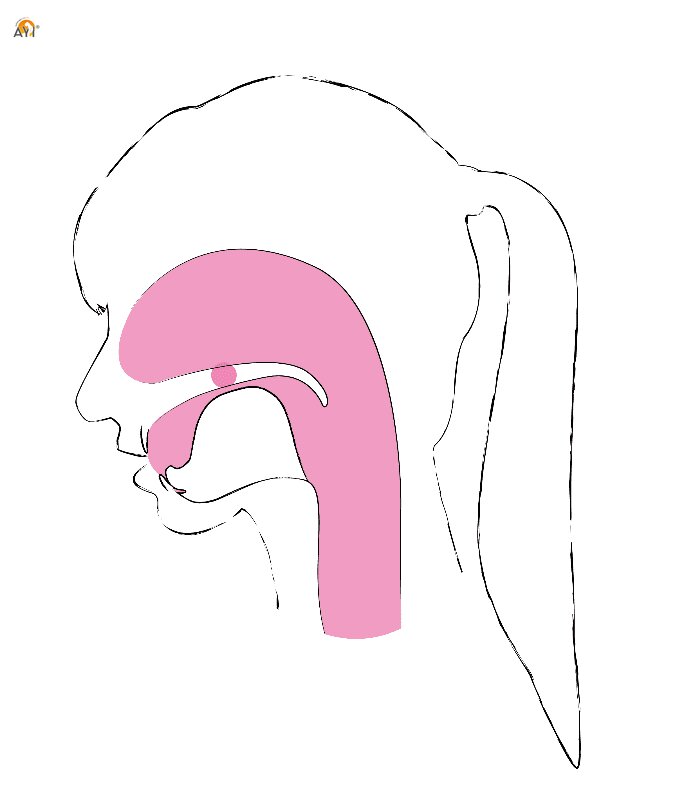
One of the best exercises to improve your pronunciation of Saṃskṛt is to consciously articulate all sounds produced at one place of articulation. Watch how similar the vibration of individual letters in the mouth is and how you can move from one letter to the next. In this exercise, the space in which the sound is formed becomes progressively narrower:
- i: vowel - The phonation space is completely open. You can feel a short vibration at the soft palate.
- ī: vowel - The phonation space is completely open. You can feel a longer vibration at the soft palate.
- y: semivowel - The phonation space is slightly narrowed down. You can only feel the vibration on the succeeding vowel.
- ś: fricative - The hard palate is almost closed off, the air swirls there.
- c: plosive - Short closure at the hard palate, the air is released afterwards.
- ch: plosive, aspirated - followed by a breath of air.
- j: plosive, voiced - pronounced with voice.
- jh: plosive, voiced, aspirated - again followed by a breath of air.
- ñ: nasal - The closure remains, air streams out through the nose.
Palatal vowels
- i / ī: Widen your mouth slightly to the sides. Again, the short i is sounded only briefly, whereas the long ī lingers. Both vowels make the palate vibrate (palatal).
Examples:
- i: Mitte, Kind
- ī: Igel, Flieder, Kies
Palatal plosives
- ca: The tongue closes off the hard palate. The contact is released after slight pressure.
- cha: The same sound with more air.
- ja: The same sound with vibration or voice.
- jha: The voiced sound with more air.
Examples:
- ca: Tschechien
- cha: Charles, Charme
- ja: Dschschungel
Not to be confused with a German j as in Jogurt! In Saṃskṛt, the German j sound corresponds to the letter Y. - jha: Jeep


Please log in to write a message. Go to login
No messages yet.