

bhaga भग – prosperity; vulva; female genital organ
adjective · substantive masculine · substantive neuter · Word type unspecified
Dictionary sources
AYI dictionary substantive masculine · substantive neuter
substantive masculine
prosperity; vulva; female genital organ
substantive neuter
womb; vulva
Cappeller 1891 substantive masculine
Original text · English · substantive masculine
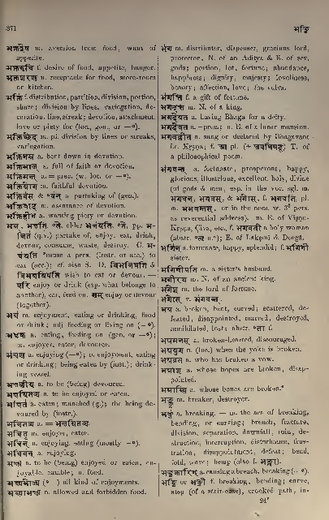
bhága ·m. distributer, dispenser, gracious lord, protector, N. of an Āditya & E. of sev. gods; portion, lot, fortune; abundance. happiness; dignity, majesty; loveliness, beauty; affection, love; the vulva.
Monier-Williams 1872 substantive masculine · Word type unspecified
Original text · English · substantive masculine
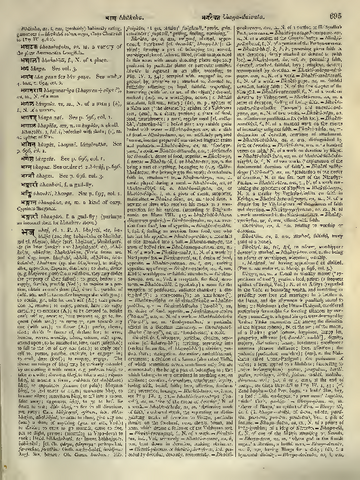
Bhaga, as, m. a liberal or wealthy master (‘ap- portioner of food’), gracious lord, patron (a frequent epithet of Savitṛ, Ved.); N. of an Āditya (regarded in the Veda as bestowing wealth, and instituting or presiding over love and marriage; he is brother of the Dawn, and the afternoon is peculiarly sacred to him; his Nakṣatra is the Uttara-Phalgunī, considered particularly favourable for forming alliances by mar- riage; according to a legend his eyes were destroyed by Rudra; Yāska enumerates him among the divinities of the highest sphere); N. of the sun; of the moon; of a Rudra; good fortune, happiness, happy lot, prosperity, affluence [cf. dur-bh˚, su-bh˚]; dignity, majesty, distinction; beauty, loveliness; excellence; amorous pleasure, dalliance; love, affection; the pudenda (pudendum muliebre); (am), n. the Nak- ṣatra called Uttara-Phalgunī; the perinæum of males; a term applied to a Muhūrta; (according to native lexicographers) = yatna, prayatna, kīrtti, yaśas, vairāgya, icchā, jñāna, mukti, mokṣa, dharma, strī; (as, ā or ī, am), at the end of comps., see Gaṇa Bahv-ādi to Pāṇ. IV. 1, 45; [cf. Zend bagha = Old Pers. baga, ‘a lord:’ Slav. bog, ‘a lord:’ Lith. na-bagas, ‘a poor man;’ bagotas, ‘rich:’ Goth. ga-bigs.]
Original text · English · Word type unspecified
bhaga bhaga. See col. 3.
Petersburger 1855 substantive masculine · substantive neuter · Word type unspecified
Original text · German · substantive masculine · substantive neuter
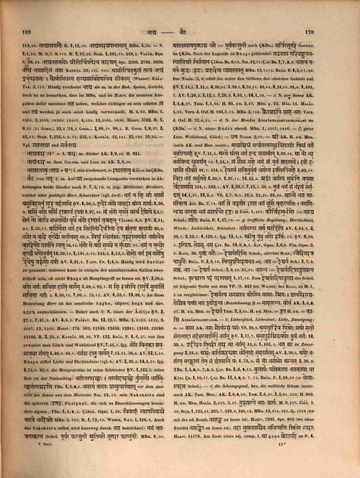
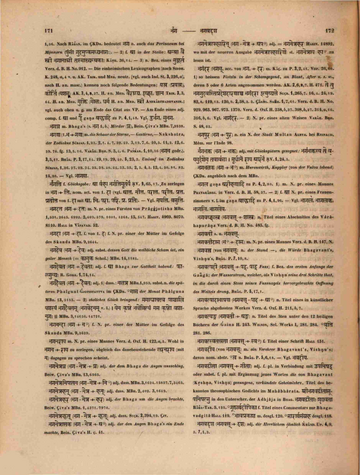
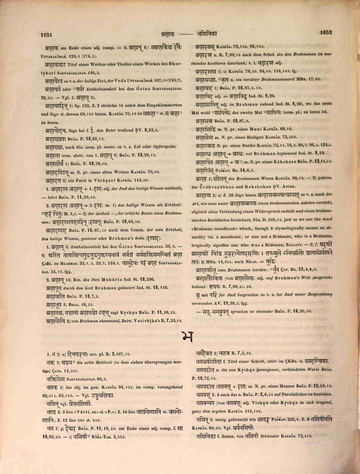
bhága (von bhaj) 1〉 m. Auf bhaga ausgehende Composita verstarken in Ableitungen beide Glieder nach P. 7,3,19. a〉 (eig. Mittheiler) Brotherr, reicher oder gnädiger, Herr, Schutzherr (vgl. lord): bhaga̱ṃ na hi tvā̀ ya̱śasàṃ vasu̱vida̱manù śūra̱ carā̀masi ṚV. 8,50,5. indro̱ bhagò vāja̱dā àsya̱ gāvàḥ ṚV. 3,36,5. asi̱ bhago̱ asì dā̱trasyà dā̱tā ṚV. 9,97,55. tvaṃ bhagò nṛpate̱ vasvà īśiṣe ṚV. 2,1,7. tenà no bodhi sadha̱mādyò vṛ̱dhe bhagò dā̱nāyà vṛtrahan VĀLAKH. 6,5. ṚV. 2,11,21. ṚV. 3,53,17. a̱gnirne̱tā bhagà iva kṣitī̱nāṃ daivī̀nāṃ de̱va ṛ̀ta̱pā ṛ̱tāvā̀ ṚV. 3,20,4. bhago̱ na kā̱re havyò matī̱nām ṚV. 3,49,3. viṣṇu̱ṃ stomā̀saḥ puruda̱smama̱rkā bhagàsyeva kā̱riṇo̱ yāmàni gman ṚV. 3,54,14. bhagò me agne sa̱khye na mṛ̀dhyāḥ ṚV. 3,54,21. bhaga̱ṃ na nṛbhyo̱ havyàṃ mayo̱bhuvàm ṚV. 10,39,10. ṚV. 1,141,6. ṚV. 1,141,10. ṚV. 1,144,3. ṚV. 6,13,2. somo̱ bhagà iva̱ yāmèṣu de̱veṣu̱ varùṇo̱ yathā̀ AV. 6,21,2. TAITT. UP. 1,4,3. Häufig wird Savitar so genannt; indessen kann in einigen der anzuführenden Stellen zweifelhaft sein, ob nicht Bhaga als Hauptbegriff zu fassen sei. ṚV. 3,56,6. yato̱ bhagàḥ savi̱tā dāti̱ vāryàm ṚV. 5,48,5. ṚV. 5,82,1. sa hi ratnā̀ni dā̱śuṣè su̱vātì savi̱tā bhagàḥ ṚV. 5,82,3. ṚV. 6,50,13. ṚV. 7,66,4. ṚV. 5,15,12. AV. 6,53,1. AV. 19,49,1. An diese Bedeutung Herr ist das zendische bagha, altpers. baga und slav. богъ anzuschliessen. — Daher auch b〉 N. eines der Āditya ṚV. 2,27,1. ṚV. 7,41,2. AV. 6,4,2. PAÑCAV. BR. 12,12,4. MBH. 1,2523. MBH. 1,4822. MBH. 9,2507. MBH. 13,3295. HARIV. 176. HARIV. 593. HARIV. 11549. HARIV. 12456. HARIV. 12911. HARIV. 13143. HARIV. 13180. HARIV. 14166. R. 2,25,8. KATHĀS. 48,96. VP. 122. BHĀG. P. 6,6,37. von ihm erwartet man Glück und Wohlstand ṚV. 7,41,1. fgg. bhagò vibha̱ktā śava̱sāva̱sā gàmat ṚV. 5,46,6. ṚV. 5,49,1. bhagàśca dātu̱ vāryàm ṚV. 7,15,11. ṚV. 7,38,6. AV. 12,1,40. Bhaga stiftet Liebe und Ehebündniss (vgl. h.) AV. 2,36,4. fgg. AV. 14,1,51. AV. 6,74,1. fgg. AV. 6,82,3. die Morgenröthe ist seine Schwester ṚV. 1,123,5. seine Zeit ist der Nachmittag: bhagàsyāparā̱hṇaḥ . tasmā̀daparā̱hṇe kùmā̱ryo bhagàmi̱cchamā̀nāścaranti TBR. 1,5,3,3. bhagasya kālaḥ prāgutsarpaṇāt vor dem Austritt der Sonne aus dem Horizont NIR. 12,13. sein Nakṣatra sind die späteren (uttara) Phalgunī. die sich zu Eheschliessungen besonders eignen, TBR. 1,1,2,4. ŚĀṄKH. GṚHY. 1,26. vivāhaṃ sthāpayitvāgre nakṣatre bhagadaivate MBH. 1,953. R. 1,72,13. WEBER, Nax. I, 310,1. Auch das Nakṣatra selbst wird kurzweg durch bhaga bezeichnet: bhagaṃ nakṣatramākramya (Schol. pūrvā phalgunī śrutimate tūttarā phalgunī) MBH. 6,81. akṣatāmāṣayuktāśca bhage (= pūrvapalgunī nach ŚKDR.) sarpistūttare JYOTIST._im_ŚKDR. Nach der Legende ist Bhaga geblendet: tadbhagāya parijahrustasyākṣiṇī nirjaghāna ŚĀṄKH. BR. 6,13. NIR. 12,14. ŚAT. BR. 1,7,4,6. bhagasya nayane kruddhaḥ (rudraḥ) prahāreṇa vyaśātayat MBH. 13,7475. BHĀG. P. 4,5,17. BHĀG. P. 4,5,20. Das NAIGH. (5,6) zählt ihn unter den Göttern des obersten Gebiets auf. ṚV. 1,14,3. ṚV. 2,31,4. ṚV. 4,30,24. ṚV. 5,50,1. ṚV. 6,51,11. ṚV. 6,49,14. ṚV. 8,31,11. ṚV. 8,91,6. ṚV. 9,101,7. AV. 1,26,2. AV. 3,12,4. AV. 5,26,9. AV. 6,53,1. AV. 14,1,59. — c〉 N. der Sonne AK. 3,4,3,27. TRIK. 1,1,98. H. 95. H. an. 2,37. MED. g. 12. HĀR. 11. HALĀY. 1,35. Verz. d. Oxf. H. 184,b,15. MBH. 3,146. krauñcadvīpe hyahaṃ bhagaḥ Verz. d. Oxf. H. 33,a,24. — d〉 N. des Mondes ANEKĀRTHADHVANIMAÑJARĪ_im_ŚKDR. — e〉 N. eines Rudra ebend. MBH. 1,2567. MBH. 1,4826. — f〉 gutes Loos, Wohlstand, Glück; = dhana NAIGH. 2,10. = śrī AK. H. an. MED. (nach AK. und MED. neutr.). ā̱dhraści̱dyaṃ manyàmānastu̱raści̱drājā̀ ci̱dyaṃ bhagàṃ bha̱kṣītyāhà ṚV. 7,41,2. a̱sme àstu̱ bhagà indra pra̱jāvā̀n ṚV. 3,30,18. ā nò bhara̱ bhagàmindra dyu̱mantàm ṚV. 3,30,19. ṚV. 1,24,4. tvaṃ sòma ma̱he bhaga̱ṃ tvaṃ yūnà ṛtāya̱te . dakṣàṃ dadhāsi jī̱vasè ṚV. 91,7. ṚV. 134,5. de̱vasyà savi̱turva̱yaṃ bhagàsya rā̱timī̀mahe ṚV. 3,62,11. vi̱dā bhaga̱ṃ vasùttaye ṚV. 8,50,7. ṚV. 9,97,44. ṚV. 10,42,3. śra̱ddhāṃ bhagàsya mū̱rdhani̱ vaca̱sā vèdayāmasi ṚV. 151,1. ṚV. 159,1. AV. 2,29,1. AV. 7,15,1. AV. 7,50,2. yu̱vaṃ bhaga̱ṃ saṃ bhàrata̱ṃ samṛ̀ddham AV. 14,1,31. AV. 19,4,3. VS. 5,7. VS. 9,1. VS. 18,8. VS. 21,21. VS. 22,24. āste bhaga āsīnasya AIT. BR. 7,15. bhagaṃ te varuṇo rājā bhagaṃ sūryo bṛhaspatiḥ . bhagamindraśca vāyuśca bhagaṃ saptarṣayo daduḥ .. YĀJÑ. 1,281. kīrtirāyurbhago (= bhāgya Schol.) gatiḥ BHĀG. P. 1,17,10. — g〉 treffliche Begabung, Herrlichkeit, Würde; Lieblichkeit, Schönheit: bhagàmasyā̱ varca̱ ādìṣi AV. 1,14,1. fgg. AV. 2,36,1. AV. 3,22,6. fgg. AV. 6,129,1. fgg. AV. 12,1,5. strī̱ṣu pu̱ṃsu bhago̱ rucìḥ AV. 1,14,25. ṚV. 9,10,5. indriya, tejas, bhaga ŚAT. BR. 14,9,4,5. ĀŚV. GṚHY. 3,6,8. PĀR. GṚHY. 2,6. KAUŚ. 36. yuktaṃ bhagéḥ (= aiśvaryādibhiḥ Schol., attribut BURN.) svairitaratra cādhruvaiḥ BHĀG. P. 2,9,16. niṣpluṣṭapauruṣabhaga adj. (bhaga = aiśvarya Sch.) BHĀG. P. 2,7,9. sattva, bhaga = aiśvarya Schol. BHĀG. P. 3,9,22. BHĀG. P. 3,31,33. bhagasya (= aiśvaryādiṣāḍguṇyasya Schol.) kṛtsnasya paraṃ parāyaṇam BHĀG. P. 5,17,18. Zum aiśvaryādiṣāḍguṇya des Schol. ist folgende Stelle aus dem VP. (S. 643 bei WILSON)_bei_KULL._zu_M. 1,2 zu vergleichen: aiśvaryasya samagrasya vīryasya yaśasaḥ śriyaḥ . jñānavairāgyayoścaiva ṣaṇṇāṃ bhaga itīṅganā (Bezeichnung) .. = māhātmya. vīrya AK. 3,4,3,27. H. an. MED. = aiśvarya TRIK. 3,3,64. H. an. MED. = rūpa H. an. = kānti ANEKĀRTHADHVANIM. — h〉 Liebesglück, Liebeslust; Liebe, Zuneigung; n. = kāma AK. bhaga̱ḥ saubhā̀gya̱ṃ pasàḥ VS. 20,9. a̱mā̱jūrìva pi̱troḥ sacā̀ sa̱tī sàmā̱nādā sadàsa̱stvāmìye̱ bhagàm ṚV. 2,17,7. a̱mā̱juràścidbhavatho yu̱vaṃ bhagàḥ ṚV. 10,39,3. udī̀raya pi̱tarā̀ jā̱ra ā bhagàm ṚV. 11,6. ṚV. 1,163,8. bhaga̱ ā in Zuneigung ṚV. 2,34,8. aśva̱ḥ kanìkrada̱dyatha̱ḥ bhagènā̱haṃ sa̱hāgàmam AV. 2,30,5. atho̱ bhagàsya̱ yacchrā̱ntaṃ tena̱ saṃ jñàpayāmi vaḥ AV. 6,74,5. saṃ vā̱ṃ bhagā̀so agmata AV. 2,30,2. TBR. 1,5,3,3. TBR. 1,7,3,3. ŚAT. BR. 2,6,2,13. kumāryaḥ patikāmā bhagakāmā vā KĀTY. ŚR. 5,10,17. ŚAT. BR. 11,4,3,3. ŚAT. BR. 11,4,3,7. ŚAT. BR. 11,4,3,15. BHĀG. P. 1,16,29 (= bhogāspadatva Schol.). — i〉 die Schamgegend, bes. die weibliche Scham (neutr.) nach AK. TRIK. MED. AK. 2,6,2,26. TRIK. 2,6,21. TRIK. 3,3,64. TRIK. 3,3,255. H. 609. H. an. MED. HALĀY. 2,359. HALĀY. 5,41. gurutalpe bhagaḥ kāryaḥ M. 9,237. YĀJÑ. 3,88. SUŚR. 1,125,21. SUŚR. 1,265,7. SUŚR. 1,339,9. SUŚR. 1,340,19. MBH. 13,818. fg. MBH. 13,825. fg. MBH. 13,2328 (wo mit der ed. Bomb. bhagāṅka zu lesen ist). HARIV. 7593. Spr. 803 (wo ohne Zweifel bhagāṅko zu lesen ist). tadā mukhabhagāścaiva bhaviṣyanti striyo 'parāḥ HARIV. 11178. Am Ende eines adj. comp. f. ā gaṇa kroḍādi zu P. 4,1,56. Nach RĀJAN._im_ŚKDR. bedeutet bhaga n. auch das Perinaeum bei Männern (puṃsāṃ gudamuṣkamadhyabhāgaḥ). — 2〉 f. ā in der Stelle: ambā vai strī bhagānāmnī tasmāttryambakāḥ KĀṬH. 36,14. — 3〉 n. Bez. eines muhūrta Verz. d. B. H. No. 912. — Die einheimischen Lexicographen (nach SIDDH. K. 248,a,4 v. u. AK. TRIK. und MED. neutr. [vgl. auch Ind. St. 3,226,a], nach H. an. masc.) kennen noch folgende Bedeutungen: yatna (prayatna), kīrti (yaśas) AK. 3,4,3,27. H. an. MED. vairāgya, icchā, jñāna TRIK. 3,3,64. H. an. MED. mukti (mokṣa), dharma H. an. MED. strī ANEKĀRTHADHVANIM.; vgl. auch oben u. g. am Ende das Citat aus VP. — Am Ende eines adj. comp. f. ā und ī́ gaṇa bahvādi zu P. 4,1,45. Vgl. durbhaga, subhaga.
Original text · German · Word type unspecified
bhaga 1〉g〉 aiśvara BHĀG. P. 11,19,40. am Ende eines adj. comp. f. ā BHĀG. P. 10,82,29. — i〉 bhaginī˚ RĀJA-TAR. 5,282.
Böhtlingk 1879 substantive masculine · substantive neuter
Original text · German · substantive masculine · substantive neuter
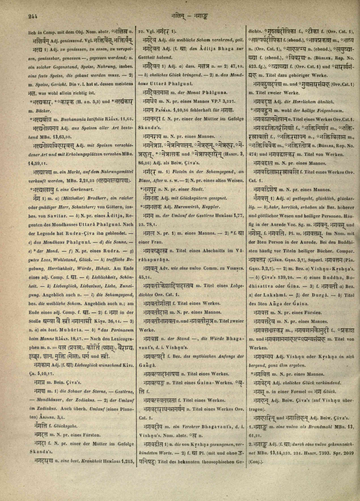
bhága — 1〉 m. — a〉 (Mittheiler) Brodherr, ein reicher oder gnädiger Herr, Schutzherr; von Göttern, insbes. von Savitar. — b〉 N. pr. eines Āditya, Regent des Mondhauses Uttara Phalgunī. Nach der Legende hat Rudra-Śiva ihn geblendet. — c〉 das Mondhaus Phalgunī. — d〉 die Sonne. — e〉 der Mond. — f〉 N. pr. eines Rudra. — g〉 gutes Loos, Wohlstand, Glück. — h〉 treffliche Begabung, Herrlichkeit, Würde, Hoheit. Am Ende eines adj. Comp. f. ā — i〉 Lieblichkeit, Schönheit. — k〉 Liebesglück, Liebeslust, Lieben, Zuneigung. Angeblich auch n. — l〉 die Schamgegend, bes. die weibliche Scham. Angeblich auch n.; am Ende eines adj. Comp. f. ā — 2〉 f. bhagā in der Stelle āmbā vai strī bhagānāmnī KĀṬH. 36,14. — 3〉 n. — a〉 ein best. Muhūrta. — b〉 das Perinaeum beim Manne RĀJAN. 18,47. — Nach den Lexicographen m. n. = yatna, prayatna, kīrti, yaśas, vairāgya, icchā, jñāna, mukti, mokṣa, dharma und strī.
Apte 1890 substantive masculine · substantive neuter
Original text · English · substantive masculine · substantive neuter
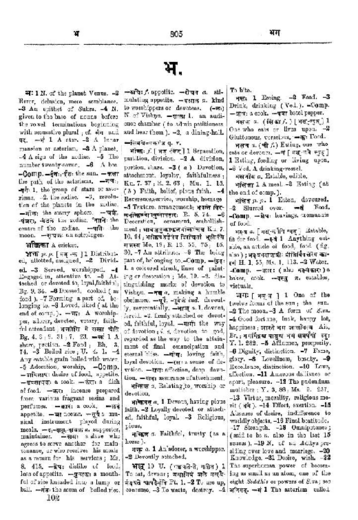
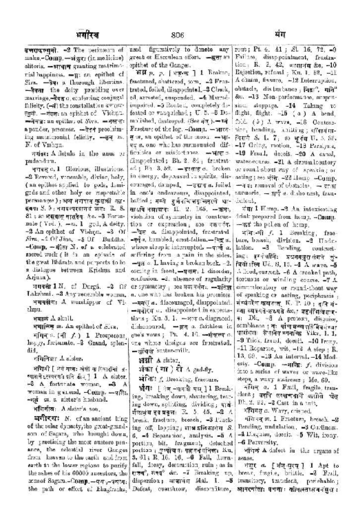
bhagaḥ [bhaj-gha] 1 One of the twelve forms of the sun; the sun. 2 The moon. 3 A form of Śiva. 4 Good fortune, luck, happy lot, happiness; āste bhaga āsīnasya Ait. Br.; bhagamiṃdraśca vāyuśca bhagaṃ saptarṣayo daduḥ Y. 1. 282. 5 Affluence, prosperity. 6 Dignity, distinction. 7 Fame, glory. 8 Loveliness, beauty. 9 Excellence, distinction. 10 Love, affection. 11 Amorous dalliance or sport, pleasure. 12 The pudendum muliebre; Y. 3. 88; Ms. 9. 237. 13 Virtue, morality, religious merit (dharma). 14 Effort, exertion. 15 Absence of desire, indifference to worldly objects. 16 Final beatitude. 17 Strength. 18 Omnipotence; (said to be n. also in the last 15 senses). 19 N. of an Āditya presiding over love and marriage. 20 Knowledge. 21 Desire, wish. 22 The superhuman power of becoming as small as an atom, one of the eight Siddhis or powers of Śiva; see aṇiman. — gaṃ 1 The asterism called ([Page 0806-a]) uttarāphalgunī. 2 The perinæum of males. Comp. — aṃkuraḥ (in medicine) clitoris. — ādhānaṃ granting matrimonial happiness. — ghnaḥ an epithet of Śiva. — devaḥ a thorough libertine. — devatā the deity presiding over marriage. — daivata a. conferring conjugal felicity. — (taṃ) the constellation uttarāphalgunī. — naṃdanaḥ an epithet of Viṣṇu. — netraghnaḥ an epithet of Śiva. — bhakṣakaḥ a pander, procurer. — vedanaṃ proclaiming matrimonial felicity. — han m. N. of Viṣṇu.
Cappeller 1887 substantive masculine
Original text · German · substantive masculine
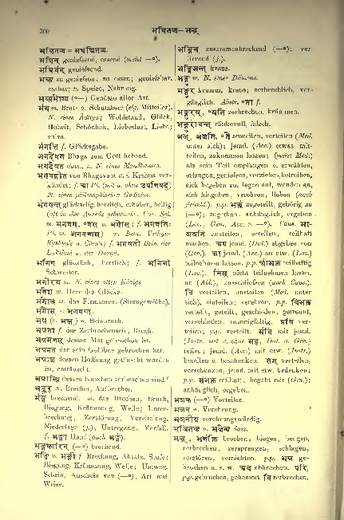
bhága m. Brot- o. Schutzherr (eig. Mitteiler), N. eines Āditya; Wohlstand, Glück, Hoheit, Schönheit, Liebeslust, Liebe; vulva.
Burnouf 1866 adjective
Original text · French · adjective
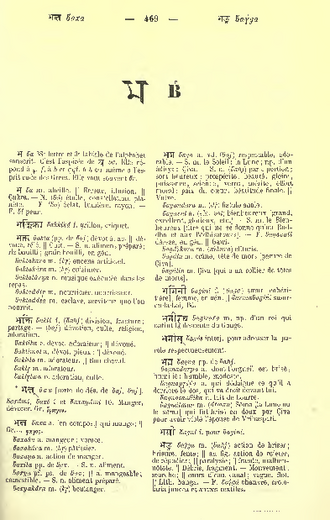
bhaga bhaga a. vd. (bhaj) respectable, adorable. — S. m. le Soleil; la Lune; np. d'un āditya; Śiva. — S. n. (bhañj) part, portion; sort heureux: prospérité, beauté, gloire, puissance, science, vertu, mérite, effort moral; paix du cœur, béatitude finale. Vulve. bhagandara m. (dṝ) fistule anale. bhagavat a. (sfx. vat) bienheureux [grand, excellent, glorieux, etc.] — S. m. le Bienheureux [titre qui ne se donne qu'au Buddha et aux Bodhisattvas]. — F. bhagavatī déesse, en gén. Gaurī. bhagāṅkura m. (aṅkura) clitoris. bhagāla m. crâne, tête de mort [parure de Śiva]. bhagālin m. Śiva [qui a un collier de têtes de morts].
Occurrences in source texts (4)
DYS 1 occurrence
HP 1 occurrence
SiSa 1 occurrence
SVU 1 occurrence
Continue with AYI Free
Image source: AYI archive.