
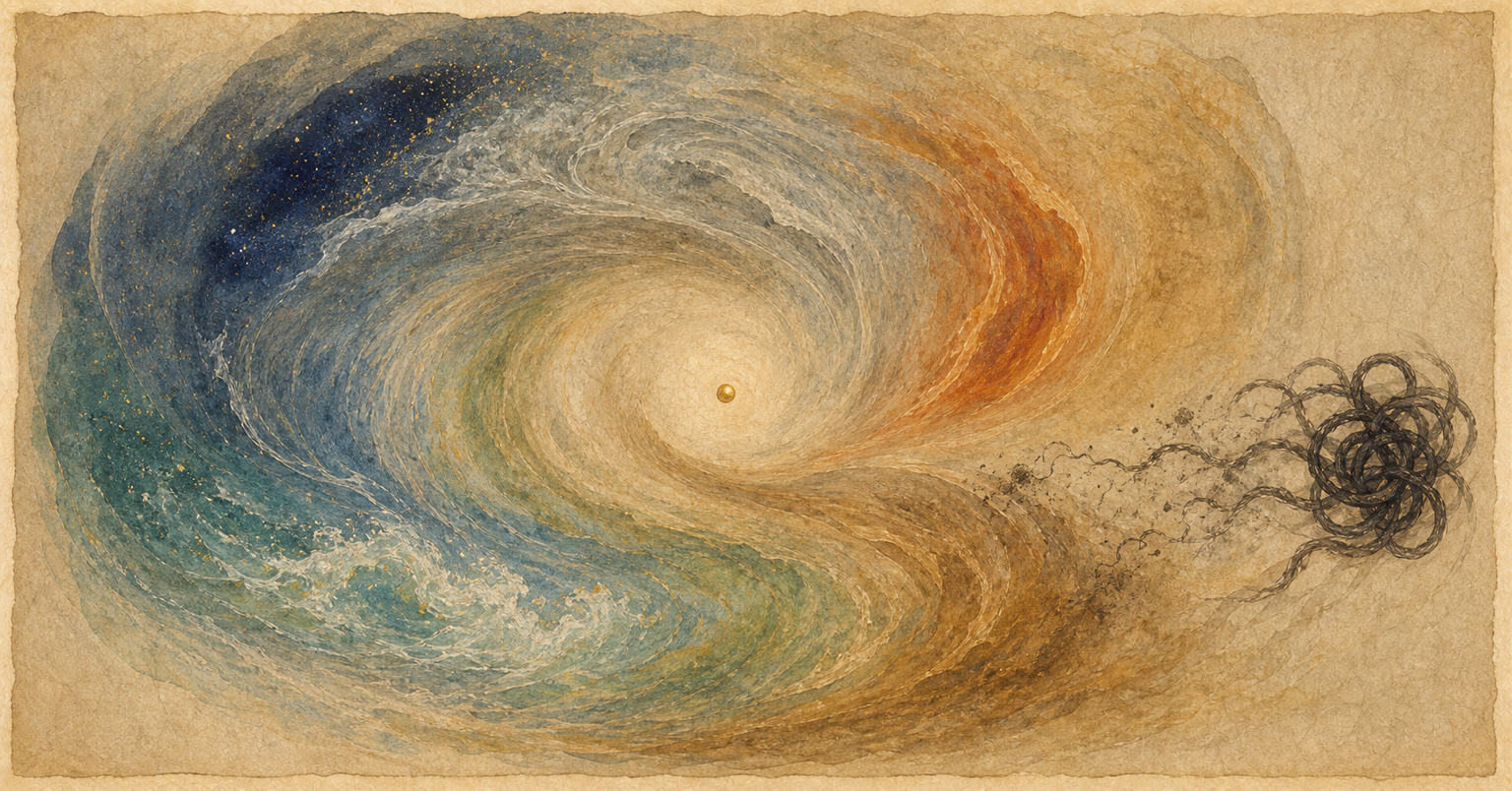
SVU 6.1–6.6: Lord of Cosmic Unfolding

SVU 6.1–6.6: God, Time, Action, and Primal Nature

It is not nature or time but God's power that moves the cosmic wheel, orders principles and karma, and leads beyond multiplicity when action comes to an end.

Śvetāśvatara Upaniṣad 6.1
स्वभावमेके कवयो वदन्ति कालं तथान्ये परिमुह्यमानाः |
sva-bhāvam eke, kavayo vadanti; kālaṃ tathānye, parimuhyamānāḥ | Analysis ▾ Analysis ▴
sva
karmadhāraya-compound
adjective
own
bhāvam
accusative singular
substantive masculine
nature
eke
nominative plural masculine
numeral
some
kavayaḥ
nominative plural
substantive masculine
seers
vadanti
3rd person plural aktive present
verbal root
say
kālam
accusative singular
substantive masculine
time
tathā
adverb
likewise
anye
nominative plural masculine
pronoun quant
others
parimuhyamānāḥ
nominative plural masculine present participle medial
previx
verbal root
utterly deluded
देवस्यैष महिमा तु लोके येनेदं भ्रामियते ब्रह्मचक्रम् ||1||
devasyaiṣa, mahimā tu loke; yenedaṃ bhrāmi*yate, brahma-cakram ||1|| Analysis ▾ Analysis ▴
devasya
genitive singular
substantive masculine
of the deity
eṣaḥ
nominative singular masculine
pronoun dem
this
mahimā
nominative singular
substantive masculine
greatness
tu
particle
but
loke
lokative singular
substantive masculine
in the world
yena
instrumental case singular masculine
pronoun rel
by which
idam
nominative singular neuter
pronoun dem
this
bhrāmyate
3rd person singular passive present causative
verbal root
is made to revolve
brahma
tatpuruṣa-compound genitive
substantive neuter
of Brahman
cakram
nominative singular
substantive neuter
wheel
Metre: Pāda 1: Triṣṭubh with Vajrā ending; Pāda 2: Triṣṭubh with Vajrā ending; Pāda 3: Triṣṭubh with Vajrā ending — 10 syllables; Pāda 4: Triṣṭubh with Śālinī ending
Some (eke | nom pl m) seers (kavayaḥ | nom pl) declare (vadanti | 3p pl act pres) inherent nature (sva-bhāvam | acc sg) [to be the cause]; others (anye | nom pl m), utterly deluded (parimuhyamānāḥ | nom pl m pcm), likewise (tathā) name time (kālam | acc sg). But (tu) this greatness (eṣaḥ mahimā | nom sg) in the world (loke | loc sg) belongs to God (devasya | gen sg), by which (yena | ins sg m) this (idam | nom sg n), namely the wheel of Brahman (brahma-cakram | nom sg), is made to revolve (bhrāmyate | 3p sg pas pres caus).
Dr. Ronald Steiner - 2026 - historically literal
Some sages take inherent nature to be the cause; others name time and lose their way. In truth, it is God's greatness that keeps the wheel of Brahman turning in this world.
Dr. Ronald Steiner - 2026 - modern transfer

The Bhāṣya attributed to Śaṅkara rejects inherent nature, time, and the other proposals as the cause of the world. For the commentary, such views arise from sensory delusion. In truth, divine greatness sets in motion the wheel of Brahman within which beings revolve.

Śaṅkara's Bhāṣya on the Śvetāśvatara Upaniṣad

Śaṅkarānanda reads the opening of the chapter as a concise return to the earlier question about causes, whose explanation the middle chapters have developed. Inherent nature and time are rival teachings held by confused thinkers. The Māyā of the highest Lord brings the wheel of Brahman into being and makes it turn.

Śaṅkarānanda's Śvetāśvataropaniṣaddīpikā

Nārāyaṇa regards the proponents of inherent nature and time as misled by the Māyā of the deity. He can read the wheel of Brahman either as a circle of disputing Brahmins or as the totality of Jīvas who are moved, according to karma, through widely differing conditions of life.

Nārāyaṇa's Śvetāśvataropaniṣaddīpikā

Vijñānabhagavat assigns the competing doctrines of causation themselves to divine Māyā. They operate as forms of delusion so long as the Lord beyond cause and effect is not known. Only his greatness explains why the wheel of the world and Saṃsāra turns at all.

Vijñānabhagavat's Śvetāśvataropaniṣadvivaraṇa
bhrāmi*yate conj. ed. ] bhrāmyate LV1958
Critical Apparatus
Die einen Lehrer reden von Natur uns, von Zeit die andern (1,2); sie gehn völlig irre; Nein, es ist Gottes Allmacht, die im Weltall Läßt jenes Brahmanrad (1,6) im Kreis sich drehen.
Paul Deussen - 1921
Some sages discourse of inherent nature (sva-bhāva); Others likewise, of time.<1> Deluded men! It is the greatness of God in the world By which this Brahma-wheel is caused to revolve.
<1: As the First Cause—as in 1. 2. See Introduction, p. 8.>
Robert Hume - 1921
Some wise men speak of Nature (of things) as the (cause of the Universe); others, being full of delusion, speak of Time (as the cause); but it is the greatness of the Luminous Being in this world by which the wheel of Brahm (or the Universe) is revolved.
Siddhesvar Varma Shastri - 1916
Die einen Lehrer reden von Natur uns, von Zeit die andern (1,2); sie gehen völlig irre; Nein, es ist Gottes Allmacht, die im Weltall Läßt jenes Brahmanrad (1,6) im Kreis sich drehen.
Paul Deussen - 1897
<1>Some wise men, deluded, speak of Nature, and others of Time (as the cause of everything<2>); but it is the greatness of God by which this Brahma-wheel is made to turn.
<1: See Muir, Metrical Translations, p. 198.>
<2: See before, I, 2.>
F. Max Müller - 1884
From delusion some sages say, that the own nature of things (is the cause of the universe), others, that time it is (vid. 1, 2); but it is the glory of God in the world, by which (glory) this wheel of Brahma revolves.
Edward Röer - 1853
Śvetāśvatara Upaniṣad 6.2
येनावृतं नित्यमिदं हि सर्वं ज्ञः कालकालो गुणी सर्वविद्यः |
yenāvṛtaṃ, nityam idaṃ hi sarvaṃ; jñaḥ kāla-kālo, guṇī sarva-vidyaḥ | Analysis ▾ Analysis ▴
yena
instrumental case singular masculine
pronoun rel
by whom
āvṛtam
nominative singular neuter past participle passive
previx
verbal root
enveloped
nityam
adverb
always
idam
nominative singular neuter
pronoun dem
this
hi
particle
indeed
sarvam
nominative singular neuter
pronoun quant
all
jñaḥ
nominative singular masculine
adjective
the knower
kāla
tatpuruṣa-compound genitive
substantive masculine
of time
kālaḥ
nominative singular
substantive masculine
destroyer
guṇī
nominative singular masculine
adjective
possessing qualities
sarva
upapada-compound
pronoun quant
all
vidyaḥ
nominative singular masculine
adjective
knowing
तेनेशितं कर्म विवर्तते ह पृथिव्याप्तेजो ऽनिलखानि चिन्त्यम् ||2||
teneśitaṃ, karma vivartate ha; pṛthivyāp-tejo, 'nila-khāni cintyam ||2|| Analysis ▾ Analysis ▴
tena
instrumental case singular masculine
pronoun dem
by him
īśitam
nominative singular neuter past participle passive
verbal root
ruled
karma
nominative singular
substantive neuter
action
vivartate
3rd person singular medial present
previx
verbal root
unfolds
ha
particle
indeed
pṛthivī
dvandva-compound
substantive feminine
earth
ap
dvandva-compound
substantive feminine
water
tejas
dvandva-compound
substantive neuter
fire
anila
dvandva-compound
substantive masculine
air
khāni
nominative plural
substantive neuter
spaces
cintyam
nominative singular neuter future participle passive
verbal root
to be contemplated
Metre: Pāda 1: Triṣṭubh with Vajrā ending; Pāda 2: Triṣṭubh with Śālinī ending; Pāda 3: Triṣṭubh with Vajrā ending; Pāda 4: Triṣṭubh with Vajrā ending
He by whom (yena | ins sg m) this (idam | nom sg n), indeed (hi) all of it (sarvam | nom sg n), is always (nityam) enveloped (āvṛtam | nom sg n ppp) is the knower (jñaḥ | nom sg m), the destroyer of time (kāla-kālaḥ | nom sg), possessing the guṇas (guṇī | nom sg m), and all-knowing (sarva-vidyaḥ | nom sg m). The governed work (īśitam karma | nom sg), under his rule (tena | ins sg m), unfolds (vivartate | 3p sg med pres), indeed (ha); it is to be contemplated (cintyam | nom sg n pfp) as earth, water, fire, air, and space (pṛthivyāptejo’nilakhāni | nom pl).
Dr. Ronald Steiner - 2026 - historically literal
The all-knowing Lord, who overcomes the power of time and commands every quality, envelops this entire world. Under his direction, cosmic activity unfolds as earth, water, fire, air, and space.
Dr. Ronald Steiner - 2026 - modern transfer

In the printed text, the Bhāṣya attributed to Śaṅkara gives kālakāra, the ‘maker of time’. The all-knowing Lord pervades and directs the world. Under his direction, karma performed by the Jīva becomes effective and unfolds into the five elements that constitute the world of experience.

Śaṅkara's Bhāṣya on the Śvetāśvatara Upaniṣad

Śaṅkarānanda reads kālakāla: the Lord is the destroyer even of all-destroying time. Jña denotes his consciousness, while the guṇas are ascribed to him only through Avidyā. Karma directed by him develops into the fivefold elemental world on which one is to meditate.

Śaṅkarānanda's Śvetāśvataropaniṣaddīpikā

Nārāyaṇa explains kālakāla as the director even of time. The three guṇas stand under his sovereignty, and the whole world appears as a transformation of the karma he directs into the five elements. Alongside sarvavidya, the commentary records sarvavāyu, the vital breath of all beings.

Nārāyaṇa's Śvetāśvataropaniṣaddīpikā

Vijñānabhagavat understands kālakāla as the director and dissolver of time. In association with Māyā, the Lord appears to possess the guṇas and causes the karmic world to emerge as a mere unfolding into the five elements. The commentary explains their sequence according to the intended sense, not merely the wording.

Vijñānabhagavat's Śvetāśvataropaniṣadvivaraṇa
kālakālo LV1958 ] kālakāro ASS1927, Silburn apud LV1958-app
Critical Apparatus
Durch ihn regiert, der stets bedeckt (Ṛgv. 10,90,1) das Weltall, Als Geist, Zeitschöpfer, gunahaft, allwissend, Entrollt dies Schöpfungswerk sich, das sich darstellt Als Erde, Wasser, Feuer, Luft und Äther.
Paul Deussen - 1921
He by whom this whole world is constantly enveloped Is intelligent, the author of time, possessor of qualities (guṇin), omniscient. Ruled o’er by Him, [his] work (karman)<2> revolves—This which is regarded as earth, water, fire, air, and space!<3>
<2: That is, the world.>
<3: The same list of five cosmic elements as in 2. 12 b.>
Robert Hume - 1921
Governed by Him who always pervades this whole (world), who is consciousness itself, the Creator of Time, possessing faultless qualities, and Omniscient, the world of effects (as is well-known) assumes different forms (of) Ether, Air, Fire, Water and Earth—this should be considered (by seekers after the Truth).
Siddhesvar Varma Shastri - 1916
Durch ihn regiert, der stets bedeckt (Ṛgv. 10,90,1) das Weltall, Als Geist, Zeitschöpfer, gunahaft, allwissend, Entrollt dies Schöpfungswerk sich, das sich darstellt Als Erde, Wasser, Feuer, Luft und Äther.
Paul Deussen - 1897
It is at the command of him who always covers this world, the knower, the time of time<3>, who assumes qualities and all knowledge<4>, it is at his command that this work (creation) unfolds itself, which is called earth, water, fire, air, and ether;
<3: The destroyer of time. Vijñānātman reads kālākālo, and explains it by kālasya niyantā, upahartā. Śaṅkarānanda explains kālaḥ sarvavināśakārī, tasyāpi vināśakaraḥ. See also verse 16.>
<4: Or sarvavid yaḥ.>
F. Max Müller - 1884
For over-ruled by him, by whom this all is eternally pervaded, who is alwise, the lord of time, possessed of (all) qualities, omniscient, turns round the creation, which is to be thought as earth, water, fire, air, and ether.
Edward Röer - 1853
Śvetāśvatara Upaniṣad 6.3
तत्कर्म कृत्वा विनिवर्त्य भूयस्तत्त्वस्य तत्त्वेन समेत्य योगम् |
tat karma kṛtvā, vinivartya bhūyas; tattvasya, tattvena sametya yogam | Analysis ▾ Analysis ▴
tat
accusative singular neuter
pronoun dem
that
karma
accusative singular
substantive neuter
work
kṛtvā
absolutus
verbal root
having performed
vinivartya
absolutus
previx
previx
verbal root
having withdrawn
bhūyas
adverb
again
tattvasya
genitive singular
substantive neuter
of reality
tattvena
instrumental case singular
substantive neuter
with reality
sametya
absolutus
previx
previx
verbal root
having united
yogam
accusative singular
substantive masculine
conjunction
एकेन द्वाभ्यां त्रिभिरष्टभिर्वा कालेन चैवात्मगुणैश्च सूक्ष्मैः ||3||
ekena dvābhyāṃ, tribhir aṣṭabhir vā; kālena caivā,tma-guṇaiś ca sūkṣmaiḥ ||3|| Analysis ▾ Analysis ▴
ekena
instrumental case singular neuter
numeral
with one
dvābhyām
instrumental case dual
numeral
with two
tribhiḥ
instrumental case plural
numeral
with three
aṣṭabhiḥ
instrumental case plural
numeral
with eight
vā
particle
or
kālena
instrumental case singular
substantive masculine
with time
ca
particle
and
eva
particle
indeed
ātma
tatpuruṣa-compound genitive
substantive masculine
of the self
guṇaiḥ
instrumental case plural
substantive masculine
with qualities
ca
particle
and
sūkṣmaiḥ
instrumental case plural masculine
adjective
subtle
Metre: Triṣṭubh with Vajrā ending
Having performed (kṛtvā | abs) that work (tat karma | acc sg), withdrawn it (vinivartya | abs), and again (bhūyas) entered (sametya | abs) into union (yogam | acc sg) with the essence (tattvena | ins sg) of the principle (tattvasya | gen sg), he [joins it] with one (ekena | ins sg n), with two (dvābhyām | ins du), with three (tribhiḥ | ins pl), or (vā) with eight (aṣṭabhiḥ | ins pl), as well as with time (kālena | ins sg), and (ca) indeed (eva) with the qualities of the self (ātma-guṇaiḥ | ins pl) and (ca) with the subtle [qualities] (sūkṣmaiḥ | ins pl m).
Dr. Ronald Steiner - 2026 - historically literal
He brings forth the work of the world, draws it back into himself, and reunites its individual principles. He orders them in groups of one, two, three, and eight, through time, qualities, and subtle powers.
Dr. Ronald Steiner - 2026 - modern transfer

The Bhāṣya attributed to Śaṅkara relates ‘one’ to earth and the subsequent numbers to expanding groups of elements; ‘eight’ denotes the eightfold Prakṛti of five elements, mind, Buddhi, and the maker of the ‘I’. Time and subtle inner qualities such as desire are added. The Lord joins these created entities to the Self.

Śaṅkara's Bhāṣya on the Śvetāśvatara Upaniṣad

Śaṅkarānanda develops a fixed catalogue of categories: one is Avidyā, two are Dharma and Adharma, three are the guṇas, and eight are the five gross elements together with mind, Buddhi, and the maker of the ‘I’. Time comprises creation, continuance, and dissolution; subtle qualities of the self are desire and related movements in seed form. The statement of identity leads beyond them.

Śaṅkarānanda's Śvetāśvataropaniṣaddīpikā

Nārāyaṇa reads the numbers biographically rather than cosmologically. According to one's maturity, a person reaches Brahman through good action and inner detachment in one, two, three, eight, or still more births. Time and subtle qualities of the self, such as Dharma and knowledge, determine when instruction in the Mahāvākya bears fruit.

Nārāyaṇa's Śvetāśvataropaniṣaddīpikā

Vijñānabhagavat turns the numerical sequence into a path of practice. One is approaching the teacher; two are devotion to teacher and God; three are hearing, reflection, and deep contemplation; eight are the limbs of Yoga. Time means the present or a later birth; as subtle qualities of the self, he names eight virtues such as compassion, patience, purity, and freedom from pretension.

Vijñānabhagavat's Śvetāśvataropaniṣadvivaraṇa
Was er erschuf, nimmt dann zurück er wieder, Zur Einheit werdend mit des Wesens Wesen<1>; Um dann, mit einem, zweien, dreien, achten<2>, Mit Zeit und feinen Guna’s, die er selbst sind (1,3),
<1: Zu tattvasya tattvena vgl. Bṛh. 2,1,20. 2,3,6 satyasya satyam.>
<2: mutmaßlich: einer, der Purusha; zwei, Avyaktam und Vyaktam; drei, Sattvam, Rajas, Tamas; acht, Buddhi, Ahaṅkāra, Manas, Tanmātra’s.>
Paul Deussen - 1921
He creates this work, and rests again. Having entered into union (yoga) with principle (tattva) after principle, With one, with two, with three, or with eight,<4> With time, too, and the subtile qualities of a self—
<4: That is, the principles as arranged in groups by systematized Sāṅkhya philosophy: the sole principle—the Person (Purusha); dual principles—the Unmanifest (avyakta) and the Manifest (vyakta); triple principles—the three Qualities (guṇa), i. e. Pureness (sattva), Passion (rajas), and Darkness (tamas); eight principles—the five cosmic elements together with mind, intellect, and self-consciousness (so enumerated, e. g., at BhG. 7. 4.)>
Robert Hume - 1921
Having done His work, having renounced (all attachment to) works, and then having brought about the communion of the individual soul with the Supreme Soul, (one gets salvation) by means of one, two, three or eight, and by (the lapse of) Time, as well as by the subtle spiritual (moral) qualifications.

Or,

Having created that world of (original) effects, having looked at (them), and having brought about the combination of the individual soul with (various) substances, either with one, two, three or eight, and with Time, as well as with the subtle qualifications of the mind (the Creator completed the Creation).
Siddhesvar Varma Shastri - 1916
Was er erschuf, nimmt dann zurück er wieder, Zur Einheit werdend mit des Wesens Wesen<1>; Um dann, mit einem, zweien, dreien, achten<2>, Mit Zeit und feinen Guna’s, die er selbst sind (1,3),
<1: Zu tattvasya tattvena vgl. Bṛh. 2,1,20. 2,3,6 satyasya satyam.>
<2: mutmaßlich: einer, der Purusha; zwei, Avyaktam und Vyaktam; drei, Sattvam, Rajas, Tamas; acht, Buddhi, Ahaṅkāra, Manas, Tanmātra’s.>
Paul Deussen - 1897
<5>He who, after he has done that work and rested again, and after he has brought together one essence (the self) with the other (matter), with one, two, three, or eight, with time also and with the subtile qualities of the mind,
<5: Instead of vinivartya, Vijñānātman and Śaṅkarānanda read vinivṛtya.>
F. Max Müller - 1884
Having created this work (the world), and reflecting on it again, he causes principle (the soul) to be joined with principle (the principle of nature), viz. with one, or two, or three, or eight (principles,)<1> also with time and with the subtle qualities of intellect (ātma.)
<1: The eight principles are the eight producers of the Sānkhya, viz. nature the root of all, intellect, self-consciousness, and the five subtle elements of matter. Śaṅkara quotes a passage, probably of a Purāṇa, in which “mind” is substituted for nature as root of all.—The one principle, to which the soul is joined, is nature, the two are perhaps nature and intellect, and the three nature, intellect and self-consciousness.>
Edward Röer - 1853
Śvetāśvatara Upaniṣad 6.4
आरभ्य कर्माणि गुणान्वितानि भावांश्च सर्वान्विनियोजयेद्यः |
ārabhya, karmāṇi guṇānvitāni; bhāvāṃś ca sarvān, viniyojayed yaḥ | Analysis ▾ Analysis ▴
ārabhya
absolutus
previx
verbal root
having begun
karmāṇi
accusative plural
substantive neuter
actions
guṇa
tatpuruṣa-compound instrumental case
substantive masculine
with guṇas
anvitāni
accusative plural neuter past participle passive
previx
verbal root
endowed
bhāvān
accusative plural
substantive masculine
states
ca
particle
and
sarvān
accusative plural masculine
pronoun quant
all
viniyojayet
3rd person singular aktive optative causative
previx
previx
verbal root
should assign
yaḥ
nominative singular masculine
pronoun rel
who
तेषामभावे कृतकर्मनाशः कर्मक्षये याति स तत्त्वतो ऽन्यः ||4||
teṣām abhāve, kṛta-karma-nāśaḥ; karma-kṣaye, yāti sa tattvato 'nyaḥ ||4|| Analysis ▾ Analysis ▴
teṣām
genitive plural masculine
pronoun dem
of them
abhāve
lokative singular
substantive masculine
in the absence
kṛta
karmadhāraya-compound past participle passive
verbal root
performed
karma
tatpuruṣa-compound genitive
substantive neuter
of action
nāśaḥ
nominative singular
substantive masculine
destruction
karma
tatpuruṣa-compound genitive
substantive neuter
of action
kṣaye
lokative singular
substantive masculine
at the exhaustion
yāti
3rd person singular aktive present
verbal root
goes
saḥ
nominative singular masculine
pronoun dem
he
tattvataḥ
adverb
in reality
anyaḥ
nominative singular masculine
pronoun quant
different
Metre: Triṣṭubh with Vajrā ending
Having begun (ārabhya | abs) the actions endowed with the guṇas (karmāṇi guṇānvitāni | acc pl), he who (yaḥ | nom sg m) directs them should assign (viniyojayet | 3p sg act opt caus) all (sarvān | acc pl m) states of being (bhāvān | acc pl) as well (ca). In their (teṣām | gen pl m) absence (abhāve | loc sg), the destruction of the work performed (kṛta-karma-nāśaḥ | nom sg) occurs; when action is exhausted (karma-kṣaye | loc sg), he (saḥ | nom sg m) goes (yāti | 3p sg act pres) beyond it, different (anyaḥ | nom sg m) in reality (tattvataḥ).
Dr. Ronald Steiner - 2026 - historically literal
He assigns beings their actions and forms of existence, all shaped by the guṇas. When these conditions disappear, the work already done dissolves; when karma comes to an end, the being passes beyond its former condition.
Dr. Ronald Steiner - 2026 - modern transfer

The Bhāṣya attributed to Śaṅkara requires all actions and qualities to be surrendered to the Lord, without asserting a personal relation to them. Former bonds are thereby destroyed; after the purification of Sattva and the exhaustion of operative karma, the practitioner recognises Brahman beyond the entities of Prakṛti.

Śaṅkara's Bhāṣya on the Śvetāśvatara Upaniṣad

Śaṅkarānanda presents the Lord as assigning every state and activity. When Avidyā disappears, its karmic effects are uprooted and the Jīva rests in its own form. The commentary thereby emphasises that knowledge of the Self preserves the truth of the Vedic statement and does not end in mere negation.

Śaṅkarānanda's Śvetāśvataropaniṣaddīpikā

Nārāyaṇa connects sāttvic action with a gradual meditation on dissolution: objects dissolve into senses, deities, elements, air, space, and finally the Self. Alternatively, desires are offered into the Self. When desire ceases and karma is consumed, the Self appears as distinct from the Tattvas.

Nārāyaṇa's Śvetāśvataropaniṣaddīpikā

Vijñānabhagavat develops a comprehensive cosmic withdrawal from the individual gross body through collective elements, Tanmātras, Prakṛti, and Māyā to being, consciousness, joy, and non-duality. Knowledge destroys karma not yet begun and future karma; when Prārabdha has run its course, bodiless liberation follows.

Vijñānabhagavat's Śvetāśvataropaniṣadvivaraṇa
Das gunahafte Werk neu zu beginnen, Verteilend einzeln die Beschaffenheiten (5,5).—Wo sie nicht sind, da wird das Werk zunichte, Hin geht er werklos, wesentlich ein andrer.
Paul Deussen - 1921
He begins with works which are connected with qualities (guṇa), And distributes all existences (bhāva).<5> In the absence of these (qualities) there is a disappearance of the work that has been done. [Yet] in the destruction of the work he continues essentially other [than it].
<5: Compare the similar line 5. 5 c.>
Robert Hume - 1921
At the non-existence of (the things of the world) there will be destruction of (all) the performed actions of him, who, having performed deeds of godly merit absorbs all (created) things into (their final cause). At the destruction of (those) actions, he goes (quite a divine being) different essentially from matter and material things.
Siddhesvar Varma Shastri - 1916
Das gunahafte Werk neu zu beginnen, Verteilend einzeln die Beschaffenheiten (5,5).—Wo sie nicht sind, da wird das Werk zu nichte, Hin geht er werklos, wesentlich ein andrer.
Paul Deussen - 1897
Who, after starting<6> the works endowed with (the three) qualities, can order all things, yet when, in the absence of all these, he has caused the destruction of the work, goes on, being in truth<7> different (from all he has produced);
<6: Āruhya for ārabhya, Śaṅkarānanda.>
<7: These two verses are again extremely obscure, and the explanations of the commentators throw little light on their real, original meaning. To begin with Śaṅkara, he assumes the subject to be the same as he at whose command this work unfolds itself, and explains tattvasya tattvena sametya yogam by ātmano bhūmyādinā yogam saṃgamayya. As the eight Tattvas he gives earth, water, fire, air, ether, mind, thought, personality, while the Ātmaguṇas are, according to him, the affections of the mind, love, anger, &c. In the second verse, however, Śaṅkara seems to assume a different subject. ‘If a man,’ he says, ‘having done works, infected by qualities, should transfer them on Īśvara, the Lord, there would be destruction of the works formerly done by him, because there would be no more connection with the self.’ Something is left out, but that this is Śaṅkara’s idea, appears from the verses which he quotes in support, and which are intended to show that Yogins, transferring all their acts, good, bad, or indifferent, on Brahman, are no longer affected by them. ‘That person,’ Śaṅkara continues, ‘his works being destroyed and his nature purified, moves on, different from all things (tattva), from all the results of ignorance, knowing himself to be Brahman.’ ‘Or,’ he adds, ‘if we read anyad, it means, he goes to that Brahman which is different from all things.’ Śaṅkarānanda takes a different view. He says: ‘If a man has performed sacrifices, and has finished them, or, has turned away from them again as vain, and if he has obtained union with that which is the real of the (apparently) real, &c.’ The commentator then asks what is that with which he obtains union, and replies, ‘the one, i.e. ignorance; the two, i.e. right and wrong; the three, i.e. the three colours, red, white, and black; and the eight, i.e. the five elements, with mind, thought, and personality; also with time, and with the subtile affections of the mind.’ He then goes on, ‘If that man, after having begun qualified works, should take on himself all states (resulting from ignorance), yet, when these states cease, there would be an end of the work, good or bad, done by him, and when his work has come to an end, he abides in truth (according to the Veda); while the other, who differs from the Veda, is wrong.’ Śaṅkarānanda, however, evidently feels that this is a doubtful interpretation, and he suggests another, viz. ‘If the Lord himself,’ he says, ‘determined these states (bhāva), it would seem that there would be no end of saṃsāra. He therefore says, that when these states, ignorance &c., cease, the work done by man ceases; and when the work done ceases, the living soul gets free of saṃsāra, being in truth another, i.e. different from ignorance and its products.’ Vijñānātman says: ‘If a man, having done work, turns away from it, and obtains union of one tattva (the tvam, or self) with the real tattva (the tat, or the Lord);—and how? By means of the one, i.e. the teaching of the Guru; the two, i.e. love of the Guru and of the Lord; the three, i.e. hearing, remembering, and meditating; the eight, i.e. restraint, penance, postures, regulation of the breath, abstraction, devotion, contemplation, and meditation (Yoga-sūtras II, 29); by time, i.e. the right time for work; by the qualities of the self, i.e. pity, &c.; by the subtile ones, i.e. the good dispositions for knowledge, then (we must supply) he becomes free.’ And this he explains more fully in the next verse. ‘If, after having done qualified works, i.e. works to please the Lord, a Yati discards all things, and recognises the phenomenal character of all states, and traces them back to their real source in Mūlaprakṛti and, in the end, in the Saccidānanda, he becomes free. If they (the states) cease, i.e. are known in their real source, the work done ceases also in its effects, and when the work has been annihilated, he goes to freedom, being another in truth; or, if we read anyat, he goes to what is different from all these things, namely, to the Lord; or, he goes to a state of perfect lordship in truth, having discovered the highest truth, the oneness of the self with the Highest Self.’ I think that, judging from the context, the subject is really the same in both verses, viz. the Lord, as passing through different states, and at last knowing himself to be above them all. Yet, the other explanations may be defended, and if the subject were taken to be different in each verse, some difficulties would disappear.>
F. Max Müller - 1884
Whoever, after he has performed works endowed with (their) qualities, places them and all his fondness (upon God),—(for), if they (the works) not exist, the effects also cease,—obtains by the cessation of work that which is different from the principles (of nature).<1>
<1: That is to say, he becomes like Brahma.>
Edward Röer - 1853
Śvetāśvatara Upaniṣad 6.5
आदिः स संयोगनिमित्तहेतुः परस्त्रिकालादकलो ऽपि दृष्टः |
ādiḥ sa, saṃyoga-nimitta-hetuḥ; paras tri-kālād, akalo 'pi dṛṣṭaḥ | Analysis ▾ Analysis ▴
ādiḥ
nominative singular
substantive masculine
beginning
saḥ
nominative singular masculine
pronoun dem
he
saṃyoga
tatpuruṣa-compound genitive
substantive masculine
of conjunction
nimitta
karmadhāraya-compound
substantive neuter
conditioning
hetuḥ
nominative singular
substantive masculine
cause
paraḥ
nominative singular masculine
adjective
beyond
tri
dvigu-compound
numeral
three
kālāt
ablative singular
substantive masculine
beyond time
akalaḥ
nominative singular masculine
adjective
partless
api
particle
also
dṛṣṭaḥ
nominative singular masculine past participle passive
verbal root
seen
तं विश्वरूपं भवभूतमीड्यं देवं स्वचित्तस्थमुपास्य पूर्वम् ||5||
taṃ viśva-rūpaṃ, bhava-bhūtam īḍyaṃ; devaṃ sva-citta,-stham upāsya pūrvam ||5|| Analysis ▾ Analysis ▴
tam
accusative singular masculine
pronoun dem
him
viśva
bahuvrīhi-compund
pronoun quant
all
rūpam
accusative singular masculine
substantive neuter
having forms
bhava
upapada-compound
substantive masculine
as existence
bhūtam
accusative singular masculine past participle passive
verbal root
become
īḍyam
accusative singular masculine future participle passive
verbal root
worthy of worship
devam
accusative singular
substantive masculine
deity
sva
karmadhāraya-compound
adjective
own
citta
tatpuruṣa-compound lokative
substantive neuter
in the mind
stham
accusative singular masculine
adjective
abiding
upāsya
absolutus
previx
verbal root
having worshipped
pūrvam
adverb
first
Metre: Triṣṭubh with Vajrā ending
He (saḥ | nom sg m) is the beginning (ādiḥ | nom sg), the conditioning cause of conjunction (saṃyoga-nimitta-hetuḥ | nom sg); though (api) partless (akalaḥ | nom sg m) and beyond (paraḥ | nom sg m) the three times (tri-kālāt | abl sg), he is seen (dṛṣṭaḥ | nom sg m ppp). First (pūrvam), one is to worship (upāsya | abs) that (tam | acc sg m) deity (devam | acc sg), all-formed (viśva-rūpam | acc sg m), manifest as existence (bhava-bhūtam | acc sg m ppp), worthy of praise (īḍyam | acc sg m pfp), and dwelling in one's own mind (sva-citta-stham | acc sg m).
Dr. Ronald Steiner - 2026 - historically literal
He is the beginning and the ground of every conjunction, beyond past, present, and future and without parts, yet capable of being seen. First seek out and worship this all-formed, worshipful God within your own awareness.
Dr. Ronald Steiner - 2026 - modern transfer

The Bhāṣya attributed to Śaṅkara calls the Lord the source and support of the conjunction of Jīva and world, together with its causes. He lies beyond the three times and the sixteen Kalās. First one should contemplate the all-formed, true Lord within one's own mind; knowledge ripens from this.

Śaṅkara's Bhāṣya on the Śvetāśvatara Upaniṣad

Śaṅkarānanda understands the Lord as the ground and object of Avidyā without himself entering into time or parts. Only knowers of Brahman apprehend this self-luminous source. Preparatory meditation therefore turns inwards towards him as one's own Self and the form of all appearances.

Śaṅkarānanda's Śvetāśvataropaniṣaddīpikā

Nārāyaṇa identifies the Lord as the source of the world and of the causes that produce its conjunctions. He is beyond time, partless, and self-luminous. The seeker should apprehend him not outside but as the Self to be worshipped within.

Nārāyaṇa's Śvetāśvataropaniṣaddīpikā

Vijñānabhagavat combines a nirguṇa and a saguṇa reading. The Lord is both the unchanging ground and the source of the means through which conjunction and knowledge arise. Inner worship of the all-formed Self leads from the imagined form to his non-dual nature.

Vijñānabhagavat's Śvetāśvataropaniṣadvivaraṇa
Anfang und Grund, bewirkend die Verbindung, Drei-Zeit-erhaben<3>, ohne Teile<4> ist er. Den allgestalt’gen Werdegrund, preiswürdig Als Gott, der in uns wohnt, zuerst verehrend,—
<3: Die drei Zeiten sind: Vergangenheit, Gegenwart, Zukunft.>
<4: Auch der Telugudruck liest akalo.>
Paul Deussen - 1921
The beginning, the efficient cause of combinations, He is to be seen as beyond the three times (kāla),<1> without parts (a-kala) too! Worship Him as the manifold, the origin of all being, The adorable God who abides in one’s own thoughts, the primeval.
<1: That is, without past, present, or future—as in Māṇḍ. 1.>
Robert Hume - 1921
He has been realized as the Original Cause (of all), the cause of the causes of (bodily) attainment, beyond the three-fold time, and also independent of (the sixteen) powers. (He goes) having worshipped Him, having many forms, the cause of all existence, the True, Praiseworthy, Luminous and already situated in his (the worshipper’s heart).
Siddhesvar Varma Shastri - 1916
Anfang und Grund, bewirkend die Verbindung, Drei-Zeit-erhaben<3>, ohne Teile<4> ist er. Den allgestalt’gen Werdegrund, preiswürdig Als Gott, der in uns wohnt, zuerst verehrend,—
<3: Die drei Zeiten sind: Vergangenheit, Gegenwart, Zukunft.>
<4: Auch der Telugudruck liest akalo.>
Paul Deussen - 1897
He is the beginning, producing the causes which unite (the soul with the body), and, being above the three kinds of time (past, present, future), he is seen as without parts<1>, after we have first worshipped that adorable god, who has many forms, and who is the true source (of all things), as dwelling in our own mind.
<1: Vijñānātman and Śaṅkarānanda read akalo ’pi, without parts, and Śaṅkara, too, presupposes that reading, though the text is corrupt in Roer’s edition.>
F. Max Müller - 1884
He is the commencement (of all), the origin of the causes, by which (the body) is united (with the soul); beyond the threefold-divided time, he appears also without time. Whosoever worships in his mind the adorable God, whose nature is the universe, who is the true origin and abides in his own heart, (obtains what is different from the principles of nature.)
Edward Röer - 1853
Śvetāśvatara Upaniṣad 6.6
स वृक्षकालाकृतिभिः परो ऽन्यो यस्मात्प्रपञ्चः परिवर्तते ऽयम् |
sa vṛkṣa-kālā,kṛtibhiḥ paro 'nyo; yasmāt prapañcaḥ, parivartate 'yam | Analysis ▾ Analysis ▴
saḥ
nominative singular masculine
pronoun dem
he
vṛkṣa
dvandva-compound
substantive masculine
tree
kāla
dvandva-compound
substantive masculine
time
ākṛtibhiḥ
instrumental case plural
substantive feminine
through forms
paraḥ
nominative singular masculine
adjective
beyond
anyaḥ
nominative singular masculine
pronoun quant
other
yasmāt
ablative singular masculine
pronoun rel
from whom
prapañcaḥ
nominative singular
substantive masculine
world-expansion
parivartate
3rd person singular medial present
previx
verbal root
revolves
ayam
nominative singular masculine
pronoun dem
this
धर्मावहं पापनुदं भगेशं ज्ञात्वात्मस्थममृतं विश्वधाम ||6||
dharmāvahaṃ, pāpa-nudaṃ bhageśaṃ; jñātvātma-stham, amṛtaṃ viśva-dhāma ||6|| Analysis ▾ Analysis ▴
dharma
upapada-compound
substantive masculine
righteousness
āvaham
accusative singular masculine
adjective
bringing
pāpa
upapada-compound
substantive neuter
evil
nudam
accusative singular masculine
adjective
removing
bhaga
tatpuruṣa-compound genitive
substantive masculine
of prosperity
īśam
accusative singular
substantive masculine
lord
jñātvā
absolutus
verbal root
having known
ātma
tatpuruṣa-compound lokative
substantive masculine
in the self
stham
accusative singular masculine
adjective
abiding
amṛtam
accusative singular masculine
adjective
immortal
viśva
tatpuruṣa-compound genitive
pronoun quant
of all
dhāma
accusative singular
substantive neuter
abode
Metre: Pāda 1: Triṣṭubh with Vajrā ending; Pāda 2: Triṣṭubh with Vajrā ending; Pāda 3: Triṣṭubh with Vajrā ending; Pāda 4: Triṣṭubh with Śālinī ending
He (saḥ | nom sg m) is beyond (paraḥ | nom sg m) and other than (anyaḥ | nom sg m) the tree, time, and forms (vṛkṣa-kālākṛtibhiḥ | ins pl); from him (yasmāt | abl sg m) this (ayam | nom sg m) world-expansion (prapañcaḥ | nom sg) proceeds in its cycle (parivartate | 3p sg med pres). Having known (jñātvā | abs) the lord of prosperity who brings righteousness and removes evil (dharmāvahaṃ pāpa-nudaṃ bhageśaṃ | acc sg) as abiding in the self (ātma-stham | acc sg m), immortal (amṛtam | acc sg m), and the abode of all (viśva-dhāma | acc sg), [one attains him].
Dr. Ronald Steiner - 2026 - historically literal
He stands beyond the world-tree, time, and every form; from him the circling expanse of the world proceeds. He brings sustaining order, dispels evil, and is Lord of all abundance. Whoever knows him as dwelling within the self, immortal and the ground of all, passes beyond multiplicity.
Dr. Ronald Steiner - 2026 - modern transfer

The Bhāṣya attributed to Śaṅkara places the Lord beyond the tree of Saṃsāra, time, and every form. From him proceeds the movement of the world. He grants Dharma, removes fault, possesses divine abundance understood in six ways, and remains present as the immortal inner support.

Śaṅkara's Bhāṣya on the Śvetāśvatara Upaniṣad

Śaṅkarānanda interprets the tree as Saṃsāra, forms as appearances of Avidyā, and time as their course. The Lord remains distinct from all three. As the immortal inner Self, he gives Dharma, removes wrongdoing, and possesses the six aspects of divine power.

Śaṅkarānanda's Śvetāśvataropaniṣaddīpikā

Nārāyaṇa places the Lord beyond the body-bound tree, time, and all forms. He remains untouched although worldly events depend on him. Worship leads to Dharma and release from fault, because the Lord lives within all as their immortal support.

Nārāyaṇa's Śvetāśvataropaniṣaddīpikā

Vijñānabhagavat compares the world supported by the Self to a dream. Worship generates Dharma and removes what is unwholesome; knowledge also burns its seed. As bearer of divine abundance, the Lord is both the innermost Self and immortal ground of appearing Saṃsāra.

Vijñānabhagavat's Śvetāśvataropaniṣadvivaraṇa
Höher als Weltbaum (3,9), Zeit und alle Formen Ist er, aus dem entspringt die Weltausbreitung,—Und ihn, der Recht schafft, Bösem wehrt, Glück austeilt, Den ew’gen Allbefasser in uns wissend,
Paul Deussen - 1921
Higher and other than the world-tree,<2> time, and forms Is He from whom this expanse proceeds. The bringer of right (dharma), the remover of evil (pāpa), the lord of prosperity—Know Him as in one’s own self (ātma-stha), as the immortal abode of all.
<2: Which is described in Kaṭha 6. 1.>
Robert Hume - 1921
He, owing to whom this universe revolves, is above and different from the world (or body), Time, and form. Having known the Uplifter towards Dharma, the Destroyer of sin, the Lord of powers, present in the reason, the Immortal, and the support of the Universe (he, the knower) (goes as a Divine Being).
Siddhesvar Varma Shastri - 1916
Höher als Weltbaum (3,9), Zeit und alle Formen Ist er, aus dem entspringt die Weltausbreitung,—Und ihn, der Recht schafft, Bösem wehrt, Glück austeilt, Den ew’gen Allbefasser in uns wissend,
Paul Deussen - 1897
He is beyond all the forms of the tree<2> (of the world) and of time, he is the other, from whom this world moves round, when<3> one has known him who brings good and removes evil, the lord of bliss, as dwelling within the self, the immortal, the support of all.
<2: Explained as saṃsāravṛkṣa, the world-tree, as described in the Kaṭha Up. VI, 1.>
<3: It seems possible to translate this verse in analogy with the former, and without supplying the verb either from yāti, in verse 4, or from vidāma, in verse 7. The poet seems to have said, he is that, he is seen as that, when one has worshipped him, or when one has known him within oneself.>
F. Max Müller - 1884
Whoever knows him, who is greater than the forms of the tree (of the world)<1> and of time, and different (from either), dependent upon whom this universe turns round,<2> who is the establisher of virtue, and the destroyer of sin, the lord of all glory, who abides in one’s self, and is immortal, (obtains that which is different from the material principles of creation.)
<1: Vid. Kāṭh 6, 1.>
<2: From creation to preservation and destruction, from destruction to creation.>
Edward Röer - 1853

Continue with AYI Free

Illustrations: AI-generated.

Messages and ratings
0 messages

Please log in to write a message. Go to login

No messages yet.