
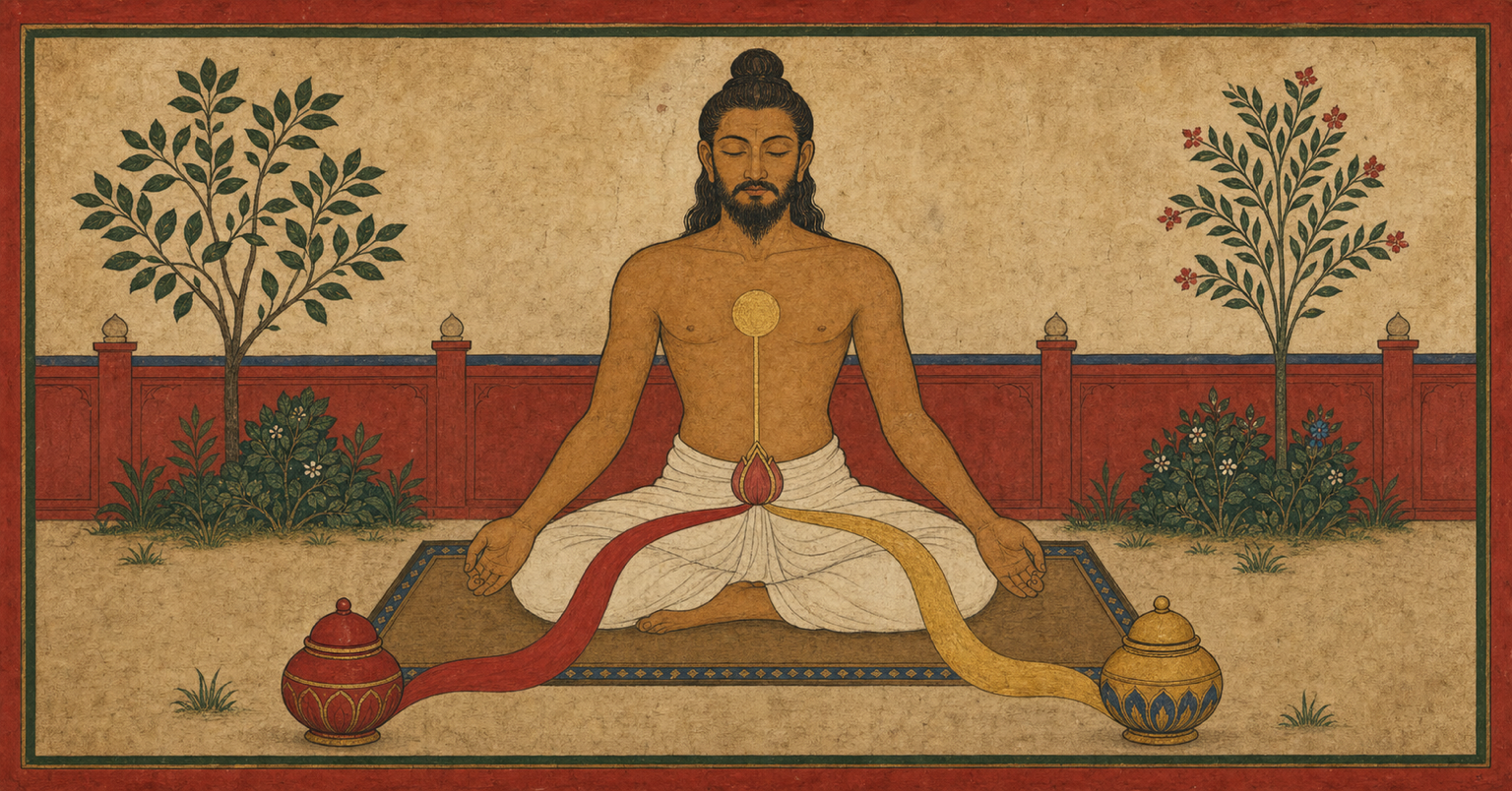

Haṭha Pradīpikā 3.80
मेहनेन शनैः सम्यग् ऊर्ध्वाकुञ्चनमभ्यसेत् |
पुरुषो वापि नारी वा वज्रोलीसिद्धिमाप्नुयात् ||80||
Metre: Anuṣṭubh
Through the urethra (mehanena | ins sg), one should slowly (śanaiḥ) and properly (samyak) practise (abhyaset | 3p sg act opt) upward contraction (ūrdhva-ākuñcanam | acc sg). Whether a man (puruṣaḥ | nom sg) or also (vāpi) a woman (nārī | nom sg), one may attain (āpnuyāt | 3p sg act opt) success in Vajrolī (vajrolī-siddhim | acc sg).
Vajrolī is described as a gentle and correct upward contraction through the urethra. Both men and women can attain success in it.
puruṣo vāpi nārī vā MBHDL2026 ] puruṣo’py athavā nārī NS1882
By practising to draw in the bindu, discharged during cohabitation, whether one be a man or a woman, one obtains success in the practice of Vajrolî.
Inter coitum yogî contractione semen lente ascendere cogat, quomodo et vir et femina vajrolîm adipisci possunt.
(Redaktionelle deutsche Übersetzung aus dem Latein: Beim Geschlechtsverkehr lasse der Yogin durch Zusammenziehen den Samen langsam aufsteigen; auf diese Weise können sowohl der Mann als auch die Frau Vajrolī erlangen.)
(Redaktionelle deutsche Übersetzung aus dem Latein: Beim Geschlechtsverkehr lasse der Yogin durch Zusammenziehen den Samen langsam aufsteigen; auf diese Weise können sowohl der Mann als auch die Frau Vajrolī erlangen.)
Haṭha Pradīpikā 3.81
यत्नतः शरनालेन फूत्कारं वज्रकन्दरे |
शनैः शनैः प्रकुर्वीत वायुसंचारकारणात् ||81||
Metre: Anuṣṭubh
Carefully (yatnataḥ), with a reed tube (śara-nālena | ins sg), one should perform (prakurvīta | 3p sg med opt) blowing (phūt-kāram | acc sg) into the opening of the penis (vajra-kandare | loc sg) very slowly (śanaiḥ), slowly (śanaiḥ), for the purpose of moving air (vāyu-saṃcāra-kāraṇāt | abl sg).
Using a fine tube, air is to be introduced very gently into the Vajra opening to prepare the movement of air within the urethra.
Brahmānanda transmits a historical, invasive preparation for Vajrolī. A lead tube fourteen fingerbreadths long is gradually inserted up to twelve fingerbreadths into the urethra. This is followed by blowing in air and drawing up water before reproductive fluid is drawn upward. He emphasizes that this can succeed only after mastery of Prāṇa and together with perfected Khecarī. The detailed passage makes clear how literally and physically he understands Vajrolī at this point.
śaranālena MBHDL2026 ] śastanālena NS1882
By means of a pipe, one should blow air slowly into the passage in the male organ.
Calamo idoneo yogî intente paulatimque in penis foramen (vajrakandare = medhravivare, Com.) spiret, spiritui viae faciendae causa.
(Redaktionelle deutsche Übersetzung aus dem Latein: Mit einem geeigneten Röhrchen blase der Yogin aufmerksam und allmählich in die Öffnung des Penis (vajrakandara = medhravivara, Komm.), um dem Atem einen Weg zu schaffen.)
(Redaktionelle deutsche Übersetzung aus dem Latein: Mit einem geeigneten Röhrchen blase der Yogin aufmerksam und allmählich in die Öffnung des Penis (vajrakandara = medhravivara, Komm.), um dem Atem einen Weg zu schaffen.)
Haṭha Pradīpikā 3.82
नार्या भगे पतद्बिन्दुम् अभ्यासेनोर्ध्वमाहरेत् |
चलितं च स्वकं बिन्दुम् ऊर्ध्वमाकृष्य रक्षयेत् ||82||
Metre: Anuṣṭubh
Through practice (abhyāsena | ins sg), one should draw (āharet | 3p sg act opt) upward (ūrdhvam) the falling Bindu (patat-bindum | acc sg) in the woman's (nāryā | gen sg) vulva (bhage | loc sg). And (ca), having drawn (ākṛṣya | abs) upward (ūrdhvam) one's own (svakam | acc sg m) Bindu (bindum | acc sg) when it has moved (calitam | acc sg m ppp), one should preserve it (rakṣayet | 3p sg act opt).
Through practice, the descending Bindu is said to be drawn upward from the woman's womb, while one's own moving Bindu is also retained.
nāryā bhage MBHDL2026 ] nārībhage NS1882
svakaṃ MBHDL2026 ] nijaṃ NS1882
svakaṃ MBHDL2026 ] nijaṃ NS1882
By practice, the discharged bindu is drawn out. One can draw back and preserve one's own discharged bindu.
Guttam in pudenda feminae casuram exercitatione reverti cogat; si autem ceciderit propria gutta, eam reverti cogat servetque.
(Redaktionelle deutsche Übersetzung aus dem Latein: Durch Übung lasse er den Tropfen zurückkehren, der in die Genitalien der Frau zu fallen droht; ist aber der eigene Tropfen gefallen, lasse er ihn zurückkehren und bewahre ihn.)
(Redaktionelle deutsche Übersetzung aus dem Latein: Durch Übung lasse er den Tropfen zurückkehren, der in die Genitalien der Frau zu fallen droht; ist aber der eigene Tropfen gefallen, lasse er ihn zurückkehren und bewahre ihn.)
Haṭha Pradīpikā 3.83
एवं तु रक्षयेद्बिन्दुं मृत्युं जयति योगवित् |
मरणं बिन्दुपातेन जीवितं बिन्दुधारणात् ||83||
Metre: Anuṣṭubh
Thus (evam), however (tu), the knower of yoga (yoga-vit | nom sg m) should preserve (rakṣayet | 3p sg act opt) Bindu (bindum | acc sg) and conquers (jayati | 3p sg act pres) death (mṛtyum | acc sg); death (maraṇam | nom sg) arises from the falling of Bindu (bindu-pātena | ins sg), life (jīvitam | nom sg) from retaining Bindu (bindu-dhāraṇāt | abl sg).
The text equates preservation of Bindu with life: its loss brings death, while retaining it brings vital power.
evaṃ tu rakṣayed MBHDL2026 ] evaṃ saṃrakṣayed NS1882
jīvitaṃ MBHDL2026 ] jīvanaṃ NS1882
jīvitaṃ MBHDL2026 ] jīvanaṃ NS1882
The Yogî who can protect his bindu thus, overcomes death; because death comes by discharging bindu, and life is prolonged by its preservation.
Yogî ita guttam servans mortem vincet; nam ut gutta lapsa mortem, eodem modo retenta vitam indicat.
(Redaktionelle deutsche Übersetzung aus dem Latein: Der Yogin, der den Tropfen so bewahrt, wird den Tod besiegen; denn wie der gefallene Tropfen den Tod, so zeigt der zurückgehaltene das Leben an.)
(Redaktionelle deutsche Übersetzung aus dem Latein: Der Yogin, der den Tropfen so bewahrt, wird den Tod besiegen; denn wie der gefallene Tropfen den Tod, so zeigt der zurückgehaltene das Leben an.)
Haṭha Pradīpikā 3.84
सुगन्धि योगिनो देहं जायते बिन्दुधारणात् |
यावद्बिन्दुः स्थिरो देहे तावन्मृत्युभयं कुतः ||84||
Metre: Anuṣṭubh
Through the retention of Bindu (bindu-dhāraṇāt | abl sg), the body (deham | nom sg) of the yogi (yoginaḥ | gen sg) becomes (jāyate | 3p sg med pres) fragrant (sugandhi | nom sg n). As long as (yāvat) Bindu (binduḥ | nom sg) remains steady (sthiraḥ | nom sg m) in the body (dehe | loc sg), whence (kutaḥ), for so long (tāvat), could fear of death (mṛtyu-bhayam | nom sg) arise?
Bindu Dhāraṇā makes the body fragrant and removes fear of death for as long as Bindu remains stable within the body.
mṛtyubhayaṃ MBHDL2026 ] kālabhayaṃ NS1882
By preserving bindu, the body of the Yogî emits a pleasing smell. There is no fear of death, so long as the bindu is well-established in the body.
Gutta servata odor jucundus exoritur in corpore; unde timor mortis, dum gutta servatur in corpore?
(Redaktionelle deutsche Übersetzung aus dem Latein: Wenn der Tropfen bewahrt ist, entsteht ein angenehmer Duft im Körper; woher käme die Furcht vor dem Tod, solange der Tropfen im Körper bewahrt wird?)
(Redaktionelle deutsche Übersetzung aus dem Latein: Wenn der Tropfen bewahrt ist, entsteht ein angenehmer Duft im Körper; woher käme die Furcht vor dem Tod, solange der Tropfen im Körper bewahrt wird?)
Haṭha Pradīpikā 3.85
मनायत्तं नृणां शुक्रं शुक्रायत्तं हि जीवितम् |
तस्माच्छुक्रं मनश्चैव रक्षणीयं प्रयत्नतः ||85||
Metre: Anuṣṭubh
In men (nṛṇām | gen pl), Śukra (śukram | nom acc sg) depends on the mind (manas-āyattam | nom sg n), and life (jīvitam | nom sg) indeed (hi) depends on Śukra (śukra-āyattam | nom sg n). Therefore (tasmāt | abl sg), Śukra (śukram | nom acc sg) and the mind (manaḥ | nom acc sg) also indeed (caiva) are to be protected (rakṣaṇīyam | nom sg n pfp) carefully (prayatnataḥ).
Śukra depends on the mind, and life depends on Śukra. Semen and mind should therefore be carefully preserved.
manāyattaṃ MBHDL2026 ] cittāyattaṃ NS1882
The bindu of men is under the control of the mind, and life is dependent on the bindu. Hence, mind and bindu should be protected by all means.
In animo semen virile, in semine vita nititur; diligenter igitur animus semenque servanda sunt.
(Redaktionelle deutsche Übersetzung aus dem Latein: Der männliche Samen beruht auf dem Geist, das Leben auf dem Samen; daher sind Geist und Samen sorgfältig zu bewahren.)
(Redaktionelle deutsche Übersetzung aus dem Latein: Der männliche Samen beruht auf dem Geist, das Leben auf dem Samen; daher sind Geist und Samen sorgfältig zu bewahren.)
Haṭha Pradīpikā 3.86
ऋतुमत्या रजो ऽप्येवं बीजं बिन्दुं च रक्षयेत् |
मेढ्रेणाकर्षयेदूर्ध्वं सम्यगभ्यासयोगवान् ||86||
Metre: Anuṣṭubh
Thus (evam), [he] should also (api) preserve (rakṣayet | 3p sg act opt) the Rajas (rajas | nom acc sg n) of a menstruating woman (ṛtumatyāḥ | gen sg f), generative fluid (bījam | acc sg), and (ca) [his] Bindu (bindum | acc sg). The practitioner endowed with correct practice (samyak-abhyāsa-yogavān | nom sg m) should draw [this] (ākarṣayet | 3p sg caus opt) upward (ūrdhvam) through the genital (meḍhreṇa | ins sg).
The verse treats generative fluids as powers worth preserving. Today, this can prompt care for sexuality and bodily boundaries.
Brahmānanda explicitly identifies the stanza he comments upon as interpolated (kṣiptaḥ). He thus identifies the verse as a later addition to the textual transmission.
abhyāsayogavān MBHDL2026 ] abhyāsayogavit NS1882
Qui in hac exercendi ratione bene versatus est et feminae menstrua et semen proprium pene hauriat atque servet.
(Redaktionelle deutsche Übersetzung aus dem Latein: Wer in dieser Übungsweise gut erfahren ist, soll sowohl die Menstruationsflüssigkeit der Frau als auch seinen eigenen Samen mit dem Penis aufsaugen und bewahren.)
(Walters anschließende Anmerkung: *ayam ślokaḥ kṣiptaḥ*, Com. - der Kommentar bezeichnet den Vers als eingeschoben.)
Haṭha Pradīpikā 3.86*1
अयं योगः पुण्यवतां धन्यानां तत्त्वशालिनाम् |
निर्मत्सराणां सिध्येत न तु मत्सरशालिनाम् ||86*1||
Metre: Anuṣṭubh
This yoga (ayaṃ yogaḥ | nom sg) may succeed (sidhyeta | 3p sg med opt) for the meritorious (puṇyavatām | gen pl m), the fortunate (dhanyānām | gen pl m), those established in truth (tattva-śālinām | gen pl m), and those without jealousy (nir-matsarāṇām | gen pl m), but (tu) not (na) for those filled with jealousy (matsara-śālinām | gen pl m).
This practice matures in people who possess inner readiness, truthfulness, and freedom from envy. It does not succeed in an envious mind.
ayaṃ yogaḥ puṇyavatāṃ dhanyānāṃ tattvaśālinām nirmatsarāṇāṃ sidhyeta na tu matsaraśālinām MBHDL2026 ] transp. NS1882 post HP 3.89
dhanyānāṃ tattvaśālinām MBHDL2026 ] dhīrāṇāṃ tattvadarśinām NS1882
dhanyānāṃ tattvaśālinām MBHDL2026 ] dhīrāṇāṃ tattvadarśinām NS1882
This Yoga is achieved by courageous wise men, who are free from sloth, and cannot he accomplished by the slothful.
Möge dieser Yoga gelingen den Verdienstvollen, den Ausharrenden, denen, die die Wahrheit sehen, den nicht Neidischen, nicht aber den Missgünstigen.
Continue with AYI Free
Illustrations: AI-generated.

Please log in to write a message. Go to login
No messages yet.