

om ओम् – Oṃ; sacred syllable
Indeclinable word · particle · Word type unspecified
Dictionary sources
AYI dictionary particle
Oṃ; sacred syllable
Cappeller 1891 Indeclinable word
Original text · English · Indeclinable word
óm ·(indecl.) the mystic syllable Om (somewhat like Amen!).
Monier-Williams 1872 particle
Original text · English · particle
om om, ind. (said to be fr. rt. av; perhaps originally oṃ, which may be derived fr. āṃ, and this fr. ā), a word of solemn affirmation and respectful assent (sometimes translated by yes, verily, so be it, and in this sense compared with Amen). It is placed at the commencement of most Hindū works, and as a sacred exclamation may be uttered (but not so as to be heard by ears profane) at the beginning and end of a reading of the Vedas or previously to any prayer. It is also regarded as a particle of auspicious salutation (Hail!). Om appears first in the Upani- shads as a mystic monosyllable, and is there set forth as the object of profound religious meditation, the highest spiritual efficacy being attributed not only to the whole word but also to the three sounds a, u, m, of which it consists. In later times om is the mystic name for the Hindū triad, and represents the union of the three gods, viz. a (Viṣṇu), u (Śiva), m (Brahmā). It may also be typical of the three Vedas. Om is usually called praṇava, more rarely akṣaram or ekākṣaram, and only in later times oṃ-kāra. The Buddhists use om at the commencement of their vidyā ṣaḍ-akṣarī or mystical formulary in six syllables (viz. om māni padme hūṃ). Lexico- graphers affirm that besides the above uses, om may imply command or injunction, removal or warding off (Away! Hence!), and be used as an inceptive par- ticle. Grammarians assert that before om a preced- ing a or ā at the end of a word should be cut off (e. g. vijayoṅkāraḥ for vijayauṅkāraḥ (˚ya-oṅ˚), thanksgiving for victory; see Gram. 38. b).
Petersburger 1855 particle
Original text · German · particle
om indecl. Uṇ. 1,140. gaṇa svarādi zu P. 1,1,37. ein Wort feierlicher Bekräftigung und ehrfurchtsvoller Anerkennung, dem Sinne nach oft dem ἀμήν vergleichbar; im Gottesdienst als ein heiliger Ausruf viel gebraucht und beim Beginn und Schluss der Recitation heiliger Schriften so wie zum Gruss ausgesprochen. Schon in den UPANIṢAD erhält das Wort einen mystischen Charakter: es wird zum Gegenstand einer religiösen Betrachtung und Vertiefung; nicht nur auf das ungetheilte Wort, sondern auch auf die einzelnen lautlichen Bestandtheile desselben, a, u und m, werden die höchsten religiösen Begriffe übertragen. In einer noch spätern Zeit suchte man darin die Trias Viṣṇu, Śiva und Brahman (akāro viṣṇuruddiṣṭa ukārastu maheśvaraḥ . makāreṇocyate brahmā praṇavena trayo matāḥ .. ŚKDR. ohne Ang. der Aut. Vgl. VP. 1, N. 1.). Die übliche Bezeichnung für om ist praṇava (s. u. d. W.), seltener und später erscheint oṃkāra. Die ursprünglichere Form ist wohl om̐ und dieses nur dumpfe Aussprache für ām̐, welches wiederum bei gedehnter Sprechung sich leicht aus dem einfachen Laut ā entwickeln konnte. Ueber analoge Erscheinungen vgl. ROTH, Zur L. u. G. d. W. p. 76. fgg. Die versuchte Zurückführung des Wortes auf ein im Sanskrit verloren gegangenes pron. ava wird durch den ganzen älteren Gebrauch des Wortes widerlegt. Ein vorangehendes a und ā fliesst mit dem o von om nicht in au zusammen, sondern verschwindet davor, P. 6,1,95. VOP. 2,5. Das gedehnte o3m soll nach P. 8,2,87 nur beim Beginn angewendet werden. o3mpra tìṣṭha VS. 2,13. yadvai netyṛcyomiti tat ŚAT. BR. 1,4,1,30. ŚAT. BR. 1,4,1,1. pṛthivīmeva rājanniti hovācomiti hovāca ŚAT. BR. 10,6,1,4. ŚAT. BR. 11,6,3,4. BṚH. ĀR. UP. 5,2,1. fgg. BṚH. ĀR. UP. 6,2,1. o3mitpṛcaḥ pratigara evaṃ tatheti gāthāyā omiti vai daivaṃ tatheti mānuṣam AIT. BR. 7,18. tebhyo 'bhitaptebhyastrayo varṇā ajāyantākāra ukāro makāra iti tānekadhā samabharattadetadomiti tasmādomiti praṇauti AIT. BR. 5,32. sa o3miti prasvarati ṚV. PRĀT. 15,3. oṃ bho3 iti cābhyanujñā ṚV. PRĀT. 15,6. ṚV. PRĀT. 15,16. oṃkāraṃ vedeṣu . athakāraṃ bhāṣyeṣu VS. PRĀT. 1,17. VS. PRĀT. 1,18. oṃpūrvā vyāhṛtayaḥ ĀŚV. GṚHY. 3,2. ĀŚV. GṚHY. 3,5. KĀTY. ŚR. 2,2,8. KĀTY. ŚR. 5,9,11. ŚĀṄKH. ŚR. 4,6,9. ŚĀṄKH. ŚR. 4,6,17. ŚĀṄKH. ŚR. 6,8,7. ŚĀṄKH. ŚR. 7,14,9. ŚĀṄKH. ŚR. 10,13,28. CHĀND. UP. 1,12,5. ityom AIT. UP. 5,4. sarve vedā yatpadamāmananti tapāṃsi sarvāṇi ca yadvadanti . yadicchanto brahmacaryaṃ caranti tatte padaṃ saṃgraheṇa bravīmyomityetat .. KAṬHOP. 2,15. fgg. omiti brahma . omitīdaṃ sarvam u. s. w. TAITT. UP. 1,8. Ind. St. 1,251. Ind. St. 1,252. Ind. St. 1,255. u. s. w. VP. 273. VP. 274, N. 6. — Die Lexicographen: omevaṃ paramaṃ mate AK. 3,5,12. H. 1540. omevaṃpraṇavārthayoḥ TRIK. 3,3,465. oṃ praṇave 'ṅgīkṛtāvapi H. an. 7,6. omupakrame . praṇave cābhyupagame cāpākṛtau ca maṅgale MED. avy. 51. — Vgl. oṃkāra und anoṃkṛta.
Böhtlingk 1879 particle
Original text · German · particle
óm Interj. der feierlichen Bekräftigung und ehrfurchtsvollen Anerkennung. dem Sinne nach oft ἀμήν entsprechend. Wird im Gottesdienst als ein heiliger Ausruf viel gebraucht und beim Beginn und Schluss der Recitation heiliger Werke, so wie vor dem Namen der Gottheit, die angerufen wird, und auch als Gruss ausgesprochen, erhält später einen mystischen Charakter und wird zum Gegenstand einer religiösen Betrachtung und Vertiefung. omiti bruvan so v. a. bejahend Comm. zu NYĀYAS. 3,2,78.
Apte 1890 particle
Original text · English · particle
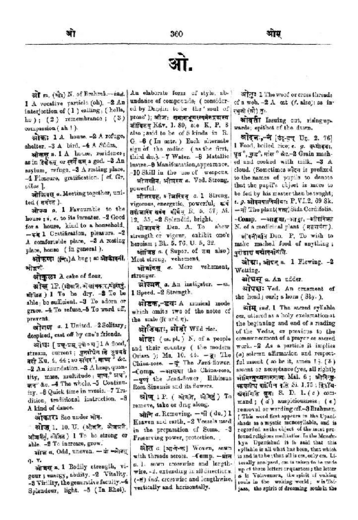
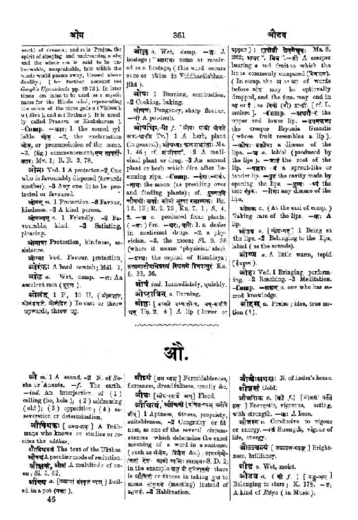
om ind. 1 The sacred syllable om, uttered as a holy exclamation at the beginning and end of a reading of the Vedas, or previous to the commencement of a prayer or sacred work. 2 As a particle it implies (a) solemn affirmation and respectful assent (so be it, amen !). (b) assent or acceptance (yes, all right); omityucyatāmamātyaḥ Māl. 6; omityuktavatotha śāṃrgiṇa iti Śi. 1. 75; dvitīyaścedomiti brūmaḥ S. D. 1. (c) command; (d) auspiciousness; (e) removal or warding off. 3 Brahman. [This word first appears in the Upanishads as a mystic monosyllable, and is regarded as the object of the most profound religious meditation. In the Māṇḍūkya Upaniṣad it is said that this syllable is all what has been, that which is and is to be; that all is om, only om. Literally analysed, om is taken to be made up of three letters or quarters; the letter a is Vaiśvānara, the spirit of waking souls in the waking world; u is Taijasa, the spirit of dreaming souls in the ([Page 0361-a]) world of dreams; and m. is Prājña, the spirit of sleeping and undreaming souls; and the whole om is said to be unknowable, unspeakable, into which the whole world passes away, blessed above duality; (for further account see Gough's Upaniṣads pp. 69-73). In later times om came to be used as a mystic name for the Hindu triad, representing the union of the three gods a (Viṣṇu), u (Śiva), and m. (Brahmā). It is usually called Praṇava or Ekākṣaram]. Comp. — kāraḥ 1 the sacred syllable om. 2 the exclamation om, or pronunciation of the same. 3 (fig.) commencement; eṣa tāvadoṃkāraḥ Mv. 1; B. R. 3. 78.
Cappeller 1887 Word type unspecified
Original text · German · Word type unspecified
óm die heilige Silbe om (etwa = Amen!).

Occurrences in source texts (5)
IVU 4 occurrences
PJH 1 occurrence
Continue with AYI Free
Image source: AYI archive.