
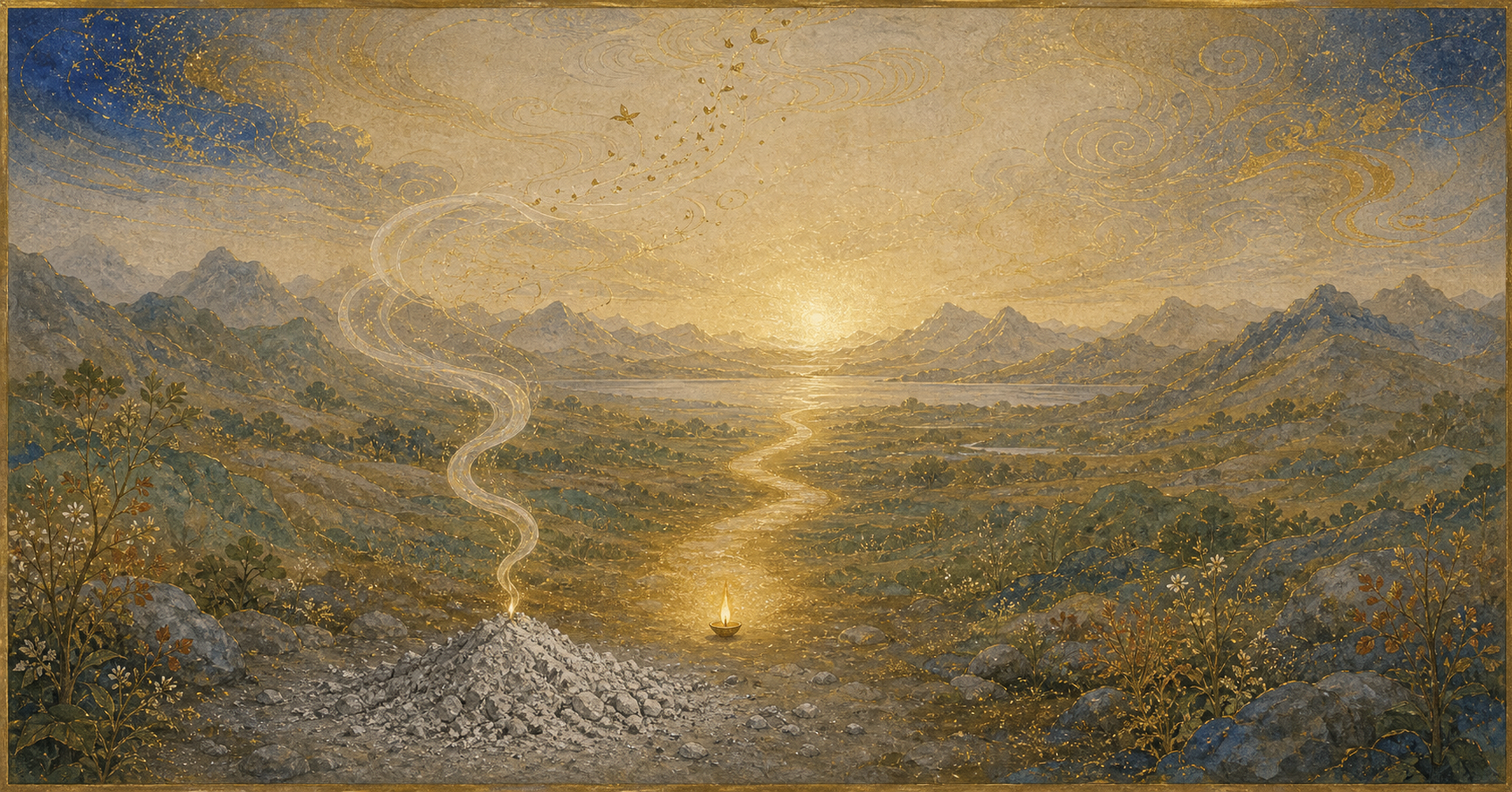
IVU 17-18: Breath, Memory, and the Good Path

Īśāvāsya Upaniṣad 17-18: Remembrance at Death

Breath and body return to their elements; the mind is called to remember, and Agni is to lead the dying person along the good path.

Dr. Ronald Steiner Dr. Ronald Steiner
Īśāvāsya Upaniṣad 17
वायुरनिलममृतमथेदं भस्मान्तं शरीरम् |
vāyur anilam amṛtam; athedaṃ bhasmāntaṃ śarīram | Analysis ▾ Analysis ▴
vāyuḥ
nominative singular
substantive masculine
breath, wind
anilam
accusative singular
substantive masculine
wind, air
amṛtam
accusative singular masculine
adjective
immortal
atha
particle
now
idam
nominative singular neuter
pronoun dem
this
bhasmāntam
nominative singular neuter
adjective
ending in ash
śarīram
nominative singular
substantive neuter
body
ॐ क्रतो स्मर कृतं स्मर क्रतो स्मर कृतं स्मर ||17||
oṃ; krato smara kṛtaṃ smara; krato smara kṛtaṃ smara ||17|| Analysis ▾ Analysis ▴
om
particle
Om
krato
vokative singular
substantive masculine
will, mind
smara
2nd person singular aktive imperative
verbal root
remember
kṛtam
accusative singular neuter past participle passive
verbal root
what has been done, deed
smara
2nd person singular aktive imperative
verbal root
remember
krato
vokative singular
substantive masculine
will, mind
smara
2nd person singular aktive imperative
verbal root
remember
kṛtam
accusative singular neuter past participle passive
verbal root
what has been done, deed
smara
2nd person singular aktive imperative
verbal root
remember
Metre: Anuṣṭubh; Oṃ extrametrical
The breath (vāyuḥ | nom sg) [goes] into the immortal (amṛtam | acc sg m) wind (anilam | acc sg); now (atha) this (idaṃ | nom sg n) body (śarīram | nom sg) ends in ash (bhasmāntam | nom sg n). Om (oṃ). O mind (krato | voc sg), remember (smara | 2p sg act imp) what has been done (kṛtaṃ | acc sg n ppp), remember (smara | 2p sg act imp); O mind (krato | voc sg), remember (smara | 2p sg act imp) what has been done (kṛtaṃ | acc sg n ppp), remember (smara | 2p sg act imp).
Dr. Ronald Steiner - 2026 - historically literal
The breath enters the immortal wind; this body becomes ash. Om. Mind, remember what has been done; remember. Mind, remember what has been done; remember.
Dr. Ronald Steiner - 2026 - modern transfer

Śaṅkara reads this verse as the request of the dying one. The individual prāṇa (life-breath) is to leave its limitation and reach the immortal cosmic Anila/Sūtrātman (wind, cosmic life-principle); the body ends as ash. Kratu (the inner resolve capable of willing and remembering) is now to remember the long-practiced upāsanā (worship, meditation) and the completed actions.

Īśā-Upaniṣad Śaṅkara-Bhāṣya
[My] breath (vāyu) to the immortal wind (anila)!<1>This body then ends in ashes! Om!
O Purpose (kratu<2>), remember! The deed (kṛta) remember!
O Purpose, remember! The deed remember!

<1:This formula recurs at Bṛih. 5. 15. The idea that at death the several parts of microcosmic man revert to the corresponding elements of the macrocosm is expressed several times in Sanskrit literature. With the specific mention here, compare ‘his spirit (ātman) to the wind (vāta)’ in the Cremation Hymn, RV. 10. 16. 3a; ‘with his breath (prāna) to wind (vāyu),’ Śat Br. 10. 3. 3. 8; ‘his breath (prāna) to wind (vāta), Bṛih. 3. 2. 13; and even of the sacrificial animal, ‘its breath (prāna) to wind (vāta), Ait. Br. 2. 6.>

<2: Compare the statement in Chānd. 3. 14. 1, ‘Now, verily, a person consists of purpose (kratu-maya).’>
Robert Hume - 1921
Nun werde, Hauch, zum Winde, dem unsterblichen,
und dieser Leib mag endigen in Asche!
Om! O Geist, gedenk! des Werks gedenk!
O Geist, gedenk! des Werks gedenk!
Paul Deussen - 1897
Breath<4> to air, and to the immortal! Then this my body ends in ashes. Om! Mind, remember! Remember thy deeds<5>! Mind, remember! Remember thy deeds!

<4: These lines are supposed to be uttered by a man in the hour of death.>
<5: The Vâgasaneyi-samhitâ reads: Om, krato smara, klibe smara, kritam smara. Uvata holds that Agni, fire, who has been worshipped in youth and manhood, is here invoked in the form of mind, or that kratu is meant for sacrifice. 'Agni, remember me! Think of the world! Remember my deeds!'>
Max Müller - 1879
Īśāvāsya Upaniṣad 18
अग्ने नय सुपथा राये अस्मान्विश्वानि देव वयुनानि विद्वान् |
agne naya, supathā rāye asmān; viśvāni deva vayunāni vidvān | Analysis ▾ Analysis ▴
agne
vokative singular
substantive masculine
Agni
naya
2nd person singular aktive imperative
verbal root
lead
supathā
instrumental case singular
substantive masculine
by a good path
rāye
dative singular
substantive masculine
to well-being, prosperity
asmān
accusative plural
pronoun pers 1p
us
viśvāni
accusative plural neuter
adjective
all
deva
vokative singular
substantive masculine
god
vayunāni
accusative plural
substantive neuter
ways, courses, insights
vidvān
nominative singular masculine past participle active
verbal root
knowing
युयोधि अस्मज्जुहुराणमेनो भूयिष्ठां ते नमौक्तिं विधेम ||18||
yuyodhi* asmaj juhurāṇam eno; bhūyiṣṭhāṃ te, nama-uktiṃ vidhema ||18|| Analysis ▾ Analysis ▴
yuyodhi
2nd person singular aktive imperative
verbal root
keep away, separate
asmat
ablative plural
pronoun pers 1p
from us
juhurāṇam
accusative singular neuter past partiziple medial
verbal root
crooked, acting falsely
enas
accusative singular
substantive neuter
sin, guilt
bhūyiṣṭhām
accusative singular feminine superlative
adjective
most abundant, fullest
te
dative singular
pronoun pers 2p
to you
namas
tatpuruṣa-compound genitive
substantive neuter
of reverence, of homage
uktim
accusative singular
substantive feminine
utterance, word of praise
vidhema
1st person plural aktive optative
previx
verbal root
may we offer, perform
Metre: Pāda 1: Śālinī; pāda 2: Indravajrā; pāda 3: Upendravajrā; pāda 4: Śālinī
O Agni (agne | voc sg), lead (naya | 2p sg act imp) us (asmān | acc pl) by a good path (supathā | ins sg) to well-being (rāye | dat sg), O god (deva | voc sg), knowing (vidvān | nom sg m ppa) all (viśvāni | acc pl n) ways (vayunāni | acc pl); keep (yuyodhi | 2p sg act imp) crooked guilt (juhurāṇam enaḥ | acc sg) away from us (asmaj | abl pl); may we offer (vidhema | 1p pl act opt) to you (te | dat sg) the fullest (bhūyiṣṭhām | acc sg f sup) utterance of homage (namas-uktiṃ | acc sg).
Dr. Ronald Steiner - 2026 - historically literal
Agni, lead us by the good path to well-being, you god who knows all ways. Keep crooked guilt away from us; to you we offer our fullest word of reverence.
Dr. Ronald Steiner - 2026 - modern transfer

Śaṅkara understands supathā (good path) as the path that avoids the southern way of return. Agni (the fire god) is to lead the worshipper to the karmically deserved goal and remove crooked enas (fault, guilt). At the end Śaṅkara again defends his reading: in verses 9-14, vidyā (knowledge) means upāsanā (worship, meditation), not highest Self-knowledge, because Paramātman-knowledge (knowledge of the highest Self) cannot be joined with karma (action).

Īśā-Upaniṣad Śaṅkara-Bhāṣya
yuyodhi* asmaj conj. ed. ] yuyodhy asmaj GRETIL2018, LV1958
Critical Apparatus
O Agni, by a goodly path to prosperity (rai) lead us,
Thou god who knowest all the ways!
Keep far from us crooked-going sin (enas)!<3>
Most ample expression of adoration to thee would we render!<4>

<3: Other prayers for freedom from sin (enas, compare also āgas) are at RV. 1. 24. 9 d; 3. 7. 10 d; 7. 86. 3 a, 4 d; 7. 88. 6 c; 7. 89. 5 c, d; 7. 93. 7 c, d; 8. 67 (56). 17; 10. 35. 3 a, c; 10. 37. 12; AV. 6 97. 2 d; 6. 115. 1, 2, 3; 6. 116. 2, 3; 6. 117; 6. 118; 6. 119; 6. 120.>

<4: This stanza is identical with RV. 1. 189. 1, and the second line also with AV. 4. 39. 10 b.>
Robert Hume - 1921
O Agni, führe uns auf ebenen Stegen,
Du pfadekundiger Gott, hin zum Gelingen!
Halt fern uns von der Sünde krummen Wegen!
Und höchste Ehre wollen wir dir bringen.
Paul Deussen - 1897
Agni, lead us on to wealth (beatitude) by a good path, thou, O God, who knowest all things!
Keep far from us crooked evil, and we shall offer thee the fullest praise! (Rv. I, 189, 1.).
Max Müller - 1879

Continue with AYI Free

Illustrations: AI-generated.

Editor

Dr. Ronald Steiner

From 89075 Ulm

The "Yoga Doc" - Dr. Ronald Steiner is the founder of the AYI method. This method links traditional Ashtanga Yoga with innovative Yogatherapy and living Philosophy. This forms a practice that is personal for each and... more ›

Messages and ratings
3 messages Ø

Please log in to write a message. Go to login