

Īśāvāsya Upaniṣad 2
कुर्वन्नेवेह कर्माणि जिजीविषेच्छतं समाः |
एवं त्वयि नान्यथेतो ऽस्ति न कर्म लिप्यते नरे ||2||
evaṃ tvayi nānyatheto 'sti; na karma lipyate nare ||2|| Analysis ▾ Analysis ▴
Metre: Anuṣṭubh
[One] may wish to live (jijīviṣet | 3p sg act opt des) a hundred (śataṃ | acc sg n) years (samāḥ | acc pl) while doing (kurvan | nom sg m pca) deeds (karmāṇi | acc pl) precisely (eva) here (iha); thus (evaṃ) it is (asti | 3p sg act pres) for you (tvayi | loc sg), not (na) otherwise (anyathā) than this (itaḥ): no (na) action (karma | nom sg) clings (lipyate | 3p sg pas pres) to the human being (nare | loc sg).
One who lives here in action may wish to live a hundred years. Only in this way, and not otherwise, does action not cling to a person.
Śaṅkara interprets this verse as an instruction for those not yet capable of ātma-jñāna-niṣṭhā (firm orientation toward Self-knowledge). For them, karma-niṣṭhā (the path of prescribed action) remains possible. At the same time he sharply separates two paths: jñāna/saṃnyāsa (knowledge and renunciation) and karma (action); they are not quietly mixed.
Even while doing deeds here,
One may desire to live a hundred years.
Thus on thee—not otherwise than this is it—
The deed (karman) adheres not on the man.
One may desire to live a hundred years.
Thus on thee—not otherwise than this is it—
The deed (karman) adheres not on the man.
Mag immerhin, sein Werk treibend,
Hundert Jahre man wünschen sich!
Drum steht's, wenn so du, nicht anders;
Werkbefleckung klebt dir nicht an.
Hundert Jahre man wünschen sich!
Drum steht's, wenn so du, nicht anders;
Werkbefleckung klebt dir nicht an.
Though a man may wish to live a hundred years, performing works, it will be thus with him; but not in any other way: work will thus not cling to a man.
Īśāvāsya Upaniṣad 3
असुर्या नाम ते लोका अन्धेन तमसावृताः |
तांस्ते प्रेत्याभिगच्छन्ति ये के चात्महनो जनाः ||3||
Metre: Anuṣṭubh
Demonic (asuryāḥ | nom pl m), so called (nāma), are those (te | nom pl m) worlds (lokāḥ | nom pl), covered (āvṛtāḥ | nom pl m ppp) with blind (andhena | ins sg n) darkness (tamasā | ins sg); into them (tān | acc pl m) go (abhigacchanti | 3p pl act pres), after dying (pretya | abs), those (te | nom pl m) people (janāḥ | nom pl), whoever (ye | nom pl m) they may be (ke | nom pl m) at all (ca), [who] destroy the Self (ātma-hanaḥ | nom pl m).
Demonic and covered with blind darkness are the worlds into which, after death, all those go who destroy their own Self.
Śaṅkara explains the dark worlds as karma-phala (fruits of action) and future births covered by avidyā (ignorance). Ātma-hanaḥ (Self-destroyers) are not literal suicides, but the ignorant who obscure the ever-present Self. Thus they lose the experience of agelessness and immortality and remain in saṃsāra (the cycle of existence).
asuryā GRETIL2018 ] asūryā LV1958
Devilish (asurya<2>) are those worlds called, <3>
With blind darkness (tamas) covered o’er!
Unto them, on deceasing, go
Whatever folk are slayers<4> of the Self.<5>
<2: Compare the persons called ‘devilish,’ āsura, at Chānd. 8. 8. 5. A variant reading here (accordant with a literalism interpreted in the following line) is a-sūrya, ‘sunless.’>
<3: The word nāma here might mean ‘certainly’ instead of ‘called.’ >
<4: This idea is in sharp contrast with the doctrine of Kaṭha 2. 19 d (and BhG. 2. 19), where it is stated that ‘he [i.e. the Self] slays not, is not slain.’ The word ātma-han here, of course, is metaphorical, like ‘smother,’ ‘stifle,’ ‘completely suppress.’ >
<5: The whole stanza is a variation of Bṛih. 4. 4. 11. >
Ja, dämonisch ist dies Weltall,
Von blinder Finsternis bedeckt!
Darein geh'n nach dem Tode alle,
Die ihre Seele mordeten.
Von blinder Finsternis bedeckt!
Darein geh'n nach dem Tode alle,
Die ihre Seele mordeten.
There are the worlds of the Asuras <1> covered with blind darkness. Those who have destroyed their self (who perform works, without having arrived at a knowledge of the true Self ), go after death to those worlds.
<1: Asuryâ, Vâg. Samhitâ; asûryâ, Upan. Asuryà in the Upanishads in the sense of belonging to the Asuras, i. e. gods, is exceptional. I should prefer asûryá, sunless, as we find asûryé támasi in the Rig-veda, V, 32, 6.>
<1: Asuryâ, Vâg. Samhitâ; asûryâ, Upan. Asuryà in the Upanishads in the sense of belonging to the Asuras, i. e. gods, is exceptional. I should prefer asûryá, sunless, as we find asûryé támasi in the Rig-veda, V, 32, 6.>
Continue with AYI Free
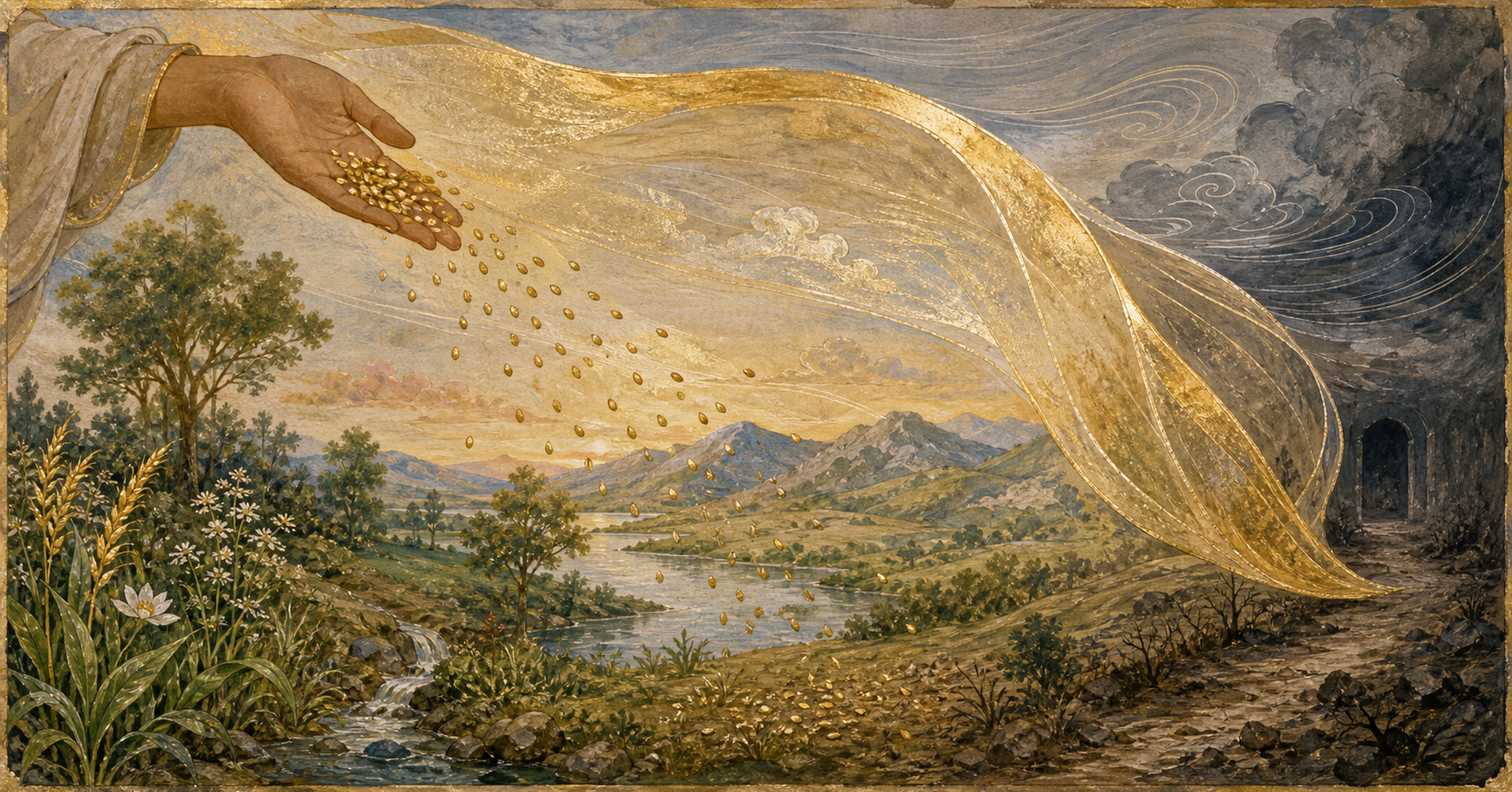
Illustrations: AI-generated.

Please log in to write a message. Go to login