

vallabha वल्लभ – precious; dear
adjective · substantive masculine · Word type unspecified
Dictionary sources
AYI dictionary adjective
precious; dear
Cappeller 1891 adjective
Original text · English · adjective
vallabha ·a. dearest to (gen., loc., or --°), dearer than (abl.), favourite, also as subst., f. ā; abstr. °tā f. (°tva* n.).
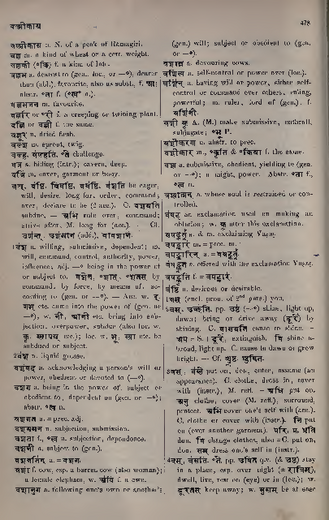
Monier-Williams 1872 adjective
Original text · English · adjective
Vallabha, as, ā, am (in Uṇādi-s. III. 125. said to be fr. rt. vall), beloved, desired, dear; supreme, superintending, superintendent; (as), m. a lover, husband, friend, favourite, (kāma-vallabha, the cinnamon tree); a superintendent, overseer; a chief herdsman; a horse (especially one with good marks); N. of a grammarian; (ās), m. pl., N. of a people; (ā), f. a beloved female, wife, mistress; (ī), f., N. of a city in Gujarāt, the capital of a line of kings.
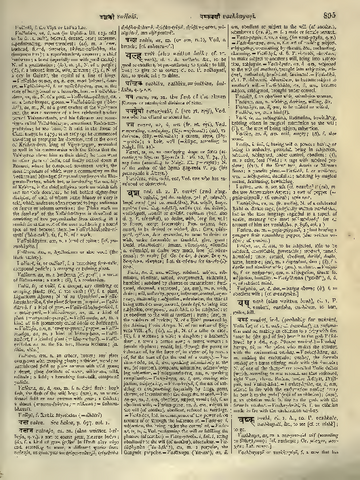
Petersburger 1855 adjective · substantive masculine
Original text · German · adjective · substantive masculine
vállabha UṆĀDIS. 3,125. Accent eines darauf ausgehenden Wortes gaṇa ghoṣādi zu P. 6,2,85. 1〉 adj. (f. ā) vor Allen lieb, subst. Liebling, Günstling, Geliebter, Geliebte AK. 3,2,3. H. 515. fg. H. an. 3,457. MED. bh. 18. HALĀY. 2,212. pramadāṃ vallabhāmiva R. 3,35,63. bhṛtya KATHĀS. 23,32. bhāryā KATHĀS. 63,21. Verz. d. Oxf. H. 15,b, No. 59. ātmasadṛśekṣaṇavallabhābhirhariṇāṅganābhiḥ ŚĀK. 26. Spr. 806. vallabhātithayo gṛhāḥ RĀJA-TAR. 3,224. prāyeṇa hi naraśreṣṭha jyeṣṭhāḥ pitṛṣu vallabhāḥ . mātṝṇāṃ ca kanīyāṃsaḥ R. 1,61,18 (R. 1,63,20 GORR.). kasyāsti ko vallabhaḥ Spr. 2883. rājñaḥ Spr. 4675. KĀM. NĪTIS. 5,19. sarvajanasya VARĀH. BṚH. S. 68,117. BṚH. 24,10. Z. d. d. m. G. 14,569. Z. d. d. m. G. 14,9. PAÑCAT. 169,25. śreyasāmekavallabhaḥ BHĀG. P. 4,24,77. vallabhatarā CAURAP. 27. ativallabhā bhāryā KATHĀS. 36,113. MĀRK. P. 65,11. rāja˚ ein Liebling des Fürsten MBH. 2,1207. Spr. 336 (II). 984. Spr. 1261. Spr. 1283. Spr. 1354. Spr. 1862. Spr. 1927. Spr. 2493. Spr. 2561. Spr. 3193. nṛpa˚ Spr. 1009. narendra˚ VARĀH. BṚH. S. 46,99. asmatsvāmi˚ PRAB. 9,3. gaṇa˚ (so die ed. Bomb.) R. 2,81,12. naigamayūtha˚ R. 2,106,33. harivajjanavallabhaḥ VET. in LA. (III) 1,14. śrī˚ Spr. 1912. aṅganā˚ VARĀH. BṚH. 17,1. pativallabhā BṚH. S. 103,8. prāṇa˚ PAÑCAT. IV, 8. samastaguṇavallabhaḥ ein Liebling aller Vorzüge so v. a. mit allen Vorzügen ausgestattet Verz. d. Oxf. H. 140,a, No. 280. guṇa˚ R. 2,81,12. kṣiti˚ Geliebter, Gatte RĀJA-TAR. 5,380. umā˚ SĀH. D. 19,1. SĀH. D. 43,12. PAÑCAT. 129,7. PAÑCAT. 129,8. VET. in LA. (III) 20,15. vallabhā Geliebte, Gattin RAGH. 19,16. Spr. 2791. Spr. 4030. RĀJA-TAR. 3,9. RĀJA-TAR. 3,482. RĀJA-TAR. 3,507. BHĀG. P. 1,14,37. CAURAP. 14. H. 185. ŚUK. in LA. (III) 38,3. DHŪRTAS. 90,16. rājāno bahuvallabhāḥ KATHĀS. 47,104. KATHĀS. 22,129. vallabhajana Geliebte RAGH. 19,24. Ausnahmsweise wird vallabha auch von Unpersönlichem gesagt: kāyaḥ kasya na vallabhaḥ Spr. 700. akhilalokavallabhataṃ śīlam Spr. 2765. (dhvaniḥ) abhūttasya vallabhaḥ RĀJA-TAR. 2,126. Verz. d. Oxf. H. 12,b,10. na me brahmakulātprāṇāḥ kuladaivānna cātmajāḥ . na śriyo na mahī rājyaṃ na dārāścātivallabhāḥ .. lieber als BHĀG. P. 9,9,43. hāreṇa — śrāvatsavakṣaḥsthalavallabhena BHĀG. P. 3,8,28. — b〉 die Aufsicht über Etwas habend AK. 3,4,22,140. H. an. MED. adhyakṣo 'tra gavādhyakṣaḥ SVĀMIN_zu_AK. nach ŚKDR. also wohl nur fehlerhaft für ballava Kuhhirt. — 2〉 m. a〉 ein edles Pferd (eher Lieblingspferd) H. an. MED. — b〉 N. pr. eines Sohnes des Balākāśva MBH. 13,204. eines Lehrers (vgl. vallabhācārya) HALL 146. WILSON, Sel. Works II, 72. eines Grammatikers Verz. d. Oxf. H. 113,b,5. Verz. d. Oxf. H. 113,b,6. — c〉 pl. N. pr. eines Volkes VP. 193, N. 129; v. l. für mallava; aparavallabhāḥ MBH. 6,370. die ed. Bomb. des MBH. liest ballavāḥ und aparavallavāḥ — 3〉 f. ā N. zweier Pflanzen: = ativiṣā und priyaṅgu AUṢ. 64. — 4〉 vallabhī s. bes. — Vgl. apara˚, kuberaṃ˚, daivajña˚, pika˚, bhavānī˚, bhū˚, bhūpāla˚, bhṛṅga˚, mukha˚, muhūrta˚, mṛga˚, rāja˚, rādhā˚, rāma˚, rohiṇī˚, lakṣmī˚, mārtaṇḍavallabhā, yājñika˚, vahni˚.
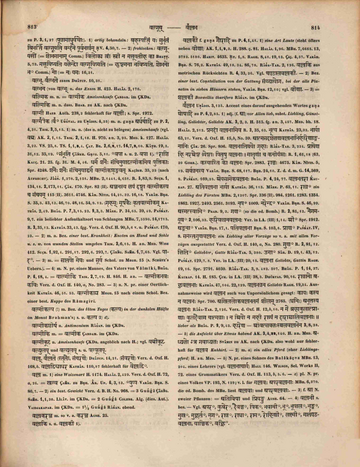
Böhtlingk 1879 adjective · substantive masculine
Original text · German · adjective · substantive masculine
vallabha — 1〉 Adj. (f. ā) — a〉 vor Allem lieb, — Jmd (Gen., Loc. oder im Comp. vorangehend), lieber als (Abl. PAÑCAT. 228,2); Subst. Liebling, Günstling, Geliebter, Geliebte. ˚turaṃga m. Lieblingspferd KĀD. 238,24. samastaguṇa˚ ein Liebling aller Vorzüge, so v. a. mit allen Vorzügen ausgestattet. Ausnahmsweise auch von Unpersönlichem gebraucht. Compar. ˚tara (Nom. abstr. ˚taratā f. KĀD. 259,15), Superl. ˚tama; am Ende [Page6-040-c] eines adj. Comp. (auch von vallabhā f.) f. ā. — b〉 *die Aufsicht über Etwas habend; nach Andern m. Kuhhirt (also fehlerhaft für ballava). — 2〉 m. — a〉 *ein edles Pferd (wohl Lieblingspferd; vgl. Chr. 323,15). — b〉 *eine Art Agallochum GAL. — c〉 N. pr. — α〉 verschiedener Männer. — β〉 Pl. eines Volkes. — 3〉 *f. ā Bez. zweier Pflanzen, = ativiṣā und priyaṅgu. — 4〉 f. ī s. bes.
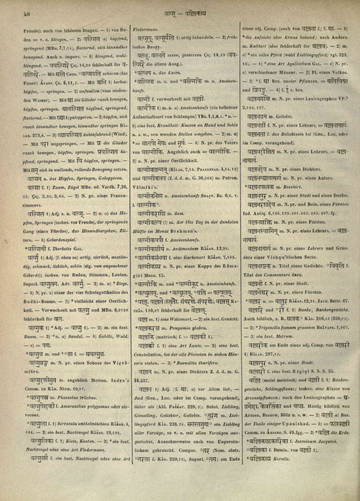
Apte 1890 adjective · substantive masculine
Original text · English · adjective · substantive masculine
vallabha a. [vall-abhac Uṇ. 3. 125] 1 Beloved, desired, dear. 2 Supreme. — bhaḥ 1 A lover, husband; (khedaḥ) tvayi vilasati tulyaṃ vallabhālokanena Māl. 3. 8; Śi. 11. 33. 2 A favourite; Pt. 1. 53. 3 A superintendent, an overseer. 4 A chief herdsman. 5 A good horse (one with auspicious marks). — bhā A beloved female, mistress, wife; bahuvallabhā rājānaḥ śrūyaṃte Ś. 3; Mu. 3. 9. Comp. — ācāryaḥ N. of the celebrated founder of a Vaiṣṇava sect. — pālaḥ a groom.
Cappeller 1887 Word type unspecified
Original text · German · Word type unspecified
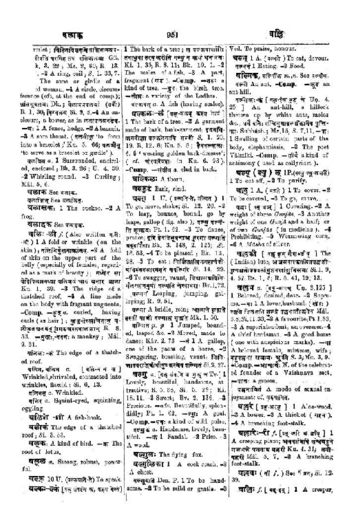
vallabha liebst, lieber als (Abl.), beliebt bei (Loc. 0. Gen.). m. Liebling, Günstling; f. ā Geliebte, Favoritin.
Burnouf 1866 adjective
Original text · French · adjective
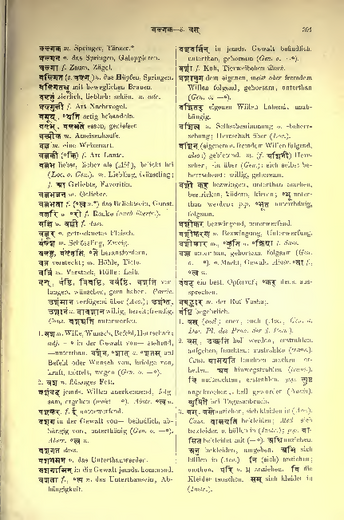
vallabha vallabha a. aimé, chéri, cher. Supérieur, surveillant. — S. m. ami, amant, mari. Chef, surintendant, surveillant; chef de bergers; cheval de race. — S. f. amie, amante, épouse. vallabhapālaka m. palefrenier.
Occurrences in source texts (10)
HP 1 occurrence
SiSa 9 occurrences
SiSa 2.13-2.20: Suṣumṇā und Citrā 2 occurrences
Direct occurrences
SiSa 5.38-5.47: Nāda-Laya 2 occurrences
Direct occurrences
SiSa 5.156-5.181: Sahasrāra 3 occurrences
Direct occurrences
-
SiSa 5.160 Segment 7
-
SiSa 5.180 Segment 8
-
SiSa 5.181 Segment 7
Continue with AYI Free
Image source: AYI archive.