
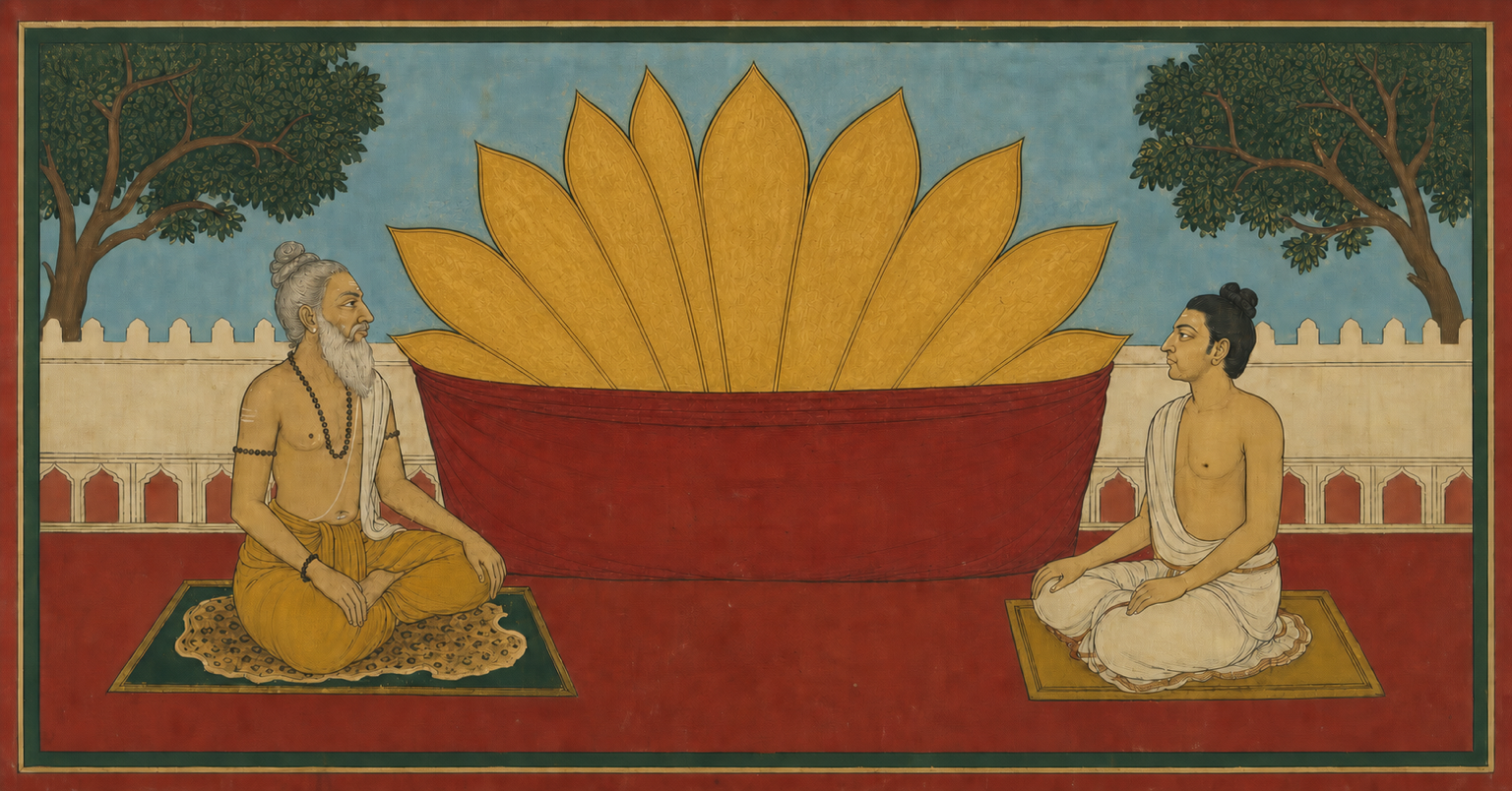
Illustration for the Haṭha Pradīpikā section “HP 3.6-3.9: The Ten Mudrās”.

Haṭha Pradīpikā 3.6-3.9: Ten Mudrās and Secrecy

The ten Mudrās are enumerated, framed as a divine transmission, and introduced as a practice to be kept secret.

Dr. Ronald Steiner Dr. Ronald Steiner
Haṭha Pradīpikā 3.6
महामुद्रा महाबन्धो महावेधश्च खेचरी |
mahā-mudrā mahā-bandho; mahā-vedhaś ca khecarī | Analysis ▾ Analysis ▴
mahā
karmadhāraya-compound
adjective
great
mudrā
nominative singular
substantive feminine
mudrā, seal
mahā
karmadhāraya-compound
adjective
great
bandhaḥ
nominative singular
substantive masculine
bandha, lock
mahā
karmadhāraya-compound
adjective
great
vedhaḥ
nominative singular
substantive masculine
piercing
ca
particle
and
khecarī
nominative singular
substantive feminine
Khecarī
उड्डीयाणं मूलबन्धस्ततो जालन्धराभिधः ||6||
uḍḍīyāṇaṃ, mūla-bandhas; tato jālandharābhidhaḥ ||6|| Analysis ▾ Analysis ▴
uḍḍīyāṇam
nominative singular
substantive neuter
Uḍḍīyāṇa
mūla
tatpuruṣa-compound genitive
substantive neuter
root
bandhaḥ
nominative singular
substantive masculine
bandha, lock
tataḥ
adverb
afterward, then
jālandhara
tatpuruṣa-compound genitive
substantive neuter
Jālandhara
abhidhaḥ
nominative singular masculine
adjective
called, designated
Metre: Anuṣṭubh
Mahāmudrā (mahā-mudrā | nom sg), Mahābandha (mahā-bandhaḥ | nom sg), Mahāvedha (mahā-vedhaḥ | nom sg), and (ca) Khecarī (khecarī | nom sg); Uḍḍīyāṇa (uḍḍīyāṇam | nom sg), Mūlabandha (mūla-bandhaḥ | nom sg), and afterwards (tataḥ) the [lock] called Jālandhara (jālandhara-abhidhaḥ | nom sg m),
Dr. Ronald Steiner - 2026 - historically literal
The practices named are Mahāmudrā, Mahābandha, Mahāvedha, Khecarī, Uḍḍīyāṇa, Mūlabandha, and Jālandhara Bandha.
Dr. Ronald Steiner - 2026 - modern transfer
uḍḍīyāṇaṃ mūlabandhas tato MBHDL2026 ] uḍḍīyānaṃ mūlabandhaś ca bandho NS1882
Critical Apparatus
Mahâ Mudrâ, Mahâ Bandha, Mahâ Vedha, Khecharî, Uḍḍiyâna Bandha, Mûla Bandha, Jâlandhara Bandha.
Pancham Sinh - 1915
Maha Mudra, Maha Bandha, Maha Vedha, Khechari, Uddiyana, Mula and Jalandhara Bandha, Viparitakarani, Vajroli and Shakti Chalana, these are the ten Mudras that destroy old-age and death.
Srinivasa Iyangar - 1893
Mahamudra, Mahabandha, Mahavedha, Khecarî, Udyana, Mûlabandha und der Jalandhara genannte Bandha.
Hermann Walter - 1893
Haṭha Pradīpikā 3.7
करणी विपरीताख्या वज्रोली शक्तिचालनम् |
karaṇī viparītākhyā; vajrolī śakti-cālanam | Analysis ▾ Analysis ▴
karaṇī
nominative singular
substantive feminine
karaṇī, technique
viparīta
karmadhāraya-compound past participle passive
previx
previx
verbal root
inverted
ākhyā
nominative singular feminine
adjective
called
vajrolī
nominative singular
substantive feminine
Vajrolī
śakti
tatpuruṣa-compound genitive
substantive feminine
śakti, power, goddess
cālanam
nominative singular
substantive neuter
moving, stimulating
इदं मुद्रादिदशकं जरामरणनाशनम् ||7||
idaṃ mudrādi-daśakaṃ; jarā-maraṇa-nāśanam ||7|| Analysis ▾ Analysis ▴
idam
nominative singular neuter
pronoun dem
this
mudrā
tatpuruṣa-compound genitive
substantive feminine
mudrā
ādi
tatpuruṣa-compound genitive
substantive neuter
and so forth
daśakam
nominative singular
substantive neuter
group of ten
jarā
dvandva-compound
substantive feminine
age
maraṇa
tatpuruṣa-compound genitive
substantive neuter
death
nāśanam
nominative singular
substantive neuter
destruction
Metre: Anuṣṭubh
the technique (karaṇī | nom sg) called inverted (viparīta-ākhyā | nom sg f), Vajrolī (vajrolī | nom sg), and moving Śakti (śakti-cālanam | nom sg): this (idam | nom sg n) group of ten mudrās and other practices (mudrā-ādi-daśakam | nom sg) destroys old age and death (jarā-maraṇa-nāśanam | nom sg).
Dr. Ronald Steiner - 2026 - historically literal
Together with Viparīta Karaṇī, Vajrolī, and Śakti Cālana, they form a group of ten practices said to overcome old age and death.
Dr. Ronald Steiner - 2026 - modern transfer
mudrādidaśakaṃ MBHDL2026 ] hi mudrādaśakaṃ NS1882
Critical Apparatus
Viparîta Karaṇî, Vajroli, and Śakti Châlana. These are the ten Mudrâs which annihilate old age and death.
Pancham Sinh - 1915
Die Viparîtâ genannte Uebung, Vajrolî und Şakticâlana; dies sind die zehn Krankheit und Tod besiegenden Mudra.
Hermann Walter - 1893
Haṭha Pradīpikā 3.8
आदिनाथोदितं दिव्यम् अष्टैश्वर्यप्रदायकम् |
ādi-nāthoditaṃ divyam; aṣṭaiśvarya-pradāyakam | Analysis ▾ Analysis ▴
ādi
karmadhāraya-compound
adjective
original, first
nātha
tatpuruṣa-compound instrumental case
substantive masculine
lord
uditam
nominative singular neuter past participle passive
verbal root
taught, stated
divyam
nominative singular neuter
adjective
divine
aṣṭa
dvigu-compound
numeral
eight
aiśvarya
tatpuruṣa-compound accusative
substantive neuter
dominion, supernatural power
pradāyakam
nominative singular neuter
adjective
bestowing
वल्लभं सर्वसिद्धानां दुर्लभं मरुतामपि ||8||
vallabhaṃ sarva-siddhānāṃ; durlabhaṃ marutām api ||8|| Analysis ▾ Analysis ▴
vallabham
nominative singular neuter
adjective
dear, precious
sarva
karmadhāraya-compound
adjective
all
siddhānām
genitive plural
substantive masculine
siddhas
durlabham
nominative singular neuter
adjective
difficult to attain
marutām
genitive plural
substantive neuter
of gods, winds
api
particle
even
Metre: Anuṣṭubh
Taught by the primordial Lord (ādi-nātha-uditam | nom sg n ppp), divine (divyam | nom sg n), bestowing the eight supernatural powers (aṣṭa-aiśvarya-pradāyakam | nom sg n), cherished (vallabham | nom sg n) by all adepts (sarva-siddhānām | gen pl), it is difficult to obtain (durlabham | nom sg n), even (api) for the gods (marutām | gen pl).
Dr. Ronald Steiner - 2026 - historically literal
This teaching is regarded as revealed by Ādinātha, divine, bestowing Siddhi, esteemed by the Siddhas, and difficult even for gods to obtain.
Dr. Ronald Steiner - 2026 - modern transfer

Brahmānanda explains the eight promised Aiśvaryas, extraordinary abilities, individually:

  • Aṇimā: making the body as small as an atom.
  • Mahimā: assuming extraordinary size.
  • Garimā: becoming very heavy.
  • Laghimā: becoming very light.
  • Prāpti: reaching even what is far away.
  • Prākāmya: realizing a wish without obstruction.
  • Īśatā: controlling the arising and dissolution of the elements.
  • Vaśitva: bringing the elements and their products under one's power.
Brahmānanda's Jyotsnā - 19th c.
They have been explained by Âdi Nâtha (Śiva) and give eight kinds of divine wealth. They are loved by all the Siddhas and are hard to attain even by the Marutas.
Pancham Sinh - 1915
These were given out by Siva and confer the eight Siddhis. They are much sought after by all Siddhas and are difficult to obtain even by the Dévas.
Srinivasa Iyangar - 1893
Diese von Siva (adinatha, Text) verkündigten wunderbaren Uebungen, welche die acht übernatürlichen Kräfte (ashtaisvarya) verleihen, bei allen Vollendeten besonders beliebt und selbst von den Marut schwer zu erreichen sind,
Hermann Walter - 1893
Haṭha Pradīpikā 3.9
गोपनीयं प्रयत्नेन यथा रत्नकरण्डकम् |
gopanīyaṃ prayatnena; yathā ratna-karaṇḍakam | Analysis ▾ Analysis ▴
gopanīyam
nominative singular neuter future participle passive
verbal root
to be concealed
prayatnena
instrumental case singular
substantive masculine
carefully
yathā
adverb
like
ratna
tatpuruṣa-compound genitive
substantive neuter
jewel
karaṇḍakam
nominative singular
substantive neuter
box, casket
कस्यचिन्नैव वक्तव्यं कुलस्त्रीसुरतं यथा ||9||
kasyacin naiva vaktavyaṃ; kula-strī-surataṃ yathā ||9|| Analysis ▾ Analysis ▴
kasyacit
genitive singular masculine
pronoun
to anyone
na
particle
not
eva
particle
indeed
vaktavyam
nominative singular neuter future participle passive
verbal root
to be said, communicated
kula
tatpuruṣa-compound genitive
substantive neuter
family, good lineage
strī
tatpuruṣa-compound genitive
substantive feminine
woman
suratam
nominative singular
substantive neuter
sexual union
yathā
adverb
like
Metre: Anuṣṭubh
It should be concealed (gopanīyam | nom sg n pfp) with care (prayatnena | ins sg), like (yathā) a jewel casket (ratna-karaṇḍakam | nom sg); it must never (na eva) be told (vaktavyam | nom sg n pfp) to any person (kasyacit | gen sg m), like (yathā) sexual union with a woman of good family (kula-strī-suratam | nom sg).
Dr. Ronald Steiner - 2026 - historically literal
The teaching of Mudrā is to be guarded strictly, like a casket full of jewels and an intimate secret.
Dr. Ronald Steiner - 2026 - modern transfer
These Mudrâs should be kept secret by every means, as one keeps one's box of jewellery, and should, on no account be told to any one, just as husband and wife keep their dealings secret.
Pancham Sinh - 1915
This should be carefully kept secret as a box of diamonds and should not be told to anybody, just as an illicit connection with a married woman of noble family.
Srinivasa Iyangar - 1893
müssen sorgfältig geheim gehalten werden gleich einem Juwelenkorb; wie über den Liebesgenuss mit einem Weib aus guter Familie soll man gegen Andere darüber nicht sprechen.
Hermann Walter - 1893

Continue with AYI Free

Illustrations: AI-generated.

Editor

Dr. Ronald Steiner

From Ulm

The "Yoga Doc" - Dr. Ronald Steiner is the founder of the AYI method. This method links traditional Ashtanga Yoga with innovative Yogatherapy and living Philosophy. This forms a practice that is personal for each and... more ›

Messages and ratings
0 messages

Please log in to write a message. Go to login

No messages yet.