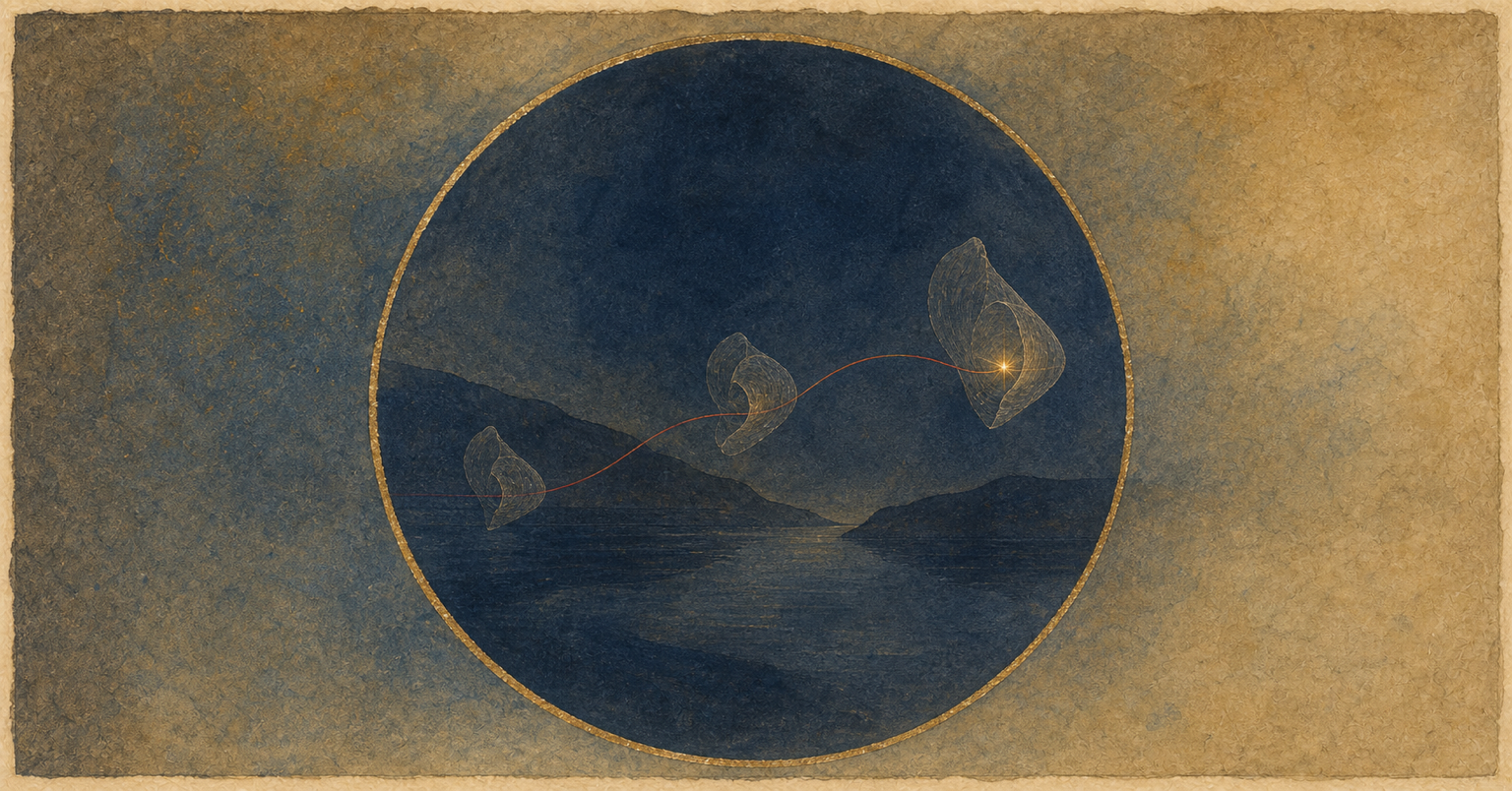
Three translucent forms linked by a red thread travel through a circle framed in gold.

Śvetāśvatara Upaniṣad 5: Sovereignty, the Self, and Freedom

The chapter contrasts the Lord of the world with the individual self wandering under karma and the guṇas, and traces its liberation to the knowledge of God.

Dr. Ronald Steiner Dr. Ronald Steiner Nils Jacob Liersch Nils Jacob Liersch
SVU 5.1–5.6: The Lord of Cosmic Origins

SVU 5.1–5.6: Knowledge, Creation, and Divine Sovereignty

Knowledge and ignorance rest in supreme Brahman; God, distinct from them both, unfolds sources and forms while remaining hidden in the Upaniṣads.

Śvetāśvatara Upaniṣad 5.1
Metre: Pāda 1: Triṣṭubh with Vajrā ending; Pāda 2: Triṣṭubh with Śālinī ending; Pāda 3: Triṣṭubh with Vajrā ending; Pāda 4: Triṣṭubh with Śālinī ending
The two (dve | nom du f)—knowledge and ignorance—are deposited in the imperishable (akṣare | loc sg n), in supreme Brahman (brahma-pare | loc sg n), indeed (tu), in the infinite (anante | loc sg n). Knowledge and ignorance (vidyāvidye | nom du) lie hidden (nihite | nom du f ppp) there where (yatra) [all rests] in concealment (gūḍhe | loc sg n ppp). Ignorance (avidyā | nom sg), however (tu), is perishable (kṣaram | nom sg n), for (hi) knowledge (vidyā | nom sg), by contrast (tu), is immortal (amṛtam | nom sg n). Whoever (yaḥ | nom sg m) rules (īśate | 3p sg med pres) over knowledge and ignorance (vidyāvidye | acc du), however (tu), is other than them: he (saḥ | nom sg m) is the other (anyaḥ | nom sg m).
Dr. Ronald Steiner - 2026 - historically literal
Śvetāśvatara Upaniṣad 5.2
Metre: Pāda 1: Triṣṭubh with Vajrā ending; Pāda 2: Triṣṭubh with Śālinī ending; Pāda 3: Triṣṭubh with Śālinī ending — 12 syllables; Pāda 4: Triṣṭubh with Śālinī ending — 12 syllables
He who (yaḥ | nom sg m) rules (adhitiṣṭhati | 3p sg act pres) over every source (yonim | acc sg), source after source (yonim | acc sg), is the One (ekaḥ | nom sg m); all forms (viśvāni rūpāṇi | acc pl), the sources (yonīḥ | acc pl), and (ca) all (sarvāḥ | acc pl f) [beings are subject to him]. As for the seer (ṛṣim | acc sg), the one brought forth (prasūtam | acc sg m ppp), Kapila (kapilam | acc sg): he who (yaḥ | nom sg m) sustains (bibharti | 3p sg act pres) him (tam | acc sg m) at the beginning (agre) with forms of knowledge (jñānaiḥ | ins pl) may also (ca) behold (paśyet | 3p sg act opt) him being born (jāyamānam | acc sg m pcm).
Dr. Ronald Steiner - 2026 - historically literal
Śvetāśvatara Upaniṣad 5.3
Metre: Pāda 1: Triṣṭubh with Vajrā ending; Pāda 2: Triṣṭubh with Śālinī ending; Pāda 3: Triṣṭubh with Vajrā ending — 10 syllables; Pāda 4: Triṣṭubh with Vajrā ending
Transforming (vikurvan | nom sg m pca) each individual (ekaikaṃ | acc sg n) net (jālam | acc sg) in manifold ways (bahudhā), this deity (eṣa devaḥ | nom sg) draws [it] together (saṃharati | 3p sg act pres) in this field (asmin kṣetre | loc sg). Again (bhūyaḥ), having created [them] (sṛṣṭvā | abs), [he sets up] the lords (patayaḥ | nom pl) in the same way (tathā); as Lord (īśaḥ | nom sg), the great Self (mahātmā | nom sg) exercises (kurute | 3p sg med pres) universal (sarva | tp gen) overlordship (ādhipatyam | acc sg).
Dr. Ronald Steiner - 2026 - historically literal
Śvetāśvatara Upaniṣad 5.4
Metre: Pāda 1: Triṣṭubh with Vajrā ending; Pāda 2: Triṣṭubh with Śālinī ending; Pāda 3: Triṣṭubh with Vajrā ending; Pāda 4: Triṣṭubh with Vajrā ending
Illuminating (prakāśayan | nom sg m pca caus) all directions (sarvā diśaḥ | nom pl), upwards (ūrdhvam), downwards (adhaḥ), and (ca) across (tiryak), he shines (bhrājate | 3p sg med pres) as (yat) indeed (u) does the solar bull (anaḍvān | nom sg). Thus (evam) he (saḥ | nom sg m), the deity (devaḥ | nom sg), the glorious (bhagavān | nom sg m) and worshipful one (vareṇyaḥ | nom sg m pfp), rules over (adhitiṣṭhati | 3p sg act pres) the beings whose nature is to arise from a source (yoni-svabhāvān | acc pl), the One (ekaḥ | nom sg m).
Dr. Ronald Steiner - 2026 - historically literal
Śvetāśvatara Upaniṣad 5.5
Metre: Pāda 1: Triṣṭubh with Vajrā ending — 12 syllables; Pāda 2: Triṣṭubh with Vajrā ending; Pāda 3: Jagatī with Vaṃśa ending; Pāda 4: Triṣṭubh with Vajrā ending
The source of all (viśva-yoniḥ | nom sg) ripens (pacati | 3p sg act pres) each thing's own nature (sva-bhāvam | acc sg), whatever (yat | acc sg n) it may be (ca). He who (yaḥ | nom sg m) directs them should transform (pariṇāmayet | 3p sg act opt caus) all (sarvān | acc pl m) those that are to be ripened (pācyān | acc pl m pfp) as well (ca). The One (ekaḥ | nom sg m) rules over (adhitiṣṭhati | 3p sg act pres) all (sarvam | acc sg n) this (etat | acc sg n), the whole universe (viśvam | acc sg n). He who (yaḥ | nom sg m) orders them should assign (viniyojayet | 3p sg act opt caus) all (sarvān | acc pl m) the guṇas (guṇān | acc pl) as well (ca).
Dr. Ronald Steiner - 2026 - historically literal
Śvetāśvatara Upaniṣad 5.6
Metre: Pāda 1: Triṣṭubh with Vajrā ending; Pāda 2: Triṣṭubh with Śālinī ending — 10 syllables; Pāda 3: Jagatī with Vaṃśa ending; Pāda 4: Triṣṭubh with Śālinī ending
That (tat | acc sg n) lies hidden (gūḍham | acc sg n ppp) in the secret Upaniṣads of the Veda (veda-guhyopaniṣatsu | loc pl). Brahmā (brahmā | nom sg) knows that (tat | acc sg n); he knows it (vedate | 3p sg med pres) as the source of Brahman (brahma-yonim | acc sg). Those who (ye | nom pl m) lived formerly (pūrvam)—the gods (devāḥ | nom pl) and (ca) seers (ṛṣayaḥ | nom pl)—knew (viduḥ | 3p pl act perf) that (tat | acc sg n). They (te | nom pl m) became (babhūvuḥ | 3p pl act perf) of its very nature (tan-mayāḥ | nom pl m) and immortal (amṛtāḥ | nom pl m), indeed (vai).
Dr. Ronald Steiner - 2026 - historically literal
SVU 5.7–5.11: The Wandering Self

SVU 5.7–5.11: Karma, Embodiment, and Rebirth

Shaped by the guṇas, actions, and perceptions, the individual self appears minute, joins itself to changing bodies, and passes through new births.

Śvetāśvatara Upaniṣad 5.7
Metre: Pāda 1: Triṣṭubh with Vajrā ending; Pāda 2: Triṣṭubh with Vajrā ending; Pāda 3: Triṣṭubh with Vajrā ending; Pāda 4: Jagatī with Vaṃśa ending
Whoever (yaḥ | nom sg m) acts as the doer of deeds directed towards their fruits (phala-karma-kartā | nom sg) is connected with the guṇas (guṇānvayaḥ | nom sg). Of the deed performed (kṛtasya | gen sg n ppp), of that very deed (tasya | gen sg n), he (saḥ | nom sg m) is indeed (eva) also (ca) the experiencer (upabhoktā | nom sg). He (saḥ | nom sg m), having every form (viśva-rūpaḥ | nom sg m bv), possessing the three guṇas (tri-guṇaḥ | nom sg m dg), travelling the three paths (tri-vartmā | nom sg m dg), is the lord of the vital forces (prāṇādhipaḥ | nom sg); he wanders (saṃcarati | 3p sg act pres) through his own actions (sva-karmabhiḥ | ins pl).
Dr. Ronald Steiner - 2026 - historically literal
Śvetāśvatara Upaniṣad 5.8
Metre: Triṣṭubh with Vajrā ending
The one who (yaḥ | nom sg m) [appears] thumb-sized (aṅguṣṭha-mātraḥ | nom sg m), sun-like in form (ravi-tulya-rūpaḥ | nom sg m bv), and endowed with intention and ego-consciousness (saṃkalpāhaṃkāra-samanvitaḥ | nom sg m ppp) is, on account of the intellect (buddheḥ | gen sg), through its limiting quality (guṇena | ins sg), and through the limiting quality of the self (ātma-guṇena | ins sg), also (ca) indeed (eva) seen (dṛṣṭaḥ | nom sg m ppp) as the lower one (avaraḥ | nom sg m), fine as the point of an awl (ārāgra-mātraḥ | nom sg m), for (hi) that is how he too (api) appears.
Dr. Ronald Steiner - 2026 - historically literal
Śvetāśvatara Upaniṣad 5.9
Metre: Anuṣṭubh
Of the hundredth part of the tip of a hair (vālāgra-śata-bhāgasya | gen sg), further imagined as divided a hundredfold (śatadhā kalpitasya | gen sg m ppp) as well (ca), one part (bhāgaḥ | nom sg) is the individual self (jīvaḥ | nom sg). It (saḥ | nom sg m) is to be known (vijñeyaḥ | nom sg m pfp); it (saḥ | nom sg m) is also (ca) fitted (kalpate | 3p sg med pres) for infinity (ānantyāya | dat sg).
Dr. Ronald Steiner - 2026 - historically literal
Śvetāśvatara Upaniṣad 5.10
Metre: Anuṣṭubh
This one (eṣaḥ | nom sg m) is neither (naiva) woman (strī | nom sg) nor (na) man (pumān | nom sg); and (ca) this very (eva) one (ayam | nom sg m) is not (na) neuter (na-puṃsakaḥ | nom sg m) either. Whichever particular body (yad yac charīram | acc sg) it takes on (ādatte | 3p sg med pres), with that (tena | ins sg n), with that very body (tena | ins sg n), it (saḥ | nom sg m) is joined (yujyate | 3p sg pas pres).
Dr. Ronald Steiner - 2026 - historically literal
Śvetāśvatara Upaniṣad 5.11
Metre: Pāda 1: Triṣṭubh with Vajrā ending; Pāda 2: Triṣṭubh with Vajrā ending — 12 syllables; Pāda 3: Triṣṭubh; Pāda 4: Jagatī with Vaṃśa ending
Through the delusions of intention, touch, and sight (saṃkalpana-sparśana-dṛṣṭi-mohaiḥ | ins pl), and (ca) through the supply of food and water (grāsāmbu-vṛṣṭyā | ins sg), [arise] the body's growth and birth (ātma-vivṛddhi-janma | nom sg). In succession (anukrameṇa | ins sg), the embodied self (dehī | nom sg) fully enters (abhisaṃprapadyate | 3p sg med pres) forms (rūpāṇi | acc pl) in different places (sthāneṣu | loc pl), [forms] corresponding to its actions (karmānugāni | acc pl n).
Dr. Ronald Steiner - 2026 - historically literal
SVU 5.12–5.14: Knowledge and Freedom

SVU 5.12–5.14: Embodiment, Knowledge of God, and Liberation

The self assumes new forms in keeping with its dispositions; whoever knows the bodiless Creator who encompasses all is released from fetters and the body.

Śvetāśvatara Upaniṣad 5.12
Metre: Triṣṭubh with Vajrā ending
The embodied self (dehī | nom sg) chooses (vṛṇoti | 3p sg act pres) many (bahūni | acc pl n) forms (rūpāṇi | acc pl), gross (sthūlāni | acc pl n) and subtle (sūkṣmāṇi | acc pl n) alike (caiva), through its own qualities (sva-guṇaiḥ | ins pl). Through the qualities of its actions (kriyā-guṇaiḥ | ins pl) and (ca) the qualities of the self (ātma-guṇaiḥ | ins pl), a further (aparaḥ | nom sg m) cause of their (teṣām | gen pl n) conjunction (saṃyoga-hetuḥ | nom sg) is also (api) seen (dṛṣṭaḥ | nom sg m ppp).
Dr. Ronald Steiner - 2026 - historically literal
Śvetāśvatara Upaniṣad 5.13
Metre: Pāda 1: Triṣṭubh with Vajrā ending; Pāda 2: Triṣṭubh with Vajrā ending; Pāda 3: Triṣṭubh with Vajrā ending — 10 syllables; Pāda 4: Triṣṭubh with Śālinī ending
Having known (jñātvā | abs) as God (devam | acc sg) the beginningless (anādi | acc sg m) and endless one (anantam | acc sg m), the creator (sraṣṭāram | acc sg) of the universe (viśvasya | gen sg n) in the midst (madhye | loc sg) of the confused mass (kalilasya | gen sg), the one of many forms (aneka-rūpam | acc sg m bv), the one (ekam | acc sg m) who envelops (pariveṣṭitāram | acc sg) the universe (viśvasya | gen sg n), one is released (mucyate | 3p sg pas pres) from all fetters (sarva-pāśaiḥ | ins pl).
Dr. Ronald Steiner - 2026 - historically literal
Śvetāśvatara Upaniṣad 5.14
Metre: Anuṣṭubh
Those who (ye | nom pl m) have known (viduḥ | 3p pl act perf) God (devam | acc sg)—the one apprehensible through inner realisation (bhāva-grāhyam | acc sg m pfp), called bodiless (anīḍākhyaṃ | acc sg m), producing existence and non-existence (bhāvābhāva-karaṃ | acc sg m), auspicious (śivam | acc sg m), and producing the creation of the parts (kalā-sarga-karam | acc sg m)—they (te | nom pl m) have left (jahuḥ | 3p pl act perf) the body (tanum | acc sg).
Dr. Ronald Steiner - 2026 - historically literal

Continue with AYI Free

Illustrations: AI-generated.

Editor

Dr. Ronald Steiner

From Ulm

The "Yoga Doc" - Dr. Ronald Steiner is the founder of the AYI method. This method links traditional Ashtanga Yoga with innovative Yogatherapy and living Philosophy. This forms a practice that is personal for each and... more ›

Nils Jacob Liersch

Meine Begeisterung für Yoga, indische Philosophie und Sanskrit führte mich zum Studium der Indologie und Religionswissenschaft an der Universität Heidelberg. Seit 2004 befinde ich mich auf meinem persönlichen Yogaweg... more ›