

ṛ ऋ – gehen; erreichen
Partikel · Verbalwurzel · Substantiv Feminin · Worttyp nicht bestimmt · Verb
Wörterbuchquellen
AYI Wörterbuch Verbalwurzel
gehen; erreichen
Cappeller 1891 Verb
Originaltext · Englisch · Verb
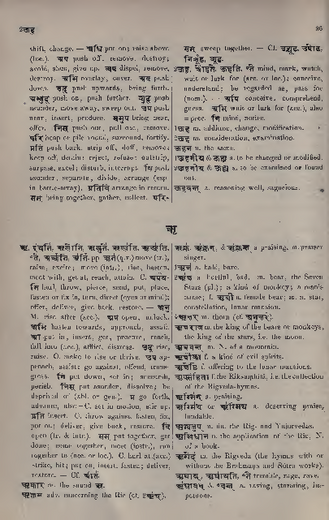
ṛ íyarti ṛṇóti ṛṇuté ṛṇváti ṛccháti ṛcchá°te arcchati árti ·v pp ṛtá (q.v.) move (tr.), raise, excite; move (intr.), rise, hasten, meet with, get at, reach, attain. C. arpáyati hurl, throw, pierce, send, put, place, fasten or fix in, turn, direct (eyes or mind); offer, deliver, give back, restore. -- anu M. rise after (acc.). apa open, unlock. abhi hasten towards, approach, assail. ā put in, insert, get, procure, reach, fall into (acc.), afflict, distress. ud rise, raise. C. make to rise or thrive. upa approach, assist; go against, offend, transgress. ni put down, set in; succumb, perish. nis put asunder, dissolve; be deprived of (abl. or gen.). pra go forth, advance, also = C. set in motion, stir up. prati insert. C. throw against, fasten, fix, put on; deliver, give back, restore. vi open (tr. & intr.). sam put together, get done; come together, meet (instr.), run together to (acc. or loc.). C. hurl at (acc.) strike, hit; put on, insert, fasten; deliver, restore. -- Cf. ā́rta.
Monier-Williams 1872 Partikel · Substantiv Feminin · Worttyp nicht bestimmt · Verb
Originaltext · Englisch · Partikel
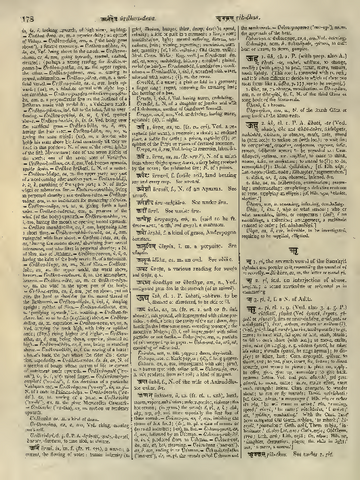
ṛ 2 . ṛ, ind. an interjection of abuse, laughter; a sound inarticulate or reiterated as in stammering.
Originaltext · Englisch · Substantiv Feminin
ṛ 3 . ṛ, ā, f. a N. of Aditi.
Originaltext · Englisch · Worttyp nicht bestimmt
ṛ 1 . ṛ, the seventh vowel of the Sanskrit alphabet and peculiar to it, resembling the sound of ri in (merṛly).
Originaltext · Englisch · Verb
ṛ 4 . ṛ, cl. 1. 9. (Ved. also 3. 4. 5. P.) ṛcchati, ṛṇāti (Ved. iyarti, āryate, ṛ- ṇoti or ṛṇvati), āra or arāñ-cakāra, ariṣyati or arīṣyati (?), ārat, artum, aritum or arītum (?), (Ved. 3rd pl. impf. ranta), to rise, tend upwards; to go, move; to meet with, fall upon or into, reach, obtain; to fall to one's share (with acc.); to move, excite, raise, raise (in singing, e. g. vācam iyarti, he raises his voice; stomān iyarti, he sings hymns); to dis- play; to injure, hurt: Caus. arpayati, -yitum, to throw, cast; to put, place, insert, fix, fasten; to direct towards, cast upon; to pierce; to place on, apply; to offer, give, give up, surrender; to give back, restore: Intens. Ved. 2nd pers. alarṣi, 3rd pers. alarti, to move, come; strive, make effort, exert one's strength: Intens. Class. arāryate, to wander about; to run or fly towards: Desid. aririṣati; [cf. Goth. airus, ‘a messenger;’ Hib. ria or rather do ria, ‘he will come or arrive;’ ria, ‘running, speed;’ riach, ‘he came;’ riachtaim, ‘I arrive;’ ar, ‘guiding, conducting.’ With the Caus. have been compared Old Germ. arbjan, ‘to inherit;’ ki- erpit, ‘possession;’ Goth. arbi, Them. arbja, ‘in- heritance:’ cf. also Lat. aro; Goth. arja; Old Germ. erru; Lith. arù; Lith. orjû; Gr. αἴρω Hib. ar, ‘slaughter, destruction, plague, the slain in fight;’ aor, ‘a satire, a course.’]
Petersburger 1855 Partikel · Substantiv Feminin
Originaltext · Deutsch · Partikel · Substantiv Feminin
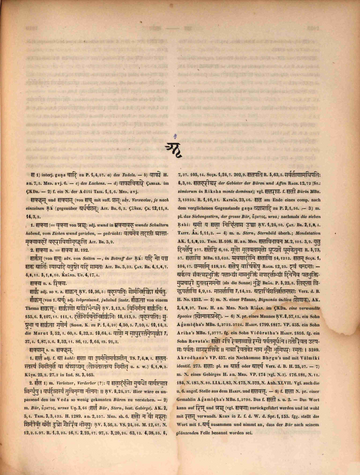
ṛ 1〉 interj. gaṇa cādi zu P. 1,4,57. a〉 des Tadels. — b〉 vākye H. an. 7,5. MED. avy. 6. — c〉 des Lachens. — d〉 vākyavikāre ŚABDAR._im_ŚKDR. — 2〉 f. ein N. der Aditi TRIK. 1,1,6. MED. avy.
Böhtlingk 1879 Partikel · Substantiv Feminin
Originaltext · Deutsch · Partikel
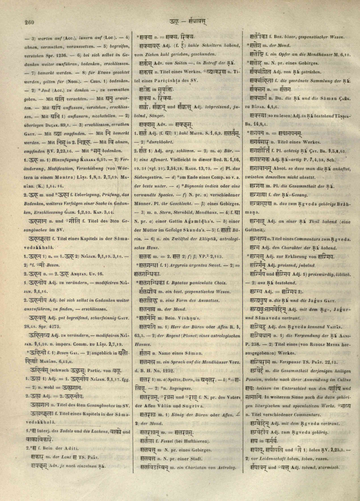
1. *ṛ Interj. des Tadels und des Lachens, vākye und vākyavikāre.
Originaltext · Deutsch · Substantiv Feminin
2. *ṛ f. Bein. der Aditi.
Whitney Roots 1885 Verbalwurzel
Originaltext · Englisch · Verbalwurzel
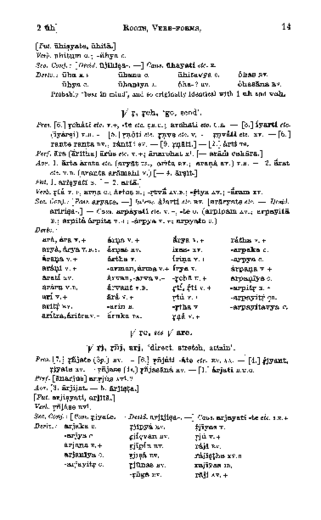
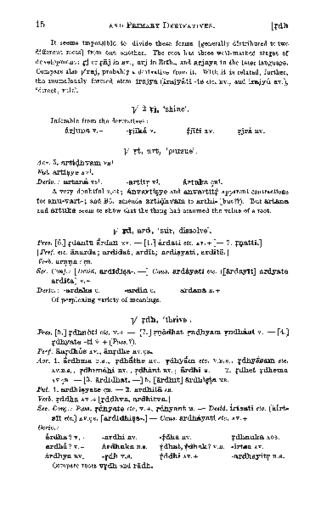
ṛ, ṛch — go, send
Apte 1890 Partikel · Verbalwurzel
Originaltext · Englisch · Partikel
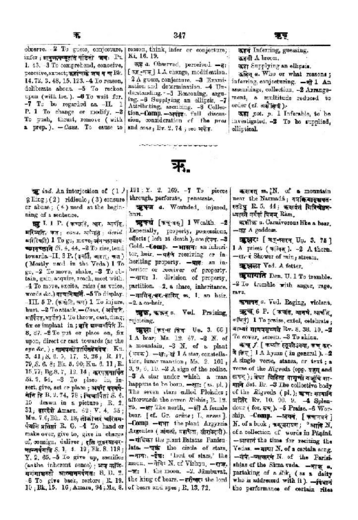
ṛ ind. An interjection of(1) calling; (2) ridicule; (3) censure or abuse; (4) used at the beginning of a sentence.
Originaltext · Englisch · Verbalwurzel
ṛ I. 1 P. (ṛcchati, āra, ārṣīt, ariṣyati, ṛta; caus. arpayati; desid. aririṣati) 1 To go, move; aṃbhaśchāyāmacchāmṛcchati Śi. 4. 44. 2 To rise, tend towards. II. 3 P. (iyarti, ārat, ṛta) (Mostly used in the Veda) 1 To go. 2 To move, shake. 3 To obtain, gain, acquire, reach, meet with. 4 To move, excite, raise (as voice, words &c.) vācamiyarti. 5 To display. III. 5 P. (ṛṇoti, ṛṇa) 1 To injure, hurt. 2 To attack. — Caus. (arpayati, ārpipat, arpita) 1 To throw, cast, fling; fix or implant in; hṛdi śalyamarpitaṃ R. 8. 87. 2 To put or place on, fix upon, direct or cast towards (as the eye &c.); vāmaprakoṣṭhārpitahemavetraḥ Ku. 3. 41; Ś. 6. 5, Ś. 6. 17, Ś. 3. 26; R. 17. 79; Ś. 6. 8; Bk. 5. 90; Ku. 6. 11; R. 15. 77; Bg. 8. 7, Bg. 12. 14; karapallavārpita Śi. 9. 54. 3 To place in, insert, give, set or place; apathe padamarpayaṃti hi R. 9. 74, R. 9. 78; citrārpitāṃ Ś. 6. 15 drawn in a picture; R. 2. 31; dvāradeśe Amaru. 62; V. 4. 35; Mu. 7. 6; Bh. 3. 18; lokottaraṃ caritamarpayati pratiṣṭhāṃ R. G. 4 To hand or make over, give to, give in charge of, consign, deliver; iti sūtasyābharaṇānyarpayati Ś. 1, Ś. 4. 19; Bk. 8. 118; Y. 2. 65. 5 To give up, sacrifice (as the inherent sense); atra kaliṃgagaṃgāśabdau ātmānamarpayataḥ S. D. 2. 6 To give back, restore; R. 19. 10; Bk. 15. 16; Amaru. 94; ([Page 0347-1b]) Ms. 8. 191; Y. 2. 169. 7 To pierce through, perforate, penetrate.
Cappeller 1887 Worttyp nicht bestimmt
Originaltext · Deutsch · Worttyp nicht bestimmt
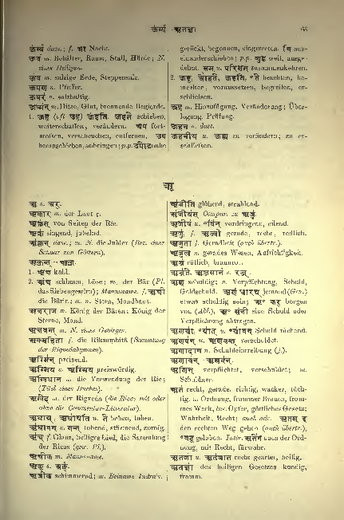
ṛ s. ar.
Burnouf 1866 Verbalwurzel · Worttyp nicht bestimmt
Originaltext · Französisch · Verbalwurzel
*ṛ ṛ. 1° [ṛcchāmi 1. de ṛcch]; p. āra, āritha, ārus; f1. artāsmi, ou aritāsmi, ou arītāsmi; f2. ariṣyāmi; a2. āram; o. aryām; a1. āriṣam. — 2° Vd.: iyarmi 2; ārye 4; ṛṇomi 5, 3p. pl. ṛṇvati. — 3° ṛṇāmi 9. — Aller; aller vers, ac.; s'avancer. Se mouvoir: iyarti reṇus la poussière s'élève, Vd. Parvenir à, obtenir: śāntim ṛcchati il atteint la béatitude; doṣam ṛcchāmi je commets une faute. Arriver, survenir: mām ārat sampad un bonheur m'est échu.
Originaltext · Französisch · Verbalwurzel
*ṛ ṛ. ṛṇomi 5; frapper, blesser, tuer. Vd. périr. Cf. ri.
Originaltext · Französisch · Worttyp nicht bestimmt
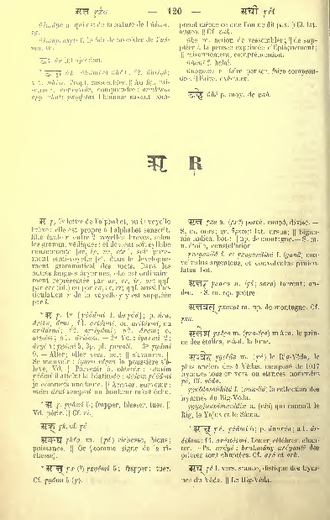
ṛ ṛ, 7ᵉ lettre de l'alphabet, ou 4ᵉ voyelle brève; elle est propre à l'alphabet sanscrit. Elle égale r entre 2 voyelles brèves, selon les gramm. védiques; et devient soit syllabe consonnante [ar, ir, ur, etc.], soit purement semi-voyelle [r], dans le développement grammatical des mots. Dans les autres langues âryennes, elle est ordinairement représentée par ar, er, ir, or; qqf. par ere (zd.) ou par ra, re, ri; qqf. aussi l'articulation r de la voyelle ṛ y est suppléée par l.
Quelltextfundstellen (1)
MAN 1 Fundstelle
Mit AYI Free weitermachen
Bildquelle: AYI Archiv.