

nāga नाग – Nāga
Adjektiv · Substantiv Maskulin · Substantiv Neutrum · Worttyp nicht bestimmt
Wörterbuchquellen
AYI Wörterbuch Substantiv Maskulin
Nāga
Cappeller 1891 Adjektiv · Substantiv Maskulin
Originaltext · Englisch · Substantiv Maskulin
nāgá1 ·m. serpent or serpent-demon; a cert. wind in the body, elephant, a man's name. f. nāgī́ a serpent-maid or fem. elephant.
Originaltext · Englisch · Adjektiv
nāga2 ·a. relating to serpents or elephants.
Monier-Williams 1872 Substantiv Maskulin
Originaltext · Englisch · Substantiv Maskulin
nāga nāga, as, m. (perhaps for original snāga; Angl. Sax. snaca; Eng. snake; or connected with naga, a mountain, or nagna, naked; said to be fr. rt. 1. dah through change of d into n), a snake in general, especially the spectacle-snake or cobra capella, Coluber; a Nāga or fabulous serpent-demon so called, having a human face with the tail of a ser- pent, (the race of these beings is said to have sprung from Kadrū, wife of Kaśyapa [or from Su-rasā], in order to people Pātāla, one of the regions below the earth, their city is called Bhoga-vatī); an elephant; a shark (= tantu-nāga); a cruel or tyrannical person; (at the end of a comp.) ‘an elephant of a man,’ any great or pre-eminent person; N. of several plants, the small tree with fragrant blossoms, Mesua Roxburghii [cf. nāga-keśara]; Rottlera Tinctoria (= pun-nāga); a Cyperus (= mustaka); Piper Betel; a poisonous plant (see nāga-stokaka); a cloud; a peg or nail projecting from a wall to hang anything upon; one of the five airs of the body, that which is expelled by eructation; N. of the number seven, (probably to be referred to seven mythical serpents, but eight principal Nāgas are mentioned); N. of a Sādhya; of a Buddhist teacher; of a king of Āryāvarta, contemporary of Samudra- gupta; N. of a dynasty consisting of nine or seven princes; N. of several men; N. of a mountain; of a district; (ī), f. a female Nāga; a female elephant; (am), n. tin; lead; one of the astronomical periods called Karaṇas, (it is one of those termed dhruva, q. v., or invariable, and corresponds to the last half of Amāvāsya or new moon); the effects of that period on anything done or happening during it; (as, ī, am), formed or consisting of snakes, serpentine, snaky; relating to serpents or serpent-demons; elephantine, belonging to or resembling an elephant; (ā), f., N. of a woman; [cf. kṣiti-n˚.]
Petersburger 1855 Adjektiv · Substantiv Maskulin · Substantiv Neutrum · Worttyp nicht bestimmt
Originaltext · Deutsch · Adjektiv
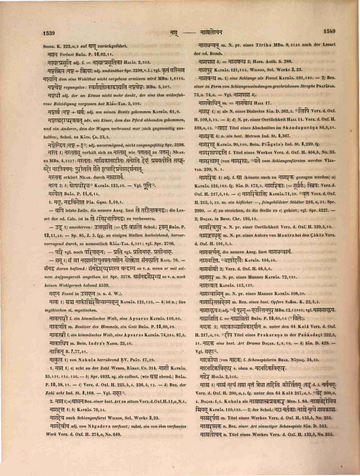
2. nāga (von 1. nāga) 1〉 adj. f. ī́ sthaulye, sonst ā P. 4,1,42. a〉 aus Schlangen gebildet, — bestehend: astra MBH. 8,2586. zu Schlangen — Schlangendämonen in Beziehung stehend; f. ā mit Ergänzung von vīthī = nāgavīthī VARĀH. BṚH. S. 9,2. — b〉 vom Elephanten kommend: mūtra SUŚR. 1,194,4. Hierher oder zu 1: nāgamāsanam eine besondere Art zu sitzen Verz. d. Oxf. H. 11,a, N. 1. nāgī gāyatrī (9 + 9 + 6 Silben) COLEBR. Misc. Ess. II, 152 (COLEBR. Misc. Ess. I, 5). Verz. d. B. H. 99,3 v. u. — 2〉 f. ā N. pr. eines Frauenzimmers RĀJA-TAR. 7,293. RĀJA-TAR. 7,1151.
Originaltext · Deutsch · Substantiv Maskulin · Substantiv Neutrum
1. nā́ga UJJVAL._zu_UṆĀDIS. 5,61. 1〉 m. a〉 Schlange TRIK. 3,3,61. H. 1312. H. an. 2,34. MED. g. 7. MED. g. 8. mahānāgamivābhisaṃsāraṃ didṛkṣitāro ye (nach SĀY. = mahāsarpa; es könnte aber auch ein Elephant gemeint sein) ŚAT. BR. 11,2,7,12. MBH. 8,2593. R. GORR. 2,25,30. VET. in LA. 16,17. In der Myth. Schlangen mit einem menschlichen Angesicht, die unter der Erde in der Stadt Bhogavatī wohnen und gewöhnlich als Kinder der Kadrū (auch Surasā) bezeichnet werden; sie werden häufig von den sarpa unterschieden. AK. 1,2,1,4. H. 1307. ĀŚV. GṚHY. 3,4. M. 1,37. MBH. 1,1076. fgg. MBH. 1,1551. fgg. MBH. 3,2617. anantaścāsmi nāgānām BHAG. 10,29. SUND. 2,8. N. 14,4. te (pāṇḍavāḥ) tayā (kṛṣṇayā) taiśca sā vīraiḥ patibhiḥ saha pañcabhiḥ . babhūva paramaprītā nāgairiva sarasvatī .. MBH. 1,7745. R. 1,5,20. R. 3,20,29. SUŚR. 1,16,16. SUŚR. 1,114,9. RAGH. 15,83. VARĀH. BṚH. S. 13,8. VARĀH. BṚH. S. 45,13. VARĀH. BṚH. S. 47,20. VARĀH. BṚH. S. 47,25. VARĀH. BṚH. S. 53,113. SŪRYAS. 12,33. KATHĀS. 22,186. RĀJA-TAR. 1,28. RĀJA-TAR. 1,30. RĀJA-TAR. 1,31. VP. 370. BHĀG. P. 1,11,12. BHĀG. P. 6,6,22. BURN. Intr. 313, N. 1. BURN. Intr. 313,317. BURN. Intr. 313,423. Lot. de la b. l. 3. LALIT. 11 u. s. w. triśīrṣā iva nāgapotāḥ HARIV. 12744. nāgībhūta RĀJA-TAR. 1,268. Nach VP. 149 N. pr. eines Nāga, aber wohl auch hier nur N. appell., welches mit elāpattra oder karkoṭa zu verbinden ist. Das f. nāgī́ (P. 4,1,42, Sch. VOP. 4,26) MBH. 1,8239. — b〉 Elephant AK. 2,8,2,2. AK. 3,4,3,22. TRIK. H. 1217. H. an. MED. pluṣi, maśaka, nāga (= hastin nach den Erklärern) ŚAT. BR. 14,4,1,24. Cit. in AIT. BR. 8,22. R. 1,6,22. R. 3,76,31. R. 5,3,19. BHARTṚ. 3,73. ŚĀK. 37. MEGH. 37. VARĀH. BṚH. S. 35,5. VARĀH. BṚH. S. 66,3. BHĀG. P. 4,15,12. Am Ende eines adj. comp. f. ā MBH. 3,12589. R. GORR. 2,106,29. nāgī́ (P. 4,1,42, Sch. VOP. 4,26) Elephantenweibchen SUŚR. 1,178,1. — c〉 = tantunāga Haifisch H. 1351. — d〉 ein grausamer Mensch H. an. MED. Wohl aus Bed. 1. hervorgegangen. — e〉 am Ende eines comp. ein Elephant von —, so v. a. ein ausgezeichneter — P. 2,1,62. AK. 3,2,9. TRIK. H. 1440. H. an. MED. go˚ P., Sch. — f〉 N. verschiedener Pflanzen: Mesua Roxburghii Wight. (vgl. nāgakeśara), ein Baum mit wohlriechenden Blüthen, H. an. MED. SUŚR. 1,171,7. SUŚR. 1,223,20. VARĀH. BṚH. S. 28,12. VARĀH. BṚH. S. 43 (34), 10. VARĀH. BṚH. S. 53,103. VARĀH. BṚH. S. 76,19. VARĀH. BṚH. S. 86,24 (105). neben puṃnāga BHĀG. P. 3,15,19. BHĀG. P. 4,6,15. BHĀG. P. 8,2,17. = puṃnāga Rottlera tinctoria Roxb. = mustaka ein Cyperus H. an. MED. Piper Betle Lin. BHAR. zu AK._im_ŚKDR. eine best. giftige Pflanze, s. u. nāgastokaka. — g〉 Wolke H. an. MED. — h〉 = nāgadantaka Pflock diess. — i〉 ein best. Wind des Körpers, der das Erbrechen hervorruft, H. an. MED. VEDĀNTAS. (Allah.) No. 55. Schliesst sich nach BALLANTYNE an Bed 1. an. — k〉 bildliche Bez. der Zahl sieben SŪRYAS. 2,20. SŪRYAS. 2,24. SŪRYAS. 8,5. SŪRYAS. 12,89. SŪRYAS. 12,90. Geht wohl auf 7 mythische Schlangen zurück. TRIK. 1,2,6 werden aber 8 Schlangenfürsten aufgeführt. — l〉 = graha (?) VAIJ. beim Schol. zu ŚIŚ. 19,45 und KIR. 3,50. — m〉 N. pr. eines Sādhya HARIV. 11537. eines buddhistischen Lehrers WASSILJEW 30. fgg. WASSILJEW 59. WASSILJEW 77. fgg. WASSILJEW 225. fg. eines Königs von Āryāvarta, Zeitgenossen des Samudragupta, LIA. II, 952. N. einer Dynastie (aus 9 oder 7 Fürsten bestehend) VP. 479; vgl. VP. 479,N. 70. N. pr. verschiedener Männer RĀJA-TAR. 7,101. RĀJA-TAR. 7,768. RĀJA-TAR. 7,1024. RĀJA-TAR. 8,2960 u. s. w. — n〉 N. pr. eines Berges VP. 169. VP. 180, N. 3. BHĀG. P. 5,16,27. einer Gegend BHAR._zu_AK. ŚKDR. — 2〉 n. a〉 Blei AK. 2,9,106. TRIK. H. 1041. H. an. MED. Zinn TRIK. H. an. MED. — Verz. d. B. H. No. 969. Verz. d. B. H. No. 971. Nach ŚKDR. masc. in medicinischen Werken. — b〉 N. des dritten festen Karaṇa (s. u. 2. karaṇa 3,m) H. an. (wo karaṇāntare st. kaṇāntare zu lesen ist) und MED. VARĀH. BṚH. S. 99,5. VARĀH. BṚH. S. 99,8. SŪRYAS. 2,67. — c〉 eine Art coitus (strībandha) H. an.; vgl. nāgapada, nāgapāśa, nāgapāśaka. — Man hat das Wort auf naga Berg zurückgeführt und sich auf nagaja Elephant dabei berufen; dieses Wort ist aber weiter nicht zu belegen und ist auch den älteren Lexicographen unbekannt. Eher liesse sich an einen etymologischen Zusammenhang mit nagna nackt (unbehaart) denken. — Vgl. kṣiti˚.
Originaltext · Deutsch · Worttyp nicht bestimmt
1. nāga 1〉a〉 acht an der Zahl WEBER, RĀMAT. UP. 314. nāgī KATHĀS. 55,151. KATHĀS. 55,154. KATHĀS. 55,156. — b〉 Spr. 4932. sg. als collect. (wie aśva ebend.) BHĀG. P. 10,58,51. — i〉 Verz. d. Oxf. H. 225,b,4. Verz. d. Oxf. H. 236,b,12. — k〉 Bez. der Zahl acht Ind. St. 8,168. — Vgl. mahā˚.
Originaltext · Deutsch · Worttyp nicht bestimmt
2. nāga 1〉a〉 āsana Bez. einer best. Art zu sitzen Verz. d. Oxf. H. 11,a, N. 1.
Originaltext · Deutsch · Worttyp nicht bestimmt
1. nāga 2〉a〉 KĀLACAKRA 5,212. KĀLACAKRA 5,217. KĀLACAKRA 5,220. eine Art Talk BHĀVAPR._im_ŚKDR. u. vajra.
Böhtlingk 1879 Adjektiv · Substantiv Maskulin · Substantiv Neutrum
Originaltext · Deutsch · Adjektiv · Substantiv Maskulin · Substantiv Neutrum
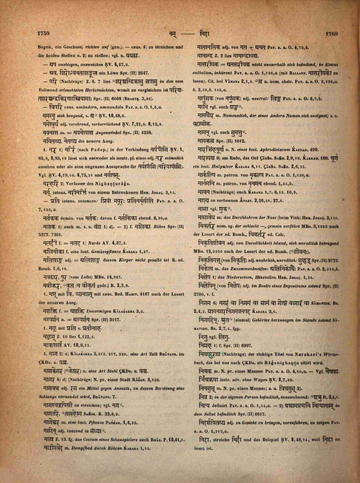
2. nāga — 1〉 Adj. (*f. ā und ī) — a〉 aus Schlangen gebildet, — bestehend, zu Schlangen —, zu Schlangendämonen in Beziehung stehend. āsana n. eine bes. Art zu sitzen. — b〉 vom Elephanten kommend. — 2〉 *m. = nāgadanta ein Pflock in der Wand zum Anhängen von Sachen. — 3〉 f. ā — a〉 = nāgavīthī ein best. Theil der Mondbahn. — b〉 N. pr. eines Frauenzimmers. — 4〉 f. ī ein best. Metrum. — 5〉 n. — a〉 Blei RĀJAN. 13,24. BHĀVAPR. 2,83. (nāṅga fehlerhaft). Zinn. Angeblich auch m. — b〉 eine Art Talk. — c〉 ein best. 2. karaṇa 4〉n〉. — d〉 *quidam coeundi modus. — e〉 N. pr. einer Abtheilung von Bhāratavarṣa GOLĀDHY. BHUV. 41.
Originaltext · Deutsch · Substantiv Maskulin
1. nāgá — 1〉 m. — a〉 Schlange. — b〉 ein Schlangendämon, ein mythisches Wesen mit einem menschlichen Gesichte. Der Sitz dieser Dämonen ist unter der Erde in der Stadt Bhogavatī und in Seen. Acht unter ihnen werden als Fürsten hervorgehoben. — c〉 Bez. der Zahl acht HEMĀDRI 1,77,5. 8. — d〉 *ein [Page3-189-b] grausamer Mensch. — e〉 (Schlange) ein best. Wind im menschlichen Körper, der das Erbrechen bewirkt Chr. 264,33. Chr. 265,3. — f〉 Elephant. Sg. auch mit collectiver Bed. Am Ende eines adj. Comp. f. ā. — g〉 *am Ende eines Comp. ein Elephant von, so v. a. ein ausgezeichneter. — h〉 *Haifisch. — i〉 *Wolke. — k〉 eine best. Pflanze PAÑCAD. nach den Lexicographen: Mesua roxburghii, Rottlera tinctoria, Piper betle, Cyperus rotundus und eine best. giftige Pflanze RĀJAN. 6,225. — l〉 N. pr. — α〉 eines Schlangendämons VP.² 2,287. 293. — β〉 eines Sādhya. — γ〉 Pl. einer Dynastie VP. 4,24,18. VP.² 4,218. fg. — δ〉 verschiedener Männer. — ε〉 eines Gebirges VP. 2,2,28. — 2〉 f. nāgī́ — a〉 f. zu 1〉b〉 SUPARṆ. 2,1. — b〉 f. zu 1〉f〉. — c〉 N. pr. der Gemahlin Saptamārgaʼs Ind. St. 14,133.
Apte 1890 Adjektiv · Substantiv Maskulin · Substantiv Neutrum
Originaltext · Englisch · Adjektiv · Substantiv Maskulin · Substantiv Neutrum
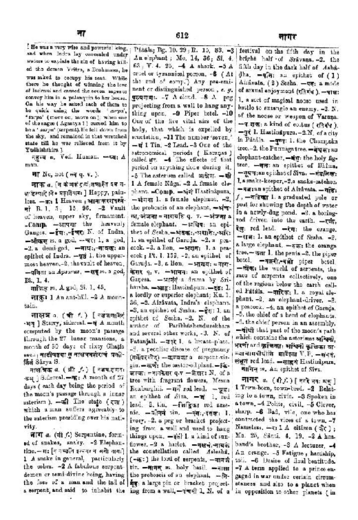
nāga a. (gī f.) 1 Serpentine, formed of snakes, snaky. 2 Elephantine. — gaḥ [na gacchati ityagaḥ na ago nāgaḥ] 1 A snake in general, particularly the cobra. 2 A fabulous serpentdemon of semi-divine being, having the face of a man and the tail of a serpent, and said to inhabit the ([Page 0612-b]) Pātāla; Bg. 10. 29; R. 15. 83. 3 An elephant; Me. 14, Me. 36; Śi. 4. 63; V. 4. 25. 4 A shark. 5 A cruel or tyrannical person. 6 (At the end of comp.) Any pre-eminent or distinguished person, e. g. puruṣanāgaḥ. 7 A cloud. 8 A peg projecting from a wall to hang anything upon. 9 Piper betel. 10 One of the five vital airs of the body, that which is expelled by eructation. 11 The number ‘seven.’ — gaṃ 1 Tin. 2 Lead. 3 One of the astronomical periods (Karaṇas) called dhruva. 4 The effects of that period on anything done during it. 5 The asterism called āśleṣā. — gī 1 A female Nāga. 2 A female elephant. Comp. — aṃgaṃ Hastināpura. — aṃganā 1 a female elephant. 2 the proboscis of an elephant. — aṃcalā, -aṃjanā = nāgayaṣṭi q. v. — aṃjanā a female elephant. — adhipaḥ an epithet of Śeṣa. — aṃtakaḥ, -arātiḥ, -ariḥ 1 an epithet of Garuḍa. 2 a peacock. 3 a lion. — aśanaḥ 1 a peacock; Pt. 1. 159. 2 an epithet of Garuḍa. 3 a lion. — ākhyaḥ = nāgakesara q. v. — ānanaḥ an epithet of Gaṇeśa. — ānaṃdaṃ a drama by Śriharsha. — āhvaḥ Hastināpura. — iṃdraḥ 1 a lordly or superior elephant; Ku. 1. 36. 2 Airāvata, Indra's elephant. 3 an epithet of Śeṣa. — īśaḥ 1 an epithet of Śeṣa. 2 N. of the author of Paribhāṣenduśekhara and several other works. 3 N. of Patañjali. — udaraṃ 1 a breast-plate. 2 a peculiar disease of pregnancy (garbhopadravabheda). — kanyakā a serpent-virgin. — karṇaḥ the castor-oil plant. — kiṃjalkaḥ = nāgakesara q. v. — kesaraḥ N. of a tree with fragrant flowers, Mesua Roxburghii. — garbhaṃ red lead. — cūḍaḥ an epithet of Śiva. — jaṃ 1 red lead. 2 tin. — jihvikā red arsenic. — jīvanaṃ tin. — daṃtaḥ, -daṃtakaḥ 1 ivory. 2 a peg or bracket projecting from a wall and used to hang things upon. — daṃtī 1 a kind of sunflower. 2 a harlot. — nakṣatraṃ, -nāyakaṃ the constellation called Āśleṣā. — (kaḥ) the lord of serpents. — nāmakaṃ tin. — nāman m. holy basil. — nāsā the proboscis of an elephant. — niryūhaḥ a large pin or bracket projecting from a wall. — paṃcamī 1 N. of a ([Page 0612-c]) festival on the fifth day in the bright half of Śrāvaṇa. 2 the fifth day in the dark half of Āshāḍha. — patiḥ an epithet of (1) Airāvata. (2) Śeṣa. — padaḥ a mode of sexual enjoyment (ratibaṃdha). — pāśaḥ 1 a sort of magical noose used in battle to entangle an enemy. 2 N. of the noose or weapon of Varuṇa. — pāśakaḥ a kind of coitus (ratibaṃdha). — puraṃ 1 Hastināpura. 2 N. of a city in Pātāla. — puṣpaḥ 1 the Campaka tree. 2 the Punnāga tree. — baṃdhakaḥ an elephant-catcher. — baṃdhuḥ the holy fig-tree. — balaḥ an epithet of Bhīma. — bhūṣaṇaḥ an epithet of Śiva. — maṃḍalikaḥ 1 a snake-keeper. 2 a snake-catcher. — mallaḥ an epithet of Airāvata. — yaṣṭiḥ f., — yaṣṭikā 1 a graduated pole or post for showing the depth of water in a newly-dug pond. 2 a boringrod driven into the earth. — raktaṃ, reṇuḥ red lead. — raṃgaḥ the orange. — rājaḥ 1 an epithet of Śeṣa. 2 a large elephant. — rukaḥ the orange tree. — latā 1 the penis 2 the piper betel. — vallarī, -vallī piper betel. — lokaḥ the world of serpents, the race of serpents collectively, one of the regions below the earth called Pātāla. — vārikaḥ 1 a royal elephant. 2 an elephant-driver. 3 a peacock. 4 an epithet of Garuḍa. 5 the chief of a herd of elephants. 6 the chief person in an assembly. — vīthī that part of the moon's path which contains the asterisms aśvinī, bharaṇī and kṛttikā; aśvinī kṛttikā yāmyānāgadīthīti śābditā V. P. — saṃbhavaṃ, saṃbhūtaṃ red lead. — sāhvayaṃ Hastināpura.
Cappeller 1887 Adjektiv · Substantiv Maskulin
Originaltext · Deutsch · Adjektiv
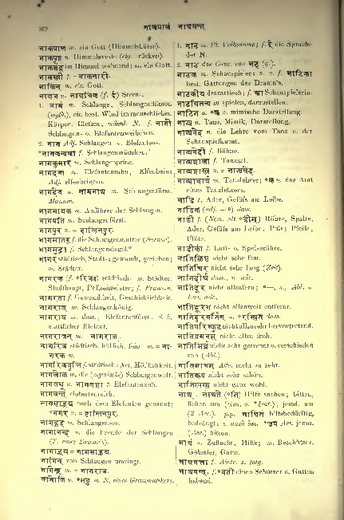
2. nāga Adj. Schlangen- o. Elefanten-.
Originaltext · Deutsch · Substantiv Maskulin
1. nāgá m. Schlange, Schlangendämon (myth.). ein best. Wind im menschlichen Körper, Elefant, männl. N. f. nāgī Schlangen o. Elefantenweibchen.
Burnouf 1866 Substantiv Maskulin
Originaltext · Französisch · Substantiv Maskulin
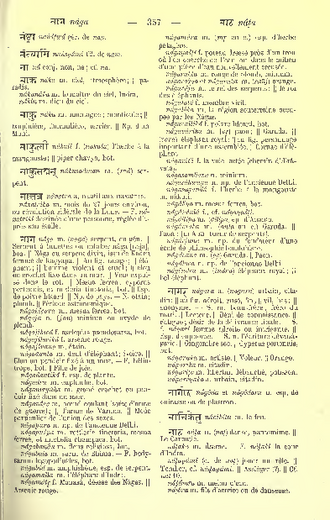
nāga nāga m. (naga) serpent, en gén. Serpent à lunettes ou coluber nāga [naja], boa. Nāga ou serpent divin, issu de Kadru femme de Kaśyapa. Au fig. nuage; éléphant; homme violent et cruel; clou ou crochet fixé dans un mur. Vent expulsé dans le rot. Mesua ferrea, cyperus pertenuis, et rottleria tinctoria, bot. Esp. de poivre bâtard. Np. de pays. — N. étain; plomb. Période astronomique. nāgakeśara m. mesua ferrea, bot. nāgaja n. (jan) minium ou oxyde de plomb. nāgajihvā f. asclepias pseudosarsa, bot. nāgajhvikā f. arsenic rouge. nāgajivana m. étain. nāgadanta m. dent d'éléphant; ivoire. Clou ou pendoir fixé à un mur. — F. héliotrope, bot. Fille de joie. nāgadantikā f. esp. de plante. nāgadru m. euphorbe, bot. nāganiryūha m. grand crochet ou pendoir fixé dans un mur. nāgapāśa m. nœud coulant [sorte d'arme de guerre]; Farme de Varuṇa. Mode particulier de l'union des sexes. nāgapura n. np. de l'ancienne Delhi. nāgapuṣpa m. rottleria tinctoria, mesua ferrea, et michelia champaca, bot. nāgabandhu m. ficus religiosa, bot. nāgabala m. surn. de Bhīma. — F. hedysarum logopodioïdes, bot. nāgabhid m. amphisbène, esp. de serpent. nāgamalla m. l'éléphant d'Indra. nāgamātṛ f. Manasā, déesse des Nāgas. Arsenic rouge. [Page357-2] nāgamāra m. (mṛ au c.) esp. d'herbe potagère. nāgayaṣṭi f. poteau dressé près d'un trou où l'on cherche de l'eau ou dans le milieu d'une pièce d'eau nouvellement creusée. nāgarakta m. rouge de plomb, minium. nāgaraṅga et nāgaraka m. (rañj) orange. nāgarāja m. le roi des serpents; le roi des éléphants. nāgalatā f. membre viril. nāgaloka m. la région souterraine occupée par les Nāgas. nāgavallikā f. poivre bâtard, bot. nāgavārika m. (vṛ) paon; Garuḍa. (vara) éléphant royal; au fig. personnage important d'une assemblée. Cornac d'éléphant. nāgavīthī f. la voie lactée [chemin d'Airāvata]. nāgasambhava n. minium. nāgasāhvaya n. np. de l'ancienne Delhi. nāgasugandhā f. l'herbe à la mangouste ou nākulī. nāgākhya m. mesua ferrea, bot. nāgāñcalā f., cf. nāgayaṣṭi. nāgādhipa m. (adhipa) ép. d'Ananta. nāgāntaka m. (anta) au c.) Garuḍa. Paon; [m à m. tueur de serpents]. nāgārjuna m. np. du fondateur d'une école de philosophie bouddhiste. nāgāśana m. (aś) Garuḍa. Paon. nāgāhva n. np. de l'ancienne Delhi. nāyendra m. (indra) éléphant royal; bel élephant.
Quelltextfundstellen (5)
HP 1 Fundstelle
MAN 1 Fundstelle
Mit AYI Free weitermachen
Bildquelle: AYI Archiv.