

pañcama पञ्चम – fünfter
Adjektiv · Substantiv Maskulin · Substantiv Neutrum · Worttyp nicht bestimmt
Wörterbuchquellen
AYI Wörterbuch Adjektiv
fünfter
Cappeller 1891 Worttyp nicht bestimmt
Originaltext · Englisch · Worttyp nicht bestimmt
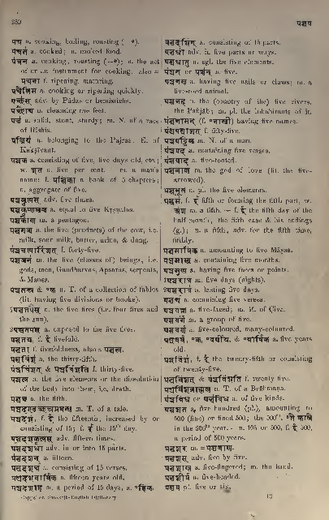
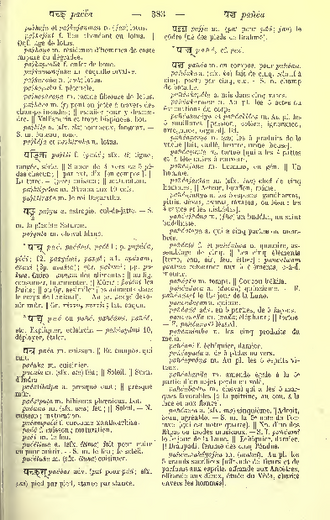
pañcamá ·f. ī́ fifth or forming the fifth part, w. aṃśa m. a fifth. --f. ī the fifth day of the half month, the fifth case & his endings (g.); n. a fifth, adv. for the fifth time, fifthly.
Monier-Williams 1872 Adjektiv
Originaltext · Englisch · Adjektiv
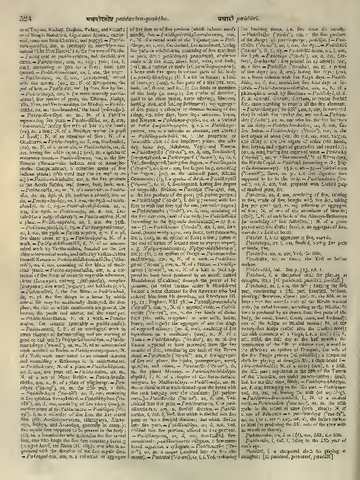
Pañcama, as, ī, am, the fifth; forming the fifth part, constituting a fifth part, beautiful, brilliant, pleasing; dexterous, clever; (as), m. the fifth or in later times the seventh note of the Hindū musical scale, (so called because, according to the Hindūs, its tone is produced by air drawn from five parts of the body, the navel, breast, throat, heart, and forehead); one of the Rāgas or musical modes; N. of the twenty-first Kalpa (called after the musical note); the fifth consonant of a Varga, i. e. a nasal; (ī), f., scil. tithi, the fifth day of the half month; the termination of the fifth or ablative case, a word in the ablative; an epithet of Draupadī, the wife of the five Pāṇḍu princes [cf. pāñcālī]; a chequered cloth for playing at draughts &c., a chess-board (= śāri-śṛṅkhalā); N. of a river; (am), n. a fifth, the fifth part; copulation as the fifth of the Tattvas of the Tāntrikas, see under pañca-tattva; (am), ind. for the fifth time, fifthly.
Petersburger 1855 Adjektiv · Substantiv Maskulin · Substantiv Neutrum · Worttyp nicht bestimmt
Originaltext · Deutsch · Adjektiv · Substantiv Maskulin · Substantiv Neutrum
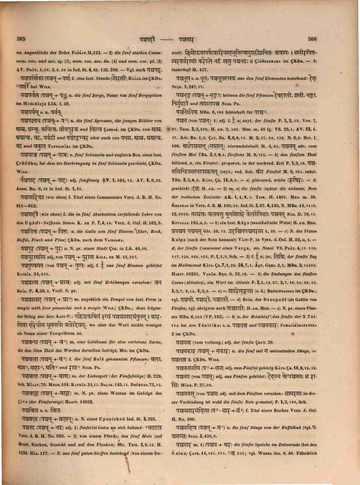
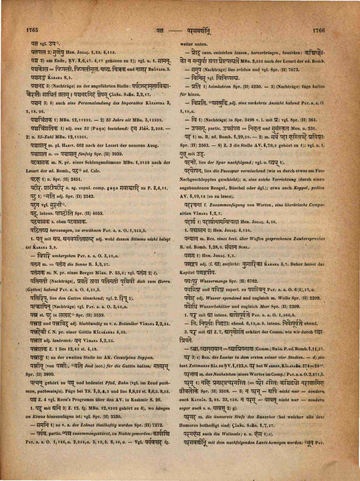
pañcama (von pañcan) 1〉 adj. f. ī a〉 oxyt. der fünfte P. 5,2,49. VOP. 7. VOP. 37. TRIK. 3,3,299. H. an. 3,469. MED. m. 48. fg. VS. 25,4. AV. 13,4,17. AIT. BR. 1,6. ŚAT. BR. 8,6,1,11. M. 2,37. M. 2,90. M. 2,136. N. 6,9. HIT. I. 100. ardhapañcamān (māsān) vierundeinhalb M. 4,95. pañcamam adv. zum fünften Mal TBR. 2,1,2,4. fünftens M. 8,125. — b〉 den fünften Theil bildend, n. ein Fünftel; proparox. in der nachved. Zeit P. 5,3,49. pañcamamindriyamasyāpākramat (oxyt.) ved. Sch. aṃśa Fünftel M. 9,164. subst. TBR. 2,3,4,3. KĀTY. ŚR. 16,8,3. — c〉 glänzend, schön (rucira). — d〉 geschickt (dakṣa) H. an. — 2〉 m. a〉 die fünfte (später die siebente) Note der indischen Tonleiter AK. 1,1,7,1. TRIK. H. 1401. MED. m. 48. CHANDAS_in_Verz. d. B. H. 100,22. Ind. St. 2,67. Ind. St. 4,140, N. MBH. 14,1419. MBH. 12,6859. mādyantaḥ kalayantu cūtaśikhare kelīpikāḥ pañcamam SĀH. D. 79. SĀH. D. 15. KUVALAY. 185,a,5. — b〉 ein best. Rāga (musikalische Weise) H. an. MED. prapañcaya pañcamam GĪT. 10,13. udañcitapañcamarāga GĪT. 1,39. — c〉 N. des 21sten Kalpa (nach der Note benannt) VĀYU-P._in_Verz. d. Oxf. H. 52,a,2. — d〉 der fünfte Consonant eines Varga, ein Nasal VS. PRĀT. 4,11. VS. PRĀT. 4,116. VS. PRĀT. 4,117. VS. PRĀT. 4,120. VS. PRĀT. 4,160. VS. PRĀT. 4,161. P. 1,1,9, Sch. — 3〉 f. ī a〉 (sc. tithi) der fünfte Tag im Halbmonat KĀTY. ŚR. 7,1,26. KĀTY. ŚR. 24,7,1. ĀŚV. GṚHY. 3,5. MBH. 3,14453. HARIV. 10241. VARĀH. BṚH. S. 33,19. — b〉 die Endungen des fünften Casus (Ablativs), ein Wort im Ablativ P. 2,1,12. P. 2,1,37. P. 2,3,7. P. 2,1,10. P. 2,1,24. P. 2,1,28. P. 2,1,42. P. 5,3,7. P. 5,4,44. P. 6,3,2. — c〉 = śāriśṛṅkhalā (s. d.) BHŪRIPRAYOGA_im_ŚKDR.; vgl. pañcanī, pañcārī, pañcālī. — d〉 Bein. der Draupadī (als Gattin von Fünfen, vgl. übrigens auch pāñcālī) H. an. MED. — e〉 N. pr. eines Flusses MBH. 6,333 (VP. 183). — 4〉 n. der Beischlaf (das fünfte der 5 Tattva bei den Tāntrika; s. u. pañcatattva und pañcamakāra) SAMAYĀCĀRATANTRA 2_im_ŚKDR.
Originaltext · Deutsch · Worttyp nicht bestimmt
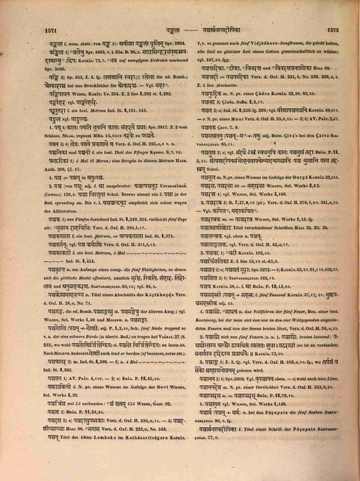
pañcama 2〉a〉 Ind. St. 8,259. fg. Ind. St. 8,269; vgl. vīṇāpañcamadhvani KATHĀS. 49,217. — e〉 N. pr. eines Muni Verz. d. Oxf. H. 55,b,22. — 3〉b〉 AV. PRĀT. 2,67.
Originaltext · Deutsch · Worttyp nicht bestimmt
pañcama 3〉b〉 auch eine Personalendung des Imperativs KĀTANTRA 3,1,18. KĀTANTRA 3,1,26.
Böhtlingk 1879 Adjektiv · Substantiv Maskulin · Substantiv Neutrum
Originaltext · Deutsch · Adjektiv · Substantiv Maskulin · Substantiv Neutrum
pañcamá — 1〉 Adj. (f. ī́) — a〉 der fünfte. ˚m Adv. zum fünften Mal, fünftens. — b〉 den fünften Theil bildend. aṃśa m. Fünftel. — c〉 *glänzend, schön. — d〉 *geschickt. — 2〉 m. — a〉 die fünfte (später die siebente) Note der indischen Tonleiter. — b〉 ein best. Rāga S. S. S. 37. — c〉 ein best. Tact S. S. S. 207. — d〉 der 21ste Kalpa 2〉h〉. — e〉 der fünfte Consonant eines Varga, ein Nasal. — f〉 N. pr. eines Muni. — 3〉 f. ī — a〉 der fünfte Tag in einem Halbmonat. — b〉 die Endungen des fünften Casus, ein Wort im Ablativ. — c〉 eine Personalendung des Imperativs. — d〉 eine best. Rāgiṇī S. S. S. 55. — e〉 eine best. Mūrchanā S. S. S. 30. — f〉 ein Backstein von der Länge eines Fünftels (eines Puruṣa) ŚULBAS. 3,42. — g〉 *Spielfigur. — h〉 *Bein. der Draupadī. — i〉 N. pr. eines Flusses. — 4〉 n. — a〉 Fünftel. — b〉 bei den Tāntrika die fünfte Realität, d. i. der Beischlaf.
Cappeller 1887 Worttyp nicht bestimmt
Originaltext · Deutsch · Worttyp nicht bestimmt
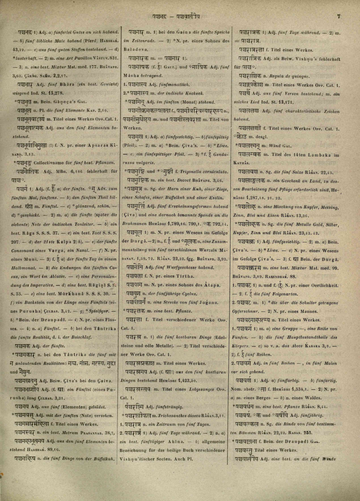
pañcama f. rí der fünfte, den fünften Teil bildend. f. der fünfte Tag im Halbmonat; die Endungen des fünften Casus (Ablativ) und dieser selbst (g.). n. ein Fünftel; auch adv. zum fünften Mal fünftens.
Burnouf 1866 Adjektiv
Originaltext · Französisch · Adjektiv
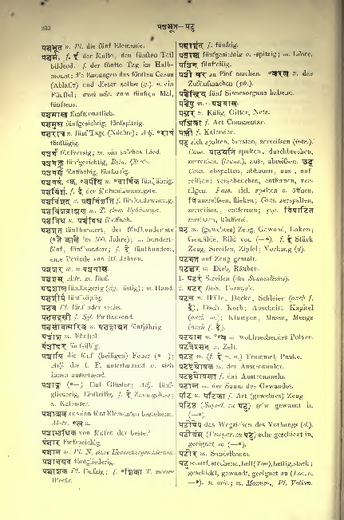
pañcama a. (sfx. ma) cinquième. Adroit, beau, agréable. — S. m. la 5ᵉ note de l'octave [qui est notre quarte]. Np. d'un des Rāgas ou modes musicaux. — S. f. pañcamī le 5ᵉ jour de la Lune. Echiquier, damier. Draupadī, femme des cinq Pāṇḍus.
Quelltextfundstellen (6)
DYS 2 Fundstellen
GoS 1 Fundstelle
Mit AYI Free weitermachen
Bildquelle: AYI Archiv.