

upasarga उपसर्ग – Störung; Hindernis
Substantiv Maskulin · Worttyp nicht bestimmt
Wörterbuchquellen
AYI Wörterbuch Substantiv Maskulin
Störung; Hindernis
Herkunft
Cappeller 1891 Substantiv Maskulin
Originaltext · Englisch · Substantiv Maskulin
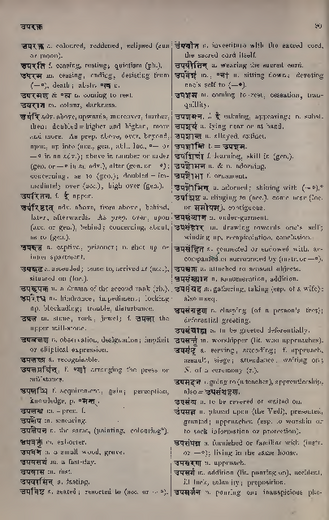
upasarga ·m. addition (lit. pouring on), accident, ill luck, calamity; preposition.
Monier-Williams 1872 Substantiv Maskulin · Worttyp nicht bestimmt
Originaltext · Englisch · Substantiv Maskulin
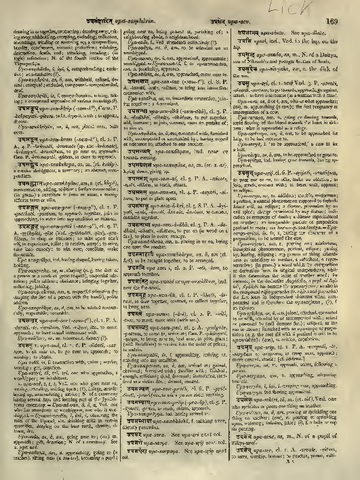
Upa-sarga, as, m. addition; trouble, misfortune; a portent, a natural phenomenon supposed to forbode future evil, an eclipse; a disease, possession by an evil spirit; change occasioned by any disease; indi- cation or symptom of death; a disease superinduced on another; an inseparable particle or preposition prefixed to roots; see karma-pravacanīya.
Originaltext · Englisch · Worttyp nicht bestimmt
upasarga upa-sarga. See upa-sṛj next col.
Petersburger 1855 Substantiv Maskulin · Worttyp nicht bestimmt
Originaltext · Deutsch · Substantiv Maskulin
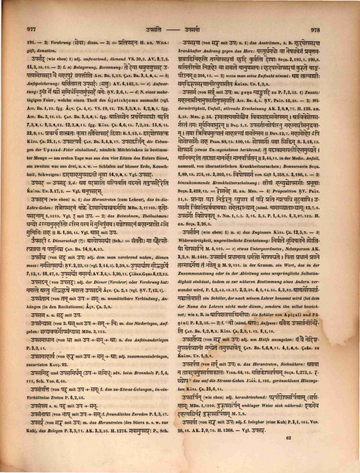
upasarga (von sarj mit upa) m. gaṇa nyaṅkvādi zu P. 7,3,53. 1〉 Zusatz: mahānāmnīnāmupasargānupasṛjati AIT. BR. 4,4. ṚV. PRĀT. 16,38. — 2〉 Widerwärtigkeit, Unfall, störende Erscheinung AK. 2,8,2,77. H. 125. H. an. 4,48. MED. g. 54. rāmalakṣmaṇayoścaiva vivāsādvāsavopamanam . āviveśopasargastaṃ tamaḥ sūryamivāsuram .. DAŚ. 1,2. upasargānaśeṣāṃstu mahāmārīsamudbhavān . tathā trividhamutpātaṃ māhātmyaṃ śamayenmam .. DEV. 12,7. mahāmoho 'pi yogopasargaiḥ saha PRAB. 88,13. PRAB. 100,16. sopasargāṃ yathā siddhim R. 5,18,13. sopasargaṃ (etwas Unangenehmes berührend) tu yadvākyamāyatīhitamucyate . nābhinandati tadrājā mānārho mānavarjitam .. R. 3,44,11. in der Medic. Anfall, namentl. von übernatürlichen Krankheitsursachen; Besessensein SUŚR. 1,89,19. SUŚR. 1,374,19. SUŚR. 2,302,11. viṣopasarga von Gift SUŚR. 1,358,5. SUŚR. 2,186,1. — 3〉 hinzukommende Krankheitserscheinung: kṣīṇaṃ hanyuścopasargāḥ prabhūtāḥ SUŚR. 2,429,13. = rogabheda H. an. MED. — 4〉 Präposition ṚV. PRĀT. 11,5. prābhyā parā nirduranu vyupāpa saṃ pari prati nyatyadhi sūdavāpi . upasargā viṃśatirarthavācakāḥ sahetarābhyām (näml. nāmākhyātabhyām) ṚV. PRĀT. 12,7. ṚV. PRĀT. 12,8. upasargo viśeṣakṛt ṚV. PRĀT. 12,9. NIR. 1,1. NIR. 1,3. NIR. 3,16. NIR. 5,5. P. 1,4,59. P. 6,3,97. P. 6,3,122. H. an. SUŚR. 2,26,5.
Originaltext · Deutsch · Worttyp nicht bestimmt
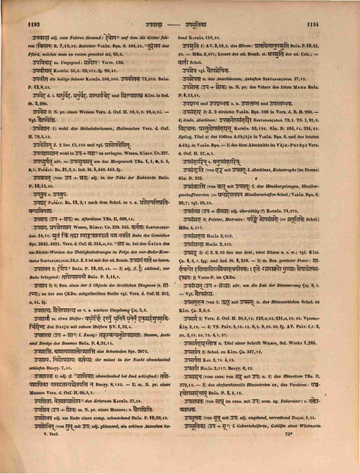
upasarga 2〉 Verz. d. Oxf. H. 50,b,12. Verz. d. Oxf. H. 123,a,22. Verz. d. Oxf. H. 231,a,26. Verz. d. Oxf. H. 231,a,28. VṚDDHA-CĀṆ. 3,19. — 4〉 VS. PRĀT. 5,16. VS. PRĀT. 5,42. VS. PRĀT. 6,2. VS. PRĀT. 8,52. VS. PRĀT. 8,56. fg. AV. PRĀT. 1,1. AV. PRĀT. 2,90. AV. PRĀT. 3,11. AV. PRĀT. 3,48. AV. PRĀT. 3,79. AV. PRĀT. 4,1. AV. PRĀT. 4,37.
Böhtlingk 1879 Substantiv Maskulin
Originaltext · Deutsch · Substantiv Maskulin
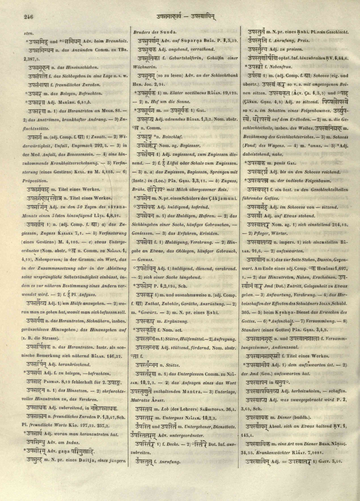
upasarga m. (adj. Comp. f. ā) — 1〉 Zusatz. — 2〉 Widerwärtigkeit, Unfall, Ungemach Chr. 292,5. — 3〉 in der Med. Anfall, das Besessensein. — 4〉 eine hinzukommende Krankheitserscheinung. — 5〉 Verfinsterung (eines Gestirns) KULL. zu M. 4,105. — 6〉 Präposition.
Apte 1890 Substantiv Maskulin · Worttyp nicht bestimmt
Originaltext · Englisch · Substantiv Maskulin
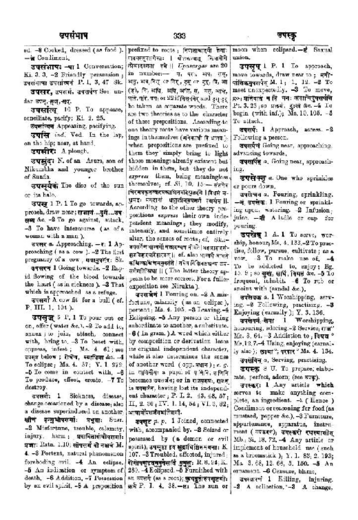
upasargaḥ 1 Sickness, disease, change occasioned by a disease; also a disease superinduced on another; kṣīṇaṃ hanyuścopasargāḥ prabhūtāḥ Suśr. 2 Misfortune, trouble, calamity, injury, harm; praśamitāśeṣopasargāḥ prajāḥ Ratn. 1. 10; sopasargaṃ vo nakṣatraṃ M. 4. 3 Portent, natural phenomenon foreboding evil. 4 An eclipse. 5 An indication or symptom of death. 6 Addition. 7 Possession by an evil spirit. 8 A preposition ([Page 0333-b]) prefixed to roots; nipātāścādayo jñeyāḥ prādayastūpasargakāḥ . dyotakatvāt kriyāyoge lokādavagatā ime .. Upasargas are 20 in number: — pra, parā, apa, sam, anu, ava, nis or nir, dus or dur, vi, ā (ṅ), ni, adhi, api, ati, su, ut, abhi, prati, pari, upa; or 22 if nis-nir and dus-dur be taken as separate words. There are two theories as to the character of these prepositions. According to one theory roots have various meanings in themselves (anekārthā hi dhātavaḥ); when prepositions are prefixed to them they simply bring to light those meanings already existent but hidden in them, but they do not express them, being meaningless themselves; cf. Śi. 10. 15: — saṃtameva ciramaprakṛtatvādaprakāśitamadidyutadaṃge . vibhramaṃ madhumadaḥ pramadānāṃ dhātulīnamupasarga ivārtham ... According to the other theory prepositions express their own independent meanings; they modify, intensify, and sometimes entirely alter, the senses of roots; cf. Sk.: -upasargeṇa dhātvartho balādanyatra nīyate . prahārāhārasaṃhāravihāraparihāravat .. cf. also dhātvarthaṃ bādhate kaścitkaścittamanuvartate . tameva viśinaṣṭyanya upasargagatistridhā .. (The latter theory appears to be more correct. For a fuller exposition see Nirukta).
Originaltext · Englisch · Worttyp nicht bestimmt
upasara, upasarga, upasarpaṇa See under upasṛ, -sṛj, -sṛp.
Cappeller 1887 Substantiv Maskulin
Originaltext · Deutsch · Substantiv Maskulin
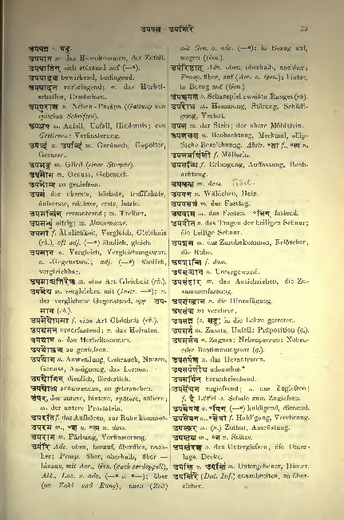
upasarga m. Zusatz, Unfall; Präposition (g.).
Burnouf 1866 Substantiv Maskulin
Originaltext · Französisch · Substantiv Maskulin
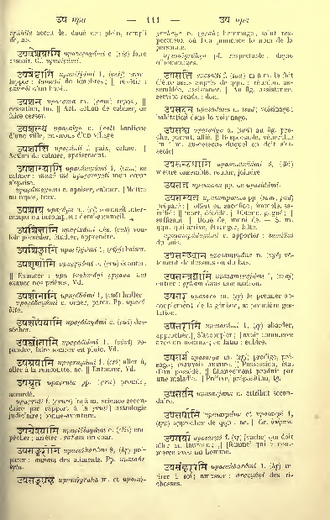
upasarga upasarga m. (sṛj) prodige, présage; mauvais augure. Possession, état d'un possédé. Changement produit par une maladie. Préfixe, préposition, tg.
Quelltextfundstellen (2)
PYS 1 Fundstelle
SiSa 1 Fundstelle
Mit AYI Free weitermachen
Bildquelle: AYI Archiv.