

upa उप – nahe; heran; hinzu
Adverb · Partikel · Präfix · Präposition · Worttyp nicht bestimmt
Wörterbuchquellen
AYI Wörterbuch Präfix
nahe; heran; hinzu
Cappeller 1891 Adverb
Originaltext · Englisch · Adverb
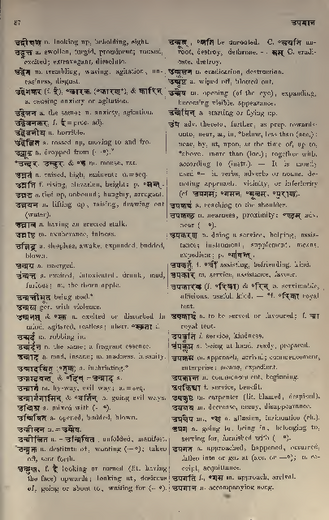
úpa ·adv. thereto, further, as prep. towards, unto, near, at, in, *below, less than (acc.); near, by, at, upon, at the time of, up to, *above, more than (loc.); together with, according to (instr.). -- It is mostly used °-- in verbs, adverbs or nouns, denoting approach, vicinity, or inferiority (cf upagam; °gamana, °mūlam, °purāṇa).
Monier-Williams 1872 Präfix
Originaltext · Englisch · Präfix
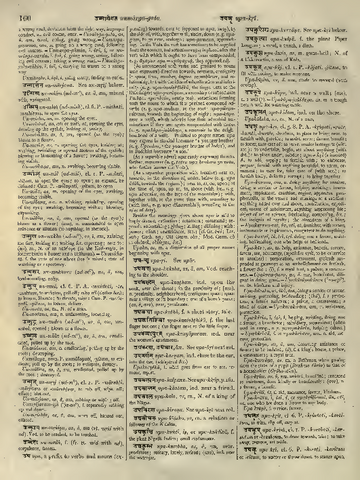
upa upa, a prefix to verbs and nouns (ex- pressing) towards, near to (opposed to apa, away), by the side of, with, together with, under, down (e. g. upa- gam, to go near, undergo; upa-gamana, approach- ing. In the Veda the verb has sometimes to be supplied from the context, and sometimes upa is placed after the verb with which it ought to have been compounded, e. g. āyayur upa = upāyayuḥ, they approached). (As unconnected with verbs and prefixed to nouns upa expresses) direction towards, nearness, contiguity in space, time, number, degree, resemblance, and re- lationship, but with the idea of subordination and inferi- ority (e. g. upa-kaniṣṭhikā, the finger next to the little finger; upa-purāṇam, a secondary or subordinate Purāṇa; upa-daśa, nearly ten); sometimes forming with the nouns to which it is prefixed compound ad- verbs (e. g. upa-mūlam, at the root; upa-pūrva- rātram, towards the beginning of night; upa-kūpe, near a well), which adverbs lose their adverbial ter- minations if they are again compounded with nouns (e. g. upakūpa-jalāśaya, a reservoir in the neigh- bourhood of a well). Prefixed to proper names upa may express in classical literature ‘a younger brother’ (e. g. Upendra, ‘the younger brother of Indra’), and in Buddhist literature ‘a son.’ (As a separable adverb upa rarely expresses) thereto, further, moreover (e. g. tatra upa brahma yo veda, who further knows the Veda). (As a separable preposition with locative) near to, towards, in the direction of, under, below (e. g. upa āśāḥ, towards the regions); near to, at, on, upon; at the time of, upon, up to, in, above (with loc., e. g. upa sānuṣu, on the tops of the mountains); with, together with, at the same time with, according to (with inst., e. g. upa dharmabhiḥ, according to the rules of duty). Besides the meanings given above upa is said to imply disease, extinction; ornament; command; re- proof; undertaking; giving; killing; diffusing; wish; power; effort; resemblance, &c.; [cf. Gr. ὑπό Lat. sub; Goth. up; Old Germ. oba; Mod. Germ. ob in obdach, obliegen, &c.]
Petersburger 1855 Adverb · Worttyp nicht bestimmt
Originaltext · Deutsch · Adverb
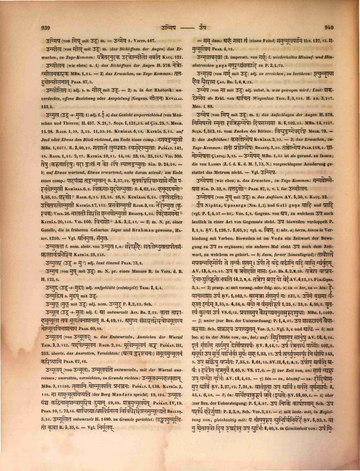
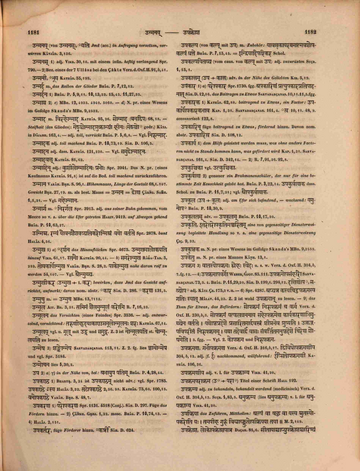
úpa Nipāta, Upasarga (NIR. 1,3) und Gati gaṇa cādi und prādi (vgl. P. 1,4,57—P. 1,4,60). VOP. 1,8. Gegens. von apa, zu welchem upa auch lautlich in einer Art von Gegensatz steht. upa bisweilen verdoppelt P. 8,1,6. ṚV. 1,126,7. ṚV. 8,63,9; vgl. u. viś. 1〉 adv. a〉 herzu, hinzu in Verbindung mit Verben. Bisweilen ist im Veda ein Zeitwort der Bewegung zu upa zu ergänzen; ein anderes Mal steht upa nach dem Zeitwort, zu welchem es gehört. — b〉 dazu, ferner (hinzufügend): tāvā̀ṃste maghavanmahi̱mopò te ta̱nvàḥ śa̱tam . upò te̱ baddhe̱ baddhā̀ni̱ yadi̱ vāsi̱ nyàrbudam AV. 13,4,44. AV. 13,4,45. upa ca trayodaśo māsaḥ ŚAT. BR. 6,2,2,29. tatropa yatprapadenābhyucchrito bhavati ŚAT. BR. 10,2,2,6. tatropa̱ brahma̱ yo vedà AV. 4,11,11. PĀR. GṚHY. 3,2. — 2〉 praep. a〉 mit vorang. oder folg. acc. α〉 zu — her, zu — hin: de̱vānā̱māśā̱ upà ṚV. 1,162,7. a̱sma̱trā gànta̱mupà naḥ ṚV. 1,137,1. upe̱maṃ ya̱jñamā vàhāta̱ indràm ṚV. 3,35,2. ṚV. 4,34,6. vayo̱ na vàsa̱tīrupà ṚV. 1,25,4. ṚV. 1,33,2. ṚV. 4,56,5. ghṛ̱tasyà ku̱lyā upà VS. 6,12. prayāntamupa kauravyamanusasrurudāyudhāḥ MBH. 1,4099. — β〉 unter (zur Bez. der Unterordnung) P. 1,4,87. upa śākaṭāyanaṃ vaiyākaraṇāḥ Sch. śakrādaya upācyutam VOP. 5,7. Vgl. b,ε und adhi. — b〉 mit loc. α〉 in der Nähe von, an, bei; auf: gi̱rī̱ṇāmupa̱ sānùṣu AV. 10,4,14. e̱taṃ mṛ̀janti̱ marjya̱mupa̱ droṇèṣvā̱yavàḥ ṚV. 9,14,7. upà tri̱tasyà pā̱ṣyòḥ ṚV. 9,102,2. a̱mūryā upa̱ sūrye̱ yābhìrvā̱ sūryaḥ sa̱ha ṚV. 1,23,17. upà tva̱cyùpa̱masyā̱ṃ ni dhā̀yi ṚV. 1,145,5. upa̱ srakvèṣu̱ bapsàtaḥ ṚV. 7,55,2. ṚV. 8,61,15. SV. II, 6,1,4,2. upòpa̱ śravàsi̱ śravàḥ . dadhī̀ta vṛtra̱tūryè ṚV. 8,63,9. VS. 17,6. — β〉 zur Zeit von, an: sā̱yaṃ nyahna̱ upa̱ vandyo̱ nṛbhìḥ AV. 18,4,65. — γ〉 hin — zu, hinauf — zu: dī̱di̱vāṃsa̱mupa̱ dyavì ṚV. 3,27,12. ṚV. 7,31,9. vātàjūtā̱ upa̱ dyavì . yatànte̱ vṛthàga̱gnayàḥ ṚV. 8,43,4. ṚV. 8,6,40. — δ〉 in: yasyèkṣvā̱kurupà vra̱te (edhate) ṚV. 10,60,4. — ε〉 über (zur Bez. der Uebersteigung) P. 1,4,87. upa niṣke kārṣāpaṇam Sch. upa parārdhe harerguṇāḥ P. 2,3,9, Sch. VOP. 5,31. — c〉 mit instr. mit, in Begleitung von, gleichzeitig mit: ya ā̀ya̱yurupa̱ dyubhi̱rvibhi̱rmadè ṚV. 5,53,3. yā nu śve̱tāva̱vo di̱va u̱ccarā̀ta̱ upa̱ dyubhìḥ ṚV. 8,40,8. in Gemässheit von: upà mi̱trasya̱ dharmàbhiḥ VĀLAKH. 4,3. — d〉 in comp. mit nomm. zur Bez. der Richtung wohin oder des Angrenzens (im Raume, in der Zeit, Anzahl, Reihenfolge, Aehnlichkeit, Verwandtschaft, mit dem Nebenbegriff des Untergeordnetseins); in adv. compp.: upakumbhaṃ paśya, upakumbhaṃ tiṣṭhati P. 2,4,83, Sch. P. 2,1,6, Sch. upamūlám an der Wurzel ŚAT. BR. 2,4,2,17. KĀTY. ŚR. 4,1,11. KAUŚ. 1. upaśiras KAUŚ. 86. upakanyāpuram DAŚAK._in_BENF. Chr. 196,21. upakhātam DAŚAK. 105,3. úpapūrvarātram gegen Anfang der Nacht P. 6,2,33, Sch. Neben der acc.-Endung erscheint auch die des loc. und instr.; die des abl. kann nicht durch die des acc. ersetzt werden P. 2,4,83. P. 2,4,84. upakumbhe oder ˚kumbhaṃ nidhehi, upakumbhena oder ˚kumbhaṃ kṛtam, upakumbhādānaya Sch. VOP. 6,58. VOP. 6,59; vgl. oben u. b und c. Am Anfange eines comp. ohne Flexionszeichen: upakūpajalāśaya ein Wasserbehälter in der Nähe eines Brunnens AK. 1,2,3,26. — upadaśāḥ nahe an zehn P. 2,2,25, Sch. Vor einem nom. pr. zur Bez. des jüngern Bruders (klass.) und des Sohnes (buddh.) BURN. Intr. 377, N. 4. Eine grosse Anzahl solcher compp. (über den Accent derselben vgl. P. 6,2,33. P. 6,2,194) wird man im Folgenden besonders aufgeführt finden. — Die Lexicographen: upāsanne hīne 'dhike sādṛśyapratiyatnayoḥ .. tadyogavyāptipūjāsu śaktāvārambhadānayoḥ . dakṣiṇācāryakaraṇadoṣākhyānātyayeṣu ca .. H. an. 7,34. fg. bloss die drei ersten Bedeutt. MED. avy. 48. — DURGAD. und ŚABDAR._im_ŚKDR. kennen noch andere Bedd., die wir füglich unerwähnt lassen können. — Abgeleitet von upa sind: upaka, upaḍa, upatya (upatyakā), upama, upara, upika, upiya, upila.
Originaltext · Deutsch · Worttyp nicht bestimmt
upa 2〉a〉γ〉 in der Nähe von, bei: babhāvupa patim BHĀG. P. 4,28,44.
Böhtlingk 1879 Adverb
Originaltext · Deutsch · Adverb
úpa — 1〉 Adv. — a〉 in Verbindung mit Verben herzu, hinzu, herbei Bisweilen ist im Veda ein Zeitwort der Bewegung zu upa zu ergänzen. — b〉 dazu, ferner. — 2〉 Präp. — a〉 mit Acc. — α〉 zu — her, zu — hin. — β〉 in der Nähe von, bei. — γ〉 *unter (zur Bezeichnung der Unterordnung). — b〉 mit Loc. — α〉 in der Nähe von, an bei, auf. — β〉 zur Zeit von, an. — γ〉 zu — hin, zu — hinauf. — δ〉 in. — ε〉 *über, mehr als. — c〉 mit Instr. — α〉 mit, in Begleitung von, gleichzeitig mit. — β〉 in Gemässheit von. — d〉 in Comp. mit einem Nom. in der Nähe von (eig. und übertr.).
Apte 1890 Partikel
Originaltext · Englisch · Partikel
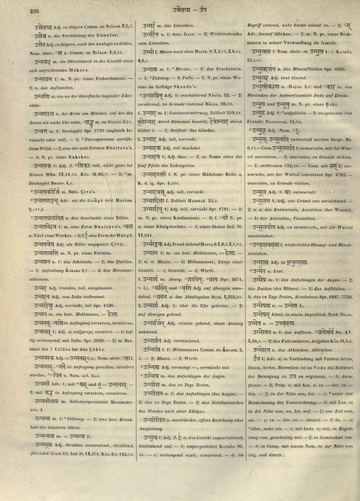
upa ind. 1 As a prefix to verbs and nouns it expresses towards, near to, by the side of, with, under, down (opp. apa). According to G. M. the following are its senses: — upa sāmīpyasāmarthyavyātyācāryakṛtimṛtidoṣadānakriyāvīpsāraṃbhādhyayanapūjaneṣuḥ- (1) nearness, contiguity; upaviśati, upagacchati goes near; (2) power, ability; upakaroti; (3) pervasion; upakīrṇa; (4) advice, instructing as by a teacher; upadiśati, upadeśa; (5) death, extinction, uparata; (6) defect, fault; upaghāta; (7) giving; upanayati, upaharati; (8) action, effort; upa tvāneṣye; (9) beginning, commencement; upakramate, upakrama; (10) study; upādhyāyaḥ; (11) reverence, worship; upasthānaṃ, upacarati pitaraṃ putraḥ. It is also said to have the senses of disease, ornament, command, reproof, killing, wish, resemblance &c. 2 As unconnected with verbs and prefixed to nouns, it expresses direction towards, nearness, resemblance, relationship, contiguity in space, number, time, degree &c., but generally involving the idea of subordination or inferiourity; upakaniṣṭhikā the finger next to the little finger; upapurāṇaṃ a secondary Purāṇa; upaguruḥ an assistant master; upādhyakṣaḥ a vice-president. It usually, however, forms Avyayī. comp. in these senses; upagaṃgaṃ = gaṃgāyāḥ samīpe; upakūlaṃ, ˚vanaṃ &c.; these are again compounded with other words; upakūpajalāśayaḥ, upakaṃṭhanivāsinī. Prefixed to proper nouns it means a ‘younger brother’; upeṃdraḥ. 3 With numerals it forms saṃkhyābahuvrīhi and means ‘nearly,’ ‘almost’; upatriṃśāḥ nearly thirty; upaviṃśāḥ about twenty &c. 4 As a separable preposition (a) with acc. when it means ([Page 0315-c]) inferiority (P. I. 4. 87); upa hariṃ surāḥ Sk the gods are under i. e. are inferior to Hari; śakrādaya upācyutaṃ Vop. (b) With loc. it expresses (1) over, above, superior to; upa niṣke kārṣāpaṇaṃ, upa parārdhe harerguṇāḥ; (2) addition; (3) near to, towards, in the direction of, under; (4) at, on, upon; (5) upto, in, above; e. g. upa sānuṣu on or above the peaks; vayo na vasatīrupa; or sometimes (c) with the instr.; with, at the same time with, according. to 5 As a separable adverb it is rarely used in the senses of further, moreover. upāsanne'dhike hīne sādṛśyapratiyatnayoḥ . tadyogavyāptipūjāsu śaktāvāraṃbhadānayoḥ .. dakṣiṇācāryakaraṇadoṣākhyānātyayeṣu ca .. [cf. Gr. hupo; L. sub; Goth. up; Germ. ob.].
Cappeller 1887 Adverb
Originaltext · Deutsch · Adverb
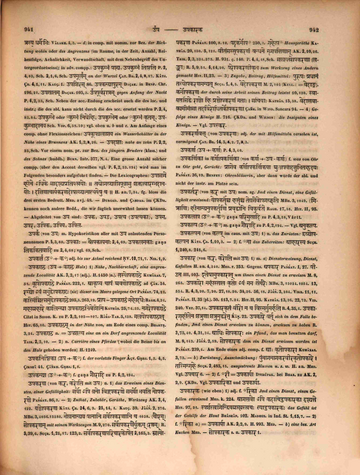
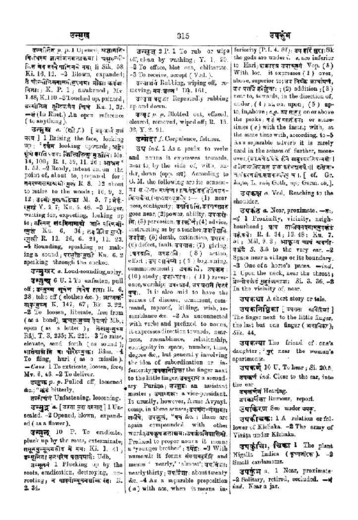
úpa Adv. (˚—) her, herzu (mit Verben, bes. der Bewegung); dazu, ferner, in der Nähe von; Neben-, Unter- (mit einem Nomen) Praep. zu, nach, bei, neben (Acc. u. Loc.)* unter, weniger als (Acc.); — auf, in, *über, mehr als (Loc.); mit, gemäßig (Instr.)
Burnouf 1866 Präposition
Originaltext · Französisch · Präposition
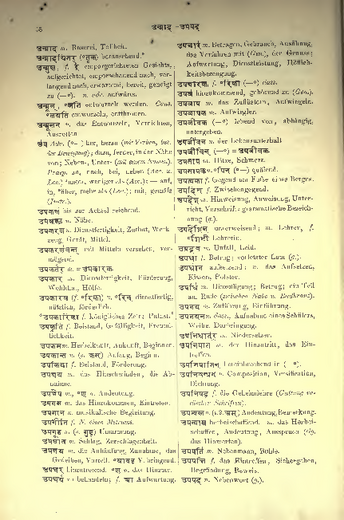
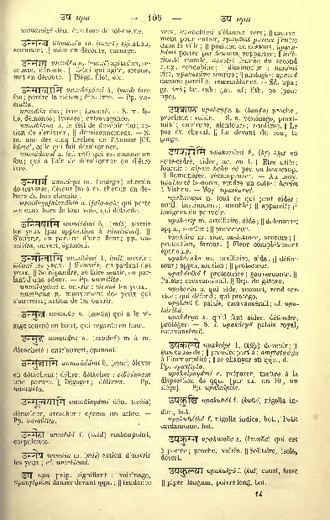
upa upa prép. signifiant: voisinage, upanṛtyāmi danser devant qqn.; tendance [Page105-2] vers, upapatāmi s'élancer vers; mouvement pour entrer, upayāmi puram j'entre dans la ville; position au-dessous, upavahāmi porter par-dessous, supporter; infériorité morale, upastrī femme du second rang, concubine; diminution: hasāmi rire, upahasāmi sourire; analogie: upamā mesure pareille, ressemblance. — Zd. upa; gr. ὑπό; lat. sub; got. uf; lith. po (pour upo).
Abgeleitete Wörter
Weitere direkte Ableitungen (4)
Weitere Ableitungen (2)
Quelltextfundstellen (60)
DYS 5 Fundstellen
GoS 2 Fundstellen
HP 12 Fundstellen
Weitere 5 Quelltextseiten
HTK 5 Fundstellen
IVU 2 Fundstellen
MandUp 3 Fundstellen
PJH 1 Fundstelle
PJH 17-19: Einfache Mittel (sukhopāyas) und Samādhi 1 Fundstelle
Über Ableitungen belegt
-
PJH 18 Segment 14
PYS 9 Fundstellen
PYS 2.23–26: Von Avidyā zu Kaivalya 2 Fundstellen
Über Ableitungen belegt
PYS 3.21–22: Unsichtbarkeit und Todeszeit 2 Fundstellen
Über Ableitungen belegt
1 weitere Quelltextseite
SiSa 15 Fundstellen
SiSa 2.41-2.43: Māyā-Projektion 3 Fundstellen
Direkt belegt
Weitere 7 Quelltextseiten
SS 1 Fundstelle
SVU 2 Fundstellen
Mit AYI Free weitermachen
Bildquelle: AYI Archiv.