

veda वेद – Veda; Wissen
Substantiv Maskulin · Worttyp nicht bestimmt
Wörterbuchquellen
AYI Wörterbuch Substantiv Maskulin
Veda; Wissen
Cappeller 1891 Substantiv Maskulin
Originaltext · Englisch · Substantiv Maskulin
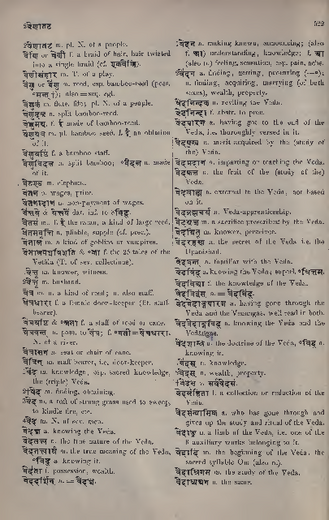
véda1 ·m. knowledge, esp. sacred knowledge, the (triple) Veda.
Originaltext · Englisch · Substantiv Maskulin
†veda2 ·m. finding, obtaining.
Originaltext · Englisch · Substantiv Maskulin
veda3 ·m. a tuft of strong grass used to sweep, to kindle fire, etc.
Originaltext · Englisch · Substantiv Maskulin
veda4 ·m. N. of sev. men.
Monier-Williams 1872 Substantiv Maskulin · Worttyp nicht bestimmt
Originaltext · Englisch · Substantiv Maskulin
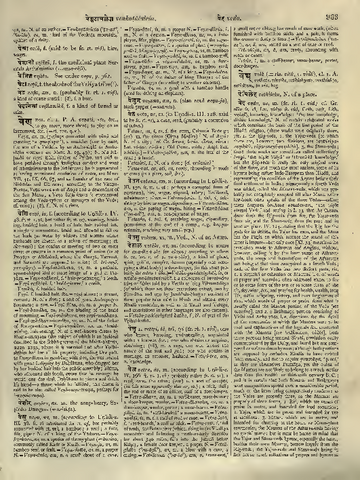
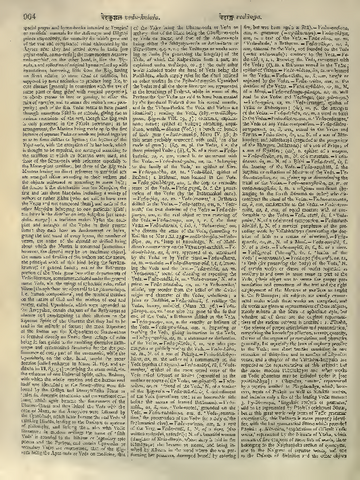
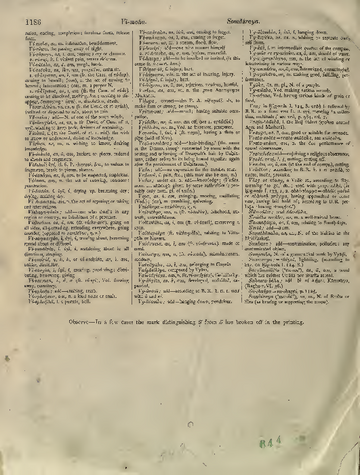
veda veda, as, m. (fr. rt. 1. vid; cf. Gr. οἶδα fr. ιδ, Lat. video fr. vid, Goth. vait, Lith. weizd), knowing, knowledge; ‘the true knowledge, divine knowledge,’ N. of certain celebrated works which constitute the basis of the first period of the Hindū religion, (these works were originally three, viz. 1. the Ṛg-veda, 2. the Yajur-veda [of which there are, however, two divisions, see taittirīya- saṃhitā, vājasaneyi-saṃhitā], 3. the Sāma-veda; these three works are sometimes called collectively, trayī, ‘the triple Vidyā’ or ‘threefold knowledge,’ but the Ṛg-veda is really the only original work of the three, and much the most ancient, some of its hymns being rather Indo-European than Hindū, and representing the condition of the Āryans before their final settlement in India; subsequently a fourth Veda was added, called the Atharva-veda, which was pro- bably not completely accepted till after Manu, as his law-book often speaks of the three Vedas — calling them trayam brahma sanātanam, ‘the triple eternal Veda,’ and stating in I. 23. that the Creator drew forth the Ṛg-veda from fire, the Yajur-veda from air, and the Sāma-veda from the sun; and in another place, IV. 124, stating that the Ṛg has the gods for its deities, the Yajur has men, and the Sāma has the Pitṛs, on which account the sound of this latter is impure — but only once [XI. 33] mentions the revelation made to Atharvan and Aṅgiras, without, however, calling it by the later name of Atharva- veda, the songs and incantations of the Atharvans not being at that time recognised as a fourth Veda; each of the four Vedas has two distinct parts, viz. 1. a Saṃhitā or collection of Mantras, i. e. of words of prayer and adoration often addressed either to fire or to some form of the sun or to some form of the air, sky, wind, &c., and praying for health, wealth, long life, cattle, offspring, victory, and even forgiveness of sins, which words of prayer or praise form what is usually called the Mantra portion of the Veda [see mantra], and 2. a Brāhmaṇa portion consisting of Vidhi and Artha-vāda, i. e. directions for the detail of the ceremonies at which the Mantras were to be used and explanations of the legends &c. connected with the Mantras [see brāhmaṇa, vidhi], both these portions being termed Śruti, revelation orally communicated by the Deity, and heard but not com- posed or written down by men; although both portions are supposed by orthodox Hindūs to have existed from eternity, and not to require pramāṇa, ‘proof,’ as they are themselves Pramāṇa, yet the oldest of the Mantras are not likely to belong to a much earlier date than the twelfth or thirteenth century B. C.; and it is certain that both Mantras and Brāhmaṇas were compositions spread over a considerable period, much of the latter being comparatively modern: as the Vedas are properly three, so the Mantras are properly of three forms, 1. Ṛc, which are verses of praise in metre, and intended for loud recitation; 2. Yajus, which are in prose, and intended for use at sacrifices; 3. Sāman, which are in metre, and intended for chanting at the Soma or Moon-plant ceremonies, the Mantras of the Atharva-veda having no special name; but it must be borne in mind that the Yajur and Sāma-veda hymns, especially the latter, besides their own Mantras, borrow largely from the Ṛg-veda; the Yajur-veda and Sāma-veda being in fact not so much collections of prayers and hymns as special prayer and hymn-books intended as liturgical or sacrificial manuals for the Adhvaryu and Udgātṛ priests respectively, the necessity for which grew out of the vast and complicated ritual elaborated by the Āryans after they had settled down in India [see yajur-veda, sāma-veda]; the more modern Atharva- veda-saṃhitā, on the other hand, is, like the Ṛg- veda, a real collection of original hymns mixed up with incantations, borrowing little from the Ṛg, having no direct relation to mere ritual or sacrifices, but supposed by mere recitation to produce long life, to cure diseases [generally in connection with the use of some plant or drug gifted with magical properties], to obtain success in love or gaming, to effect the ruin of enemies, and to secure the reciter's own pros- perity; each of the four Vedas seems to have passed through numerous Śākhās or schools, giving rise to various recensions of the text, though the Ṛg-veda is only preserved in the Śākala recension; as to arrangement, the Mantras being made up in the first instance of separate Padas or words are joined together so as to form Sūktas or hymns; the hymns of the Yajur-veda, with the exception of its last book, which is thought to be mystical, are arranged according to the sacrifices at which its Mantras were used, and those of the Sāma-veda with reference especially to the Moon-plant sacrifices, but those of the Ṛg-veda Mantras having no direct reference to sacrificial acts are arranged either according to their authors and the objects addressed or according to mere bulk; the former is the distribution into ten Maṇḍalas, the first and last three Maṇḍalas including a variety of authors or rather Ṛṣis [who are said to have seen the Vedas and not composed them], and each of the other Maṇḍalas belonging to one particular Ṛṣi; the latter is the distribution into Aṣṭakas [see maṇ- ḍala, varga]: a tradition makes Vyāsa the com- piler and arranger of the Vedas in their present form: they each have an Anukramaṇī or Index, giving the first word of every hymn, the number of verses, the name of the devatā or deified being about which the Mantra is concerned [sometimes, however, the devatā may be an inanimate object], the names and families of the authors and the metre, the principal work of this kind being the Sarvānu- kramaṇī or general Index; out of the Brāhmaṇa portion of the Veda grew two other departments of Vedic literature, sometimes included under the general name Veda, viz. the strings of aphoristic rules, called Sūtras [though these are often said to be pauruṣeya, i. e. human compositions], and the mystical treatises on the nature of God and the relation of soul and matter, called Upaniṣads, which were appended to the Āraṇyakas, certain chapters of the Brāhmaṇas so obscure and awe-inspiring in their allusions to the Supreme Spirit of the Universe that they had to be read in the solitude of forests; the most important of the former are the Kalpa-sūtras or Śrauta-sūtras as founded directly on Śruti; these strings of rules being in fact guides to the rambling discursive Brāh- maṇas and systematized directories for the due per- formance of every part of the ceremonial, while the Upaniṣads, on the other hand, taught the secret doctrine [called rahasya in Manu II. 165. and ve- dānta in VI. 83, 94] underlying the ceremonial, viz. the existence of one Universal Spirit, called Brahma, with which the whole creation and the human soul itself was identified; as the Śrauta-sūtras were fol- lowed by the Gṛhya and Sāmayācārika Sūtras or ‘rules for domestic ceremonies and conventional cus- toms,’ which again became the forerunners of the Dharma-śāstras and thus linked the Veda with the code of Manu, so the Āraṇyakas were followed by the Upaniṣads, which latter became the real Veda of thinking Hindūs, leading to the Darśanas or systems of philosophy, and linking them also with Vedic literature: in modern writings the name of ‘fifth Veda' is accorded to the Itihāsas or legendary epic poems and the Purāṇas, and certain Upa-vedas or secondary Vedas are enumerated, that of the Ṛg- veda being the Āyur-veda or Veda on medicine, that of the Yajur being the Dhanur-veda or Veda on archery, that of the Sāma being the Gāndharva-veda or Veda on music, and that of the Atharva-veda being either the Sthāpatya-veda or Artha-śāstra or Śilpa-śāstra, q. q. v. v.; the Vedāṅgas or works serv- ing as limbs [for preserving the integrity] of the Veda, of which the Kalpa-sūtras form a part, are explained under vedāṅga, col. 3: the only other works included under the head of Veda being the Pariśiṣṭas, which supply rules for the ritual omitted in other works; in the Bṛhad-āraṇyaka Upaniṣad the Vedas and all the above literature are represented as the breathings of Brahmā, while in some of the Purāṇas the four Vedas are said to have been created by the four-faced Brahmā from his several mouths, and in the Viṣṇu-Purāṇa the Veda and Viṣṇu are identified); reading the Veda, (Sāy. = vedādhya- yana, Ṛg-veda VIII. 19, 5); comment, explana- tion; metre; epithet of Viṣṇu; obtaining, acqui- sition, wealth, = dhana (Ved.); a bunch or bundle of Kuśa grass (= kuśa-muṣṭi, Manu IV. 36; in this sense probably connected with vedi, ‘an altar made of grass’); (ās), m. pl. the Vedas, i. e. the three principal Vedas; (ā), f., N. of a river.
Originaltext · Englisch · Worttyp nicht bestimmt
Veda, vedya, &c. See s. v.
Originaltext · Englisch · Worttyp nicht bestimmt
Veda; add — an expression for the number four.
Petersburger 1855 Substantiv Maskulin · Worttyp nicht bestimmt
Originaltext · Deutsch · Substantiv Maskulin
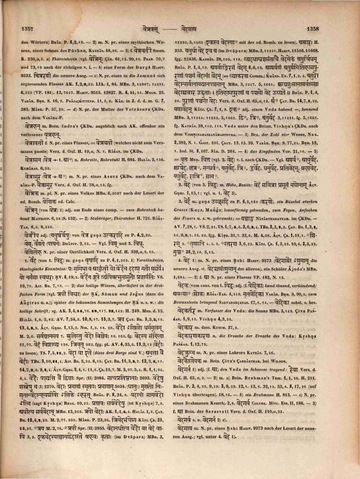
1. véda (von 1. vid) m. gaṇa vṛṣādi zu P. 6,1,203. 1〉 Verständniss, theologische Kenntniss: yaḥ sa̱midhā̱ ya āhùtī̱ yo vedèna dadāśa̱ martò a̱gnayè . yo namàsā svadhva̱raḥ ṚV. 8,19,5. vedèna rū̱pe vyàpibatsutāsu̱tau pra̱jāpàtiḥ VS. 19,78. AIT. BR. 7,18. — 2〉 das heilige Wissen, überliefert in der dreifachen Form (vgl. trayī vidyā) der Ṛc, Sāman und Yajus (dazu die Aṅgiras u. a.); später die bekannten Sammlungen der Ṛc, u. s. w.: die heilige Schrift; sg. AK. 3,4,14,76. AK. 3,4,18,117. AK. 3,4,22,142. H. 249. MED. d. 15. HALĀY. 1,9. HALĀY. 5,82. AV. 7,54,2. AV. 10,8,17. AV. 15,3,7. traya ŚAT. BR. 5,5,5,10. ŚAT. BR. 13,4,3,3. ĀŚV. GṚHY. 1,15,3. NIR. 1,2. NIR. 1,18. NIR. 1,20. vedo 'khilo dharmamūlam M. 2,6. sarvajñānamaya M. 7. śrutistu vedo vijñeyaḥ M. 10. M. 165. fg. vedasya saṃhitā M. 11,77. vedaṃ viplāvya M. 198. trivṛt M. 263. fgg. pl. AV. 4,35,6. AV. 19,2,12 (vedā̀ḥ zu lesen). TS. 7,5,11,2. vedā̱ vā e̱te (diese drei Berge sind V.) a̱na̱ntā vai vedā̀ḥ TBR. 3,10,11,4. AIT. BR. 5,32. AIT. BR. 6,15. ŚAT. BR. 11,3,3,7. ŚAT. BR. 12,3,4,11. ŚAT. BR. 14,7,3,6. ŚAT. BR. 14,9,2,4. ĀŚV. GṚHY. 3,4,1. ĀŚV. GṚHY. 3,11,1. ŚR. 10,7. M. 2,97. M. 5,4. R. 1,1,94. R. 1,4,4. vedaiḥ paśyanti vai dvijāḥ Spr. (II) 2084. satyapratiṣṭhānāḥ Spr. (II) 2693. vedeṣu śastreṣu ca Spr. (I) 2270. vedāḥ pramāṇaṃ smṛtayaḥ pramāṇam Spr. (I) 5034. (dhātuḥ) mukhato niḥsṛtānvedānhayagrīvo 'ntike 'harat BHĀG. P. 8,24,8. vadānāṃ sāmavedo 'smi (sagt Kṛṣṇa) BHAG. 10,22. praṇavaḥ sarvavedeṣu (ist Kṛṣṇa) BHAG. 7,8. adhītya sarvavedān MBH. 13,363. trayo vedāḥ AK. 1,1,5,4. HALĀY. 1,8. ŚAT. BR. 10,4,2,25. M. 2,77. M. 2,230. MĀRK. P. 23,36. trivedasaṃyoga KĀTY. ŚR. 25,14,37. ˚traya M. 2,76. ˚trayī Spr. (II) 2955. vedānadhītya vedau vā vedaṃ vāpi Spr. (II) 3,2. ekavedasyājñānādvedāste bahavaḥ kṛtāḥ (im Dvāpara) MBH. 3,11253. MBH. 5,1663 (ekasya vedasyā˚ mit der ed. Bomb. zu lesen). catvāraḥ H. 253. caturdhā veda eva ca (im Dvāpara) MBH. 3,11251. HARIV. 11516. fgg. HARIV. 11668. fgg. HARIV. 12436. KATHĀS. 38,103. KATHĀS. 38,118. vyadadhādyajñasaṃtatyai vedamekaṃ caturvidham BHĀG. P. 1,4,19. atharvāṅgirasaṃ vedam BHĀG. P. 6,6,19. ātharvaṇaṃ caturthamitihāsapurāṇaṃ pañcamaṃ vedānāṃ vedam (= vyākaraṇa Comm.) CHĀND. UP. 7,1,2. CHĀND. UP. 7,1,4. caturo vedānsarvānākhyānapañcamān MBH. 3,2247. MBH. 5,1661. ṛgyajuḥsāmātharvākhyā vedāścatvāra uddhṛtāḥ . itihāsapurāṇaṃ ca pañcamo veda ucyate .. BHĀG. P. 1,4,20. purāṇaṃ pañcamo vedaḥ Verz. d. Oxf. H. 65,a,13. á˚ ŚAT. BR. 14,7,1,22. yathāvedam KĀTY. ŚR. 7,1,8. eka˚ adj. einen Veda habend —, kennend MBH. 3,11244. MBH. 3,11252. MBH. 5,1662. dvi˚, tri˚, caturveda MBH. 3,11251. fg. MBH. 5,1661. fg. KATHĀS. 38,102. KATHĀS. 38,118. Veda unter den Beinn. Viṣṇuʼs ŚKDR. nach dem VIṢṆUSAHASRANĀMASTOTRA. — 3〉 Bez. der Zahl vier WEBER, Nax. 2,382, N. 1. JYOT. 101. ŚRUT. 13. ŚRUT. 15. ŚRUT. 39. VARĀH. BṚH. S. 77,24. BṚH. 12,1. Ind. St. 8,167. SĀH. D. 264. — 4〉 das Empfinden VOP. 21,10. — 5〉 = vṛtta MED. vitta (vgl. 2. veda) v. l. nach ŚKDR. — Vgl. atharva˚, āyurveda, ṛgveda, kṣatra˚, gandharva˚, caturveda, tri˚, durveda, dhanurveda, prativedam, brahmaveda, yajurveda, rātri˚, sāma˚.
Originaltext · Deutsch · Substantiv Maskulin
2. veda (von 3. vid) m. Habe, Besitz: vedaṃ savitrā prasūtaṃ maghonām ĀŚV. GṚHY. 1,15,1; vgl. u. 1. veda 5〉.
Originaltext · Deutsch · Substantiv Maskulin
3. vedá m. gaṇa uñchādi zu P. 6,1,160 (karaṇe). ein Büschel starken Grases (Kuśa, Muñja) besenförmig gebunden, zum Fegen, Anfachen des Feuers u. s. w. gebraucht; = yajñāṅga NĀNĀRTHARATNAM._im_ŚKDR. — AV. 7,28,1. VS. 2,21. TS. 1,7,4,6. TS. 2,6,3,4. TBR. 3,3,7,2. ŚAT. BR. 1,3,1,11. ŚAT. BR. 1,9,2,1. ŚAT. BR. 1,3,1,16. ŚAT. BR. 1,3,1,22. fgg. KĀṬH. 31,7. KĀṬH. 32,6. M. 4,36. ĀŚV. ŚR. 1,11,1. ˚śiras ĀŚV. ŚR. 2. ˚tṛṇāni ĀŚV. ŚR. 4. ĀŚV. ŚR. 5. ĀŚV. ŚR. 9. ˚staraṇa ĀŚV. ŚR. 3,6,23. KĀTY. ŚR. 1,3,23. KĀTY. ŚR. 1,10,6. KĀTY. ŚR. 2,5,25. muñja˚ KĀTY. ŚR. 26,2,10. KĀTY. ŚR. 26,5,15.
Originaltext · Deutsch · Substantiv Maskulin
4. veda 1〉 m. N. pr. eines Ṛṣi HARIV. 9573 (vedagāthoṃ 'śumān die neuere Ausg. st. vedaścāthāṃśumān der älteren). ein Schüler Āyodaʼs MBH. 1,684. — 2〉 f. ā N. pr. eines Flusses VP. 182, N. 13.
Originaltext · Deutsch · Worttyp nicht bestimmt
2. veda vgl. su˚.
Böhtlingk 1879 Substantiv Maskulin
Originaltext · Deutsch · Substantiv Maskulin
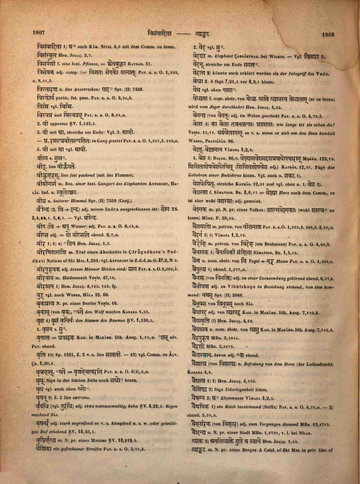
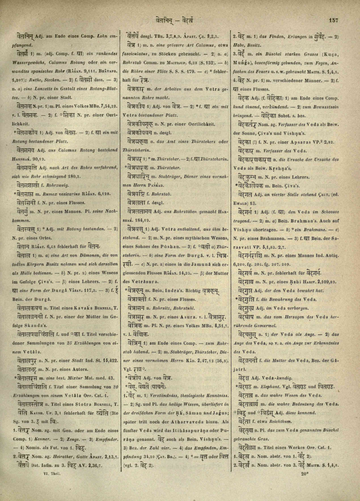
1. véda m. — 1〉 Verständniss, theologische Kenntniss. — 2〉 Sg. und Pl. das heilige Wissen, überliefert in der dreifachen Form der Ṛc, Sāman und Yajus; später tritt noch der Atharvaveda hinzu. Als fünfter Veda wird das Itihāsapurāṇa oder Purāṇa genannt. veda auch als Bein. Viṣṇuʼs. — 3〉 Bez. der Zahl vier. — 4〉 das Empfinden, Empfindung Chr. 34,20. (ŚAT. BR.). — 5〉 = vṛtta oder vitta (Vgl. 2. veda) 2〉.
Originaltext · Deutsch · Substantiv Maskulin
2. veda m. — 1〉 das Finden, Erlangen in suvéda — 2〉 Habe, Besitz.
Originaltext · Deutsch · Substantiv Maskulin
3. vedá m. ein Büschel starken Grases (Kuśa, Muñja), besenförmig gebunden, zum Fegen, Anfachen des Feuers u. s. w. gebraucht MAITR. S. 1,4,3.
Originaltext · Deutsch · Substantiv Maskulin
4. veda N. pr. — 1〉 m. verschiedener Männer. — 2〉 f. ā eines Flusses.
Apte 1890 Substantiv Maskulin
Originaltext · Englisch · Substantiv Maskulin
vedaḥ [vid-ac ghañ vā] 1 Knowledge. 2 Sacred knowledge, holy learning, the scriptures of the Hindus. (Originally there were ([Page 1010-b]) only three Vedas: ṛgveda, yajurveda and sāmaveda, which are collectively called trayī ‘the sacred triad’; but a fourth, the atharvaveda, was subsequently added to them. Each of the Vedas has two distinct parts, the Mantra or Saṃhitā and Brāhmaṇa. According to the strict orthodox faith of the Hindus the Vedas are a-paurusheya, ‘not human compositions’, being supposed to have been directly revealed by the Supreme Being Brahman, and are called ‘Śruti’ i. e. ‘what is heard or revealed’, as distinguished from ‘Smṛti’, i. e. ‘what is remembered or is the work of human origin’; see śruti, smṛti also; and the several sages, to whom the hymns of the Vedas are ascribed, are, therefore, called draṣṭāraḥ ‘seers’, and not kartāraḥ or sraṣṭāraḥ ‘composers’). 3 A bundle of Kuśa grass; Ms. 4. 36. 4 N. of Viṣṇu. 5 A part of a sacrifice (yajñāṃga). 6 Exposition, comment, gloss. 7 A metre. 8 Acquisition, gain, wealth (Ved.). Comp. — agraṇīḥ N. of Sarasvatī. — aṃgaṃ ‘a member of the Veda’, N. of certain classes of works regarded as auxiliary to the Vedas and designed to aid in the correct pronunciation and interpretation of the text and the right employment of the Mantras in ceremonials; (the Vedāṅgas are six in number: — śikṣā kalyo vyākaraṇaṃ niruktaṃ chaṃdasāṃ cayaḥ . jyotiṣāmayanaṃ caiva vedāṃgāni ṣaḍeva tu ..; i. e. 1 śikṣā ‘the science of proper articulation and pronunciation’; 2 chaṃdas ‘the science of prosody’; 3 vyākaraṇa ‘grammar’; 4 nirukta ‘etymological explanation of difficult Vedic words’; 5 jyotiṣa ‘astronomy’, and 6 kalpa ‘ritual or ceremonial’). — adhigamaḥ, — adhyayanaṃ holy study, study of the Vedas. — adhipaḥ 1 one who presides over the Veda; ṛgvedādhipatirjīvo yajurvedādhipo bhṛguḥ . sāmavedādhipo bhaumaḥ śaśijo'tharvavedapaḥ ... 2 N. of Viṣṇu. — adhyāpakaḥ a teacher of the Vedas, a holy preceptor. — aṃtaḥ 1 ‘the end of the Veda’, an Upanishad (which comes at the end of the Veda). 2 the last of the six principal Darśanas or systems of Hindu philosophy; (so called because it teaches the ultimate aim ([Page 1010-c]) and scope of the Veda, or because it is based on the Upaniṣads which come at the end of the Veda); (this system of philosophy is sometimes called uttaramīmāṃsā being regarded as a sequel to Jaimini's pūrvamīmāṃsā, but it is practically quite a distinct system; see mīmāṃsā. It represents the popular pantheistic creed of the Hindus, regarding, as it does, the whole world as synthetically derived from one eternal principle, the Brahman or Supreme Spirit; see brahman also). ˚gaḥ, ˚jñaḥ a follower of the Vedānta philosophy. — aṃtin m. a follower of the Vedānta philosophy. — abhyāsaḥ 1 the study of the Vedas. 2 the repetition of the sacred syllable om. — arthaḥ the meaning of the Vedas. — avatāraḥ revelation of the Vedas. — ādi n., — ādivarṇaḥ, — ādibījaṃ the sacred syllable om. — ukta a. scriptural, taught in the Vedas. — udayaḥ N. of the sun (the SāmaVeda being said to have proceeded from him). — udita a. scriptural, ordained by the Vedas. — kauleyakaḥ an epithet of Śiva. — garbhaḥ 1 an epithet of Brahman. 2 a Brāhmaṇa versed in the Vedas. 3 N. of Viṣṇu. — jñaḥ a Brāhmaṇa versed in the Vedas. — trayaṃ, -trayī the three Vedas collectively. — dṛṣṭa a. sanctioned by the Vedas — niṃdakaḥ 1 an atheist, a heretic, an unbeliever (one who rejects the divine origin and character of the Vedas). 2 a Jaina or Buddhist. — niṃdā unbelief, heresy. — pāragaḥ a Brāhmaṇa skilled in the Vedas. — mātṛ f. N. of a very sacred Vedic verse called Gāyatrī q. v. — vacanaṃ, -vākyaṃ a Vedic text. — vadanaṃ grammar. — vāsaḥ a Brāhmaṇa. — vāhya a. contrary to, or not founded on, the Veda. — vid m. 1 a Brāhmaṇa versed in the Vedas. 2 N. of Viṣṇu. — vihita a. enjoined by the Vedas. — vyāsaḥ an epithet of Vyāsa who is regarded as the ‘arranger’ of the Vedas in their present form; see vyāsa. — saṃnyāsaḥ giving up the ritual of the Vedas. — saṃmata, -saṃmita a. sanctioned by the Vedas.

Cappeller 1887 Substantiv Maskulin
Originaltext · Deutsch · Substantiv Maskulin
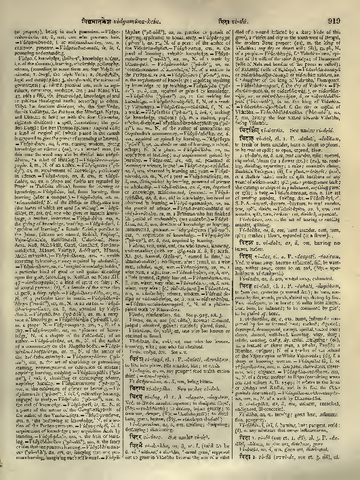
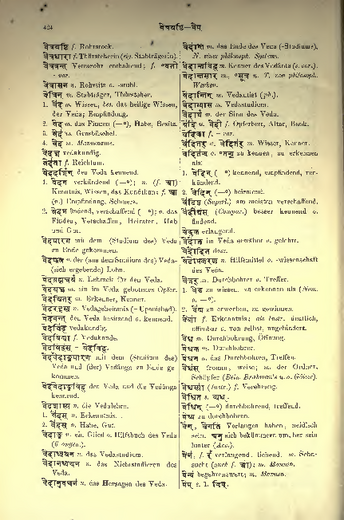
1. véda m. Wissen, bes. das heilige Wissen, der Veda; Empfindung.
Originaltext · Deutsch · Substantiv Maskulin
2. veda m. das Finden (—˚), Habe, Besitz.
Originaltext · Deutsch · Substantiv Maskulin
3. vedá m. Grasbüschel.
Originaltext · Deutsch · Substantiv Maskulin
4. veda m. Mannsname.
Burnouf 1866 Substantiv Maskulin · Worttyp nicht bestimmt
Originaltext · Französisch · Substantiv Maskulin
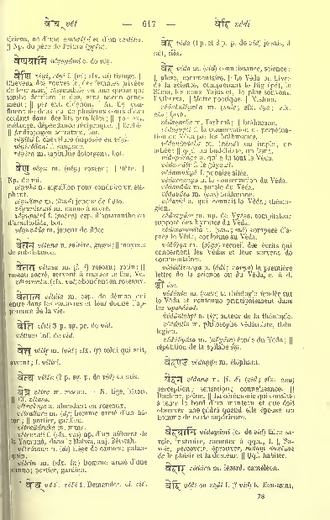
veda veda m. (vid) connaissance, science; glose, commentaire. Le Veda ou Livre de la science, comprenant le Ṛg (ṛc), le Sāma, les deux Yajus et, le plus souvent, l'Atharva. Mètre poètique. Viṣṇu. vedakauleyaka m. (kula; sfx. eya; sfx. aka) Śiva. vedagarbha m. Brahmā; brâhmane. vedagupti f. la conservation et perpétuation du Veda par les brâhmanes. vedanindaka m. (nind) un impie, un athée; qqf. un buddhiste, un jaina. vedapāraga a. qui a lu tout le Veda. vedamātṛ f. le gāyatrī. vedamukhyā f. punaise ailée. vedarakṣaṇa n. la conservation du Veda. vedavāda m. parole du Veda. vedavāsa m. (vas) brâhmane. vedavid a. qui connaît le Veda; théologien. vedavyāsa m. np. de Vyāsa, compilateur supposé des hymnes du Veda. vedasammita a. (sam; mā) composé d'après le Veda, conforme au Veda. vedāṅga m. (aṅga) recueil des écrits qui concernent les Vedas et leur servent de commentaires. vedādivarṇa n. (ādi; varṇa) la première lettre de la science ou du Veda, c-à-d. oṃ om. vedānta m. (anta) la théologie fondée sur le Veda et contenue principalement dans les upaniṣad. vedāntakṛt a. (kṛ) auteur de la théologie. vedāntin m. philosophe vêdântiste, théologien. vedābhyāsa m. (abhyāsa) étude du Veda; répétition de la syllabe oṃ.
Originaltext · Französisch · Worttyp nicht bestimmt
veda veda (1p. et 3p. p. de vid) je sais, il sait, οἶδα.
Quelltextfundstellen (7)
HP 1 Fundstelle
SiSa 3 Fundstellen
Mit AYI Free weitermachen
Bildquelle: AYI Archiv.