
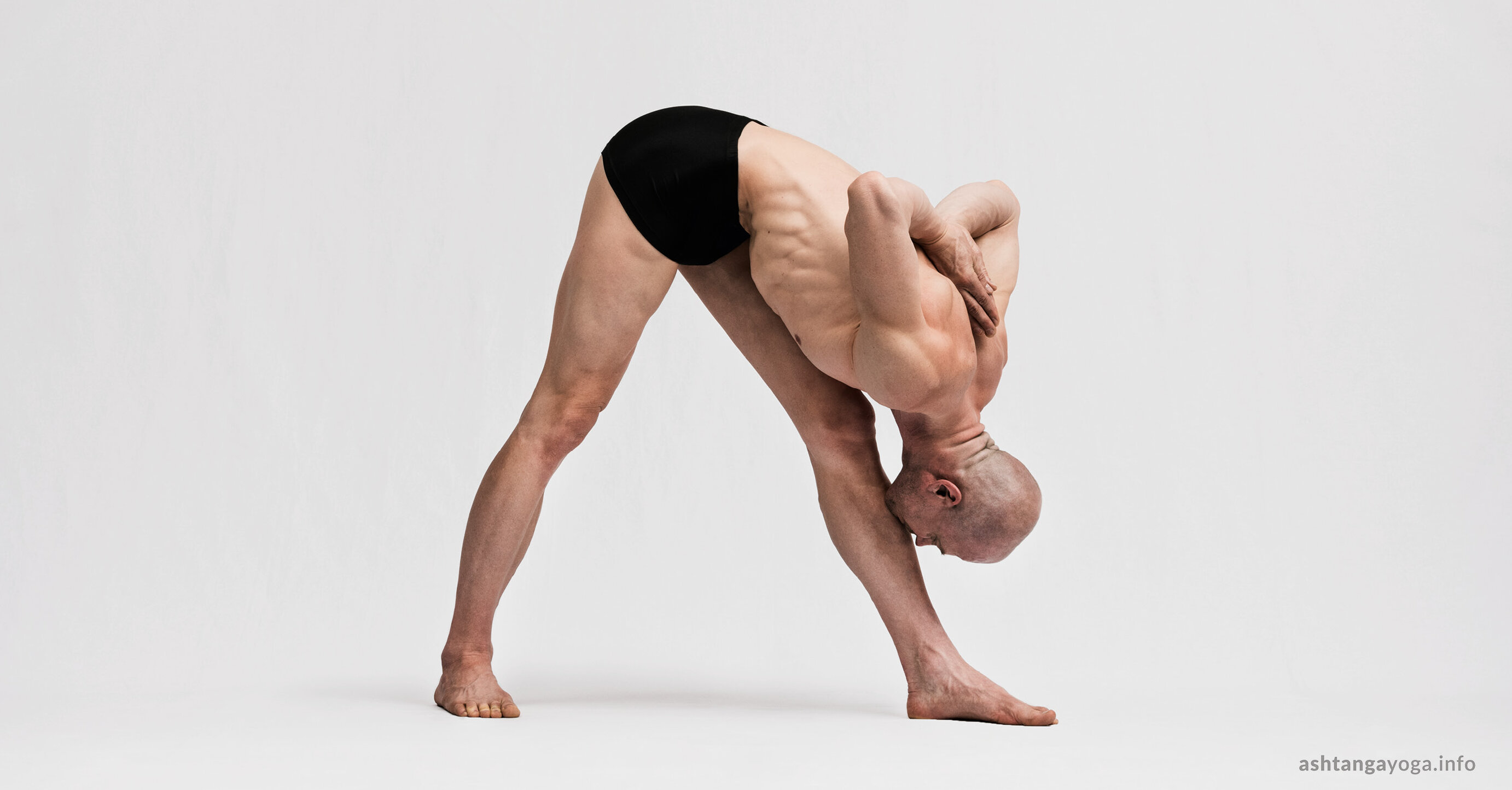
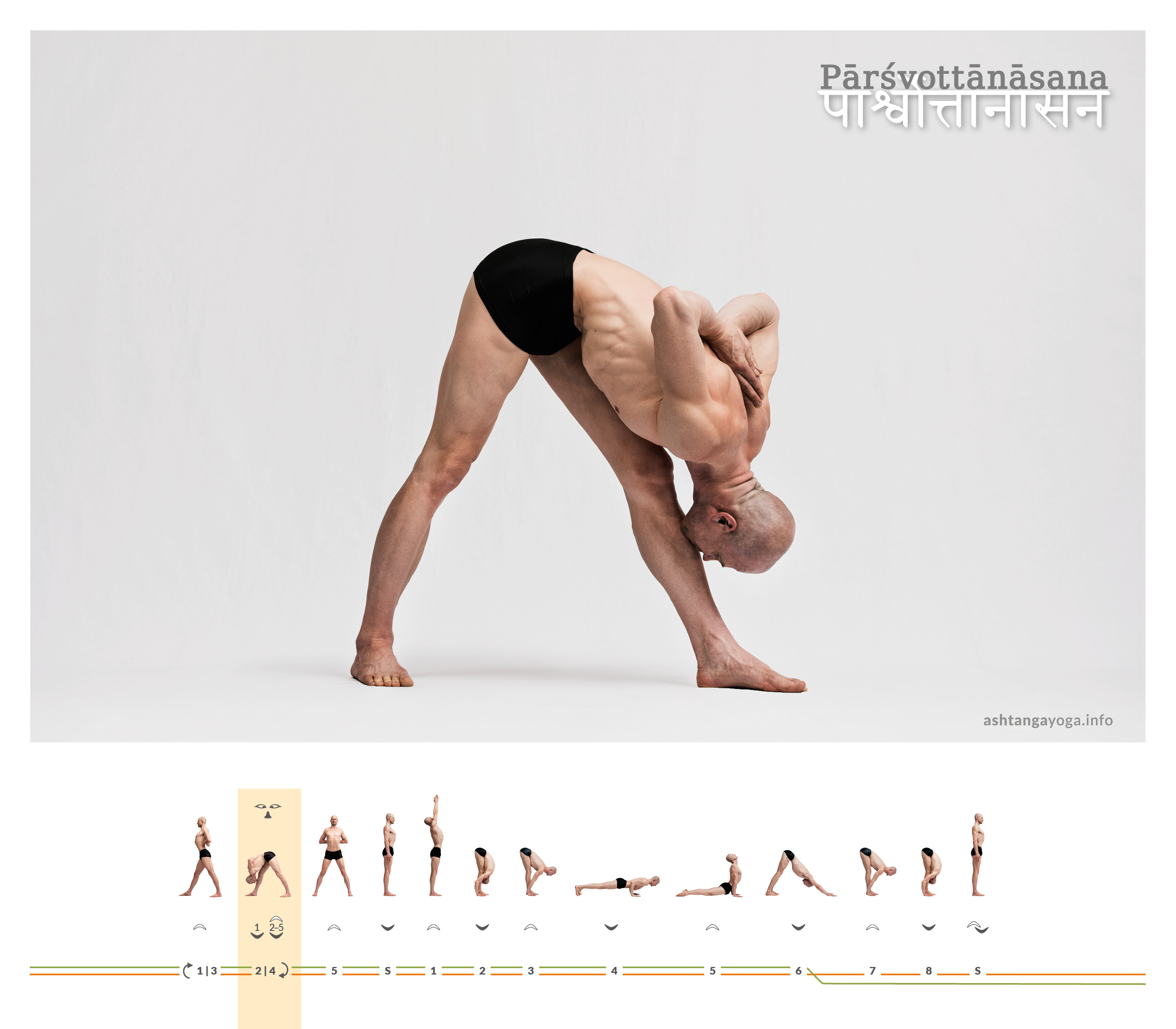
Pārśvottānāsana: intense side stretch
The intense side stretch is a forward bend over the front leg in a relatively narrow stance. The palms press together behind the back in Pārśvottānāsana.
Note: The foot position in this posture is similar to the two revolved postures, revolved triangle (parivṛtta trikoṇāsana) and revolved side angle (parivṛtta pārśva koṇāsana). The back foot is turned clearly inward. The stance is wide enough that the pelvis can comfortably face the back leg. Unlike the preceding postures, however, the step is relatively short. About one arm's length is the optimal distance for a harmonious forward bend.
Vinyāsa 2 - Exhale, 5 breaths
As you exhale, fold forward from your pelvis over your right leg until your chin touches your shin. Stay here until the fifth exhalation.
Vinyāsa 3 to 4
Inhale and lift your torso upright. In the same breath, turn your feet and place them again as in Vinyāsa 1, this time with the left foot in front. From here, repeat Vinyāsa 2 on the left side of your body.
Vinyāsa 5 - Inhale
Inhale and lift your torso upright. In the same breath, turn both legs and slide your feet until they stand parallel and symmetrical to one another. Keep your hands in position behind your back.
Samasthitiḥ - Exhale
Step or jump both feet back to the starting position of neutral standing as you exhale. Release your hands and lower your arms.
In the first series, you can traditionally move directly from here into the movement flow of the next posture. In the AYI method, follow the movement flow of this posture through one complete vinyāsa. This helps you keep warmth and rhythm. For the second, third, or fourth series, continue a little further through the vinyāsa sequence.
Vinyāsa 1 to 6, or 1 to 9 and Samasthitiḥ
Follow the movement flow you know through one complete vinyāsa back to neutral standing if you want to continue your practice with the first series. Otherwise, for the second, third, or fourth series, a vinyāsa into Downward-Facing Dog is enough.
Tradition: This vinyāsa sequence from standing into Downward-Facing Dog can be understood in different ways, depending on taste: either as the end of Pārśvottānāsana or as the entry into the movement sequence of the first posture of the series being practiced. The hold and even the count of the movement sequence are the same in both cases. The only question is where the teacher names the next posture: in Downward-Facing Dog or already while standing. Sri K. Pattabhi Jois usually practiced the latter. For Western students, however, that is often more confusing. I therefore recommend the former.
From neutral standing in the first series, or from the hold in Downward-Facing Dog in the second, third, or fourth series, move into the movement flow of the next posture.
Tradition: This posture is the last of the Fundamentals. From here, depending on your experience, aim, and the day, you move into one of the practice series. Even though the first series begins with several standing postures, these do not belong to the Fundamentals. So if you move from here into the second, third, or fourth series, you traditionally do not practice the standing postures of the first series.
Effect: The intense side stretch, Pārśvottānāsana, is the most intensive stretch for the back of the leg within the Fundamentals. Because you fold forward over only one leg, you can keep the trunk easily in its neutral length and focus the stretch strongly into the back of the front leg. The hand position brings mobility into the wrists and shoulders.
Continue with AYI Free
Photographer: Richard Pilnick - www.richardpilnick.com

Please log in to write a message. Go to login