
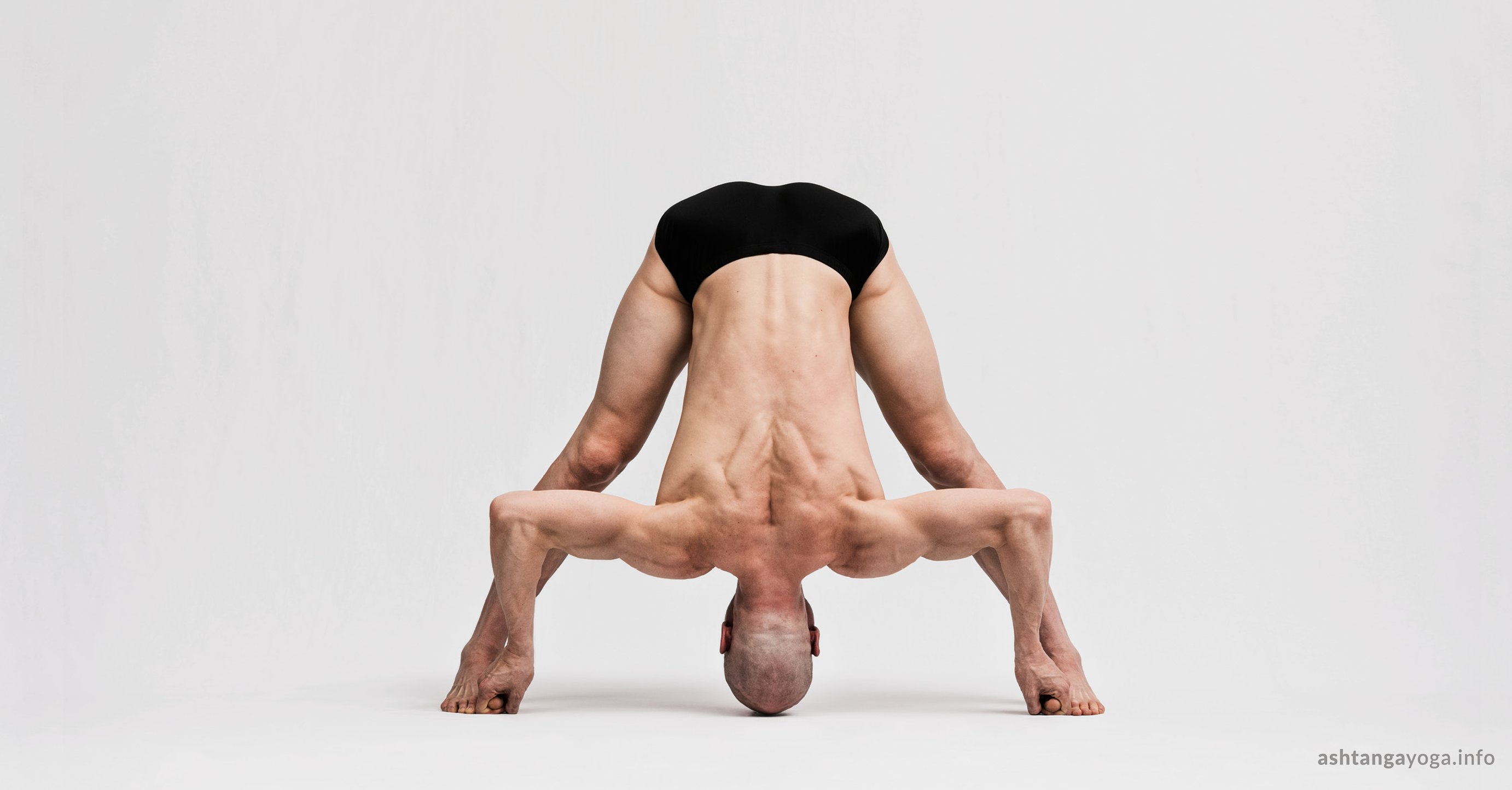
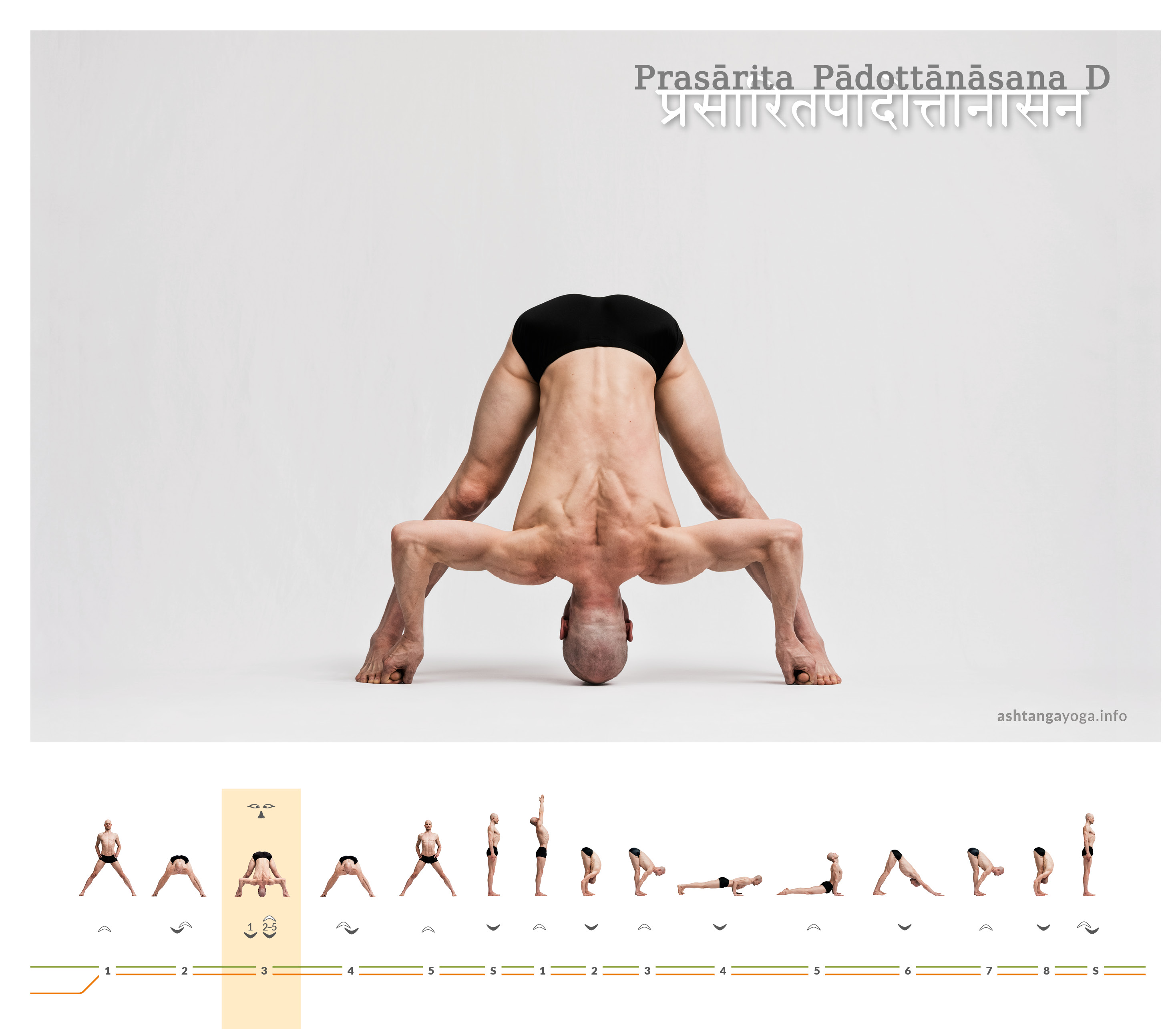
Prasārita Pādottānāsana D: wide-legged forward bend
In the fourth version of the wide-legged forward bend, the feet stand about one body-length apart, the torso folds forward, and two fingers hold the big toes.
Vinyāsa 3 - Exhale, 5 breaths
Now, as you exhale, bend your elbows out to the sides and let your spine grow long and as straight as possible downward. With the necessary flexibility, the crown of your head reaches the floor. Stay here until the fifth exhalation.
Note: Consciously notice the position of your shoulder blades. Let them glide sideways across your back in the direction of the upper arms. This creates space between them and allows your neck to relax.
Vinyāsa 4 - Inhale, exhale
As you inhale, straighten your arms and lift your gaze. Your grip on the big toes remains unchanged. Exhale slowly here.
Vinyāsa 5 - Inhale
As you inhale, place your hands from above onto the rim of your pelvis. Your fingers point forward. Rise fully upright with the same inhalation.
Note: By pressing your hands from above into the rim of your pelvis, you create length in the spine and protect your intervertebral discs.
Samasthitiḥ - Exhale
Step or jump both feet back to the starting position of neutral standing as you exhale.
Traditionally, you can move directly from here into the movement flow of the next posture. In the AYI method, follow the movement flow of this posture through one complete vinyāsa. This helps you keep warmth and rhythm.
Vinyāsa 1 to 9 and Samasthitiḥ
Follow the movement flow you know through one complete vinyāsa.
From neutral standing, move into the movement flow of the next posture.
Effect: Prasārita Pādottānāsana D is the most intensive forward bend with the legs spread wide. Through the pull of the arms on the big toes, you can intensify the stretch along the backs of the legs. Fascia changes shape under tension that you hold for at least 30 seconds, the creeping effect. Holding intensely for longer, however, would tend to lead to hardening. After a small movement of the fascia, you can trigger this creeping effect again. This principle, called repetitive stretching, makes it possible to build flexibility optimally. In this fourth round of an almost identical practice, your dorsal fascia is ideally prepared to move even deeper into the posture.
Continue with AYI Free
Photographer: Richard Pilnick - www.richardpilnick.com

Please log in to write a message. Go to login
No messages yet.