
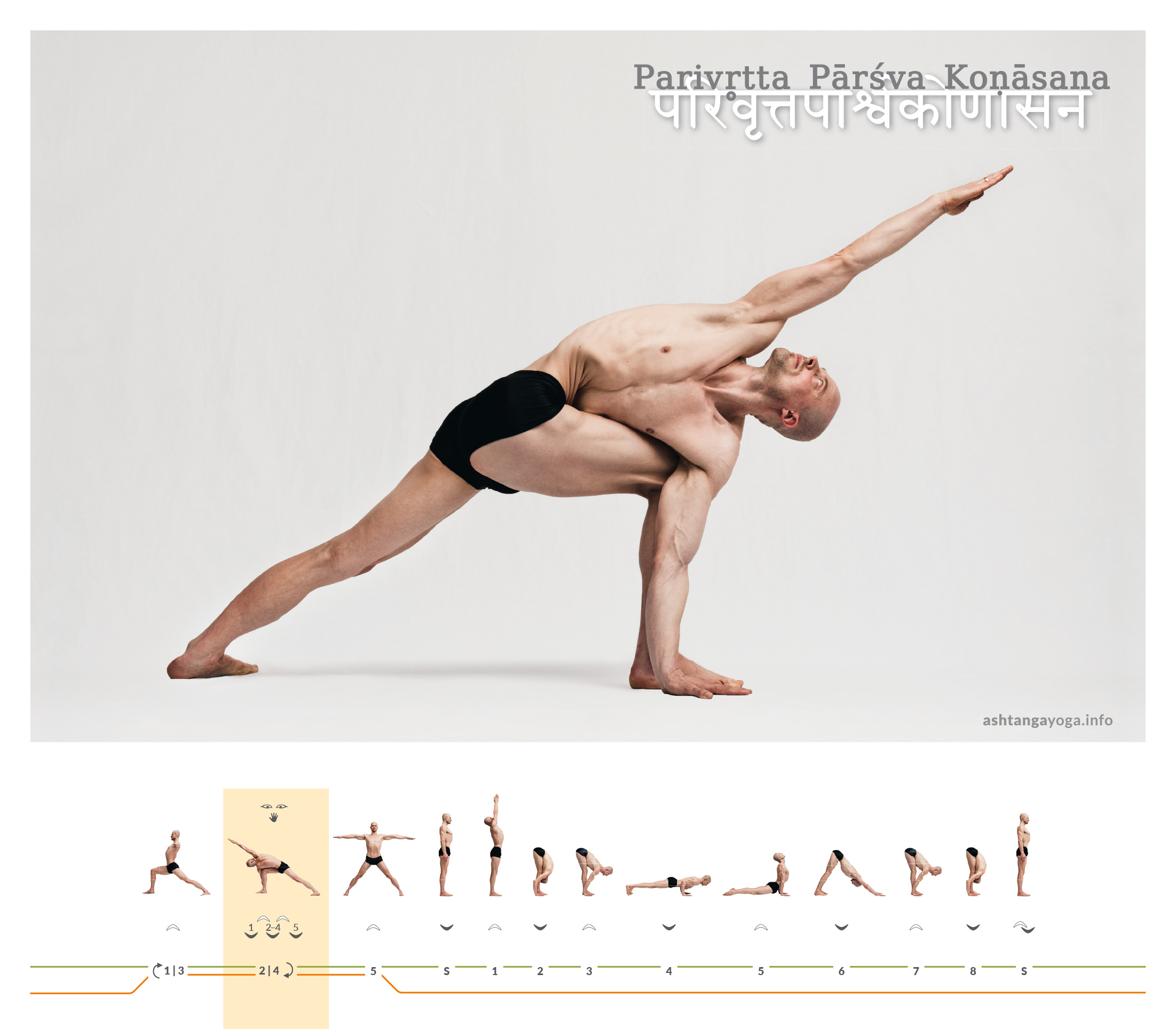
Parivṛtta Pārśva Koṇāsana: revolved side angle
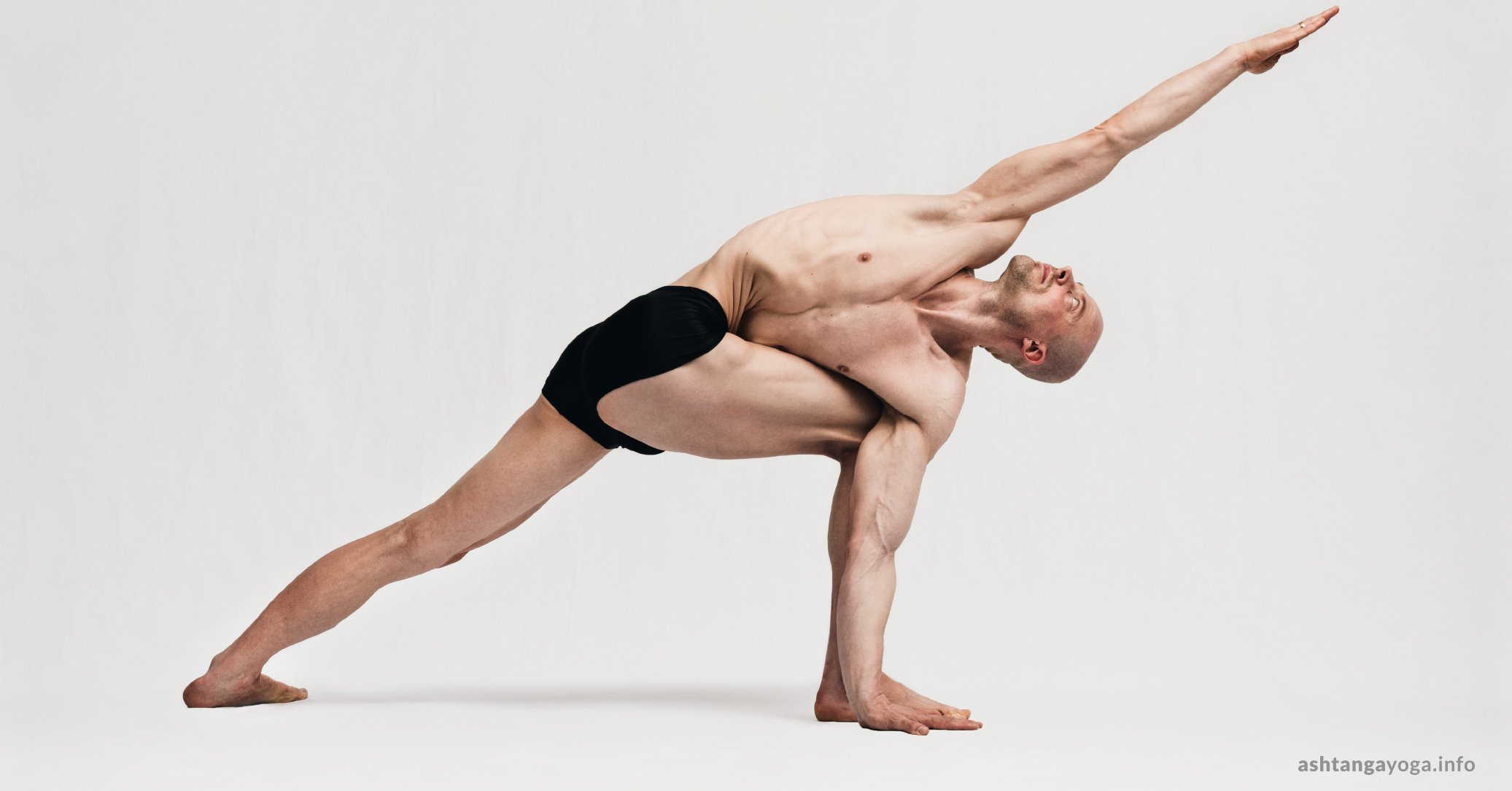
Revolved side angle is a standing posture with a turned pelvis, a bent front leg, and an intense rotation through the torso over the front leg.
In the traditional count: Begin directly from Vinyāsa 4 of the previous movement sequence.
Vinyāsa 1 - Inhale
At the end of the fifth exhalation, turn your gaze down toward the left hand. Inhale and lift your torso upright. In the same breath, turn both legs. Now place your feet so that your right foot points straight forward. Your left foot stands about one foot-width inside the line defined by the center of your right foot. This allows your pelvis to align comfortably across the slightly wider stance, parallel to the short edge of your yoga mat. Your back foot is turned clearly inward, more than in Utthita Pārśva Koṇāsana. Bend your right knee until it is vertically above your ankle. Spread your arms parallel to your pelvis, parallel to the short edge of your yoga mat.
Vinyāsa 2 - Exhale, 5 breaths
Then, as you exhale, slide your upper body forward over your right thigh, leading with the left flank. Place your left hand beside the outer edge of the right foot. Your fingers point in the same direction as the foot. Bring your right arm into the continuation of the line formed by your right flank and left leg. Stay here until the fifth exhalation.
Try: To move deeply into the twist, first place your right hand on your right thigh. With this hand, slide your right knee diagonally inward. Deliberately round your spine and reach your left arm far across the knee that the right hand has moved to the left. Repeat this movement several times if you like, until your left shoulder blade slides over the right thigh. This gives you an ideal starting position for the intense rotation to emerge.
Vinyāsa 3 to 4
At the end of the fifth exhalation, turn your gaze down toward the left hand. Inhale and lift your torso upright. In the same breath, turn your feet and place them as in Vinyāsa 1. From here, repeat Vinyāsa 2 on the left side of your body.
Vinyāsa 5 - Inhale
At the end of the fifth exhalation, turn your gaze down toward the left hand. Inhale and lift your torso upright. In the same breath, turn both legs and slide your feet until they stand parallel and symmetrical to one another. Your arms are spread horizontally, palms facing down.
Samasthitiḥ - Exhale
Step or jump both feet back to the starting position of neutral standing as you exhale.
Traditionally, you can move directly from here into the movement flow of the next posture. In the AYI method, follow the movement flow of this posture through one complete vinyāsa. This helps you keep warmth and rhythm.
Vinyāsa 1 to 9 and Samasthitiḥ
Follow the movement flow you know through one complete vinyāsa.
From neutral standing, move into the movement flow of the next posture.
Effect: Revolved side angle, Parivṛtta Pārśva Koṇāsana, brings an intense rotation into your entire trunk. Breath and trunk flexibility are closely connected. Only as much air can enter your lungs as the flexibility of your trunk allows expansion. Likewise, only as much air can leave your lungs as the flexibility of your trunk allows. Because this posture already asks the maximum of your trunk's flexibility, breathing often feels difficult. Keep breathing consciously as deeply as you can. Breath develops further flexibility, and flexibility develops the depth of your breath.
Continue with AYI Free
Photographer: Richard Pilnick - www.richardpilnick.com

Please log in to write a message. Go to login