

ha ह – eben; gewiss; wahrlich
Adjektiv · Partikel · Substantiv Feminin · Substantiv Maskulin · Substantiv Neutrum · Worttyp nicht bestimmt
Wörterbuchquellen
AYI Wörterbuch Partikel
eben; gewiss; wahrlich
Cappeller 1891 Worttyp nicht bestimmt
Originaltext · Englisch · Worttyp nicht bestimmt
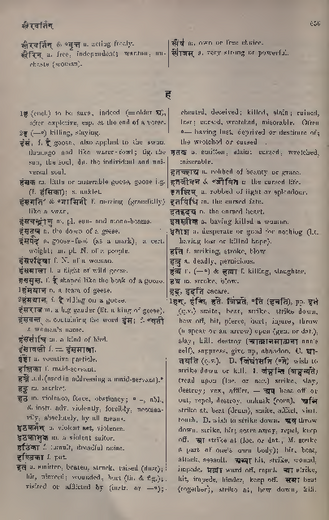
ha1 ·(encl.) to be sure, indeed ( = older gha), often expletive, esp. at the end of a verse.
Originaltext · Englisch · Worttyp nicht bestimmt
ha2 ·(--°) killing, slaying.
Monier-Williams 1872 Partikel · Substantiv Maskulin · Worttyp nicht bestimmt
Originaltext · Englisch · Partikel
ha 3 . ha, ind. = Ved. 2. gha, an emphatic particle laying stress on the preceding word (generally equivalent to ‘verily,’ ‘indeed,’ ‘manifestly,’ ‘evi- dently,’ &c., e. g. na ha, not indeed; it is eu- phonically changed to dha, e. g. yad dha = yadā khalu, when indeed; kad dha, what then? and is sometimes used without any distinct signification, often with the Perfect and Impf.; cf. Pāṇ. III. 2, 116); a vocative particle (corresponding to ‘ho!’ &c.); a particle of reproach or disdain; of laughter; [cf. Gr. γε Dor. γα; (according to some also) Lat. hi, ha, ho in hic, hœc, hoc; Goth. prefix ga-; Angl. Sax. ge-.]

Originaltext · Englisch · Substantiv Maskulin
ha 2 . ha, as, m. a form of Śiva or Bhairava, (see nakulīśa); water; a cipher (i. e. the arith- metical figure expressing nothing); meditation; auspiciousness; sky, heaven; paradise; blood; dying; fear; knowledge; the moon; Viṣṇu; war, battle; horripilation; a horse; pride; a physician; cause, motive; (according to Śabda-k.) = pāpa-haraṇa; = sakopa-vāraṇa; = śuṣka; (ā), f. (according to some) coition; a lute; (am), n. (according to some) the supreme Spirit; pleasure, delight; a weapon; the sparkling of a gem; the sound of a lute; (as, ā, am), mad, drunk (according to some).
Originaltext · Englisch · Worttyp nicht bestimmt
ha 1 . ha, the thirty-third and last con- sonant of the Nāgarī alphabet (belonging to the guttural class, and in sound corresponding to the English h in hard).
Originaltext · Englisch · Worttyp nicht bestimmt
ha 4 . ha. See under rt. 1. han.
Originaltext · Englisch · Worttyp nicht bestimmt
ha 5 . ha. See under rt. 3. hā.
Originaltext · Englisch · Worttyp nicht bestimmt
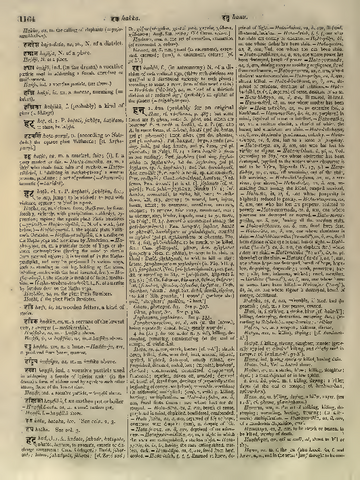
4. ha (for 5. ha see under rt. 3. hā), killing, de- stroying, removing, counteracting (at the end of comps., cf. viṣa-ha).
Originaltext · Englisch · Worttyp nicht bestimmt
5. ha, (at the end of comps.) abandoning, leaving, quitting, avoiding; see p. 1163, col. 2.
Petersburger 1855 Adjektiv · Partikel · Substantiv Maskulin · Substantiv Neutrum · Worttyp nicht bestimmt
Originaltext · Deutsch · Adjektiv
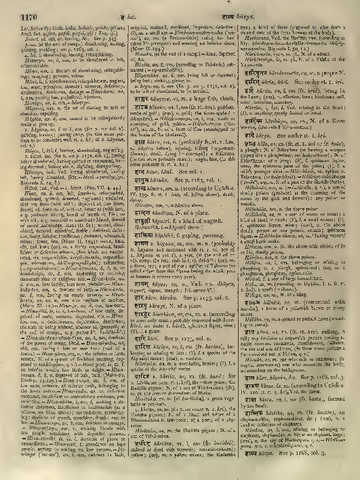
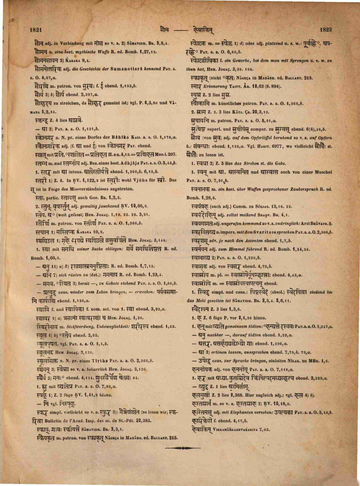
2. ha (von 1. han) adj. (f. ā) am Ende eines comp. tödtend, Tödter; vernichtend, zerstörend P. 3,2,49 (āśiṣi). VOP. 26,33. — Vgl. arāti˚, ākhuviṣa˚, kṛmi˚, mala˚, viṣa˚, vṛtra˚, vraṇa˚, śatru˚, śleṣma˚, satrā˚, sapta˚, sahasra˚.
Originaltext · Deutsch · Adjektiv
3. ha (von hā verlassen, meiden) 1〉 adj. verlassend, meidend in anoka˚ und vāpī˚. — 2〉 f. ā das Verlassen, Meiden ŚABDĀRTHAK._bei_WILSON.
Originaltext · Deutsch · Adjektiv · Partikel · Substantiv Maskulin · Substantiv Neutrum
4. ha 1〉 m. = śiva, salila, śūnya, dhāraṇa, maṅgala, gagana, nakulīśa, rakta und nāka MED. h. 1. = pāpaharaṇa und candra ŚABDAR._im_ŚKDR. = sakopavāraṇa und śuṣka EKĀKṢARAK._im_ŚKDR. dying; fear; knowledge WILSON nach ders. Aut. Viṣṇu; war, battle; horripilation; a horse; pride; a physician; cause, motive. — 2〉 f. ā coition; a lute. — 3〉 n. God, the supreme soul; pleasure, delight; calling, calling to; a weapon; the sparkling of gem; the sound of a lute. — 4〉 m. f. (ā) und n. laughter. — 5〉 adj. mad, drunk WILSON nach ŚABDĀRTHAK. — 6〉 indecl. (!) = aham (!) Ind. St. 2,86, N. 3.
Originaltext · Deutsch · Worttyp nicht bestimmt
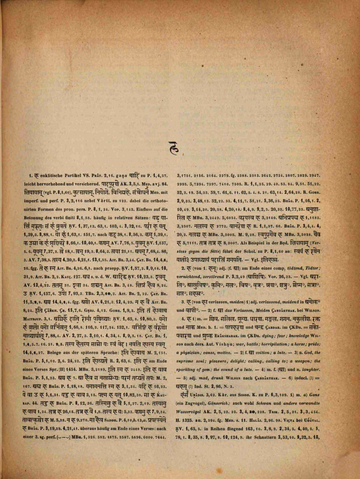
1. ha enklitische Partikel VS. PRĀT. 2,16. gaṇa cādi zu P. 1,4,57. leicht hervorhebend und versichernd. pādapūraṇe AK. 3,5,5. MED. avy. 84. kṣiyāyām (vgl. P. 8,1,60), kutsāyām, niyoge, vinigrahe, saṃbodhane MED. mit imperf. und perf. P. 3,2,116 nebst Vārtt. zu P. 3,2,122. dabei die orthotonirten Formen des pron. pers. P. 8,1,24. VOP. 3,143. Einfluss auf die Betonung des verbi finiti VOP. 8,1,58. häufig in relativen Sätzen: yaddha̱ yāntì ma̱ruta̱ḥ saṃ hà bruvate ṚV. 1,37,13. ṚV. 1,63,1. ṚV. 1,103,4. ṚV. 3,32,10. parā̀ ha̱ yat ṚV. 1,39,3. ṚV. 9,88,1. yo hà ṚV. 1,63,1. ṚV. 1,151,7. nach kad ṚV. 38,1. ṚV. 8,56,5. kam ṚV. 1,39,1. ka u̱grā ke hà śṛṇvire ṚV. 8,66,1. ṚV. 10,40,1. katham AV. 7,76,5. yuvam ṚV. 1,157,5. ṚV. 1,157,6. yūyam ṚV. 7,37,2. tve ṚV. 7,18,1. tvam ṚV. 19,2. ṚV. 8,64,3. tvayā ṚV. 8,21,11. ayam ṚV. 7,68,4. ṚV. 7,86,3. AV. 7,38,5. tasya AV. 4,20,3. AV. 6,21,1. AV. 13,1,55. AIT. BR. 3,44. ŚAT. BR. 14,4,1,26. fgg. te ha sma AIT. BR. 4,26. AIT. BR. 6,1. nach praepp. ṚV. 1,57,2. ṚV. 8,9,18. ṚV. 10,31,9. AIT. BR. 2,2. KAUŚ. 127. adha s. u. d. W. ādiddha ṚV. 10,23,3. evam AV. 12,4,22. tatas 31. evā 34. śaśvat AIT. BR. 3,48. kṣipraṃ haiva AIT. BR. 8,24. u ṚV. 1,157,6. upo ṚV. 7,93,3. TBR. 2,3,10,2. AIT. BR. 2,22. ŚAT. BR. 11,5,2,8. atha ŚAT. BR. 14,4,1,4. fgg. atho AV. 6,21,3. AV. 12,4,39. na ha vai AIT. BR. 8,24. iti ŚĀṄKH. ŚR. 15,7,6. GṚHY. 4,12. GOBH. 1,9,2. iti taṃ hovāca MAITRYUP. 3,1. a̱gnirhà dāti̱ romā̀ pṛthi̱vyāḥ ṚV. 1,65,8. ṚV. 10,80,3. ya̱mo hà jā̱to ya̱mo janìtvam ṚV. 1,66,8. ṚV. 1,116,3. ṚV. 1,117,24. ṚV. 1,152,1. vasìṣṭhaṃ ha̱ vàruṇo nā̱vyādhā̀t ṚV. 7,88,4. AV. 2,27,3. AV. 3,10,1. AV. 4,34,4. AV. 8,9,5. AV. 8,9,18. ŚAT. BR. 1,1,1,5. ŚAT. BR. 1,1,1,7. ŚAT. BR. 1,1,1,16. ŚAT. BR. 1,1,1,21. ŚAT. BR. 1,1,2,5. tasya haitasya sāmno yaḥ svaṃ veda . bhavati hāsya svam ŚAT. BR. 14,4,1,27. Belege aus der späteren Sprache: iti hovāca M. 2,151. BHĀG. P. 5,1,10. BHĀG. P. 5,2,6. BHĀG. P. 5,24,23. iti hocyate R. 2,63,6. iti ha am Ende eines Verses Spr. (II) 1454. MBH. 3,2189. iti sma ha MBH. 3,2448. iti ha vāva BHĀG. P. 5,1,23. atha ha 7. ā haiva sa nakhāgrebhyaḥ paramaṃ tapyate tapaḥ M. 2,167. adya ha BHĀG. P. 1,18,18. yamāmananti sma ha BHĀG. P. 3,1,34. yadi ha BHĀG. P. 16,23. ye vā u ha BHĀG. P. 5,1,31. yadu ha vāva BHĀG. P. 3,15. pakṣma ha yat BHĀG. P. 10,82,38. sā ha CAURAP. 44. tadu ha BHĀG. P. 8,12,36. tasminnu ha vai BHĀG. P. 5,1,27. BHĀG. P. 5,2,19. tasyāmu ha vāva BHĀG. P. 1,24. tatra ha BHĀG. P. 26,15. tatra ha vai BHĀG. P. 1,9. tasya ha yaḥ BHĀG. P. 5,33. kathamu ha BHĀG. P. 7,9,34. tāvatkṛtvo ha M. 5,38. na ha M. 9,270. mā haiva SADDH. P. 4,10,b. 13,a. prapatsyete ha BHĀG. P. 3,19,29. BHĀG. P. 4,21,41. überaus häufig am Ende eines Verses: nach einer 3. sg. perf. (⏑ – ⏑) MBH. 1,526. fg. MBH. 1,582. MBH. 1,1875. fg. MBH. 1,5587. MBH. 1,5896. fg. MBH. 1,6000. MBH. 1,7644. fg. MBH. 3,1751. MBH. 3,2156. fg. MBH. 3,2164. MBH. 3,2279. fg. MBH. 3,2388. MBH. 3,2513. fg. MBH. 3,2642. MBH. 3,2724. fg. MBH. 3,2807. MBH. 3,2829. fg. MBH. 3,2947. MBH. 3,2995. fg. MBH. 5,7394. MBH. 5,7397. fg. MBH. 5,7410. fg. MBH. 5,7505. R. 1,1,25. R. 1,1,29. R. 1,1,40. R. 1,1,53. R. 1,1,84. R. 1,9,51. R. 1,51,22. R. 1,52,2. R. 1,1,19. R. 1,54,23. R. 1,59,7. R. 1,61,6. R. 1,1,11. R. 1,62,2. R. 1,1,4. R. 1,1,8. R. 1,1,21. R. 1,63,14. R. 2,64,28. R. GORR. 2,9,35. R. GORR. 3,48,13. R. GORR. 3,52,22. R. GORR. 3,48,53. R. GORR. 4,11,7. R. GORR. 4,51,21. R. GORR. 5,36,25. BHĀG. P. 1,16,1. BHĀG. P. 2,10,49. BHĀG. P. 3,14,30. BHĀG. P. 3,20,28. BHĀG. P. 4,20,18. BHĀG. P. 8,4,9. BHĀG. P. 9,2,5. BHĀG. P. 9,20,33. BHĀG. P. 10,77,33. anuśāsti ha MBH. 3,2449. MBH. 5,6054. varayasva ha MBH. 3,2140. abhiprapadya ha MBH. 1,1182. MBH. 3,2507. nalasya ha MBH. 3,2773. vānareṇa ha R. 1,1,57. R. 1,1,60 BHĀG. P. 3,4,4. BHĀG. P. 4,20,2. nalaśca ha MBH. 3,3005. M. 9,28. svapurameva ha MBH. 3,3028. caiva ha MBH. 5,7111. tatra tatra ha MBH. 8,3007. Als Beispiel in der Bed. kṣiyāyām (Verstoss gegen die Sitte) führt der Schol. zu P. 8,1,60 an.: svayaṃ ha rathena yātī3 upādhyāyaṃ padātiṃ gamayati. — Vgl. itihāsa.
Originaltext · Deutsch · Worttyp nicht bestimmt
1. ha Z. 6 füge P. vor P. 8,1,58 hinzu.
Böhtlingk 1879 Adjektiv · Partikel · Substantiv Feminin · Substantiv Maskulin · Substantiv Neutrum
Originaltext · Deutsch · Adjektiv
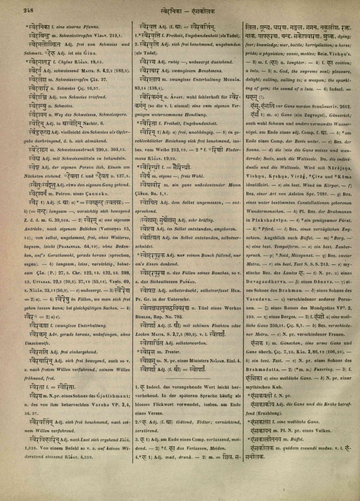
2. ˚ha Adj. (f. ā) tödtend, Tödter; vernichtend, zerstörend.
Originaltext · Deutsch · Adjektiv
3. ha — 1〉 Adj. am Ende eines Comp. verlassend, meidend. — 2〉 *f. hā das Verlassen, Meiden.
Originaltext · Deutsch · Adjektiv · Partikel · Substantiv Feminin · Substantiv Maskulin · Substantiv Neutrum
4. *ha — 1〉 Adj. mad, drunk. — 2〉 m. = śiva, sa [Page7-248-c] lila, śūnya, dhāraṇa, maṅgala, gagana, nakulīśa, rakta, nāka, pāpaharaṇa m., candra, sakopavāraṇa, śuṣka, dying; fear; knowledge; war, battle; horripilation; a horse; pride; a physician; cause, motive; Bein. Viṣṇuʼs. — 3〉 m. f. (hā) n. laughter. — 4〉 f. hā coition; a lute. — 5〉 n. God, the supreme soul; pleasure, delight; calling, calling to; a weapon; the sparkling of gem; the sound of a lute. — 6〉 Indecl. = aham (!).
Originaltext · Deutsch · Partikel
1. ha Indecl. das vorangehende Wort leicht hervorhebend. In der späteren Sprache häufig als blosses Flickwort verwendet, insbes. am Ende eines Verses.
Apte 1890 Partikel · Substantiv Maskulin · Substantiv Neutrum
Originaltext · Englisch · Partikel · Substantiv Maskulin · Substantiv Neutrum
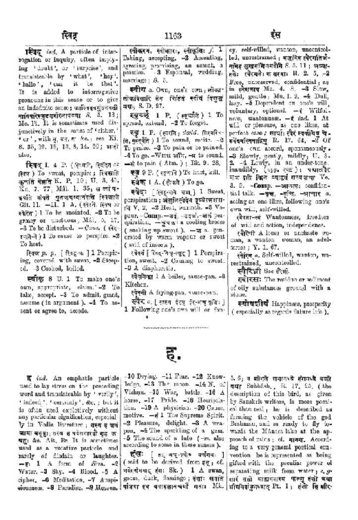
ha ind. An emphatic particle used to lay stress on the preceding word and translateable by ‘verily’, ‘indeed’, ‘certainly’, &c.; but it is often used expletively without any particular signification, especially in Vedic literature; tasya ha śataṃ jāyā babhūvuḥ; tasya ha parvatanāradau gṛha ūṣatuḥ &c. Ait. Br. It is sometimes used as a vocative particle and rarely of disdain or laughter. — haḥ 1 A form of Śiva. 2 Water. 3 Sky. 4 Blood. 5 A cipher. 6 Meditation. 7 Auspiciousness. 8 Paradise. 9 Heaven. ([Page 1163-1b]) 10 Drying. 11 Fear. 12 Knowledge. 13 The moon. 14 N. of Viṣṇu. 15 War, battle. 16 A horse. 17 Pride. 18 Horripilation. 19 A physician. 20 Cause, motive. — haṃ 1 The Supreme Spirit. 2 Pleasure, delight. 3 A weapon. 4 The sparkling of a gem. 5 The sound of a lute ( — m. also according to some in these senses).
Cappeller 1887 Worttyp nicht bestimmt
Originaltext · Deutsch · Worttyp nicht bestimmt
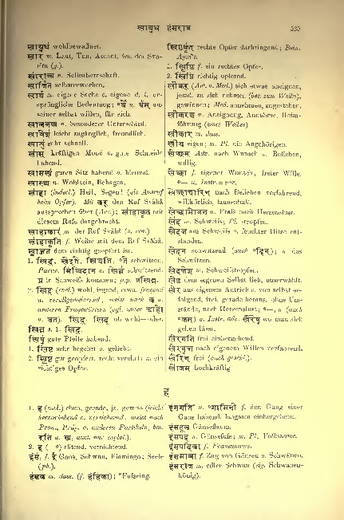
1. ha (encl.) eben, gerade, ja, gewiss (leicht hervorhebend o. versichernd, meist nach Pron., Präp. o. anderen Partikeln, bes. iti u. sma, auch nur explet.).
Originaltext · Deutsch · Worttyp nicht bestimmt
2. ha (—˚) tötend, vernichtend.
Burnouf 1866 Adjektiv · Worttyp nicht bestimmt
Originaltext · Französisch · Adjektiv
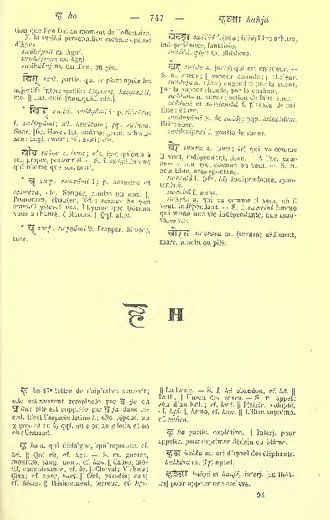
ha ha a. qui dédaigne, qui repousse, cf. hā. Qui rit, cf. has. — S. m. guerre, meurtre, sang, mort, cf. han. Cause, motif, connaissance, cf. hi. Cheval; Viṣṇu; Śiva; cf. hara, hari. Ciel, paradis; eau; cf. hima. Hérissement, terreur, cf. hṛs. [Page747a-2] La Lune. — S. f. hā abandon, cf. hā. Luth. Union des sexes. — S. n. appel: son d'un luth; cf. hve. Plaisir, volupté, cf. hṛṣ. Arme, cf. han. L'Etre suprême, cf. haṃsa.
Originaltext · Französisch · Worttyp nicht bestimmt
ha ha 47ᵉ lettre de l'alphabet sanscrit; elle est souvent remplacée par gha gha ou dha dha; elle est suppléée par ja ja dans les red. C'est l'aspirée latine h; elle répond au χ grec et au θ, qqf. au c ou au g latin et au ch allemand.
Originaltext · Französisch · Worttyp nicht bestimmt
ha ha partic. explétive. Interj. pour appeler, pour exprimer dédain ou blâme.
Quelltextfundstellen (9)
MandUp 3 Fundstellen
SVU 5 Fundstellen
VBT 1 Fundstelle
Mit AYI Free weitermachen
Bildquelle: AYI Archiv.