
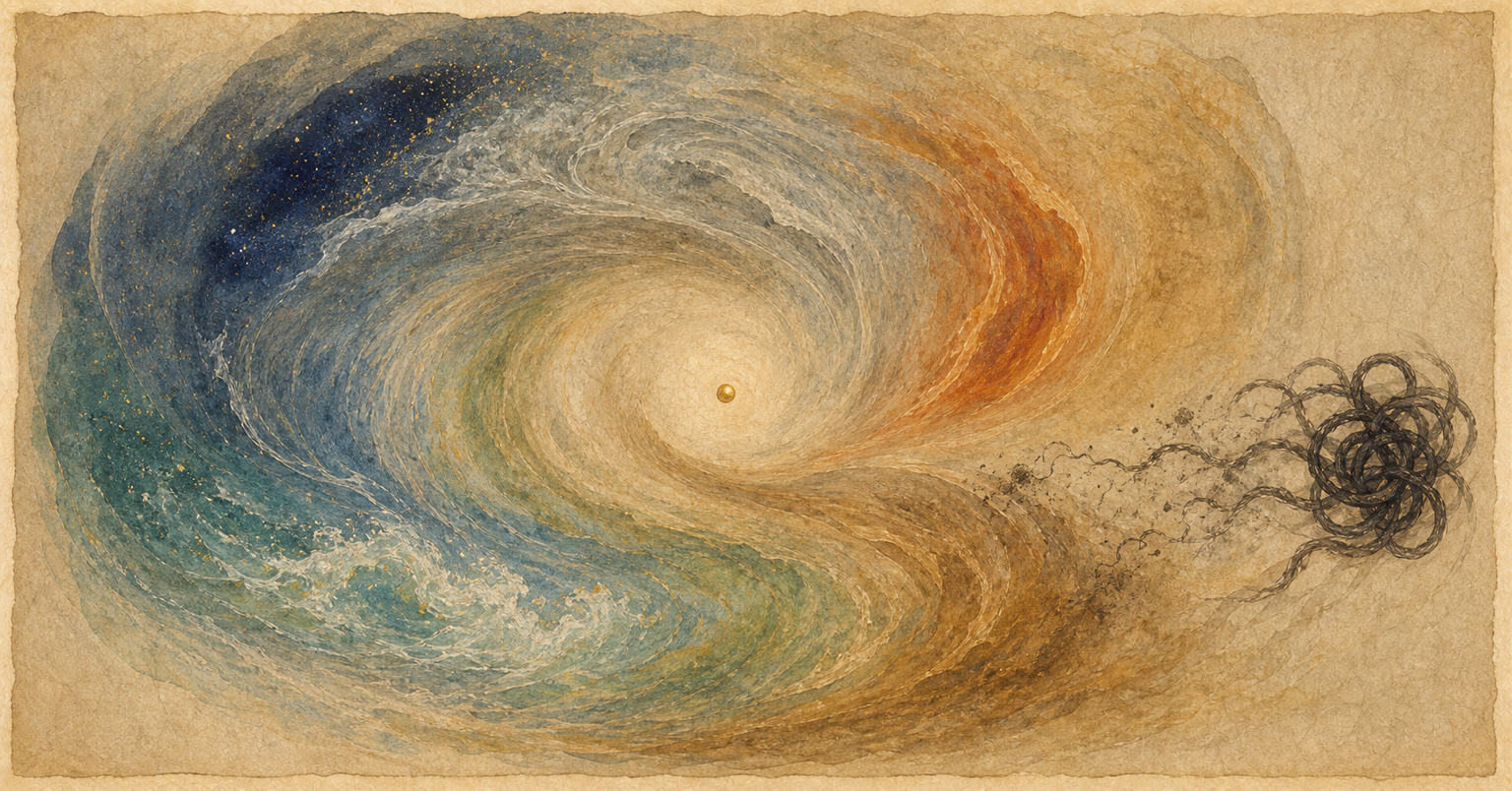
SVU 6.1-6.6: Herr der Weltentfaltung

SVU 6.1-6.6: Gott, Zeit, Wirken und Urnatur

Nicht Natur oder Zeit, sondern Gottes Macht bewegt das Weltrad, ordnet Prinzipien und Karma und führt beim Erlöschen des Wirkens über die Vielheit hinaus.

Śvetāśvatara Upaniṣad 6.1
स्वभावमेके कवयो वदन्ति कालं तथान्ये परिमुह्यमानाः |
sva-bhāvam eke, kavayo vadanti; kālaṃ tathānye, parimuhyamānāḥ | Analyse ▾ Analyse ▴
sva
Karmadhāraya-Kompositum
Adjektiv
eigen
bhāvam
Akkusativ Singular
Substantiv Maskulin
Wesen, Natur
eke
Nominativ Plural Maskulin
Zahlwort
die einen, einige
kavayaḥ
Nominativ Plural
Substantiv Maskulin
Seher, Weise
vadanti
3. Person Plural Aktiv Präsens
Verbalwurzel
sie sagen, erklären
kālam
Akkusativ Singular
Substantiv Maskulin
Zeit
tathā
Adverb
ebenso, so
anye
Nominativ Plural Maskulin
Pronomen quant
andere
parimuhyamānāḥ
Nominativ Plural Maskulin Partizip Präsens Medial
Präfix
Verbalwurzel
völlig verwirrt, in die Irre geraten
देवस्यैष महिमा तु लोके येनेदं भ्रामियते ब्रह्मचक्रम् ||1||
devasyaiṣa, mahimā tu loke; yenedaṃ bhrāmi*yate, brahma-cakram ||1|| Analyse ▾ Analyse ▴
devasya
Genitiv Singular
Substantiv Maskulin
Gottes
eṣaḥ
Nominativ Singular Maskulin
Pronomen dem
dieser, dies
mahimā
Nominativ Singular
Substantiv Maskulin
Größe, Herrlichkeit
tu
Partikel
aber, wahrlich
loke
Lokativ Singular
Substantiv Maskulin
in der Welt
yena
Instrumentalis Singular Maskulin
Pronomen rel
durch welchen, wodurch
idam
Nominativ Singular Neutrum
Pronomen dem
dieses
bhrāmyate
3. Person Singular Passiv Präsens Causativ
Verbalwurzel
wird in Umlauf gebracht, wird gedreht
brahma
Tatpuruṣa-Kompositum Genitiv
Substantiv Neutrum
des Brahman
cakram
Nominativ Singular
Substantiv Neutrum
Rad, Kreislauf
Metrum: Pāda 1: Triṣṭubh mit Vajrā-Ausklang; Pāda 2: Triṣṭubh mit Vajrā-Ausklang; Pāda 3: Triṣṭubh mit Vajrā-Ausklang — 10 Silben; Pāda 4: Triṣṭubh mit Śālinī-Ausklang
Die eigene Natur (sva-bhāvam | acc sg) geben einige (eke | nom pl m) Weise (kavayaḥ | nom pl) [als Ursache] an; so sagen sie (vadanti | 3p pl act pres). Die Zeit (kālam | acc sg) dagegen nennen ebenso (tathā) andere (anye | nom pl m), die völlig in die Irre geraten sind (parimuhyamānāḥ | nom pl m pcm). Gottes (devasya | gen sg) ist diese Herrlichkeit (eṣaḥ mahimā | nom sg) aber (tu) in der Welt (loke | loc sg), durch welche (yena | ins sg m) dieses [Rad] (idam | nom sg n) in Umlauf gebracht wird (bhrāmyate | 3p sg pas pres caus), [nämlich] das Brahman-Rad (brahma-cakram | nom sg).
Dr. Ronald Steiner - 2026 - historisch wörtlich
Einige Weise halten die eigene Natur für die Ursache, andere nennen die Zeit und geraten dabei in die Irre. In Wahrheit ist es die Herrlichkeit Gottes, durch die das Rad des Brahman in dieser Welt kreist.
Dr. Ronald Steiner - 2026 - moderner Transfer

Das Śaṅkara zugeschriebene Bhāṣya verwirft Eigenart, Zeit und die übrigen Vorschläge als Weltursache. Solche Meinungen entstehen für den Kommentar aus sinnlicher Verblendung. In Wahrheit setzt die göttliche Größe das Brahmanrad in Bewegung, in dem die Wesen kreisen.

Śvetāśvatara-Upaniṣad Śaṅkara-Bhāṣya

Śaṅkarānanda liest den Kapitelbeginn als knappe Wiederaufnahme der früheren Ursachenfrage, deren Erklärung die mittleren Kapitel entfaltet haben. Eigenart und Zeit sind gegnerische Lehrmeinungen verwirrter Denker. Die Māyā des höchsten Herrn lässt das Brahmanrad entstehen und umlaufen.

Śaṅkarānandas Śvetāśvataropaniṣaddīpikā

Nārāyaṇa erklärt die Vertreter von Eigenart und Zeit für durch die Māyā der Gottheit irregeführt. Das Brahmanrad kann er als Kreis disputierender Brahmanen oder als Gesamtheit der Jīvas lesen, die je nach Karma in sehr verschiedene Lebenslagen bewegt werden.

Nārāyaṇas Śvetāśvataropaniṣaddīpikā

Vijñānabhagavat ordnet die konkurrierenden Ursachenlehren selbst der göttlichen Māyā zu. Sie wirken als Verblendungsformen, solange der jenseits von Ursache und Wirkung stehende Herr nicht erkannt wird. Erst dessen Größe erklärt, warum das Welt- und Saṃsārarad überhaupt umläuft.

Vijñānabhagavats Śvetāśvataropaniṣadvivaraṇa
bhrāmi*yate conj. ed. ] bhrāmyate LV1958
Kritischer Apparat
Die einen Lehrer reden von Natur uns, von Zeit die andern (1,2); sie gehn völlig irre; Nein, es ist Gottes Allmacht, die im Weltall Läßt jenes Brahmanrad (1,6) im Kreis sich drehen.
Paul Deussen - 1921
Some sages discourse of inherent nature (sva-bhāva); Others likewise, of time.<1> Deluded men! It is the greatness of God in the world By which this Brahma-wheel is caused to revolve.
<1: As the First Cause—as in 1. 2. See Introduction, p. 8.>
Robert Hume - 1921
Some wise men speak of Nature (of things) as the (cause of the Universe); others, being full of delusion, speak of Time (as the cause); but it is the greatness of the Luminous Being in this world by which the wheel of Brahm (or the Universe) is revolved.
Siddhesvar Varma Shastri - 1916
Die einen Lehrer reden von Natur uns, von Zeit die andern (1,2); sie gehen völlig irre; Nein, es ist Gottes Allmacht, die im Weltall Läßt jenes Brahmanrad (1,6) im Kreis sich drehen.
Paul Deussen - 1897
<1>Some wise men, deluded, speak of Nature, and others of Time (as the cause of everything<2>); but it is the greatness of God by which this Brahma-wheel is made to turn.
<1: See Muir, Metrical Translations, p. 198.>
<2: See before, I, 2.>
F. Max Müller - 1884
From delusion some sages say, that the own nature of things (is the cause of the universe), others, that time it is (vid. 1, 2); but it is the glory of God in the world, by which (glory) this wheel of Brahma revolves.
Edward Röer - 1853
Śvetāśvatara Upaniṣad 6.2
येनावृतं नित्यमिदं हि सर्वं ज्ञः कालकालो गुणी सर्वविद्यः |
yenāvṛtaṃ, nityam idaṃ hi sarvaṃ; jñaḥ kāla-kālo, guṇī sarva-vidyaḥ | Analyse ▾ Analyse ▴
yena
Instrumentalis Singular Maskulin
Pronomen rel
durch welchen, von dem
āvṛtam
Nominativ Singular Neutrum Partizip Perfekt Passiv
Präfix
Verbalwurzel
umhüllt, bedeckt
nityam
Adverb
beständig, immer
idam
Nominativ Singular Neutrum
Pronomen dem
dieses
hi
Partikel
denn, wahrlich
sarvam
Nominativ Singular Neutrum
Pronomen quant
alles, das ganze
jñaḥ
Nominativ Singular Maskulin
Adjektiv
wissend, der Kenner
kāla
Tatpuruṣa-Kompositum Genitiv
Substantiv Maskulin
der Zeit
kālaḥ
Nominativ Singular
Substantiv Maskulin
Zeit, Vernichter
guṇī
Nominativ Singular Maskulin
Adjektiv
eigenschaftsmächtig, Herr der Guṇas
sarva
Upapada-Kompositum
Pronomen quant
alles
vidyaḥ
Nominativ Singular Maskulin
Adjektiv
wissend, allwissend
तेनेशितं कर्म विवर्तते ह पृथिव्याप्तेजो ऽनिलखानि चिन्त्यम् ||2||
teneśitaṃ, karma vivartate ha; pṛthivyāp-tejo, 'nila-khāni cintyam ||2|| Analyse ▾ Analyse ▴
tena
Instrumentalis Singular Maskulin
Pronomen dem
durch ihn, von ihm
īśitam
Nominativ Singular Neutrum Partizip Perfekt Passiv
Verbalwurzel
beherrscht, gelenkt
karma
Nominativ Singular
Substantiv Neutrum
Wirkkraft, Handlung
vivartate
3. Person Singular Medial Präsens
Präfix
Verbalwurzel
entfaltet sich, wandelt sich
ha
Partikel
wahrlich, gewiss
pṛthivī
Dvandva-Kompositum
Substantiv Feminin
Erde
ap
Dvandva-Kompositum
Substantiv Feminin
Wasser
tejas
Dvandva-Kompositum
Substantiv Neutrum
Feuer, Licht
anila
Dvandva-Kompositum
Substantiv Maskulin
Luft, Wind
khāni
Nominativ Plural
Substantiv Neutrum
Räume, Äther
cintyam
Nominativ Singular Neutrum Partizip Futur Passiv
Verbalwurzel
zu denken, als solches zu erkennen
Metrum: Pāda 1: Triṣṭubh mit Vajrā-Ausklang; Pāda 2: Triṣṭubh mit Śālinī-Ausklang; Pāda 3: Triṣṭubh mit Vajrā-Ausklang; Pāda 4: Triṣṭubh mit Vajrā-Ausklang
Derjenige (yena | ins sg m), von dem umhüllt (āvṛtam | nom sg n ppp) beständig (nityam) dieses (idam | nom sg n) nämlich (hi) alles (sarvam | nom sg n) [ist], [ist] der Kenner (jñaḥ | nom sg m), der Vernichter der Zeit (kāla-kālaḥ | nom sg), eigenschaftsmächtig (guṇī | nom sg m) [und] allwissend (sarva-vidyaḥ | nom sg m). Das von ihm (tena | ins sg m) beherrschte Wirken (īśitam karma | nom sg) entfaltet sich (vivartate | 3p sg med pres), wahrlich (ha); als Erde, Wasser, Feuer, Luft und Räume (pṛthivyāptejo’nilakhāni | nom pl) ist [es] zu denken (cintyam | nom sg n pfp).
Dr. Ronald Steiner - 2026 - historisch wörtlich
Der allwissende Herr, der die Macht der Zeit überwindet und alle Eigenschaften trägt, umhüllt diese ganze Welt. Unter seiner Leitung entfaltet sich das kosmische Wirken und nimmt die Gestalt von Erde, Wasser, Feuer, Luft und Raum an.
Dr. Ronald Steiner - 2026 - moderner Transfer

Das Śaṅkara zugeschriebene Bhāṣya bietet im Druck kālakāra, den „Macher der Zeit“. Der allwissende Herr durchdringt und lenkt die Welt. Unter seiner Leitung wird das vom Jīva vollzogene Karma wirksam und entfaltet sich bis zu den fünf Elementen, aus denen die Erfahrungswelt besteht.

Śvetāśvatara-Upaniṣad Śaṅkara-Bhāṣya

Śaṅkarānanda liest kālakāla: Der Herr ist der Vernichter selbst der alles vernichtenden Zeit. Jña bezeichnet sein Bewusstsein, während die Guṇas ihm nur durch Avidyā zugeschrieben werden. Von ihm gelenktes Karma entwickelt sich zur fünfgliedrigen Elementwelt, über die meditiert werden soll.

Śaṅkarānandas Śvetāśvataropaniṣaddīpikā

Nārāyaṇa erklärt kālakāla als den Lenker sogar der Zeit. Die drei Guṇas stehen unter seiner Herrschaft, und die ganze Welt erscheint als Umformung des von ihm geleiteten Karmas in die fünf Elemente. Neben sarvavidya verzeichnet der Kommentar sarvavāyu, den Lebenshauch aller Wesen.

Nārāyaṇas Śvetāśvataropaniṣaddīpikā

Vijñānabhagavat versteht kālakāla als Lenker und Auflöser der Zeit. Der Herr erscheint in Verbindung mit Māyā als guṇahaft und lässt die karmische Welt als bloße Entfaltung in die fünf Elemente hervortreten. Deren Reihenfolge erklärt der Kommentar nach dem gemeinten Sinn, nicht nur nach dem Wortlaut.

Vijñānabhagavats Śvetāśvataropaniṣadvivaraṇa
kālakālo LV1958 ] kālakāro ASS1927, Silburn apud LV1958-app
Kritischer Apparat
Durch ihn regiert, der stets bedeckt (Ṛgv. 10,90,1) das Weltall, Als Geist, Zeitschöpfer, gunahaft, allwissend, Entrollt dies Schöpfungswerk sich, das sich darstellt Als Erde, Wasser, Feuer, Luft und Äther.
Paul Deussen - 1921
He by whom this whole world is constantly enveloped Is intelligent, the author of time, possessor of qualities (guṇin), omniscient. Ruled o’er by Him, [his] work (karman)<2> revolves—This which is regarded as earth, water, fire, air, and space!<3>
<2: That is, the world.>
<3: The same list of five cosmic elements as in 2. 12 b.>
Robert Hume - 1921
Governed by Him who always pervades this whole (world), who is consciousness itself, the Creator of Time, possessing faultless qualities, and Omniscient, the world of effects (as is well-known) assumes different forms (of) Ether, Air, Fire, Water and Earth—this should be considered (by seekers after the Truth).
Siddhesvar Varma Shastri - 1916
Durch ihn regiert, der stets bedeckt (Ṛgv. 10,90,1) das Weltall, Als Geist, Zeitschöpfer, gunahaft, allwissend, Entrollt dies Schöpfungswerk sich, das sich darstellt Als Erde, Wasser, Feuer, Luft und Äther.
Paul Deussen - 1897
It is at the command of him who always covers this world, the knower, the time of time<3>, who assumes qualities and all knowledge<4>, it is at his command that this work (creation) unfolds itself, which is called earth, water, fire, air, and ether;
<3: The destroyer of time. Vijñānātman reads kālākālo, and explains it by kālasya niyantā, upahartā. Śaṅkarānanda explains kālaḥ sarvavināśakārī, tasyāpi vināśakaraḥ. See also verse 16.>
<4: Or sarvavid yaḥ.>
F. Max Müller - 1884
For over-ruled by him, by whom this all is eternally pervaded, who is alwise, the lord of time, possessed of (all) qualities, omniscient, turns round the creation, which is to be thought as earth, water, fire, air, and ether.
Edward Röer - 1853
Śvetāśvatara Upaniṣad 6.3
तत्कर्म कृत्वा विनिवर्त्य भूयस्तत्त्वस्य तत्त्वेन समेत्य योगम् |
tat karma kṛtvā, vinivartya bhūyas; tattvasya, tattvena sametya yogam | Analyse ▾ Analyse ▴
tat
Akkusativ Singular Neutrum
Pronomen dem
dieses, jenes
karma
Akkusativ Singular
Substantiv Neutrum
Werk, Schöpfungswerk
kṛtvā
Absolutus
Verbalwurzel
nachdem er vollbracht, in Gang gesetzt hat
vinivartya
Absolutus
Präfix
Präfix
Verbalwurzel
nachdem er zurückgezogen, beendet hat
bhūyas
Adverb
wiederum, erneut
tattvasya
Genitiv Singular
Substantiv Neutrum
des Prinzips, der Wirklichkeit
tattvena
Instrumentalis Singular
Substantiv Neutrum
mit dem Prinzip, durch die Wirklichkeit
sametya
Absolutus
Präfix
Präfix
Verbalwurzel
nachdem er zusammengeführt, verbunden hat
yogam
Akkusativ Singular
Substantiv Maskulin
Verbindung, Vereinigung
एकेन द्वाभ्यां त्रिभिरष्टभिर्वा कालेन चैवात्मगुणैश्च सूक्ष्मैः ||3||
ekena dvābhyāṃ, tribhir aṣṭabhir vā; kālena caivā,tma-guṇaiś ca sūkṣmaiḥ ||3|| Analyse ▾ Analyse ▴
ekena
Instrumentalis Singular Neutrum
Zahlwort
mit einem
dvābhyām
Instrumentalis Dual
Zahlwort
mit zweien
tribhiḥ
Instrumentalis Plural
Zahlwort
mit dreien
aṣṭabhiḥ
Instrumentalis Plural
Zahlwort
mit achten
vā
Partikel
oder
kālena
Instrumentalis Singular
Substantiv Maskulin
durch die Zeit, mit der Zeit
ca
Partikel
und
eva
Partikel
allein, eben
ātma
Tatpuruṣa-Kompositum Genitiv
Substantiv Maskulin
des Selbst, der eigenen Natur
guṇaiḥ
Instrumentalis Plural
Substantiv Maskulin
durch Eigenschaften, mit Guṇas
ca
Partikel
und
sūkṣmaiḥ
Instrumentalis Plural Maskulin
Adjektiv
durch die feinen, subtilen
Metrum: Triṣṭubh mit Vajrā-Ausklang
Nachdem er dieses Werk (tat karma | acc sg) vollbracht hat (kṛtvā | abs), [es] zurückgezogen hat (vinivartya | abs) [und] wiederum (bhūyas) das Prinzip (tattvasya | gen sg) mit dem Prinzip (tattvena | ins sg) zusammengeführt hat (sametya | abs) zur Vereinigung (yogam | acc sg), [verbindet er es] mit einem (ekena | ins sg n), mit zweien (dvābhyām | ins du), mit dreien (tribhiḥ | ins pl) [oder] mit acht (aṣṭabhiḥ | ins pl), wahlweise (vā), [sowie] mit der Zeit (kālena | ins sg) und (ca) eben (eva) mit den Eigenschaften des Selbst (ātma-guṇaiḥ | ins pl) und (ca) mit den subtilen [Eigenschaften] (sūkṣmaiḥ | ins pl m).
Dr. Ronald Steiner - 2026 - historisch wörtlich
Er bringt das Werk der Welt hervor, zieht es wieder in sich zurück und führt die einzelnen Prinzipien erneut zur Einheit. Dabei ordnet er sie in Gruppen von eins, zwei, drei und acht sowie durch Zeit, Eigenschaften und subtile Kräfte.
Dr. Ronald Steiner - 2026 - moderner Transfer

Das Śaṅkara zugeschriebene Bhāṣya bezieht „eins“ auf die Erde und die weiteren Zahlen auf wachsende Elementgruppen; „acht“ bezeichnet die achtfältige Prakṛti aus fünf Elementen, Geist, Buddhi und Ichmacher. Hinzu kommen Zeit und feine innere Eigenschaften wie Begehren. Der Herr verbindet diese geschaffenen Größen mit dem Selbst.

Śvetāśvatara-Upaniṣad Śaṅkara-Bhāṣya

Śaṅkarānanda entwickelt einen festen Kategorienkatalog: eins ist Avidyā, zwei sind Dharma und Adharma, drei die Guṇas und acht die fünf groben Elemente samt Geist, Buddhi und Ichmacher. Zeit umfasst Schöpfung, Bestand und Auflösung; subtile Selbstqualitäten sind Begehren und verwandte Regungen im Keimzustand. Das Identitätswort führt über sie hinaus.

Śaṅkarānandas Śvetāśvataropaniṣaddīpikā

Nārāyaṇa liest die Zahlen biographisch statt kosmologisch. Ein Mensch erreicht Brahman durch gutes Handeln und innere Abkehr je nach Reife in einer, zwei, drei, acht oder noch mehr Geburten. Zeit und feine Selbstqualitäten wie Dharma und Erkenntnis bestimmen, wann die Mahāvākya-Unterweisung ihre Frucht trägt.

Nārāyaṇas Śvetāśvataropaniṣaddīpikā

Vijñānabhagavat macht aus der Zahlenreihe einen Praxisweg. Eins ist das Aufsuchen des Lehrers, zwei sind Hingabe an Lehrer und Gott, drei Hören, Erwägen und Vertiefen, acht die Glieder des Yoga. Zeit bedeutet die gegenwärtige oder eine spätere Geburt; als feine Selbstqualitäten nennt er acht Tugenden wie Mitgefühl, Geduld, Reinheit und Anspruchslosigkeit.

Vijñānabhagavats Śvetāśvataropaniṣadvivaraṇa
Was er erschuf, nimmt dann zurück er wieder, Zur Einheit werdend mit des Wesens Wesen<1>; Um dann, mit einem, zweien, dreien, achten<2>, Mit Zeit und feinen Guna’s, die er selbst sind (1,3),
<1: Zu tattvasya tattvena vgl. Bṛh. 2,1,20. 2,3,6 satyasya satyam.>
<2: mutmaßlich: einer, der Purusha; zwei, Avyaktam und Vyaktam; drei, Sattvam, Rajas, Tamas; acht, Buddhi, Ahaṅkāra, Manas, Tanmātra’s.>
Paul Deussen - 1921
He creates this work, and rests again. Having entered into union (yoga) with principle (tattva) after principle, With one, with two, with three, or with eight,<4> With time, too, and the subtile qualities of a self—
<4: That is, the principles as arranged in groups by systematized Sāṅkhya philosophy: the sole principle—the Person (Purusha); dual principles—the Unmanifest (avyakta) and the Manifest (vyakta); triple principles—the three Qualities (guṇa), i. e. Pureness (sattva), Passion (rajas), and Darkness (tamas); eight principles—the five cosmic elements together with mind, intellect, and self-consciousness (so enumerated, e. g., at BhG. 7. 4.)>
Robert Hume - 1921
Having done His work, having renounced (all attachment to) works, and then having brought about the communion of the individual soul with the Supreme Soul, (one gets salvation) by means of one, two, three or eight, and by (the lapse of) Time, as well as by the subtle spiritual (moral) qualifications.

Or,

Having created that world of (original) effects, having looked at (them), and having brought about the combination of the individual soul with (various) substances, either with one, two, three or eight, and with Time, as well as with the subtle qualifications of the mind (the Creator completed the Creation).
Siddhesvar Varma Shastri - 1916
Was er erschuf, nimmt dann zurück er wieder, Zur Einheit werdend mit des Wesens Wesen<1>; Um dann, mit einem, zweien, dreien, achten<2>, Mit Zeit und feinen Guna’s, die er selbst sind (1,3),
<1: Zu tattvasya tattvena vgl. Bṛh. 2,1,20. 2,3,6 satyasya satyam.>
<2: mutmaßlich: einer, der Purusha; zwei, Avyaktam und Vyaktam; drei, Sattvam, Rajas, Tamas; acht, Buddhi, Ahaṅkāra, Manas, Tanmātra’s.>
Paul Deussen - 1897
<5>He who, after he has done that work and rested again, and after he has brought together one essence (the self) with the other (matter), with one, two, three, or eight, with time also and with the subtile qualities of the mind,
<5: Instead of vinivartya, Vijñānātman and Śaṅkarānanda read vinivṛtya.>
F. Max Müller - 1884
Having created this work (the world), and reflecting on it again, he causes principle (the soul) to be joined with principle (the principle of nature), viz. with one, or two, or three, or eight (principles,)<1> also with time and with the subtle qualities of intellect (ātma.)
<1: The eight principles are the eight producers of the Sānkhya, viz. nature the root of all, intellect, self-consciousness, and the five subtle elements of matter. Śaṅkara quotes a passage, probably of a Purāṇa, in which “mind” is substituted for nature as root of all.—The one principle, to which the soul is joined, is nature, the two are perhaps nature and intellect, and the three nature, intellect and self-consciousness.>
Edward Röer - 1853
Śvetāśvatara Upaniṣad 6.4
आरभ्य कर्माणि गुणान्वितानि भावांश्च सर्वान्विनियोजयेद्यः |
ārabhya, karmāṇi guṇānvitāni; bhāvāṃś ca sarvān, viniyojayed yaḥ | Analyse ▾ Analyse ▴
ārabhya
Absolutus
Präfix
Verbalwurzel
nachdem er begonnen, in Gang gesetzt hat
karmāṇi
Akkusativ Plural
Substantiv Neutrum
Werke, Handlungen
guṇa
Tatpuruṣa-Kompositum Instrumentalis
Substantiv Maskulin
mit Eigenschaften, mit Guṇas
anvitāni
Akkusativ Plural Neutrum Partizip Perfekt Passiv
Präfix
Verbalwurzel
verbunden, ausgestattet
bhāvān
Akkusativ Plural
Substantiv Maskulin
Wesen, Zustände
ca
Partikel
und
sarvān
Akkusativ Plural Maskulin
Pronomen quant
alle, sämtliche
viniyojayet
3. Person Singular Aktiv Optativ Causativ
Präfix
Präfix
Verbalwurzel
er möge einsetzen, zuweisen
yaḥ
Nominativ Singular Maskulin
Pronomen rel
welcher, der
तेषामभावे कृतकर्मनाशः कर्मक्षये याति स तत्त्वतो ऽन्यः ||4||
teṣām abhāve, kṛta-karma-nāśaḥ; karma-kṣaye, yāti sa tattvato 'nyaḥ ||4|| Analyse ▾ Analyse ▴
teṣām
Genitiv Plural Maskulin
Pronomen dem
ihrer, von ihnen
abhāve
Lokativ Singular
Substantiv Maskulin
bei ihrem Nichtsein, in ihrer Abwesenheit
kṛta
Karmadhāraya-Kompositum Partizip Perfekt Passiv
Verbalwurzel
vollbracht, erzeugt
karma
Tatpuruṣa-Kompositum Genitiv
Substantiv Neutrum
des Werkes, der Wirkung
nāśaḥ
Nominativ Singular
Substantiv Maskulin
Vernichtung, Auflösung
karma
Tatpuruṣa-Kompositum Genitiv
Substantiv Neutrum
des Werkes, der Wirkung
kṣaye
Lokativ Singular
Substantiv Maskulin
beim Schwinden, bei der Auflösung
yāti
3. Person Singular Aktiv Präsens
Verbalwurzel
er geht, gelangt
saḥ
Nominativ Singular Maskulin
Pronomen dem
er, jener
tattvataḥ
Adverb
in Wahrheit, seinem Wesen nach
anyaḥ
Nominativ Singular Maskulin
Pronomen quant
anders, verschieden
Metrum: Triṣṭubh mit Vajrā-Ausklang
Nachdem er begonnen hat (ārabhya | abs), die mit Guṇas verbundenen Werke (karmāṇi guṇānvitāni | acc pl), soll er die Zustände (bhāvān | acc pl) und (ca) alle [Wesen] (sarvān | acc pl m) zuweisen (viniyojayet | 3p sg act opt caus), er, welcher (yaḥ | nom sg m) [sie lenkt]. Bei ihrem (teṣām | gen pl m) Nichtsein (abhāve | loc sg) [tritt] die Vernichtung des vollbrachten Werkes (kṛta-karma-nāśaḥ | nom sg) [ein]; beim Schwinden des Werkes (karma-kṣaye | loc sg) gelangt (yāti | 3p sg act pres) er (saḥ | nom sg m) seinem Wesen nach (tattvataḥ) [als] ein anderer (anyaḥ | nom sg m) [darüber hinaus].
Dr. Ronald Steiner - 2026 - historisch wörtlich
Er weist den Wesen ihre von den Guṇas geprägten Handlungen und Daseinsformen zu. Wenn diese Bedingungen verschwinden, erlischt das vollbrachte Werk; mit dem Ende des Karmas geht das Wesen über seinen bisherigen Zustand hinaus.
Dr. Ronald Steiner - 2026 - moderner Transfer

Das Śaṅkara zugeschriebene Bhāṣya fordert, alle Handlungen und Eigenschaften dem Herrn zu überlassen und keine Eigenbeziehung zu ihnen zu behaupten. Frühere Bindungen werden so zerstört; nach Reinigung des Sattva und Erschöpfung des wirksamen Karmas erkennt der Übende Brahman jenseits der Prakṛti-Größen.

Śvetāśvatara-Upaniṣad Śaṅkara-Bhāṣya

Śaṅkarānanda lässt den Herrn sämtliche Zustände und Tätigkeiten zuweisen. Wenn die Avidyā schwindet, werden deren karmische Wirkungen entwurzelt und der Jīva ruht in der eigenen Gestalt. Der Kommentar betont damit, dass die Selbsterkenntnis die Wahrheit der vedischen Aussage wahrt und nicht in eine bloße Leugnung mündet.

Śaṅkarānandas Śvetāśvataropaniṣaddīpikā

Nārāyaṇa verbindet sāttvisches Handeln mit einer stufenweisen Auflösungsmeditation: Gegenstände gehen in Sinne, Gottheiten, Elemente, Luft, Raum und schließlich ins Selbst zurück. Alternativ werden Wünsche im Selbst geopfert. Wenn Begehren versiegt und Karma verbraucht ist, zeigt sich das Selbst als von den Tattvas verschieden.

Nārāyaṇas Śvetāśvataropaniṣaddīpikā

Vijñānabhagavat entfaltet eine umfassende kosmische Rücknahme vom individuellen Grobkörper über kollektive Elemente, Tanmātras, Prakṛti und Māyā bis zu Sein, Bewusstsein, Freude und Nichtdualität. Erkenntnis vernichtet noch nicht begonnenes und künftiges Karma; nach dem Ablauf des Prārabdha folgt die körperlose Befreiung.

Vijñānabhagavats Śvetāśvataropaniṣadvivaraṇa
Das gunahafte Werk neu zu beginnen, Verteilend einzeln die Beschaffenheiten (5,5).—Wo sie nicht sind, da wird das Werk zunichte, Hin geht er werklos, wesentlich ein andrer.
Paul Deussen - 1921
He begins with works which are connected with qualities (guṇa), And distributes all existences (bhāva).<5> In the absence of these (qualities) there is a disappearance of the work that has been done. [Yet] in the destruction of the work he continues essentially other [than it].
<5: Compare the similar line 5. 5 c.>
Robert Hume - 1921
At the non-existence of (the things of the world) there will be destruction of (all) the performed actions of him, who, having performed deeds of godly merit absorbs all (created) things into (their final cause). At the destruction of (those) actions, he goes (quite a divine being) different essentially from matter and material things.
Siddhesvar Varma Shastri - 1916
Das gunahafte Werk neu zu beginnen, Verteilend einzeln die Beschaffenheiten (5,5).—Wo sie nicht sind, da wird das Werk zu nichte, Hin geht er werklos, wesentlich ein andrer.
Paul Deussen - 1897
Who, after starting<6> the works endowed with (the three) qualities, can order all things, yet when, in the absence of all these, he has caused the destruction of the work, goes on, being in truth<7> different (from all he has produced);
<6: Āruhya for ārabhya, Śaṅkarānanda.>
<7: These two verses are again extremely obscure, and the explanations of the commentators throw little light on their real, original meaning. To begin with Śaṅkara, he assumes the subject to be the same as he at whose command this work unfolds itself, and explains tattvasya tattvena sametya yogam by ātmano bhūmyādinā yogam saṃgamayya. As the eight Tattvas he gives earth, water, fire, air, ether, mind, thought, personality, while the Ātmaguṇas are, according to him, the affections of the mind, love, anger, &c. In the second verse, however, Śaṅkara seems to assume a different subject. ‘If a man,’ he says, ‘having done works, infected by qualities, should transfer them on Īśvara, the Lord, there would be destruction of the works formerly done by him, because there would be no more connection with the self.’ Something is left out, but that this is Śaṅkara’s idea, appears from the verses which he quotes in support, and which are intended to show that Yogins, transferring all their acts, good, bad, or indifferent, on Brahman, are no longer affected by them. ‘That person,’ Śaṅkara continues, ‘his works being destroyed and his nature purified, moves on, different from all things (tattva), from all the results of ignorance, knowing himself to be Brahman.’ ‘Or,’ he adds, ‘if we read anyad, it means, he goes to that Brahman which is different from all things.’ Śaṅkarānanda takes a different view. He says: ‘If a man has performed sacrifices, and has finished them, or, has turned away from them again as vain, and if he has obtained union with that which is the real of the (apparently) real, &c.’ The commentator then asks what is that with which he obtains union, and replies, ‘the one, i.e. ignorance; the two, i.e. right and wrong; the three, i.e. the three colours, red, white, and black; and the eight, i.e. the five elements, with mind, thought, and personality; also with time, and with the subtile affections of the mind.’ He then goes on, ‘If that man, after having begun qualified works, should take on himself all states (resulting from ignorance), yet, when these states cease, there would be an end of the work, good or bad, done by him, and when his work has come to an end, he abides in truth (according to the Veda); while the other, who differs from the Veda, is wrong.’ Śaṅkarānanda, however, evidently feels that this is a doubtful interpretation, and he suggests another, viz. ‘If the Lord himself,’ he says, ‘determined these states (bhāva), it would seem that there would be no end of saṃsāra. He therefore says, that when these states, ignorance &c., cease, the work done by man ceases; and when the work done ceases, the living soul gets free of saṃsāra, being in truth another, i.e. different from ignorance and its products.’ Vijñānātman says: ‘If a man, having done work, turns away from it, and obtains union of one tattva (the tvam, or self) with the real tattva (the tat, or the Lord);—and how? By means of the one, i.e. the teaching of the Guru; the two, i.e. love of the Guru and of the Lord; the three, i.e. hearing, remembering, and meditating; the eight, i.e. restraint, penance, postures, regulation of the breath, abstraction, devotion, contemplation, and meditation (Yoga-sūtras II, 29); by time, i.e. the right time for work; by the qualities of the self, i.e. pity, &c.; by the subtile ones, i.e. the good dispositions for knowledge, then (we must supply) he becomes free.’ And this he explains more fully in the next verse. ‘If, after having done qualified works, i.e. works to please the Lord, a Yati discards all things, and recognises the phenomenal character of all states, and traces them back to their real source in Mūlaprakṛti and, in the end, in the Saccidānanda, he becomes free. If they (the states) cease, i.e. are known in their real source, the work done ceases also in its effects, and when the work has been annihilated, he goes to freedom, being another in truth; or, if we read anyat, he goes to what is different from all these things, namely, to the Lord; or, he goes to a state of perfect lordship in truth, having discovered the highest truth, the oneness of the self with the Highest Self.’ I think that, judging from the context, the subject is really the same in both verses, viz. the Lord, as passing through different states, and at last knowing himself to be above them all. Yet, the other explanations may be defended, and if the subject were taken to be different in each verse, some difficulties would disappear.>
F. Max Müller - 1884
Whoever, after he has performed works endowed with (their) qualities, places them and all his fondness (upon God),—(for), if they (the works) not exist, the effects also cease,—obtains by the cessation of work that which is different from the principles (of nature).<1>
<1: That is to say, he becomes like Brahma.>
Edward Röer - 1853
Śvetāśvatara Upaniṣad 6.5
आदिः स संयोगनिमित्तहेतुः परस्त्रिकालादकलो ऽपि दृष्टः |
ādiḥ sa, saṃyoga-nimitta-hetuḥ; paras tri-kālād, akalo 'pi dṛṣṭaḥ | Analyse ▾ Analyse ▴
ādiḥ
Nominativ Singular
Substantiv Maskulin
Anfang, Ursprung
saḥ
Nominativ Singular Maskulin
Pronomen dem
er, jener
saṃyoga
Tatpuruṣa-Kompositum Genitiv
Substantiv Maskulin
der Verbindung, Vereinigung
nimitta
Karmadhāraya-Kompositum
Substantiv Neutrum
bedingend, als Anlass
hetuḥ
Nominativ Singular
Substantiv Maskulin
Ursache, Grund
paraḥ
Nominativ Singular Maskulin
Adjektiv
höher, jenseitig
tri
Dvigu-Kompositum
Zahlwort
drei
kālāt
Ablativ Singular
Substantiv Maskulin
über die Zeiten hinaus, von den Zeiten
akalaḥ
Nominativ Singular Maskulin
Adjektiv
teillos, ohne Teile
api
Partikel
auch, obwohl
dṛṣṭaḥ
Nominativ Singular Maskulin Partizip Perfekt Passiv
Verbalwurzel
gesehen, wahrgenommen
तं विश्वरूपं भवभूतमीड्यं देवं स्वचित्तस्थमुपास्य पूर्वम् ||5||
taṃ viśva-rūpaṃ, bhava-bhūtam īḍyaṃ; devaṃ sva-citta,-stham upāsya pūrvam ||5|| Analyse ▾ Analyse ▴
tam
Akkusativ Singular Maskulin
Pronomen dem
ihn, jenen
viśva
Bahuvrīhi-Kompositum
Pronomen quant
alle, das All
rūpam
Akkusativ Singular Maskulin
Substantiv Neutrum
Gestalt habend, allgestaltig
bhava
Upapada-Kompositum
Substantiv Maskulin
zum Dasein, als Werden
bhūtam
Akkusativ Singular Maskulin Partizip Perfekt Passiv
Verbalwurzel
geworden, als Dasein bestehend
īḍyam
Akkusativ Singular Maskulin Partizip Futur Passiv
Verbalwurzel
zu preisen, verehrungswürdig
devam
Akkusativ Singular
Substantiv Maskulin
Gott, das göttliche Wesen
sva
Karmadhāraya-Kompositum
Adjektiv
eigen
citta
Tatpuruṣa-Kompositum Lokativ
Substantiv Neutrum
im Geist, im Bewusstsein
stham
Akkusativ Singular Maskulin
Adjektiv
befindlich, wohnend
upāsya
Absolutus
Präfix
Verbalwurzel
nachdem er verehrt, meditiert hat
pūrvam
Adverb
zuvor, zuerst
Metrum: Triṣṭubh mit Vajrā-Ausklang
Der Anfang (ādiḥ | nom sg) ist er (saḥ | nom sg m), die bedingende Ursache der Verbindung (saṃyoga-nimitta-hetuḥ | nom sg); als jenseitig (paraḥ | nom sg m) über die drei Zeiten hinaus (tri-kālāt | abl sg) [und] teillos (akalaḥ | nom sg m) wird er doch auch (api) geschaut (dṛṣṭaḥ | nom sg m ppp). Jenen (tam | acc sg m) allgestaltigen (viśva-rūpam | acc sg m), als Dasein bestehenden (bhava-bhūtam | acc sg m ppp), verehrungswürdigen (īḍyam | acc sg m pfp) Gott (devam | acc sg), der im eigenen Geist wohnt (sva-citta-stham | acc sg m), hat man verehrt (upāsya | abs), und zwar zuvor (pūrvam), [bevor man ihn schaut].
Dr. Ronald Steiner - 2026 - historisch wörtlich
Er ist der Anfang und der Grund aller Verbindungen, jenseits der drei Zeiten und ohne Teile, obwohl er geschaut werden kann. Zuerst soll man diesen allgestaltigen, verehrungswürdigen Gott im eigenen Bewusstsein aufsuchen und verehren.
Dr. Ronald Steiner - 2026 - moderner Transfer

Das Śaṅkara zugeschriebene Bhāṣya nennt den Herrn Ursprung und Träger der Verbindung von Jīva und Welt samt deren Ursachen. Er liegt jenseits der drei Zeiten und der sechzehn Kalās. Zunächst soll man den allgestaltigen, wahren Herrn im eigenen Geist betrachten; daraus reift die Erkenntnis.

Śvetāśvatara-Upaniṣad Śaṅkara-Bhāṣya

Śaṅkarānanda versteht den Herrn als Grundlage und Gegenstand der Avidyā, ohne selbst in Zeit oder Teile einzugehen. Nur Brahmankenner erfassen diesen selbstleuchtenden Ursprung. Die vorbereitende Meditation richtet sich daher nach innen auf ihn als eigenes Selbst und als Gestalt aller Erscheinungen.

Śaṅkarānandas Śvetāśvataropaniṣaddīpikā

Nārāyaṇa bestimmt den Herrn als Ursprung der Welt und der Ursachen, die ihre Verbindungen hervorbringen. Er ist jenseits der Zeit, teilelos und selbstleuchtend. Der Suchende soll ihn nicht außerhalb, sondern als das im eigenen Inneren zu verehrende Selbst erfassen.

Nārāyaṇas Śvetāśvataropaniṣaddīpikā

Vijñānabhagavat verbindet eine nirguṇahafte und eine saguṇahafte Lesart. Der Herr ist sowohl unveränderlicher Grund als auch Ursprung der Mittel, durch die Vereinigung und Erkenntnis zustande kommen. Die innere Verehrung des allgestaltigen Selbst führt von der vorgestellten Gestalt zu seinem nichtdualen Wesen.

Vijñānabhagavats Śvetāśvataropaniṣadvivaraṇa
Anfang und Grund, bewirkend die Verbindung, Drei-Zeit-erhaben<3>, ohne Teile<4> ist er. Den allgestalt’gen Werdegrund, preiswürdig Als Gott, der in uns wohnt, zuerst verehrend,—
<3: Die drei Zeiten sind: Vergangenheit, Gegenwart, Zukunft.>
<4: Auch der Telugudruck liest akalo.>
Paul Deussen - 1921
The beginning, the efficient cause of combinations, He is to be seen as beyond the three times (kāla),<1> without parts (a-kala) too! Worship Him as the manifold, the origin of all being, The adorable God who abides in one’s own thoughts, the primeval.
<1: That is, without past, present, or future—as in Māṇḍ. 1.>
Robert Hume - 1921
He has been realized as the Original Cause (of all), the cause of the causes of (bodily) attainment, beyond the three-fold time, and also independent of (the sixteen) powers. (He goes) having worshipped Him, having many forms, the cause of all existence, the True, Praiseworthy, Luminous and already situated in his (the worshipper’s heart).
Siddhesvar Varma Shastri - 1916
Anfang und Grund, bewirkend die Verbindung, Drei-Zeit-erhaben<3>, ohne Teile<4> ist er. Den allgestalt’gen Werdegrund, preiswürdig Als Gott, der in uns wohnt, zuerst verehrend,—
<3: Die drei Zeiten sind: Vergangenheit, Gegenwart, Zukunft.>
<4: Auch der Telugudruck liest akalo.>
Paul Deussen - 1897
He is the beginning, producing the causes which unite (the soul with the body), and, being above the three kinds of time (past, present, future), he is seen as without parts<1>, after we have first worshipped that adorable god, who has many forms, and who is the true source (of all things), as dwelling in our own mind.
<1: Vijñānātman and Śaṅkarānanda read akalo ’pi, without parts, and Śaṅkara, too, presupposes that reading, though the text is corrupt in Roer’s edition.>
F. Max Müller - 1884
He is the commencement (of all), the origin of the causes, by which (the body) is united (with the soul); beyond the threefold-divided time, he appears also without time. Whosoever worships in his mind the adorable God, whose nature is the universe, who is the true origin and abides in his own heart, (obtains what is different from the principles of nature.)
Edward Röer - 1853
Śvetāśvatara Upaniṣad 6.6
स वृक्षकालाकृतिभिः परो ऽन्यो यस्मात्प्रपञ्चः परिवर्तते ऽयम् |
sa vṛkṣa-kālā,kṛtibhiḥ paro 'nyo; yasmāt prapañcaḥ, parivartate 'yam | Analyse ▾ Analyse ▴
saḥ
Nominativ Singular Maskulin
Pronomen dem
er, jener
vṛkṣa
Dvandva-Kompositum
Substantiv Maskulin
Baum, Weltenbaum
kāla
Dvandva-Kompositum
Substantiv Maskulin
Zeit
ākṛtibhiḥ
Instrumentalis Plural
Substantiv Feminin
durch Gestalten, Formen
paraḥ
Nominativ Singular Maskulin
Adjektiv
höher, jenseitig
anyaḥ
Nominativ Singular Maskulin
Pronomen quant
anders, verschieden
yasmāt
Ablativ Singular Maskulin
Pronomen rel
von welchem, aus dem
prapañcaḥ
Nominativ Singular
Substantiv Maskulin
Weltentfaltung, Vielheit
parivartate
3. Person Singular Medial Präsens
Präfix
Verbalwurzel
kreist, entfaltet sich
ayam
Nominativ Singular Maskulin
Pronomen dem
dieser
धर्मावहं पापनुदं भगेशं ज्ञात्वात्मस्थममृतं विश्वधाम ||6||
dharmāvahaṃ, pāpa-nudaṃ bhageśaṃ; jñātvātma-stham, amṛtaṃ viśva-dhāma ||6|| Analyse ▾ Analyse ▴
dharma
Upapada-Kompositum
Substantiv Maskulin
Recht, heilsame Ordnung
āvaham
Akkusativ Singular Maskulin
Adjektiv
herbeibringend, tragend
pāpa
Upapada-Kompositum
Substantiv Neutrum
Übel, Sünde
nudam
Akkusativ Singular Maskulin
Adjektiv
vertreibend, beseitigend
bhaga
Tatpuruṣa-Kompositum Genitiv
Substantiv Maskulin
des Glücks, der Fülle
īśam
Akkusativ Singular
Substantiv Maskulin
Herrn, Herrscher
jñātvā
Absolutus
Verbalwurzel
nachdem man erkannt hat
ātma
Tatpuruṣa-Kompositum Lokativ
Substantiv Maskulin
im Selbst
stham
Akkusativ Singular Maskulin
Adjektiv
befindlich, wohnend
amṛtam
Akkusativ Singular Maskulin
Adjektiv
unsterblich
viśva
Tatpuruṣa-Kompositum Genitiv
Pronomen quant
des Alls, von allem
dhāma
Akkusativ Singular
Substantiv Neutrum
Stätte, Grundlage
Metrum: Pāda 1: Triṣṭubh mit Vajrā-Ausklang; Pāda 2: Triṣṭubh mit Vajrā-Ausklang; Pāda 3: Triṣṭubh mit Vajrā-Ausklang; Pāda 4: Triṣṭubh mit Śālinī-Ausklang
Er (saḥ | nom sg m) [ist] über Baum, Zeit und Formen (vṛkṣa-kālākṛtibhiḥ | ins pl) hinaus (paraḥ | nom sg m) [und] anders (anyaḥ | nom sg m); von ihm (yasmāt | abl sg m) [stammt] die Weltentfaltung (prapañcaḥ | nom sg), [die] sich kreisend entfaltet (parivartate | 3p sg med pres): Sie ist diese [Welt] (ayam | nom sg m). Den Recht bringenden, Sünde vertreibenden Herrn des Glücks (dharmāvahaṃ pāpa-nudaṃ bhageśaṃ | acc sg), nachdem man [ihn] erkannt hat (jñātvā | abs) als im Selbst wohnend (ātma-stham | acc sg m), unsterblich (amṛtam | acc sg m) [und] als Stätte des Alls (viśva-dhāma | acc sg), [erlangt man].
Dr. Ronald Steiner - 2026 - historisch wörtlich
Er steht über Weltenbaum, Zeit und allen Gestalten; aus ihm geht die kreisende Weltentfaltung hervor. Er bringt die heilsame Ordnung, vertreibt das Böse und ist Herr aller Fülle. Wer ihn als das unsterbliche, im Selbst wohnende Fundament des Alls erkennt, gelangt über die Vielheit hinaus.
Dr. Ronald Steiner - 2026 - moderner Transfer

Das Śaṅkara zugeschriebene Bhāṣya setzt den Herrn jenseits des Saṃsārabaums, der Zeit und sämtlicher Formen an. Von ihm geht die Bewegung der Welt aus. Er verleiht Dharma, beseitigt Schuld, besitzt die sechsfach verstandene göttliche Fülle und bleibt als unsterblicher innerer Träger gegenwärtig.

Śvetāśvatara-Upaniṣad Śaṅkara-Bhāṣya

Śaṅkarānanda deutet den Baum als Saṃsāra, die Formen als Avidyāgestalten und die Zeit als deren Verlauf. Der Herr bleibt von allen drei verschieden. Als inneres unsterbliches Selbst gibt er Dharma, nimmt Verfehlung hinweg und verfügt über die sechs Aspekte der göttlichen Macht.

Śaṅkarānandas Śvetāśvataropaniṣaddīpikā

Nārāyaṇa lässt den Herrn jenseits des körpergebundenen Baumes, der Zeit und aller Gestalten stehen. Er selbst bleibt unberührt, obwohl das Weltgeschehen von ihm abhängt. Verehrung führt zu Dharma und Lösung von Schuld, weil der Herr als innerer, unsterblicher Halt in allen lebt.

Nārāyaṇas Śvetāśvataropaniṣaddīpikā

Vijñānabhagavat vergleicht die vom Selbst getragene Welt mit einem Traum. Verehrung erzeugt Dharma und beseitigt das Unheilsame; Erkenntnis verbrennt darüber hinaus dessen Keim. Der Herr ist als Träger der göttlichen Fülle zugleich innerstes Selbst und unsterbliche Grundlage des erscheinenden Saṃsāra.

Vijñānabhagavats Śvetāśvataropaniṣadvivaraṇa
Höher als Weltbaum (3,9), Zeit und alle Formen Ist er, aus dem entspringt die Weltausbreitung,—Und ihn, der Recht schafft, Bösem wehrt, Glück austeilt, Den ew’gen Allbefasser in uns wissend,
Paul Deussen - 1921
Higher and other than the world-tree,<2> time, and forms Is He from whom this expanse proceeds. The bringer of right (dharma), the remover of evil (pāpa), the lord of prosperity—Know Him as in one’s own self (ātma-stha), as the immortal abode of all.
<2: Which is described in Kaṭha 6. 1.>
Robert Hume - 1921
He, owing to whom this universe revolves, is above and different from the world (or body), Time, and form. Having known the Uplifter towards Dharma, the Destroyer of sin, the Lord of powers, present in the reason, the Immortal, and the support of the Universe (he, the knower) (goes as a Divine Being).
Siddhesvar Varma Shastri - 1916
Höher als Weltbaum (3,9), Zeit und alle Formen Ist er, aus dem entspringt die Weltausbreitung,—Und ihn, der Recht schafft, Bösem wehrt, Glück austeilt, Den ew’gen Allbefasser in uns wissend,
Paul Deussen - 1897
He is beyond all the forms of the tree<2> (of the world) and of time, he is the other, from whom this world moves round, when<3> one has known him who brings good and removes evil, the lord of bliss, as dwelling within the self, the immortal, the support of all.
<2: Explained as saṃsāravṛkṣa, the world-tree, as described in the Kaṭha Up. VI, 1.>
<3: It seems possible to translate this verse in analogy with the former, and without supplying the verb either from yāti, in verse 4, or from vidāma, in verse 7. The poet seems to have said, he is that, he is seen as that, when one has worshipped him, or when one has known him within oneself.>
F. Max Müller - 1884
Whoever knows him, who is greater than the forms of the tree (of the world)<1> and of time, and different (from either), dependent upon whom this universe turns round,<2> who is the establisher of virtue, and the destroyer of sin, the lord of all glory, who abides in one’s self, and is immortal, (obtains that which is different from the material principles of creation.)
<1: Vid. Kāṭh 6, 1.>
<2: From creation to preservation and destruction, from destruction to creation.>
Edward Röer - 1853

Mit AYI Free weitermachen

Illustrationen: KI-generiert.

Nachrichten und Bewertungen
0 Nachrichten

Bitte melde Dich an, um eine Nachricht zu schreiben. Hier gehts zum Login

Noch keine Nachrichten.