

kṛmi कृमि – Parasit; Wurm
Adjektiv · Substantiv Feminin · Substantiv Maskulin · Worttyp nicht bestimmt
Wörterbuchquellen
AYI Wörterbuch Substantiv Maskulin
Parasit; Wurm
Cappeller 1891 Substantiv Maskulin
Originaltext · Englisch · Substantiv Maskulin
kṛmi ·m. worm, esp. silk-worm, mite, spider, insect i.g.; a man's name; f. a woman's name (also kṛmī), N. of a river.
Monier-Williams 1872 Worttyp nicht bestimmt
Originaltext · Englisch · Worttyp nicht bestimmt
kṛmi kṛmi, is, or krimi, is, m. (said to be fr. rt. kram; cf. krami), a worm, an insect in general; a spider; an ant; lac, the red dye caused by insects; N. of a son of Uśīnara; N. of an Asura, the brother of Rāvaṇa; N. of a Nāga-rāja; (is), f., N. of the wife of Uśīnara and mother of Kṛmi; [cf. Lith. kirminis, kirmele; Russ. cervj; Hib. cruimh; Cambro-Brit. pryv; Goth. vaurms, Them. vaurmi for hvaurmi; Lat. vermi-s for quermi-s; perhaps Gr. ἕλμινς for ἕρμινς.]
Petersburger 1855 Adjektiv · Substantiv Feminin · Substantiv Maskulin · Worttyp nicht bestimmt
Originaltext · Deutsch · Adjektiv · Substantiv Feminin · Substantiv Maskulin
kṛ́mi und krími Uṇ. 4,123. (Die Schreibart ist so wechselnd, dass z. B. im AV. kaum eine Stelle ist, in welcher nicht die Handschriften sowohl die eine als die andere darböten; der besseren Uebersicht wegen haben wir Alles unter kṛmi zusammengestellt, welche Form sich näher an die der verwandten Sprachen anschliesst.) 1〉 m. SIDDH. K. 249,b,3 v. u. a〉 Wurm, Made AK. 2,5,13. AK. 2,6,3,12. AK. 3,1,51. H. 1202. H. 21. H. an. 2,319. MED. m. 7. HĀR. 163. VS. 24,30. TS. 5,5,11,1. AV. 2,31,1. fgg. AV. 2,32,1. fgg. AV. 5,23,1. fgg. ŚAT. BR. 5,4,1,2. ŚAT. BR. 14,9,2,14. M. 1,40. M. 2,201. M. 3,92. M. 8,232. M. 10,91. M. 11,70. M. 12,42. M. 12,56. M. 12,59. MBH. 1,1796. MBH. 1,1798. MBH. 14,1136. SUŚR. 1,4,20. SUŚR. 1,155,12. SUŚR. 1,172,7. SUŚR. 2,509,11. fgg. (Aufzählung der versch. Arten). BHARTṚ. 1,63. BHĀG. P. 3,31,6. BHĀG. P. 3,31,27. BHĀG. P. 5,26,18. Spinne H. 1210. tiraskriyante kṛmitantujālaiḥ — gavākṣāḥ RAGH. 16,20. Ameise; vgl. kṛmiparvata, kṛmiśaila. — b〉 die von einem Insect herrührende rothe Farbe lākṣā H. an. MED. VIŚVA_im_ŚKDR. — c〉 N. pr. eines Sohnes von Uśīnara HARIV. 1676. HARIV. 1678. VP. 444. von Bhajamāna HARIV. 2002. VP. 424, N. 2. N. pr. eines Asura, des Bruders von Rāvaṇa (khara) MED. VIŚVA_im_ŚKDR. eines Nāgarāja VYUTP. 84. — 2〉 f. N. pr. der Gemahlin Uśīnaraʼs und Mutter Kṛmiʼs HARIV. 1675. — 3〉 adj. = kṛmila MED. VIŚVA. — Viell. von kram; vgl. krami.
Originaltext · Deutsch · Worttyp nicht bestimmt
kṛmi 1〉a〉 kṛmikīṭādayaḥ WEBER, RĀMAT. UP. 345. = kīṭa HALĀY. 3,14. Spinne HALĀY. 2,101. Seidenwurm HALĀY. 394. — b〉 HALĀY. 5,37; vgl. kṛmirāga.
Böhtlingk 1879 Substantiv Feminin · Substantiv Maskulin
Originaltext · Deutsch · Substantiv Feminin · Substantiv Maskulin
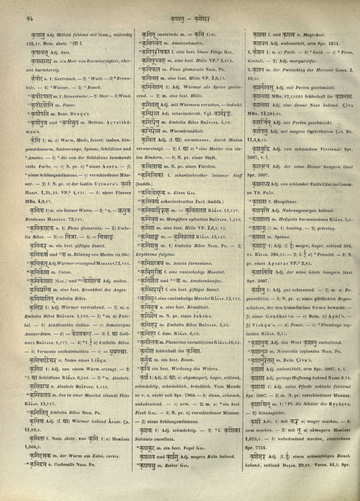
kṛ́mi — 1〉 m. — a〉 Wurm, Made, Insect; insbes. Eingeweidewurm, Seidenraupe, Spinne, Schildlaus und *Ameise. — b〉 *die von der Schildlaus kommende rothe Farbe. — c〉 N. pr. — α〉 *eines Asura. — β〉 *eines Schlangendämons. — γ〉 verschiedener Männer. — 2〉 f. N. pr. — a〉 der Gattin Uśīnaraʼs kṛmī HARIV. 1,31,23. VP.² 4,121. — b〉 eines Flusses MBH. 6,9,17.
Apte 1890 Adjektiv · Substantiv Maskulin
Originaltext · Englisch · Adjektiv · Substantiv Maskulin
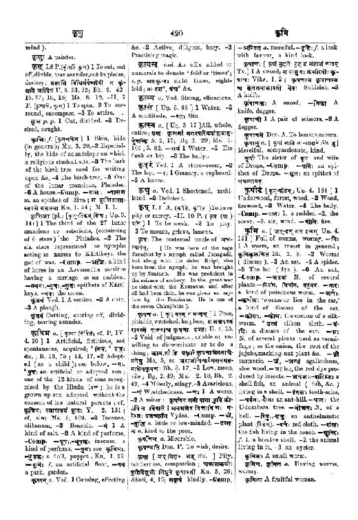
kṛmi a. [kram-in ata itvam Uṇ. 4. 121] Full of worms, wormy. — miḥ 1 A worm, an insect in general; kṛmikulacitaṃ Bh. 2. 9. 2 Worms (disease). 3 An ass. 4 A spider. 5 The lac. (dye). 6 An ant. Comp. — kaṃṭakaṃ N. of several plants:-viḍaṃga, citrāṃga, uduṃbara. — karaḥ a kind of poisonous worm. — karṇaḥ, — karṇakaḥ ‘worms or lice in the ear,’ a kind of disease of the ear. — kośaḥ, -koṣaḥ the cocoon of a silkworm. ˚utthaṃ silken cloth. — graṃthiḥ a disease of the ear. — ghnaḥ N. of several plants used as vermifuge; as the onion, the root of the jujube, marking-nut plant &c. — ghnī turmeric. — jaṃ, -jagdhaṃ agallochum, aloe wood. — jā lac, the red dye produced by insects. — jalajaḥ, -vāriruhaḥ a shell-fish, an animal (fish, &c.) living in a shell. — daṃtakaḥ tooth-ache. — parvataḥ, -śailaḥ an ant-hill. — phalaḥ the Udumbara tree. — bhojanaḥ N. of a hell. — ripuḥ, -śatruḥ an anthelmintic plant (viḍaṃga). — varṇaḥ red cloth. — śaṃkhaḥ the fish living in the conch. — śuktiḥ f. 1 a bivalve shell. 2 the animal living in it. 3 an oyster.
Cappeller 1887 Substantiv Maskulin
Originaltext · Deutsch · Substantiv Maskulin
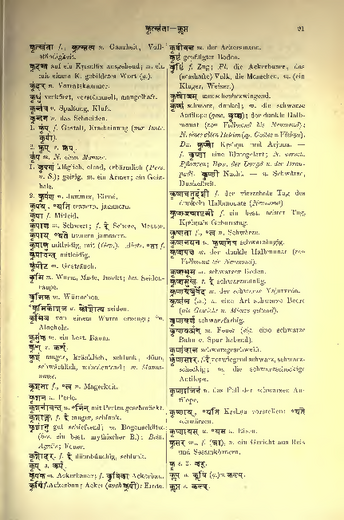
kṛmi m. Wurm, Made, Insekt; bes. Seidenraupe.
Burnouf 1866 Substantiv Maskulin
Originaltext · Französisch · Substantiv Maskulin
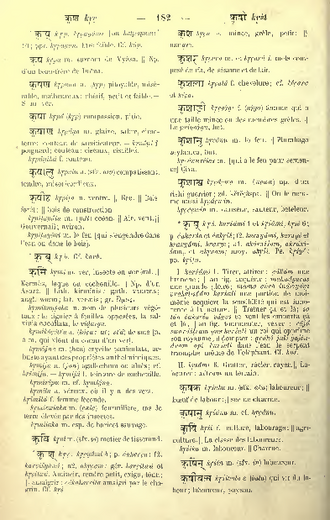
kṛmi kṛmi m. ver, insecte en général. Kermès, laque ou cochenille. Np. d'un Asura. Lith. kirminis; goth. vaurms; angl. worm; lat. vermis; gr. ἔλμινς. kṛmikaṇṭaka n. nom de plusieurs végétaux: le figuier à feuilles opposées, la salvinia cucullata, le viḍaṅga. kṛmikośottha a. (kośa; ut; sthā) de soie [m à m. qui vient du cocon d'un ver]. kṛmighna m. (han) erycibe paniculata, arbuste ayant des propriétés anthelmintiques. kṛmija n. (jan) agallochum ou aloès; cf. krimija. — kṛmijā f. teinture de cochenille. kṛmiripu m. cf. kṛmighna. kṛmila a. véreux, où il y a des vers. — kṛmilā f. femme féconde. kṛmiśailaka m. (śaila) fourmilière, tas de terre élevée par des insectes. kṛmīlaka m. esp. de haricot sauvage.
Quelltextfundstellen (4)
GoS 1 Fundstelle
HP 1 Fundstelle
HTK 1 Fundstelle
SiSa 1 Fundstelle
Mit AYI Free weitermachen
Bildquelle: AYI Archiv.