

parameśvara परमेश्वर – höchster Herr
Substantiv Maskulin · Substantiv Neutrum · Worttyp nicht bestimmt
Wörterbuchquellen
AYI Wörterbuch Substantiv Maskulin
höchster Herr
Herkunft
Cappeller 1891 Substantiv Maskulin
Originaltext · Englisch · Substantiv Maskulin
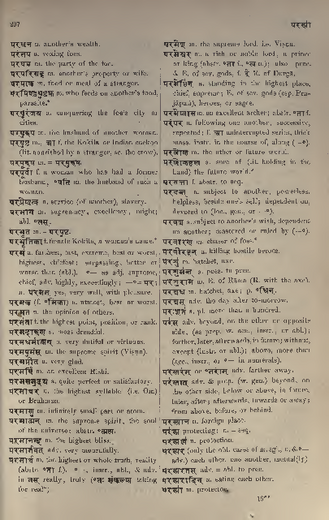
parameśvara ·m. a rich or noble lord, a prince or king (abstr. °tā f., °tva n.); also = prec. & E. of sev. gods, f. ī E. of Durgā.
Monier-Williams 1872 Substantiv Maskulin
Originaltext · Englisch · Substantiv Maskulin
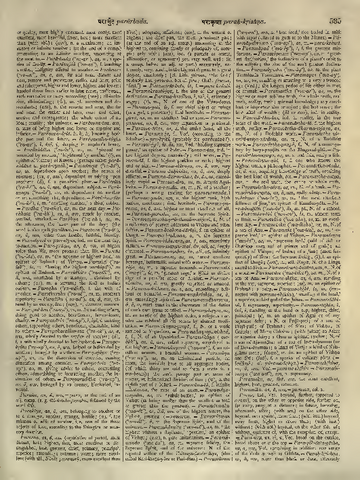
—Parameśvara (˚ma-īś˚), as, m. ‘supreme lord,’ (said of rich or illustrious men and of princes and of gods); an epithet of Viṣṇu; of Indra; of a Jina; (most fre- quently) of Śiva; the Supreme Being; (ī), f. an epi- thet of Durgā; (am), n., scil. liṅga, N. of a Liṅga sacred to Śiva.
Petersburger 1855 Substantiv Maskulin · Substantiv Neutrum · Worttyp nicht bestimmt
Originaltext · Deutsch · Substantiv Maskulin · Substantiv Neutrum
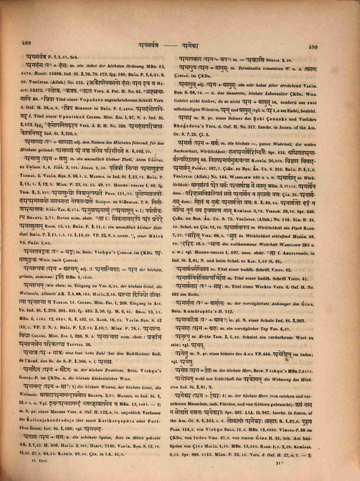
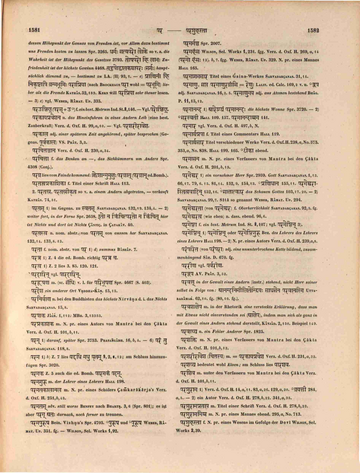
parameśvara (parama + īśvara) 1〉 m. der höchste Herr (von reichen und vornehmen Menschen, insb. Fürsten, und von Göttern gebraucht): kathaṃ nāma na sevyante yatnataḥ parameśvarāḥ Spr. 587. LIA. II, 947. Inschr. in Journ. of the Am. Or. S. 6,543,4. Journ. of the Am. Or. S. 6,543,6. lokānāṃ parameśvaraḥ (brahmā) R. 1,57,6. puruṣa PRAB. 114,5. von Viṣṇu BHAG. 11,3. MBH. 13,6990. VĀMANA-P. 58_im_ŚKDR. von Indra VIKR. 87,5. von einem Jina H. 31, Sch. Am häufigsten von Śiva HALĀY. 1,11. MBH. 13,595. RAGH. 1,1. RAGH. 2,39. KUMĀRAS. 6,25. Spr. 898. Spr. 1143. MĀRK. P. 23,42. Verz. d. Oxf. H. 27,a,7. — 2〉 f. ī die höchste Herrin, Bein. der Durgā HARIV. 10279. Verz. d. Oxf. H. 39,b,15. Verz. d. Oxf. H. 93,a,10. — 3〉 n. (sc. liṅga) N. eines Heiligthums des Śiva Verz. d. Oxf. H. 64,a,6.
Originaltext · Deutsch · Worttyp nicht bestimmt
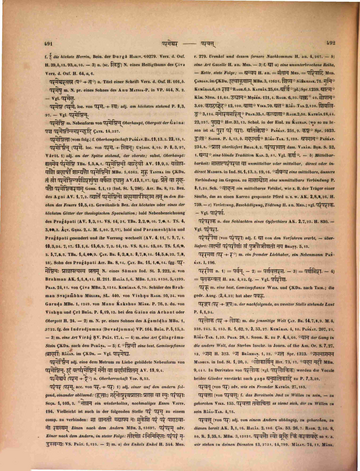
parameśvara 1〉 ein vornehmer Herr Spr. 2959. Gott SARVADARŚANAS. 1,13. SARVADARŚANAS. 66,17. SARVADARŚANAS. 79,6. SARVADARŚANAS. 79,15. SARVADARŚANAS. 81,14. SARVADARŚANAS. 152,9. SARVADARŚANAS. 154,13. ˚praṇidhāna SARVADARŚANAS. 155,11. parameśvarāstitvavādin SARVADARŚANAS. 152,16. ˚sākṣātkāra das Schauen Gottes SARVADARŚANAS. 103,17. SARVADARŚANAS. 103,20. — 2〉 SARVADARŚANAS. 99,7. Sītā so genannt WEBER, RĀMAT. UP. 294.
Böhtlingk 1879 Substantiv Maskulin · Substantiv Neutrum
Originaltext · Deutsch · Substantiv Maskulin · Substantiv Neutrum
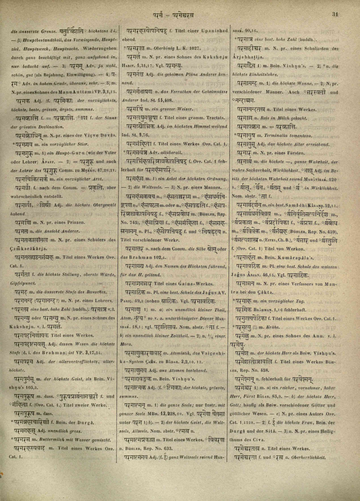
parameśvara — 1〉 m. — a〉 ein reicher, vornehmer, hoher Herr, Fürst BĀLAR. 85,9. — b〉 der höchste Herr, Gott; häufig als Beiw. verschiedener Götter und göttlicher Wesen. — c〉 N. pr. eines Autors OPP. CAT. 1,4528. — 2〉 f. ī die höchste Frau, Bein. der Durgā und der Sītā. — 3〉 n. N. pr. eines Heiligthums des Śiva.
Cappeller 1887 Substantiv Maskulin
Originaltext · Deutsch · Substantiv Maskulin
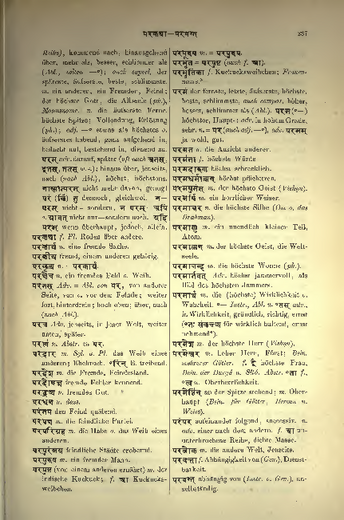
parameśvara m. hoher Herr, Fürst; Bein. mehrerer Götter. f. ī höchste Frau, Bein. der Durgā u. Sītā. Abstr. ˚tā f., ˚tva n. Oberherrlichkeit.
Burnouf 1866 Substantiv Maskulin
Originaltext · Französisch · Substantiv Maskulin
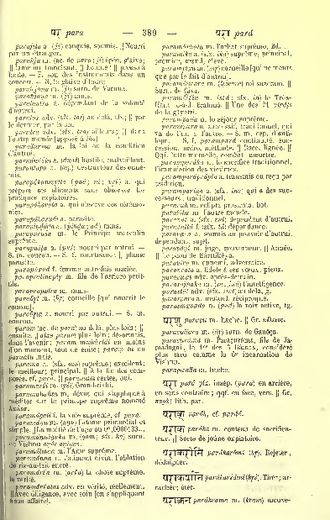
parameśvara m. (īśvara) roi suzerain. Surn. de Śiva.
Quelltextfundstellen (4)
SiSa 1 Fundstelle
Mit AYI Free weitermachen
Bildquelle: AYI Archiv.