

tṝ तॄ – hinübergelangen; überqueren
Verbalwurzel · Worttyp nicht bestimmt · Verb
Wörterbuchquellen
AYI Wörterbuch Verbalwurzel
hinübergelangen; überqueren
Monier-Williams 1872 Verb
Originaltext · Englisch · Verb
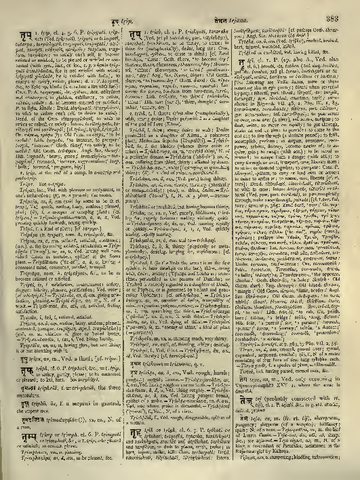
tṝ tṝ, cl. 1. P. (ep. also A., Ved. also cl. 6.) tarati, -te, tatāra (2nd sing. teritha, 3rd du. teratus, 3rd pl. terus), tariṣyati or ta- rīṣyati, atārīt, taritum or tarītum or tartum; [the following are Vedic forms, some of them occurring also in epic poetry; tirati when preceded by prep.; titarti, part. titrat; tīryati, -te; turyāt, tuturyāt; Aor. tāriṣat, atārima, tarīt; taru- ṣema in Ṛg-veda VII. 48, 2, Pāṇ. III. 1, 85, taruṣanta, taruṣante; titirus, part. titirvas; gen. tataruṣas; inf. taradhyai]; to pass across or over, cross over (a river), sail across, navigate; to float, swim; to move on rapidly; to get through, attain an end or aim; to pervade; to come to the end of; to live through (a definite period); to fulfil, accomplish, perform; to surpass, overcome, over- power, subdue, destroy, become master of; to ac- quire, gain; to escape (with acc.); to be saved or rescued; to escape from a danger (with abl.); to carry through or over, transport, save, liberate from; to strive or contend together, to compete: Caus. P. tārayati, -yitum, to carry or lead over or across; to cause to arrive at; to rescue, save, liberate [cf. rt. trai]: Desid. titīrṣati, titariṣati, titarīṣati, to wish to cross: Intens. tetīryate, tātarīti or tā- tarti (Ved. pres. part. taritrat), to pass completely through, make a way through, pervade; [cf. 1. tur, tul, turv; tara at p. 365: Zend tarō, ‘over:’ Gr. τερ- έ-ω, τέρ-ε-τρο-ν, τέρ-θρο-ν, τέρ-μα, τέρμων, τέρμ- ιο-ς, τερμιό-ει-ς, τείρ-ω, τρύ-ω, τρί-βω, τρύ-χ-ω, τέρ-ην, τι-τρά-ω, τι-τραίν-ω, τέρ-α-ς, τορ-ό-ς, τόρ- ο-ς, τόρ-νο-ς, τορ-ύνη, τορ-εύ-ω, τρῦ-μα, τρῶ-μα, τρῆ-μα, τέλος, τέλλω (‘to rise’), τηρέω (caus.), τρῡτάνη; perhaps also Τάρᾱς, Τρο-ία, Τροιζήν, τελέω, τέλειος, τελευτή, τᾶλις, θραύ-ω, τραῦ-μα θλά-ω, θλίβ-ω: Lat. ter-mo, ter-men, ter-minu-s, ter-o, ter-e(t)-s, ter-e-bra, trib-ula, tribulare, trī- ti-cu-m, in-tra-re, peni-tra-re, ex-tra-re, trans: Umbr. termnu, traf = trans: Osc. teremenniu§: Sabin. terentum, Terentius, tur-unda, tru-a, ‘a ladle;’ trāme(t)-s, Tras-im-enu-s, ‘the opposite, ulterior:’ Goth. thair-ko, ‘a hole;’ thairh: Old Germ. durh: Eng. through: Old Island. thrö-m, ‘margin:’ Old Germ. dru-m, ‘limit, border:’ Angl. Sax. thrā-v-an: Old Germ. drā-y-an, ‘to turn, whirl;’ thearl, thearm, thirel, thirlian, thole, tholian, thaelian, for-thyldian: Slav. tre†-ti, try- ti, ‘to rub:’ Lith. trī1n-ti, ‘to rub, file, polish, bore;’ til-tas, ‘a bridge;’ tolùs, ‘long, distant:’ Hib. toir, ‘a pursuit;’ tor, ‘a pursuer;’ toramh, ‘pursuit;’ toras, ‘a journey;’ teirin, ‘a descent;’ tearnadh, ‘descending;’ tarradh, ‘protection;’ tarthadoir, ‘a saviour.’]
Apte 1890 Verbalwurzel
Originaltext · Englisch · Verbalwurzel
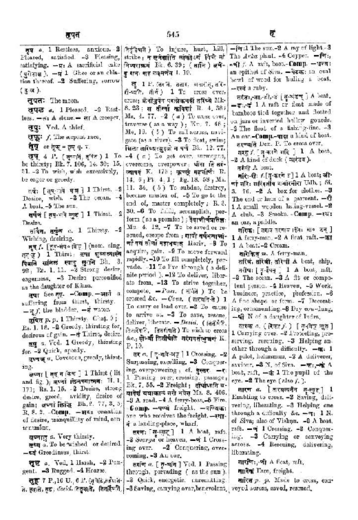
tṝ 1 P. (tarati, tatāra, atārīt, tarirī-ṣyati, tīrṇa) 1 To cross over, cross; kenoḍupena paralokanadīṃ tariṣye Mk. 8. 23; sa tīrtvā kapiśāṃ R. 4. 38; Ms. 4. 77. 2 (a) To cross over, traverse (as a way); Ku. 7. 48; Me. 19. (b) To sail across, navigate (as a river). 3 To float, swim; śilā tariṣyatyudake na parṇaṃ Bk. 12. 77. 4 (a) To get over, surmount, overcome, overpower; dhīrā hi taraṃtyāpadaṃ K. 175; kṛcchraṃ mahattīrṇa. R. 14. 6; Pt. 4. 1; Bg. 18. 58; Ms. 11. 34. (b) To subdue, destroy, become master of. 5 To go to the end of, master completely; R. 3. 30. 6 To fulfil, accomplish, perform (as a promise); daivāttīrṇapratijñaḥ Mu. 4. 12. 7 To be saved or rescued, escape from; gāvo varṣabhayāttīrṇā vayaṃ tīrṇā mahābhayāt Hariv. 8 To acquire, gain. 9 To move forward rapidly. 10 To fill completely, pervade. 11 To live through (a definite period). 12 To deliver, liberate from. 13 To strive together, compete. — Pass. (tīryate) To be crossed &c. — Caus. (tārayati-te) 1 To carry or lead over. 2 To cause to arrive at. 3 To save, rescue, deliver, liberate. — Desid. (titīrṣati. titariṣati, titarīṣati) To wish to cross &c.; dorbhyāṃ titīrṣati taraṃgavatībhujaṃgaṃ K. P. 10.
Cappeller 1887 Worttyp nicht bestimmt
Originaltext · Deutsch · Worttyp nicht bestimmt
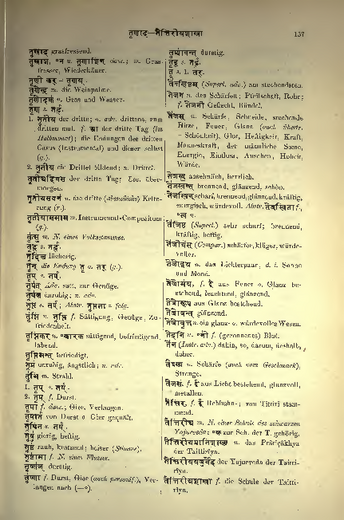
tṝ s. 1. tar.
Burnouf 1866 Verbalwurzel
Originaltext · Französisch · Verbalwurzel
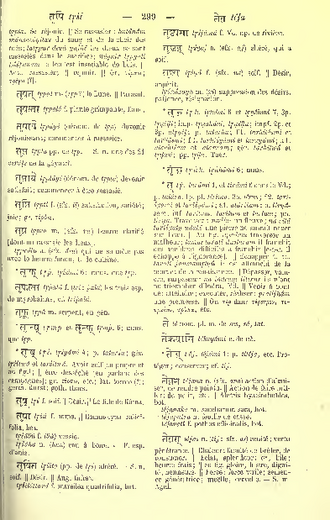
*tṝ tṝ. tarāmi 1, et tirāmi 6 dans le Vd.; p. tatāra, 1p. pl. terima. 3p. terus; f2. tariṣyāmi et tarīṣyāmi; a1. atāriṣam; o. tīryāsam; inf. tarītum, taritum et tartum; pp. tīrṇa. Traverser: nadīm un fleuve; na śitā tariṣyaty udake une pierre ne saurait nager sur l'eau. Au fig. āpadam traverser un malheur; tamas tarati dustaram il franchit des ténèbres difficiles à franchir [c-à-d. il échappe à l'ignorance]. Echapper à, ac. tarati janmamṛtyū il est affranchi de la mort et de la renaissance. Dépasser, vaincre, surpasser: na indram titirus ils n'ont pu triompher d'Indra, Vd. Venir à bout de; atteindre; exécuter, réaliser: pratijñām une promesse. Gr.τερ dans τέρετρον, τιτραίνω, τρύπα, etc.
Quelltextfundstellen (7)
SiSa 6 Fundstellen
SVU 1 Fundstelle
Mit AYI Free weitermachen
Bildquelle: AYI Archiv.