

pari परि – around; fully
adverb · particle · previx · Word type unspecified
Dictionary sources
AYI dictionary previx
around; fully
Cappeller 1891 adverb
Original text · English · adverb
pári ·adv. round, about (often °--, also to denote abundance or high degree); prep. round, about, against, opposite to, beyond, above, more than (acc.); from, out of, after, in consequence or on account of, according to (abl.); *around i.e. outside or with exception of (abl., also pari pari).
Monier-Williams 1872 Word type unspecified
Original text · English · Word type unspecified
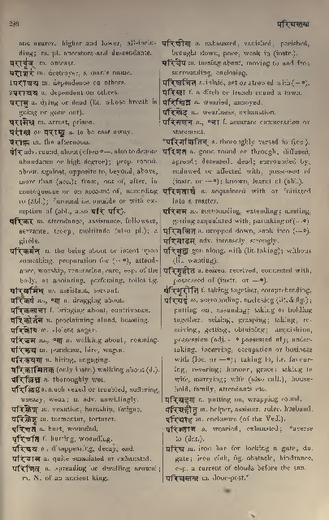
pari pari (an indeclinable particle and prefix to verbs and their derivative nouns; often parī in composition; allied to para, parā, pra), round, around, about, round about; further, in addition to; against, opposite to, in the way; much, excessively. (As a separable preposition, especially in the Veda), around, about (with acc., e. g. madhyan-dinam pari, about midday); against, opposite to, towards, to (with acc., e. g. vṛkṣam pari, in the direction of a tree; tvā pari, against thee); to the share of (with acc., e. g. yan mām pari syāt, what may fall to my lot); beyond, more than (with acc., e. g. dai- vīm pari vāk, a voice more than divine); after, successively, severally (with acc. distributively, e. g. vṛkṣaṃ vṛkṣam pari siñcati, he waters tree after tree); from, away from, out of (with abl. after verbs of motion, e. g. samudrād uta vā divaḥ pari, out of sea or sky); outside of, except, with exception of (with abl., e. g. pari Trigartebhyaḥ, round about or outside Tri-garta); after the lapse or expiration of (with abl., e. g. pari saṃvatsarāt, after the lapse of a full year); in consequence of, on account of, for the sake of (with abl., e. g. Rakṣasaḥ pari, on account of the Rakṣas); according to, in accordance with (with abl., e. g. dharmaṇaḥ pari, according to the ordinance); above, over (Ved. according to the Scholiast = adhi, upari). (As an adverbial prefix to nouns not immediately connected with verbs), very, excessively (e. g. pary- aśru, very tearful; pari-durbala, excessively weak). At the beginning of an adverbial comp. pari implies outside, without, except, exclusive of (e. g. pari-trigartam, outside Trigarta, Pāṇ. II. 1. 12, VI. 2, 33; and according to Pāṇ. II. 1, 10, it may be used in this sense at the end of an adverbial comp., but only after akṣa, śalākā, and a numeral). At the beginning of an adjective comp., according to Pāṇ. (II. 2, 18, Vārt. 7), pari may be used in the sense of pari-glāna, exhausted, (but pary- adhyayana is said to mean ‘one to whom study is repugnant.’) Native lexicographers explain the senses of pari by the following Sanskrit words: ā-liṅgana, doṣākhyāna (doṣa-kīrtana), nir-asana (ni- vasana), pūjā, bhūṣaṇa, vyādhi, vy-āpti, upa- rama, śoka, śeṣa, ati-śaya, tyāga, ni-yama; [cf. Zend pairi; Gr. περί, πέριξ, περι-σσό-ς, -περ; Lat. per- in adj., e. g. per-idoneus: probably Old Germ. furi; Old Iceland. fyri; Mod. Germ. für; Hib. faoi, ‘about, round.’]
Petersburger 1855 adverb · Word type unspecified
Original text · German · adverb
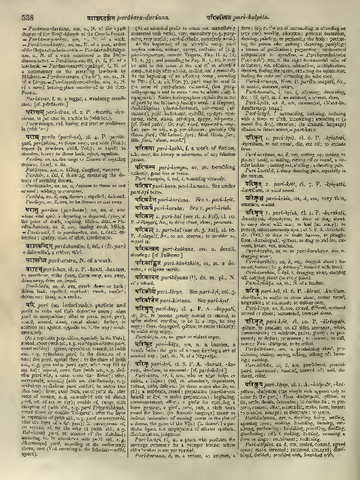
pári adv. und praep. NIR. 1,3. gaṇa prādi zu P. 1,4,58. VOP. 1,8. Der Auslaut häufig gedehnt (vgl. parīṇāma u. s. w.) 1〉 adv. a〉 rings, umher: di̱dṛ̱kṣeṇya̱ḥ pari̱ kāṣṭhā̀su̱ jenyàḥ ṚV. 1,146,5. avyo̱ vāre̱ parì pri̱yo hari̱rvanèṣu sīdati ṚV. 9,7,6. — b〉 weiterhin, dazu: yathā̀ va̱ḥ svāhā̱gnaye̱ dāśèma̱ parīḻā̀bhirghṛ̱tavàdbhiśca ha̱vyaiḥ ṚV. 7,3,7. — c〉 entgegen, im Wege: avā̀ no vāja̱yuṃ rathàṃ su̱karàṃ te̱ kimitparì es ist dir leicht; was steht im Wege? ṚV. 8,69,6. — d〉 als adv. ist pari aufzufassen in Zusammensetzungen wie paryaśru adj. von Thränen gefüllt, paridurbala überaus schwach, paricaturdaśan volle vierzehn u. s. w. — 2〉 praep. a〉 mit dem acc. α〉 um (von Ort und Zeit): mā̱yāḥ kṛ̀ṇvā̱nasta̱nvaṃ1̱̀ pari̱ svām ṚV. 3,53,8. diva̱ṃ pari̱ bhūmà ṚV. 1,62,8. pari̱ dhānàma̱ktoḥ ṚV. 3,7,6. ma̱dhyaṃdìna̱ṃ parì AV. 4,11,2. AV. 6,108,5. — β〉 gegen, nach — hin, entgegen (lakṣaṇe und itthaṃbhūtākhyāne) P. 1,4,90. VOP. 5,7. MED. avy. 67. H. an. 7,44. vṛkṣaṃ pari vidyotate vidyut Schol. zu P. 1,4,90. P. 2,3,10. sādhurdevadatto mātaraṃ pari Schol. zu P. 1,4,90. SIDDH. K._zu_P. 2,3,43. prā̱cīnèna̱ manàsā ba̱rhaṇā̀vatā̱ yada̱dyā cìtkṛ̱ṇava̱ḥ kastvā̱ parì wer hindert dich? ṚV. 1,54,5. yadeko̱ viśva̱ṃ pari̱ bhūma̱ jāyàse dass du allein bist gegenüber der ganzen Welt AV. 13,2,3. — γ〉 zu Theil (bhāge) P. 1,4,90. VOP. 5,7. MED. H. an. yadatra māṃ pari syāt was da auf meinen Theil fallen sollte Schol. zu P. 1,4,90. hariṃ paryabhavallakṣmīḥ VOP. 5,7. — δ〉 hinaus über, mehr als: paryàsya mahi̱mā pṛ̀thi̱vīm AV. 13,2,45. a̱haṃ daivī̱ṃ pari̱ vāca̱ṃ viśàśca AV. 6,61,2. — ε〉 in distributiver Bedeutung (vīpsāyām) P. 1,4,90. VOP. 5,7. MED. H. an. vṛkṣaṃ vṛkṣaṃ pari siñcati er begiesst einen Baum nach dem andern P. 1,4,90, Sch. — b〉 mit dem ablat. Euphonisches Verhalten des vorangehenden ablat. im Veda P. 8,3,51 (pari = adhi d. i. nach den Scholl. = upari). α〉 von — her, von — weg, aus — her; in Verbindung mit Verben der Bewegung, des Hervorgehens und Entstehens: sa̱mu̱drādu̱ta vā̀ di̱vasparì ṚV. 1,47,6. ṚV. 1,23,12. ṚV. 1,49,3. udva̱yaṃ tamàsa̱spari̱ sūryàmaganma ṚV. 50,10. ṚV. 2,31,1. u̱ttiṣṭha̱nparì ba̱rhiṣàḥ ṚV. 7,33,1. yadoṣàdhībhya̱ḥ pari̱ jāyàte vi̱ṣam ṚV. 7,50,3. AV. 4,9,9. apàsa̱sparyupa̱ pra yànti dhītayàḥ . ṛ̱tasyà pa̱thyā̱3̱̀ anù ṚV. 3,12,7. pa̱ri̱kṛtya̱ parì tva̱caḥ AV. 5,14,3. keśā̀ vardhantāṃ śī̱rṣṇaḥ parì AV. 6,137,2. va̱dhama̱smadyā̀vayata̱ṃ parì AV. 1,20,2. tadagnirdevo vanutāṃ vayamagneḥ pari mānuṣāḥ ŚAT. BR. 1,9,1,19. indra̱ āśā̀bhya̱spari̱ sarvā̀bhyo̱ abhàyaṃ karat von allen Seiten ṚV. 2,41,12. vyu̱cchantī̱ pari̱ svasùḥ aufleuchtend aus der Schwester (der Nacht) ṚV. 4,52,1. kutaḥ paryāgacchati (pari soll hier bedeutungslos sein und daher seinen Ton bewahren) P. 1,4,93, Sch. In der Verbindung divaḥ pṛthivyāḥ paryoja uddhṛtam soll nach den Scholl. zu P. 8,3,51 vor pari das sa des ablat. in Visarga übergegangen sein, weil pari hier sarvatobhāve (vgl. H. an. MED.) gebraucht werde, während es im andern Falle = adhi (= upari) sei. Es ist ohne Zweifel ṚV. 6,47,27 di̱vaspṛ̀thi̱vyāḥ paryoja̱ udbhṛ̀ta̱ṃ (uddhṛta ist gar nicht vedisch) vana̱spatìbhya̱ḥ paryābhṛ̀ta̱ṃ sahàḥ gemeint, wo also doch sa steht; die Bed. von pari ist auch hier von — her. — β〉 ausserhalb, mit Ausschluss von, bis auf (varjane) P. 1,4,88. P. 2,3,10. VOP. 5,21. H. an. MED. pari trigartebhyo vṛṣṭo devaḥ eig. um Trigarta herum (aber nicht in Trigarta selbst) Schol. zu P. 1,4,88. P. 2,1,12. P. 2,3,10. paryanantāttrayastāpāḥ VOP. 5,21. pari wird in diesem Falle auch verdoppelt nach P. 8,1,5 (vgl. Vārtt. 2). pari pari vaṅgebhyo vṛṣṭo devaḥ P., Sch. Vgl. u. 2,c. — γ〉 nach Ablauf von (nach KULL.): pari saṃvatsarāt M. 3,119. Mit demselben Rechte könnte man parisaṃ˚ zusammenschreiben und übersetzen: nach einem runden (vollen) Jahre; vgl. parisaṃvatsara und MBH. 13,4672, wo st. parisaṃvatsarātpunaḥ des Manu parisaṃvatsaroṣitān gelesen wird. — δ〉 in Folge von, aus Anlass von, wegen: dhi̱ṣaṇā̀bhya̱sparì ṚV. 4,36,8. unmàtta̱ṃ rakṣàsa̱sparì AV. 6,111,3. AV. 6,116,3. viśvèbhyastvā̱ bhuvànebhya̱spari̱ tvaṣṭā̀janat ṚV. 2,23,17. — ε〉 secundum: pra pra̱jābhìrjāyate̱ dharmàṇa̱sparì nach der Ordnung ṚV. 6,70,3. keno̱ nu ka̱ṃ śromàtena̱ na śùśruve ja̱nuṣa̱ḥ parì vṛtra̱hā ṚV. 8,55,9. — c〉 am Anfange eines adv. comp. (pari behält seinen Ton) ausserhalb, mit Ausschluss von, bis auf P. 2,1,12. P. 6,2,33. páritrigartaṃ vṛṣṭo devaḥ Sch. Vgl. u. 2,b,β. — d〉 am Ende eines adv. comp. nach akṣa, śalākā und einem Zahlwort dass. P. 2,1,10. — e〉 am Anf. eines adj. comp. in der Bed. von pariglāna P. 2,2,18, Vārtt. 7. paryadhyayanaḥ = pariglāno 'dhyayanāya der einen Abscheu vor dem Studium hat Sch. Hier könnte pari auch als adv. gefasst werden: dem das Studium zuwider ist. — Die indischen Lexicographen und Grammatiker kennen noch folgende Bedeutungen: āliṅgana, doṣākhyāna (doṣakīrtana), nirasana (nivasana H. an.), pūjā, bhūṣaṇa, vyādhi, vyāpti H. an. MED. uparama, śoka H. an. śeṣa MED. atiśaya, tyāga, niyama DURGĀD._zu_VOP. ŚKDR. Bei Aufstellung dieser verschiedenen Bedeutungen hat man zum grössten Theil übertragene Bedeutungen von Verbalwurzeln, die mit pari verbunden werden, im Auge gehabt. pari geht wie para, parā und pra auf 1. par zurück.
Original text · German · Word type unspecified
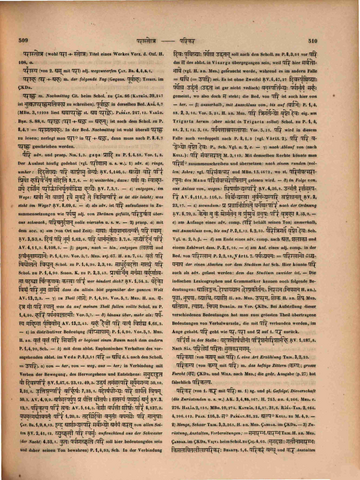
pari 2〉d〉 = paritas um, um — herum BHĀG. P. 10,14,1.
Böhtlingk 1879 adverb
Original text · German · adverb
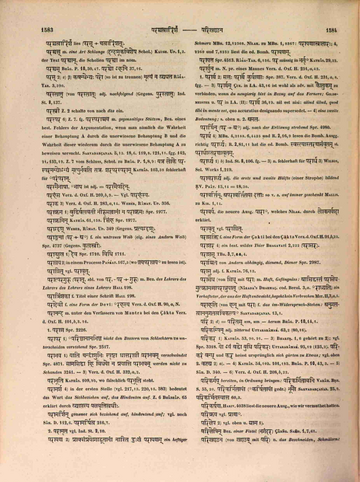
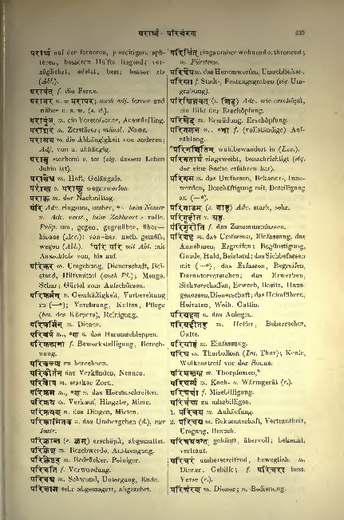
pári — 1〉 Adv. — a〉 rings, ringsum, umher zu Spr. 867. — b〉 ringsum, hier und dort, so v. a. reichlich ṚV. 7,3,7. Häufig am Anf. eines Comp. als Ausdruck der Fülle, des vollen Maasses, des hohen Grades. — 2〉 Präp. — a〉 mit Acc. — α〉 um (örtlich und zeitlich). — β〉 gegen, nach — hin, entgegen, gegenüber. — γ〉 hinaus über, mehr als. — δ〉 *gegen, so v. a. in Bezug auf Jmd. — ε〉 *zu Theil. Mit as oder bhū Jmd zu Theil werden. — ζ〉 *in distributiver Bed. vṛkṣaṃ vṛkṣaṃ pari siñcati (nicht pariṣiñcati) Baum für Baum. — b〉 mit Abl. — α〉 von — her, von — weg, aus — her. — β〉 *um — herum so v. a. ausserhalb, mit Ausschluss von, bis auf, Auch verdoppelt. — γ〉 nach Ablauf von. — δ〉 in Folge —, aus Anlass von, wegen. — ε〉 gemäss, nach, secundum PĀR. GṚHY. 2,11,12. (vgl. ĀŚV. ŚR. 6,12,12). — c〉 *am Anf. und am Ende eines adv. Comp. ausserhalb, mit Ausschluss von bis auf. — d〉 *am Anf. eines adj. Comp. gegen (als Ausdruck der Abneigung u. s. w.).
Apte 1890 particle
Original text · English · particle
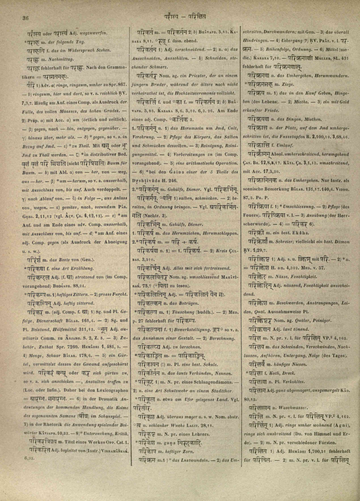
pari ind. (Sometimes changed to parī, as parivāha or parīvāha, parihāsa or parīhāsa) 1 As a prefix to verbs and nouns derived from them, it means (a) round, round about, about. (b) in addition to, further. (c) opposite to, against. (d) much, excessively. 2 As a separable preposition it means (a) towards, in the direction of, to, opposite to; (with an acc.); vṛkṣaṃ pari vidyotate vidyut (b) successessively, severally (with an acc.); vṛkṣa vṛkṣaṃ pari siṃcati ‘he waters tree after tree.’ (c) to the share or lot ([Page 0670-c]) of (showing bhāga or participation) (with acc.); yadatra māṃ pari syāt ‘what may fall to my lot’; or lakṣmīrhariṃ pari. Sk. (d) from, out of. (e) except, outside of, with the exception of (with abl.); pari trigartebhyo vṛṣṭo devaḥ or paryanaṃtāttrayastāpāḥ Vop. (f) after the lapse of. (g) in consequence of. (h) beyond, more than. (i) according to, in accordance with. (j) above, over. 3 As an adverbial prefix to nouns not directly connected with verbs, it means ‘very,’; ‘very much,’ ‘excessively’; as in paryaśru ‘bursting into tears’; so paricaturdaśan, paridaurvalya. 4 At the beginning of adverbial compounds pari means (a) without, except, outside, with the exception of; as in paritrigartaṃ vṛṣṭo devaḥ P. II. 1. 12; P. VI. 2. 33. According to P. II. 1. 10 pari may be used at the end of adverbial comp. after akṣa, śalākā, and a numeral to denote ‘loss or defeat in a game by an unlucky or adverse cast of dice’ (dyūtavyavahāre parājaye evāyaṃ samāsaḥ); e. g. akṣapari, śalākāpari, ekapari; cf. akṣapari. (b) round about, all round, surrounded by; as in paryagni ‘in the midst of flames’. 5 At the end of an adjectival comp. pari has the sense of ‘exhausted by,’ or ‘feeling repugnance, for’; as in paryadhyayanaḥ = pariglāno'dhyayanāya.
Cappeller 1887 adverb
Original text · German · adverb
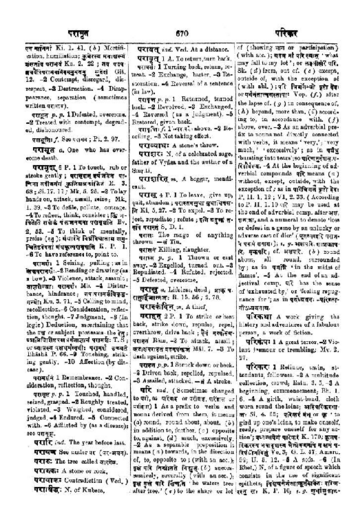
pári Adv. ringsum, umher, ˚— beim Nomen u. Adv. verst., beim Zahlwort = volle. Präp um, gegen, gegenüber, über— hinaus (Acc.); von-her, nach, gemäßig, wegen (Abl.). *pari pari mit Abl. mit Ausschluß von, bis auf.
Burnouf 1866 Word type unspecified
Original text · French · Word type unspecified
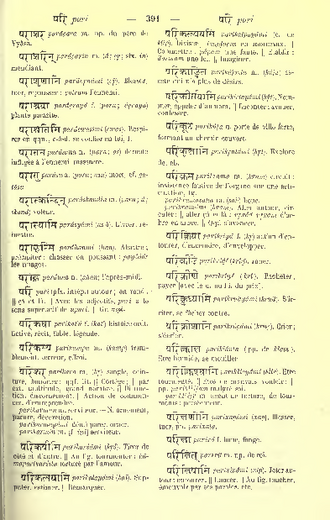
pari pari (pfx. insép.) autour; en rond; çà et là. Avec les adjectifs; pari a le sens superlatif de upari. Gr. περὶ.
Derived words
More direct derivatives (3)
Further derivatives (1)
Occurrences in source texts (73)
AsFu 2 occurrences
DYS 6 occurrences
GoS 2 occurrences
HP 13 occurrences
HP 3.33-3.48*1: Khecarī and Soma 2 occurrences
Direct occurrences
-
HP 3.33 Segment 5
-
HP 3.34*1–34*2 Segment 7
HP 3.94-3.102*1: Śakti Cālana 2 occurrences
Direct occurrences
4 more source pages
HTK 1 occurrence
HTK 10.34*2–38*1: Asvaṅgaśṛṅkhalā and Kumbhāntaraśṛṅkhalā 1 occurrence
Direct occurrences
-
HTK 10.35 Segment 10
IVU 2 occurrences
MAN 1 occurrence
PJH 2 occurrences
PYS 18 occurrences
PYS 1.5–11: The Five Vṛtti 2 occurrences
Occurrences through derived words
PYS 2.15–17: Everything Is Suffering 1 occurrence
Occurrences through derived words
-
PYS 2.15 Segment 1
8 more source pages
PYS 3.9–12: Three Transformations of Citta 3 occurrences
Occurrences through derived words
PYS 3.13–14: Three Kinds of Transformation 1 occurrence
Occurrences through derived words
-
PYS 3.13 Segment 7
PYS 3.15–16: Sequence of Transformation 2 occurrences
Occurrences through derived words
PYS 4.12–14: Real Objects in Transformation 1 occurrence
Occurrences through derived words
-
PYS 4.14 Segment 1
SiSa 12 occurrences
5 more source pages
SVU 5 occurrences
Continue with AYI Free
Image source: AYI archive.