

yama यम – restraint; ethical restraint
adjective · substantive masculine · substantive neuter · Word type unspecified
Dictionary sources
AYI dictionary substantive masculine
restraint; ethical restraint
Derived from
Cappeller 1891 substantive masculine · Word type unspecified
Original text · English · substantive masculine
yáma1 ·m. holder, i.e. bridle or driver; restraint, self-control, any paramount moral duty or observance (ph.).
Original text · English · Word type unspecified
yamá ·(f. ā́2 & ī́) paired, twin; m. a twin (du. twins), N. of a god, either the Twin (with his sister yamī́ f.) or the Restrainer, the god of death. n. pair, twin letter (g.)
Monier-Williams 1872 substantive masculine
Original text · English · substantive masculine
Yama, as, m. a rein, curb, bridle (Ved.); a driver, charioteer (Ved.); restraining, controlling, taming, keeping in check, restraint, (vācāṃ yamaḥ, restraint of words, silence); self-control, any great moral duty or observance, (as opposed to niyama, a minor duty or observance, see Manu IV. 204; some of the Yamas are as follow, ‘restraining the organs of sense,’ ‘chastity, and the control of all sensual desires,’ ‘refraining from violence or injury,’ ‘patience,’ ‘truthfulness,’ ‘honesty’); a twin, one of a pair or couple, a fellow, (yamau, ‘the twins,’ an epithet of the Aśvins and of their twin children by Mādrī, called Nakula and Sahadeva); a symbolical expression for the number two; N. of the god who presides over the Pitṛs, q. v., and rules the spirits of the dead, (he is regarded in Post-vedic mythology as the appointed Judge and ‘Restrainer’ or Punisher of the dead, in which capacity he corresponds to the Greek Pluto and to Minos; he is one of the eight guardians of the world as regent of the South quarter, in which direction in some region of the lower world is his abode, called Yama-pura; thither a soul, when it leaves the body, is said to repair, and there, after the recorder, Citra-gupta, has read an account of its actions kept in a book called Agra-sandhānī, it receives a just sentence, either ascending to heaven or to the world of the Pitṛs or being driven down to one of the twenty-one hells [called the awful provinces of the kingdom of Yama] to be born again, after undergoing its appointed recompense of bliss or pain, in higher or lower forms of being; in unison with these functions Yama is sometimes called ‘king of Justice’ or simply ‘Justice’ [see dharma-rāja, dharma], sometimes ‘Rod-bearer’ or ‘Noose-bearer’ [see daṇḍa-dhara, pāśin], some- times ‘lord of the Pitṛs or Manes’ [see pitṛ-pati], sometimes ‘king of Death’ or simply ‘Death’ [see mṛtyu-rāj, mṛtyu, kāla, antaka], sometimes ‘god of the Śrāddha’ [see śrāddha-deva]: in the Vana-parvan of the Mahā-bhārata, 1. 16754, where there is a story of his appearing to a dying man, he is described as dressed in blood-red garments, with a glittering form, a crown on his head, glowing eyes, and, like Varuṇa, holding a noose, with which he binds the spirit after drawing it from the body, in size about the measure of a man's thumb: he is otherwise represented as grim in aspect, green in colour, clothed in red, riding on a buffalo, and holding a club in one hand and noose in the other: he is said to possess two four-eyed watch-dogs, called Karbura [= Cerberus?], ‘spotted,’ and Śyāma, ‘dark,’ which guard the road to his abode: in the later mythology he is always represented as a terrible deity inflicting tortures, called yātanā, on departed souls: according to some the earlier legends point to the original meanings of his name being ‘twin,’ and make him a kind of first man, Yama and his twin sister Yamī being the first pair of beings born from Vivasvat, ‘the Sun,’ and his wife Sa- raṇyū; the seventh Manu, another form of the first man, being also born from the Sun, and so regarded as a brother of Yama, [see especially Ṛg-veda X. 10, part of which is ascribed to the authorship of Yama Vaivasvata, and cf. Vaivasvata]; Yama is, how- ever, described as resisting sexual alliance with his sister; Yama is also regarded as the regent of the Nakṣatra Apabharaṇī or Bharaṇī, see yama- devatā); N. of the author of a hymn to Viṣṇu; of the author of a Dharma-śāstra; of the planet Saturn, (Saturn being regarded as the son of Vivasvat and Chāyā); of one of Skanda's attendants (men- tioned together with Ati-yama); a crow [cf. yama- dūtaka]; (ās), m. pl., N. of a class of deities with Buddhists; (ī), f., N. of Yama's twin sister, who is identified in Post-vedic mythology with the river goddess Yamunā; (am), n. a pair, brace, couple; (in gram.) the twin letter of any consonant, (when a nasal consonant follows immediately after one of the four other consonants in each class, the consonant preceding the nasal may be doubled, and the inter- posed letter is then called its yama or twin, thus in kkṅ, the interposed k is a yama; but this inter- posed letter is generally understood, and not written in practice); pitch of the voice, tone of utterance, key; (as, ā or ī, am), twin-born, twin, double, coupled, paired.
Petersburger 1855 adjective · substantive masculine · substantive neuter
Original text · German · adjective · substantive masculine · substantive neuter
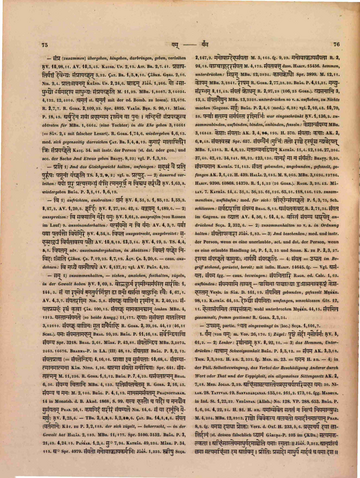
2. yamá 1〉 adj. (f. ā und ī) geminus, von Geburt doppelt, gepaart; m. Zwilling TRIK. 3,3,302. H. 1424. H. an. 2,232. fg. MED. m. 23. HALĀY. 4,15. sa̱ptathàmāhureka̱jaṃ ṣaḻidya̱māḥ ṚV. 1,164,15 (vgl. AV. 10,8,5). ṚV. 2,39,2. ya̱mā ci̱datrà yama̱sūràsūta ṚV. 3,39,3. ya̱mā ìva̱ susàdṛśaḥ ṚV. 5,57,4. ṚV. 6,59,2. ṚV. 10,117,9. ṚV. 1,66,4. ya̱me ìva̱ yatàmāne̱ yadaitàm ṚV. 10,13,2. yasya bhāryā gaurvā yamau janayet AIT. BR. 7,9. a̱gnirvāva ya̱ma̱ i̱yaṃ ya̱mī TS. 3,3,8,3. ya̱mī va̱śā TS. 2,1,9,5. aṣṭau yamā ādityāḥ NIDĀNA 10,2. yamau mithunau Zwillinge verschiedenen Geschlechts KĀṬH. 13,4. NIR. 12,10. — PAÑCAV. BR. 16,4,10. KĀTY. ŚR. 25,4,35. yamāṃ dviguṇāmiva śriyamicchantaḥ ĀŚV. ŚR. 11,5,4. ŚAUNAKA_in_Z. f. vgl. Spr. 1,442. putrau prasuṣuve yamau BHĀG. P. 3,17,2. BHĀG. P. 9,11,11. yamau Zwillinge M. 9,126. MBH. 1,124. MBH. 1,3818. MBH. 1,15694. MBH. 7,68. SUŚR. 1,318,7. VARĀH. BṚH. S. 78,24. KATHĀS. 21,49. BHĀG. P. 1,10,9. BHĀG. P. 3,16,35. yamābhyāṃ supravṛddhābhyāmarjunābhyām HARIV. 3451 (nach der Lesart der neueren Ausg.). BHĀG. P. 10,10,26. n. Paar VARĀH. BṚH. S. 77,33. yamau heissen die Aśvin H. 182. u̱ṣa ùṣo̱ hi vàso̱ agra̱meṣi̱ tvaṃ ya̱mayòrabhavo vi̱bhāvā̀ du Agni gehst voran jeder Morgenröthe, du strahltest für die Zwillinge (nämlich, wenn sie zum Frühopfer kommen) ṚV. 10,8,4. thou wast the divider of the two twins i. e. of day and night M. MÜLLER, Lect. II, 511. yama als Bez. der Zahl zwei SŪRYAS. 1,32. fg. SŪRYAS. 2,19. — 2〉 m. N. des Gottes, der im Himmel über die Seligen (pitaraḥ) herrscht, deshalb auch König heisst, ein Sohn Vivasvantʼs. Die nachvedische Zeit sieht in ihm den Beherrscher der Todten in der Unterwelt und fasst seinen Namen als Bändiger (schon ŚAT. BR. 7,2,1,10. auch von yu abgeleitet TS. 2,1,4,3). Die wirkliche Bed. ist Zwilling: Yama und Yamī sind das erste Menschenpaar. Wie diese nach der Legende NIR. 12,10 von Vivasvant mit der Saraṇyū erzeugt sind, so zeugt derselbe mit dem Abbilde der Saraṇyū den Manu, eine andere Form des Erstlings der Menschheit. Ueber den ganzen Mythus vgl. ROTH_in_Z. d. d. m. G. 4,425. fgg. und J. MUIR_in_Journ. R. As. S. new ser. I, 287. — AK. 1,1,1,54. AK. 3,4,7,33. TRIK. 1,1,71. TRIK. 3,3,302. H. 169. H. 184. H. an. MED. HĀR. 57. HALĀY. 1,72. HALĀY. 1,100. HALĀY. 5,70. HALĀY. 5,83. ṚV. 10,14,1. fgg. ṚV. 10,15,8. fgg. ṚV. 10,18,13. yattè ya̱maṃ vaìvasva̱taṃ manò ja̱gāmà dūra̱kam ṚV. 57,7. ṚV. 60,10. yasmìnvṛ̱kṣe sùpalā̱śe de̱vaiḥ sa̱ṃpibàte ya̱maḥ ṚV. 10,135,1. tasmaì ya̱māya̱ namò astu mṛ̱tyavè ṚV. 10,165,4. āstè ya̱ma upà yāti de̱vān AV. 4,34,3. AV. 4,34,4. ya̱masyà jā̱tama̱mṛtàṃ yajāmahe ṚV. 1,83,5. yo ma̱mārà pratha̱mo martyā̀nā̱ṃ yaḥ pre̱yāyà pratha̱mo lo̱kame̱tam . vai̱vasva̱taṃ sa̱ṃgamana̱ṃ janā̀nāṃ ya̱maṃ rājā̀naṃ ha̱viṣā̀ saparyata .. AV. 18,3,13. AV. 6,28,3. yamasya bhavanam ṚV. 1,35,6. paḍvīśam ṚV. 10,97,16. yoniḥ ṚV. 10,123,6. lokaḥ AV. 6,118,2. AV. 19,56,1. sādanam AV. 2,12,7. AV. 18,2,56. AV. 18,3,70. gṛham AV. 6,29,3. rājyam AV. 18,4,31. fg. Ross AV. 5,5,8. Boten AV. 5,30,6. śvānau ? AV. 8,1,9. Mutter ṚV. 10,17,1. König Yama AV. 8,10,23. AV. 15,14,7. AV. 18,3,69. AV. 1,14,2. AIT. BR. 8,7. ŚAT. BR. 2,3,2,1. KAUṢ. UP. 4,15. yāvànto̱ vai mṛ̱tyubàndhava̱steṣā̀ṃ ya̱ma ādhìpatya̱ṃ parī̀yāya TS. 5,1,8,2. — Yama und Yamī (Yamunā) HARIV. 552. VP. 266. BHĀG. P. 6,6,38. BHĀG. P. 8,13,9. MĀRK. P. 77,7. MĀRK. P. 106,4. Verz. d. Oxf. H. 82,b,41. fg. ein jüngerer Bruder Manuʼs MBH. 1,3136. fg. HARIV. 552. MĀRK. P. 108,15. fgg. māṇḍavyaśāpādbhagavānprajāsaṃyamano yamaḥ . bhrātuḥ kṣetre bhujiṣyāyāṃ jātaḥ satyavatīsutāt .. BHĀG. P. 3,5,20. yamaḥ saṃyamatāmaham sagt Kṛṣṇa BHAG. 10,29. pitṝṇāmadhipaḥ MBH. 14,1176. HARIV. 260. VP. 153. —VP. 207. VP. 286. Verz. d. Oxf. H. 61,a,1. fgg. einer der 8 Welthüter M. 5,96. im Süden MBH. 8,2102. R. 4,51,32. yathā yamaḥ priyadveṣyau prāpte kāle niyacchati Spr. 2321. śarīrāntakaro nṝṇām MBH. 3,2138. yamo vaivaśvato devo yastavaiṣa hṛdi sthitaḥ Spr. 2406. samatayā — anuyayau yamam RAGH. 9,6. yamastvannarasaṃ prādāddharme ca paramāṃ sthitim MBH. 3,2228. raktākṣaṃ yamaprabhaṃ vyādham ŚUK. in LA. (III) 34,17. sarujapada Spr. 803; vgl. HARIV. 565. fgg. und śīrṇapādayamāya nī BHĀG. P. 9,6,17. yamasya sadanam DAŚ. 2,35. daṇḍī yamo mahiṣagaḥ VARĀH. BṚH. S. 58,57. ˚matanibarhaṇa Verz. d. Oxf. H. 250,b,37. als Gottheit (Beherrscher) des Nakṣatra Apabharaṇi (Bharaṇi) WEBER, JYOT. 94. fg. WEBER, Nax. 2,300. WEBER, Nax. 2,376. VARĀH. BṚH. S. 98,4. der 4ten Tithi VARĀH. BṚH. S. 99,1 eines Karaṇa 4. Liedverfasser von ṚV. 10,10. ṚV. 10,14. Verfasser einer Hymne auf Viṣṇu Verz. d. Oxf. H. 82,b,39. eines Gesetzbuchs YĀJÑ. 1,4. Verz. d. B. H. No. 140. Verz. d. B. H. No. 322. Verz. d. B. H. No. 1017. Verz. d. B. H. No. 1166. Verz. d. Oxf. H. 14,a, N. 1. Verz. d. Oxf. H. 266,a,41. Verz. d. Oxf. H. 268,a,6. Verz. d. Oxf. H. 268,a,12. Verz. d. Oxf. H. 270,b,32. Verz. d. Oxf. H. 279,a,22. MADHUS._in_Ind. St. 1,20,21. ˚saṃhitā GILD. Bibl. 450. Vgl. kālāntaka˚, bṛhadyama, mahā˚, laghu˚, svalpa˚. — 3〉 m. der Planet Saturn H. ś. 14. MED. VARĀH. BṚH. S. 4,21. VARĀH. BṚH. S. 20,7. VARĀH. BṚH. S. 28,21. VARĀH. BṚH. S. 98,13. Ind. St. 2,278. fg. Ind. St. 2,283. Verz. d. B. H. No. 1249. auch Saturn gilt für einen Sohn Vivasvantʼs, aber von der ChāyāH vgl. HARIV. 564. BHĀG. P. 8,13,10. — 4〉 m. N. pr. eines Wesens im Gefolge Skandaʼs (neben Atiyama) MBH. 9,2547. — 5〉 m. pl. N. pr. einer Klasse von Göttern bei den Buddhisten LALIT. ed. Calc. 58,4. fehlerhaft für yāma. — 6〉 m. Krähe H. an. MED. Vgl. yamadūtaka. — 7〉 n. in der Gramm. a〉 Zwillingslaut; so heissen gewisse von den Grammatikern angenommene nasale Zwischenlaute zwischen Mutis und folgenden Nasalen; vgl. WHITNEY_in_AV. PRĀT. S. 63. WEBER_in_Ind. St. 4,123. ṚV. PRĀT. 1,10. fgg. ṚV. PRĀT. 1,49. ṚV. PRĀT. 6,8. fgg. ṚV. PRĀT. 14,10. fgg. ṚV. PRĀT. 14,22. VS. PRĀT. 1,41. VS. PRĀT. 1,74. VS. PRĀT. 1,82. VS. PRĀT. 1,103. VS. PRĀT. 4,111. VS. PRĀT. 4,161. VS. PRĀT. 8,29. AV. PRĀT. 1,99. TS. PRĀT. 21,8. TS. PRĀT. 22,12. PAT._zu_P. 1,1,8. — b〉 Tonlage: samāna˚ AV. PRĀT. 1,14. eka˚ (= ekaśruti Comm.) TS. PRĀT. 15,9. dvi˚ (= svarita Comm.) TS. PRĀT. 19,3. TS. PRĀT. 23,16. caturyama TS. PRĀT. 18. sapta ṚV. PRĀT. 13,17. — 8〉 f. yamī N. pr. der Zwillingsschwester Yamaʼs. die in der nachvedischen Zeit der Yamunā gleichgesetzt wird, NAIGH. 5,5. NIR. 11,33. TRIK. 1,2,31. H. 1083. ṚV. 10,10,7. ṚV. 10,10,9. ŚAT. BR. 7,2. ŚAT. BR. 1,10. VS. 12,63. KĀṬH. 7,10. PAÑCAV. BR. 11,10,23. ŚAUNAKA_in_Z. f. vgl. Spr. 1,442. HARIV. 609. fg. VP. 266. BHĀG. P. 6,6,38. BHĀG. P. 8,13,9. MĀRK. P. 106,4. Verz. d. Oxf. H. 82,b,41. fg.
Original text · German · substantive masculine
1. yáma (von yam) m. VOP. 26,170. 1〉 Zügel: pṛ̱ṣṭhe sadò na̱soryamàḥ ṚV. 5,61,2. — 2〉 Lenker: rathā̀nām ṚV. 8,92,10. — 3〉 das Hemmen, Unterdrücken: vācām Schweigsamkeit BHĀG. P. 5,5,12. = saṃyama AK. 3,3,18. TRIK. 3,3,302. H. an. 2,332. fg. MED. m. 23. = yamana H. an. — 4〉 in der Phil. Selbstbezwingung, das Verbot der Beschädigung Anderer durch Wort oder That und der Ueppigkeit, ein allgemeines Sittengesetz AK. 2,7,48. MED. YOGAS. 2,29. ahiṃsāsatyāsteyabrahmacaryāparigrahā yamaḥ YOGAS. 2,30. NĪLAK. 28. TATTVAS. 19. SARVADARŚANAS. 155,10. SARVADARŚANAS. 161,2. SARVADARŚANAS. 173,16. fgg. MADHUS._in_Ind. St. 1,22,22. VEDĀNTAS. (Allah.) No. 128. VP. 288. VP. 653. BHĀG. P. 1,6,36. BHĀG. P. 4,22,24. H. 81. H. an. yamānseveta satataṃ na nityaṃ niyamānbudhaḥ M. 4,204. MBH. 12,8913. rājño vivekasya balavato yamādīnamātyān PRAB. 8,9. fg. yamaśca daśadhā proktaḥ Verz. d. Oxf. H. 233,b,6. brahmacaryaṃ dayā kṣāntirdānaṃ (st. dessen fälschlich dhyānaṃ GĀRUḌA-P. 105_im_ŚKDR.) satyamakalkatā . ahiṃsāsteyamādhuryadamāśceti yamāḥ smṛtāḥ .. YĀJÑ. 3,313. ānṛśaṃsyaṃ kṣamā satyamahiṃsā dama ārjavam . prītiḥ prasādo mādhuryaṃ mārdavaṃ ca yamā daśa .. Spr. 350. Observanz überh. PĀR. GṚHY. 2,7. — 5〉 festgesetzte Ordnung, s. yāma˚. — Vgl. prāṇa˚, vācaṃ˚, su˚.
Böhtlingk 1879 adjective · substantive masculine · substantive neuter · Word type unspecified
Original text · German · adjective · substantive masculine · substantive neuter
2. yamá — 1〉 Adj. (f. ā́ und ī́) geminus, von Geburt doppelt, gepaart. yamyāṃ Nomin. Du. f. ṚV. 3,55,11. — 2〉 m. — a〉 Zwilling, Du. Zwillinge. — b〉 Bez. der Zahl zwei HEMĀDRI 1,135,23. — c〉 Du. Bez. der Aśvin. — d〉 Name des Gottes, der im Himmel über die Seligen herrscht, deshalb auch König heisst, ein Sohn Vivasvantʼs. Die nachvedische Zeit sieht in ihm den in der Unterwelt thronenden Todesgott und fasst seinen Namen als Bändiger (s. 1. yáma). Die wirkliche Bed. ist Zwilling: Yama und Yamī sind das erste Menschenpaar. Wie diese nach der Legende von Vivasvant mit der Saraṇyū (Saṃjñā Chr. 100,6. Chr. 100,7) den Manu, eine andere Form des Erstlings der Menschen. Im MBH. und später ist Yama ein jüngerer Bruder Manuʼs. Trauer der Yamī über den Tod Yamaʼs MAITR. S. 1,5,12. Yama ist Welthüter des Südens, Regent des Mondhauses Apabharaṇī (Bharaṇī), Verfasser von Liedern und eines Gesetzbuches. yamasyārkaḥ Name eines Sāman ĀRṢ. BR. — e〉 der Planet Venus (gilt gleichfalls für einen Sohn Vivasvantʼs). — f〉 *Krähe. — g〉 N. pr. — α〉 eines Wesens im Gefolge Skandaʼs. — β〉 Pl. einer Klasse von Göttern bei den Buddhisten: richtig yāma. — 3〉 f. ī́ N. pr. der Zwillingsschwester Yamaʼs (MAITR. S. 1,5,12), die in der nachvedischen Zeit der Yamunā gleichgesetzt wird. — 4〉 n. — a〉 Paar. — b〉 in der Grammatik. — α〉 Zwillingslaut; so heissen gewisse von den Grammatikern angenommene nasale Zwischenlaute zwischen Mutis und folgenden Nasalen. — β〉 Tonlage.

Original text · German · Word type unspecified
1. yáma — 1〉 Zügel. — 2〉 Lenker ṚV. 8,24,22. — 3〉 Hemmung, Unterdrückung. — 4〉 in der Philosophie Selbstbezwingung, das Verbot der Beschädigung Anderer durch Wort oder That und der Ueppigkeit, ein allgemeines Sittengesetz, eine grosse Pflicht (vgl. niyama). — 5〉 Observanz, Regel überh.
Apte 1890 adjective · substantive masculine · substantive neuter
Original text · English · adjective · substantive masculine · substantive neuter
yama a. [yam-ghañ] 1 Twin, twinborn. 2 Coupled. — maḥ 1 Restraining, controlling, curbing. 2 Control, restraint. 3 Self-control. 4 Any great moral or religious duty or observance (opp. niyama); taptaṃ yamena niyamena tapo'munaiva N. 13. 16. (yama and niyama are thus distinguished:- śarīrasādhanāpekṣaṃ nityaṃ yatkarma tadyamaḥ . niyamastu sa yatkarma nityamāgatuṃsādhanaṃ .. Ak.; see Malli. on Śi. 13. 23 and Ki. 10. 10 also. The yamas are usually said to be ten, but their names are given differently by different writers; e. g. brahmacaryaṃ dayā kṣāṃtirdānaṃ satyamakalkatā . ahiṃsā'steyamādhurye damaśceti yamāḥ smṛtāḥ .. Y. 3. 313; or ānṛśaṃsyaṃ dayā satyamahiṃsā kṣāṃtirārjavam . prītiḥ prasādo mādhuryaṃ mārdavaṃ ca yamā daśa ..; sometimes only five yamas are mentioned: — ahiṃsā satyavacanaṃ brahmacayarmakalkatā . asteyamiti paṃcaite yamākhyāni vratāni ca ..). 5 The first of the eight angas or means of attaining Yoga; the eight angas are: -yamaniyamāsanaprāṇāyāmapratyāhāradhāraṇādhyānasamādhayo'ṣṭāvaṃgāni. 6 The god of death, death personified, regarded as a son of the sun; dattābhaye tvayi yamādapi daṃḍadhāre U. 2. 11. 7 A twin; dharmātmajaṃ prati yamau ca (i. e. nakulasahadevau) kathaiva nāsti Ve. 2. 25; yamayoścaiva garbheṣu janmato jyeṣṭhatā matā Ms. 9. 126. 8 One of a pair or couple, a fellow. 9 N. of Saturn. 10 A crow. 11 A symbolical expression for the number ‘two’. 12 Ved. A rein, bridle. 13 Ved. A driver, charioteer. — maṃ 1 A pair or couple. 2 (In gram.) The twin letter of any consonant. 3 Pitch of the voice. — mī N. of the river Yamunā. Comp. — anugaḥ, -anucaraḥ a servant or attendant of Yama. — aṃtakaḥ an epithet of 1 Śiva. 2 of Yama. — ariḥ, -ghnaḥ, — ripuḥ &c. N. of Viṣṇu. — īśaṃ the Nakṣatra Bharaṇī. — kiṃkaraḥ a messenger of death. — kīṭaḥ 1 a wood-louse. 2 an earth-worm. — kīlaḥ N. of Viṣṇu. — koṭiḥ -ṭī N. of a mythical town to the east of Laṅkā. — ja a. twin-born, twin; bhrātarau āvāṃ yamajau U. 6; U. 4. — daṃṣṭrā ([Page 0889-b]) ‘Yama's tooth’, the jaws of death. ( — ṣṭrāḥ pl.) the last eight days of the month Āśvina and the whole of Kārtika (regarded as a period of general sickness). — dūtaḥ -dūtakaḥ 1 a messenger of death. 2 a crow. — dūtikā tamarind. — devatā the asterism Bharaṇī. — dvitīyā the second day in the bright half of Kārtika when sisters entertain their brothers (Mar. bhāūbīja); cf. bhrātṛdvitīyā. — dhānī the abode of Yama; naraḥ saṃsārāṃte viśati yamadhānījavanikāṃ Bh. 3. 112. — dhāraḥ a kind of double-edged weapon. — pāśaḥ the noose of Yama. — puruṣaḥ Yama's servant or minister. — priyaḥ the fig-tree. — bhaginī N. of the river Yamunā. — yātanā the tortures inflicted by Yama upon sinners after death, (the word is sometimes used to denote ‘horrible tortures’, ‘extreme pain’). — rāja m. Yama, the god of death. — vāhanaḥ, — rathaḥ a buffalo. — sabhā the tribunal of Yama. — sūryaṃ a building with two halls, one facing the west and the other facing the north. — svasṛ f. 1 N. of the river Yamunā. 2 N. of Durgā.

Cappeller 1887 substantive masculine
Original text · German · substantive masculine
1. yáma m. Zügel, Halter, Lenker; Hemmung, Unterdrückung, Selbstbewzwingung; große Pflicht (Ph.).
Burnouf 1866 adjective
Original text · French · adjective
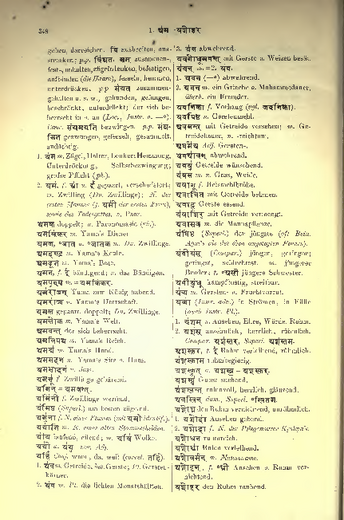
yama yama a. (yam) jumeau; camarade; qui fait la paire; lat. geminus. — S. n. paire, couple. — S. m. répression, coercition; répression des désirs; acte pieux propre à réprimer les désirs. Lettre accouplée à une autre [par ex. n dans ghna, kna, jña, etc.]. Note correspondante d'une autre [et éloignée d'elle d'une on de deux octaves]. Corneille. Yama, dieu des morts, régent du midi, fils de Sūrya et frère de Manu, cf. dharmarāja; zd. Yima. La planète Saturne. yamaka a. jumeau; camarade; qui fait le couple. — S. m. observance pieuse, obligation. — S. n. allitération, rime. yamakālindī f. l'épouse de Sūrya. yamakīṭa m. ver. yamaja a. né d'un jumeau; jumeau. yamatva n. qualité de jumeau. Le fait [Page523-1] d'être ou de se nommer Yama. yamadūta m. messager de Yama. yamadūtaka m. messager de Yama. Corneille. — F. tamarix, bot. yamadevatā f. l'astérisme de bharaṇī. yamana n. (sfx. ana) action de maintenir, de réprimer, de lier, d'arrêter. — S. m. Yama. yamanikā f. (sfx. ika) mur ou tenture entourant un pavillon. yamapriya m. ficus indica, bot. yamabhaginī f. la Yamunā [sœur de Yama]. yamayāmi; pqp. ayīyamam, (dénom.) Réfréner, contenir, Donner, procurer, annam des aliments à qqn. d.; cf. yam. yamaratha m. buffle. yamarāj et yamarāja m. Yama. yamala n. couple, paire. — F. [ī] sorte de vêtement. yamavāhana m. (vah) buffle. yamavrata n. un des devoir royaux [rendre la justice sans acception de personne]. yamasādana n. la demeure de Yama, les Enfers. yamasvaṛ f. la Yamunā, sœur de Yama. Durgā. yamānī f. livèche ajoaën, bot. yamānlaka m. (anta au c.) Śiva.
Occurrences in source texts (8)
DYS 2 occurrences
HP 3 occurrences
IVU 1 occurrence
Continue with AYI Free
Image source: AYI archive.