
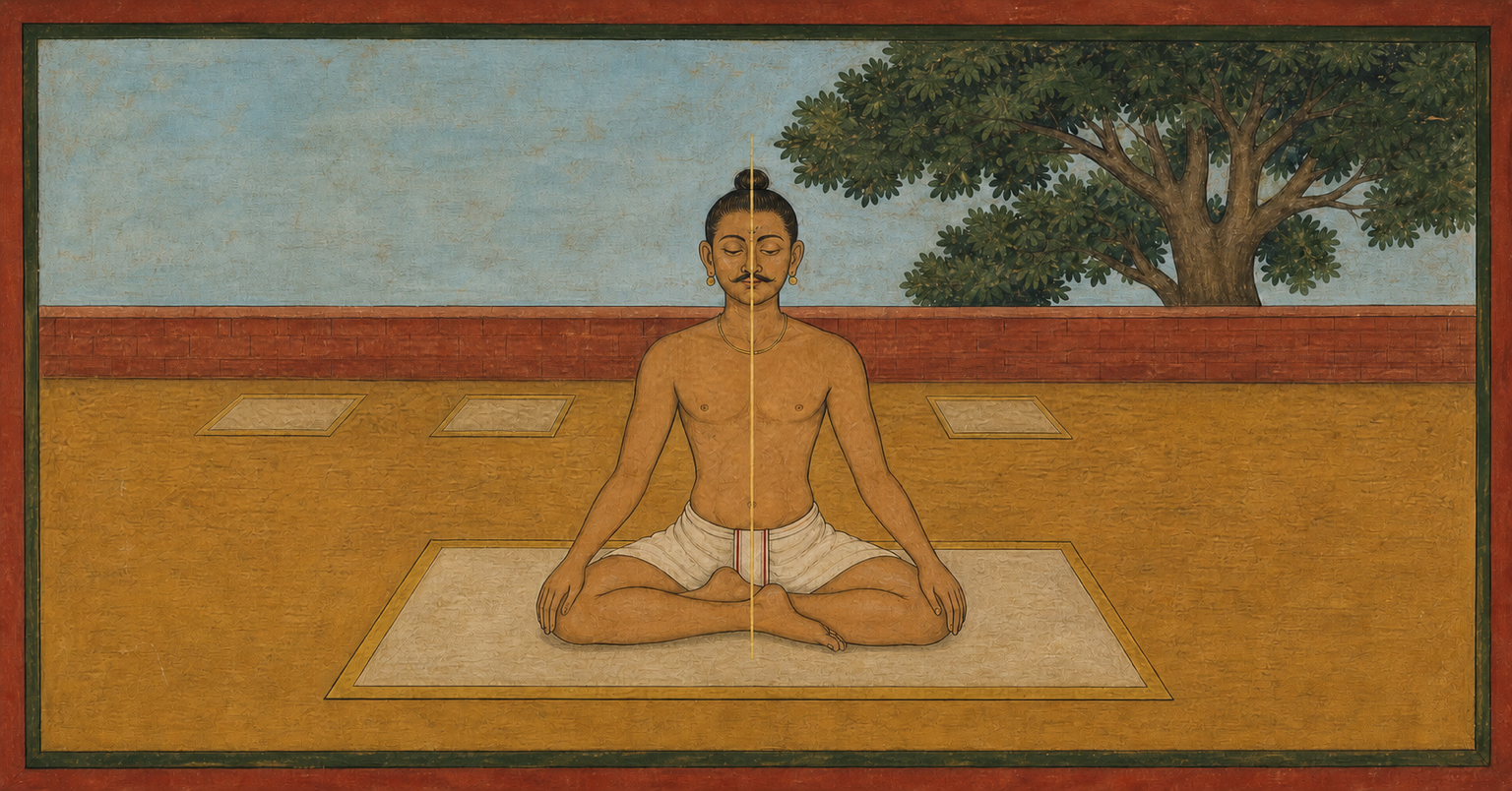

yoni-sthānakam aṅghri-mūla-ghaṭitaṃ, kṛtvā dṛḍhaṃ vinyasen; meḍhre pādam athaikam eka-hṛdayo,dhṛtvā samaṃ vigraham | Analysis ▾ Analysis ▴
|
yoni
|
yoni, perineal region | |
|
sthānakam
|
place, location | |
|
aṅghri
|
foot, heel | |
|
mūla
|
root, base | |
|
ghaṭitam
|
applied, joined | |
|
kṛtvā
|
having made | |
|
dṛḍham
|
firmly | |
|
vinyaset
|
he should place | |
|
meḍhre
|
at the penis | |
|
pādam
|
the foot | |
|
atha
|
then | |
|
ekam
|
one | |
|
eka
|
one-pointed | |
|
hṛdayaḥ
|
heart, mind | |
|
dhṛtvā
|
having held | |
|
samam
|
straight, even | |
|
vigraham
|
body |
sthāṇuḥ saṃyamitendriyo 'cala-dṛśā, paśyan bhruvor antaraṃ; caitan mokṣa-kapāṭa-bheda-janakaṃ, siddhāsanaṃ procyate ||35|| Analysis ▾ Analysis ▴
|
sthāṇuḥ
|
motionless | |
|
saṃyamita
|
restrained | |
|
indriyaḥ
|
possessing senses | |
|
acala
|
unmoving | |
|
dṛśā
|
with the gaze | |
|
paśyan
|
looking | |
|
bhruvoḥ
|
of the eyebrows | |
|
antaram
|
space between | |
|
ca
|
and | |
|
etat
|
this | |
|
mokṣa
|
liberation | |
|
kapāṭa
|
door leaf, gate | |
|
bheda
|
breaking through | |
|
janakam
|
producing | |
|
siddha
|
siddha, perfected | |
|
āsanam
|
posture | |
|
procyate
|
is called |
According to Brahmānanda's oral tradition, the chin should not be pressed against the chest; about four fingerbreadths remain between them. At the same time, the senses are withdrawn from their objects and the gaze remains motionless between the eyebrows. Siddhāsana thus “opens the gate” to liberation as a posture of both bodily and sensory concentration.
Brahmānanda does not treat the four names as simply interchangeable terms. In his tradition, Siddhāsana, Vajrāsana, Muktāsana, and Guptāsana differ in the order and position of the two heels at the perineum and genital region. For him, the verse preserves several closely related traditions of sitting.
dvāsaptatisahasreṣu suṣumṇām iva nāḍiṣu MBHDL2026 ] dvāsaptatisahasrāṇāṃ nāḍīnāṃ malaśodhanam NS1882
Brahmānanda understands Niṣpatti as the consummation of yoga. He interprets the statement strongly: one who meditates on the self, eats moderately, and continually practises Siddhāsana could reach this consummation even without another yogic practice. This explains the seat's special preeminence in his interpretation.
For Brahmānanda, Unmanī is the state in which the ordinary mind has been transcended. Because of its blissful effect, he compares it to a crescent moon. As soon as Prāṇa is truly bound in Kevala Kumbhaka, spontaneous suspension of the breath, this state is said to arise by itself without additional effort.
Brahmānanda identifies the “triple bond” as Mūlabandha, Uḍḍiyānabandha, and Jālandharabandha. Once Siddhāsana has been firmly mastered, the bodily conditions for these three locks are said to be so fully present that they arise by themselves, without the exertion otherwise described.
Continue with AYI Free
Illustrations: AI-generated.

Please log in to write a message. Go to login
No messages yet.