
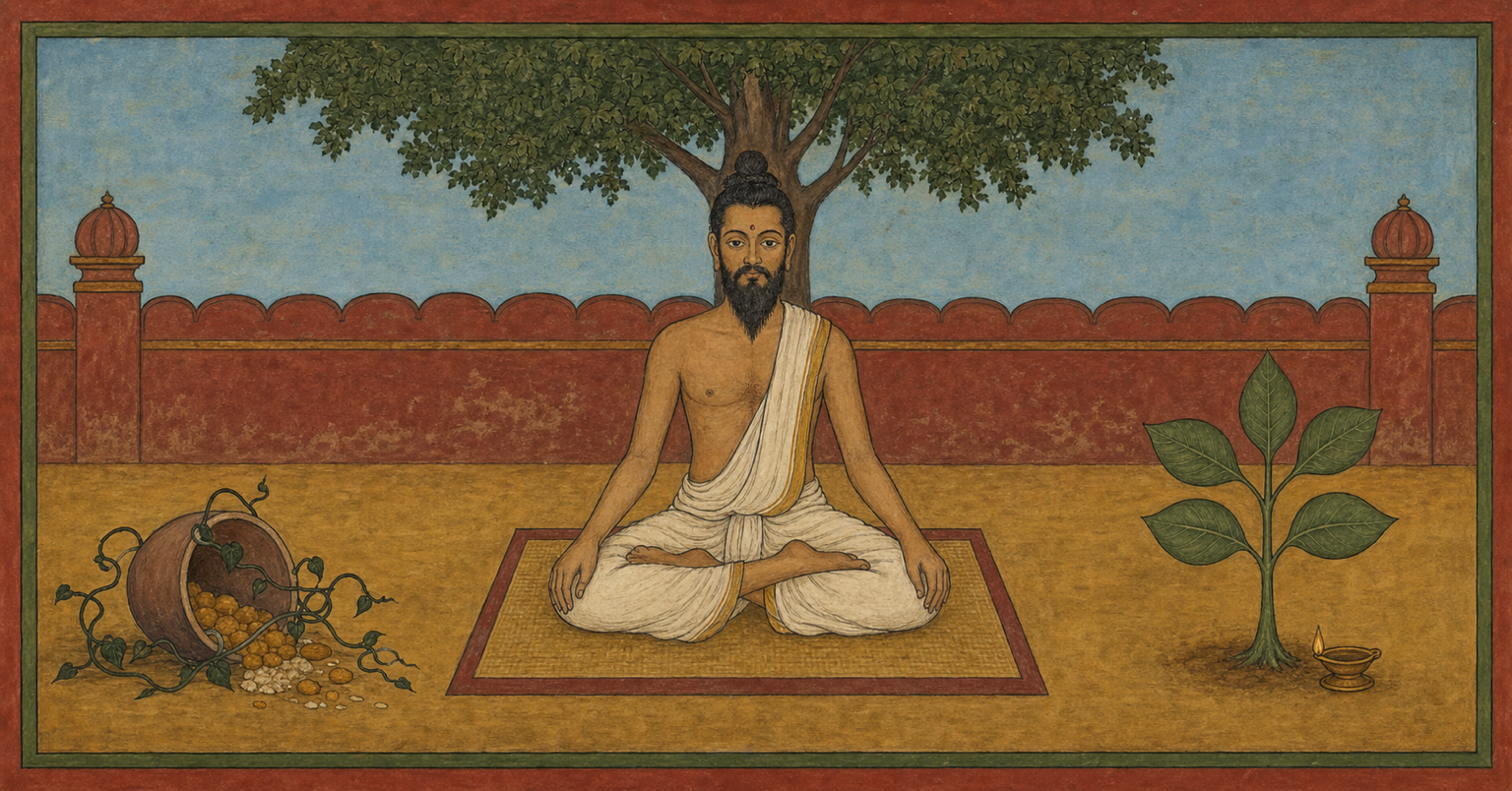
Illustration for the Haṭha Pradīpikā section “HP 1.15-1.16*2: Factors of Practice”.

Haṭha Pradīpikā 1.15-1.16*2: Obstacles, Supports, and Ethics

Excess, distraction, and harmful conduct are contrasted with supportive qualities as well as Yama and Niyama.

Dr. Ronald Steiner Dr. Ronald Steiner
Haṭha Pradīpikā 1.15
अत्याहारः प्रयासश्च प्रजल्पो ऽनियमग्रहः |
aty-āhāraḥ prayāsaś ca; prajalpo 'niyama-grahaḥ | Analysis ▾ Analysis ▴
ati
karmadhāraya-compound
previx
excessive
āhāraḥ
nominative singular
substantive masculine
eating, food
prayāsaḥ
nominative singular
substantive masculine
exertion
ca
particle
and
prajalpaḥ
nominative singular
substantive masculine
chatter
a-niyama
tatpuruṣa-compound genitive
substantive neuter
absence of rules, irregularity
grahaḥ
nominative singular
substantive masculine
grasping, adherence
जनसङ्गश्च लौल्यं च षड्भिर्योगो विनश्यति ||15||
jana-saṅgaś ca laulyaṃ ca; ṣaḍbhir yogo vinaśyati ||15|| Analysis ▾ Analysis ▴
jana
tatpuruṣa-compound genitive
substantive masculine
people
saṅgaḥ
nominative singular
substantive masculine
company, attachment
ca
particle
and
laulyam
nominative singular
substantive neuter
fickleness, greed
ca
particle
and
ṣaḍbhiḥ
instrumental case plural
numeral
by six
yogaḥ
nominative singular
substantive masculine
yoga
vinaśyati
3rd person singular aktive present
previx
verbal root
perishes
Metre: Anuṣṭubh
Through these six (ṣaḍbhiḥ | ins pl), yoga (yogaḥ | nom sg) is lost (vinaśyati | 3p sg act pres): overeating (ati-āhāraḥ | nom sg), overexertion (prayāsaḥ | nom sg), idle talk (prajalpaḥ | nom sg), clinging to non-observance (a-niyama-grahaḥ | nom sg), socialising (jana-saṅgaḥ | nom sg), and (ca) fickleness (laulyam | nom sg).
Dr. Ronald Steiner - 2026 - historically literal
Six things weaken the practice: overeating, overexertion, idle talk, misapplication of rules, distracting company, and inner restlessness.
Dr. Ronald Steiner - 2026 - modern transfer

Brahmānanda specifies the six obstacles. Overeating means consuming more than hunger requires; overexertion is activity that produces exhaustion; talkativeness is excessive speech. By rigid observance of rules, he means inappropriate self-restrictions such as cold morning baths, eating only at night, or living solely on fruit. Company encourages desires, while fickleness makes the mind unstable.

Brahmānanda's Jyotsnā - 19th c.
prajalpo’niyamagrahaḥ MBHDL2026 ] prajalpo niyamāgrahaḥ NS1882
Critical Apparatus
Yoga is destroyed by the following six causes:—Over-eating, exertion, talkativeness, adhering to rules, i.e., cold bath in the morning, eating at night, or eating fruits only, company of men, and unsteadiness.
Pancham Sinh - 1915
The Yogi perishes by over-eating, hard physical labour, too much talk, the observance of vows, promiscuous company, and a greedy stomach.
Srinivasa Iyangar - 1893
Uebermässiges Essen, Anstrengung, Geschwätzigkeit, Beobachtung von (unnöthigen) Gelübden, Umgang mit Menschen, Unbeständigkeit; durch diese sechs wird der Yoga vereitelt.
Hermann Walter - 1893
Haṭha Pradīpikā 1.16
उत्साहान्निश्चयाद्धैर्यात् तत्त्वज्ञानात्मदर्शनात् |
utsāhān niścayād dhairyāt; tattva-jñānātma-darśanāt | Analysis ▾ Analysis ▴
utsāhāt
ablative singular
substantive masculine
through energy, enthusiasm
niścayāt
ablative singular
substantive masculine
through conviction, determination
dhairyāt
ablative singular
substantive neuter
through steadfastness
tattva
tatpuruṣa-compound genitive
substantive neuter
reality, truth
jñāna
dvandva-compound
substantive neuter
knowledge
ātman
tatpuruṣa-compound genitive
substantive masculine
of the self
darśanāt
ablative singular
substantive neuter
through seeing, insight
जनसङ्गपरित्यागात् षड्भिर्योगः प्रसिध्यति ||16||
jana-saṅga-parityāgāt; ṣaḍbhir yogaḥ prasidhyati ||16|| Analysis ▾ Analysis ▴
jana
tatpuruṣa-compound genitive
substantive masculine
people
saṅga
tatpuruṣa-compound genitive
substantive masculine
company, association
parityāgāt
ablative singular
substantive masculine
through relinquishing
ṣaḍbhiḥ
instrumental case plural
numeral
by six
yogaḥ
nominative singular
substantive masculine
yoga
prasidhyati
3rd person singular aktive present
previx
verbal root
succeeds, is perfected
Metre: Anuṣṭubh
Through these six (ṣaḍbhiḥ | ins pl), yoga (yogaḥ | nom sg) succeeds (prasidhyati | 3p sg act pres): through energy (utsāhāt | abl sg), conviction (niścayāt | abl sg), steadfastness (dhairyāt | abl sg), knowledge of reality and vision of the self (tattva-jñāna-ātma-darśanāt | abl sg), and relinquishing social contact (jana-saṅga-parityāgāt | abl sg).
Dr. Ronald Steiner - 2026 - historically literal
Energy, determination, and perseverance matter in your yoga practice. Seek clarity about reality and yourself, and make room away from distracting company.
Dr. Ronald Steiner - 2026 - modern transfer

Brahmānanda also interprets the six conditions for success concretely. Enthusiasm is the resolve to calm the mind as it runs toward sense objects. Courage begins after careful examination, and perseverance continues without despondency, if necessary for an entire lifetime. Knowledge recognizes the objective world as no more real than a mirage and Brahman as real. Certainty means trust in scripture and guru; unsuitable company is abandoned.

Brahmānanda's Jyotsnā - 19th c.
tattvajñānātmadarśanāt em. MBHDL2026 ] saṃtoṣāt tattvadarśanāt MBHDL2024; tattvajñānāc ca niścayāt NS1882
Critical Apparatus
The following six bring speedy success:—Courage, daring, perseverance, discriminative knowledge, faith, aloofness. from company.
Pancham Sinh - 1915
The Yogi succeeds by cheerfulness, perseverance, courage, true knowledge, firm belief in the words of the Guru and by abandoning company.
Srinivasa Iyangar - 1893
Ausdauer, Muth, Entschlossenheit, Erkenntniss des Wahren, Glaube (niscaya), Vermeidung des Umgangs mit Menschen. Diese sechs verhelfen zum Gelingen des Yoga.
Hermann Walter - 1893
Haṭha Pradīpikā 1.16*1
अहिंसा सत्यमस्तेयं ब्रह्मचर्यं क्षमा धृतिः |
ahiṃsā satyam asteyaṃ; brahmacaryaṃ kṣamā dhṛtiḥ | Analysis ▾ Analysis ▴
ahiṃsā
nominative singular
substantive feminine
non-violence
satyam
nominative singular
substantive neuter
truth, truthfulness
asteyam
nominative singular
substantive neuter
non-stealing
brahmacaryam
nominative singular
substantive neuter
brahmacarya, celibate conduct
kṣamā
nominative singular
substantive feminine
patience, forbearance
dhṛtiḥ
nominative singular
substantive feminine
firmness, steadfastness
दयार्जवं मिताहारः शौचं चैव यमा दश ||16*1||
dayārjavaṃ mitāhāraḥ; śaucaṃ caiva yamā daśa ||16*1|| Analysis ▾ Analysis ▴
dayā
nominative singular
substantive feminine
compassion
ārjavam
nominative singular
substantive neuter
rectitude, sincerity
mita
karmadhāraya-compound
adjective
measured
āhāraḥ
nominative singular
substantive masculine
diet
śaucam
nominative singular
substantive neuter
purity
ca
particle
and
eva
particle
indeed
yamāḥ
nominative plural
substantive masculine
yamas, restraints
daśa
numeral
ten
Metre: Anuṣṭubh
Non-violence (ahiṃsā | nom sg), truthfulness (satyam | nom sg), non-stealing (asteyam | nom sg), celibate conduct (brahmacaryam | nom sg), patience (kṣamā | nom sg), steadfastness (dhṛtiḥ | nom sg), compassion (dayā | nom sg), sincerity (ārjavam | nom sg), moderate eating (mita-āhāraḥ | nom sg), and also (caiva) purity (śaucam | nom sg): these are the ten (daśa) restraints (yamāḥ | nom pl).
Dr. Ronald Steiner - 2026 - historically literal
The ten Yamas are nonviolence, truthfulness, non-stealing, Brahmacarya, patience, steadfastness, compassion, sincerity, moderate eating, and purity.
Dr. Ronald Steiner - 2026 - modern transfer
The ten rules of conduct are: ahiṃsâ (non-injuring), truth, non-stealing, continence, forgiveness, endurance, compassion, meekness, sparing diet and cleanliness.
Pancham Sinh - 1915
To do no harm to any object, to speak the truth, to refrain from taking what belongs to another, to preserve continence, to practise forbearance and fortitude, to be merciful to all, to walk straightforwardly, to be moderate in diet, and to purify oneself constitute Yama.
Srinivasa Iyangar - 1893
Ahimsa, Wahrheitsliebe, Ehrlichkeit, Keuschheit, Geduld, Festigkeit, Mitleid, Aufrichtigkeit, Mässigkeit im Essen, Reinheit; dies sind die zehn grossen Gelübde (Yama). Inbrunst (tapas) Zufriedenheit, Gläubigkeit, Freigebigkeit, Gottesverehrung, Studium der Lehrbücher, Studium der Vorschriften (i. e. des Lehrers), Bescheidenheit, Askese (tapas), Opfer; dies sind die zehn kleinen Gelübde (Niyama), wie sie die Yogagelehrten aufzählen. s. Einleitung, p. III.
Hermann Walter - 1893
Haṭha Pradīpikā 1.16*2
तपः संतोषमास्तिक्यं दानमीश्वरपूजनम् |
tapaḥ saṃtoṣam āstikyaṃ; dānam īśvara-pūjanam | Analysis ▾ Analysis ▴
tapaḥ
nominative singular
substantive neuter
asceticism, discipline
saṃtoṣam
accusative singular
substantive masculine
contentment
āstikyam
nominative singular
substantive neuter
faith, believing confidence
dānam
nominative singular
substantive neuter
giving, generosity
īśvara
tatpuruṣa-compound genitive
substantive masculine
Īśvara, Lord
pūjanam
nominative singular
substantive neuter
worship
सिद्धान्तश्रवणं चैव ह्रीर्मतिश्च जपो हुतम् ||16*2||
siddhānta-śravaṇaṃ caiva; hrīr matiś ca japo hutam ||16*2|| Analysis ▾ Analysis ▴
siddhānta
tatpuruṣa-compound genitive
substantive neuter
doctrine, tradition
śravaṇam
nominative singular
substantive neuter
hearing, study
ca
particle
and
eva
particle
indeed
hrīḥ
nominative singular
substantive feminine
modesty, moral shame
matiḥ
nominative singular
substantive feminine
understanding, intelligence
ca
particle
and
japaḥ
nominative singular
substantive masculine
recitation
hutam
nominative singular neuter past participle passive
verbal root
offering, oblation
Metre: Anuṣṭubh
Ascetic discipline (tapaḥ | nom sg), contentment (saṃtoṣam | acc sg), faith (āstikyam | nom sg), generosity (dānam | nom sg), worship of Īśvara (īśvara-pūjanam | nom sg), listening to doctrine (siddhānta-śravaṇam | nom sg), and likewise (caiva) moral shame (hrīḥ | nom sg), understanding (matiḥ | nom sg), recitation (japaḥ | nom sg), and (ca) offering into the fire (hutam | nom sg n ppp) constitute the observances.
Dr. Ronald Steiner - 2026 - historically literal
The Niyamas are discipline, contentment, trust, generosity, devotion to Īśvara, study of the teachings, moral restraint, clear understanding, recitation, and sacrifice.
Dr. Ronald Steiner - 2026 - modern transfer
saṃtoṣam āstikyaṃ MBHDL2026 ] saṃtoṣa āstikyaṃ NS1882

siddhāntaśravaṇaṃ caiva MBHDL2026 ] siddhāntavākyaśravaṇaṃ NS1882
Critical Apparatus
The ten niyamas mentioned by those proficient in the knowledge of yoga are: Tapa, patience, belief in God, charity, adoration of God, hearing discourses on the principles of religion, shame, intellect, Japa and Yajña.
Pancham Sinh - 1915
Tapas (austerities), cheerfulness, belief in God, charity, worship of the deity, hearing the exposition of Vedantic doctrines, shame, sound mind, Japa (repeating prayers) and Vratas (observance of vows), these constitute Niyama.
Srinivasa Iyangar - 1893

Continue with AYI Free

Illustrations: AI-generated.

Editor

Dr. Ronald Steiner

From Ulm

The "Yoga Doc" - Dr. Ronald Steiner is the founder of the AYI method. This method links traditional Ashtanga Yoga with innovative Yogatherapy and living Philosophy. This forms a practice that is personal for each and... more ›

Messages and ratings
0 messages

Please log in to write a message. Go to login

No messages yet.