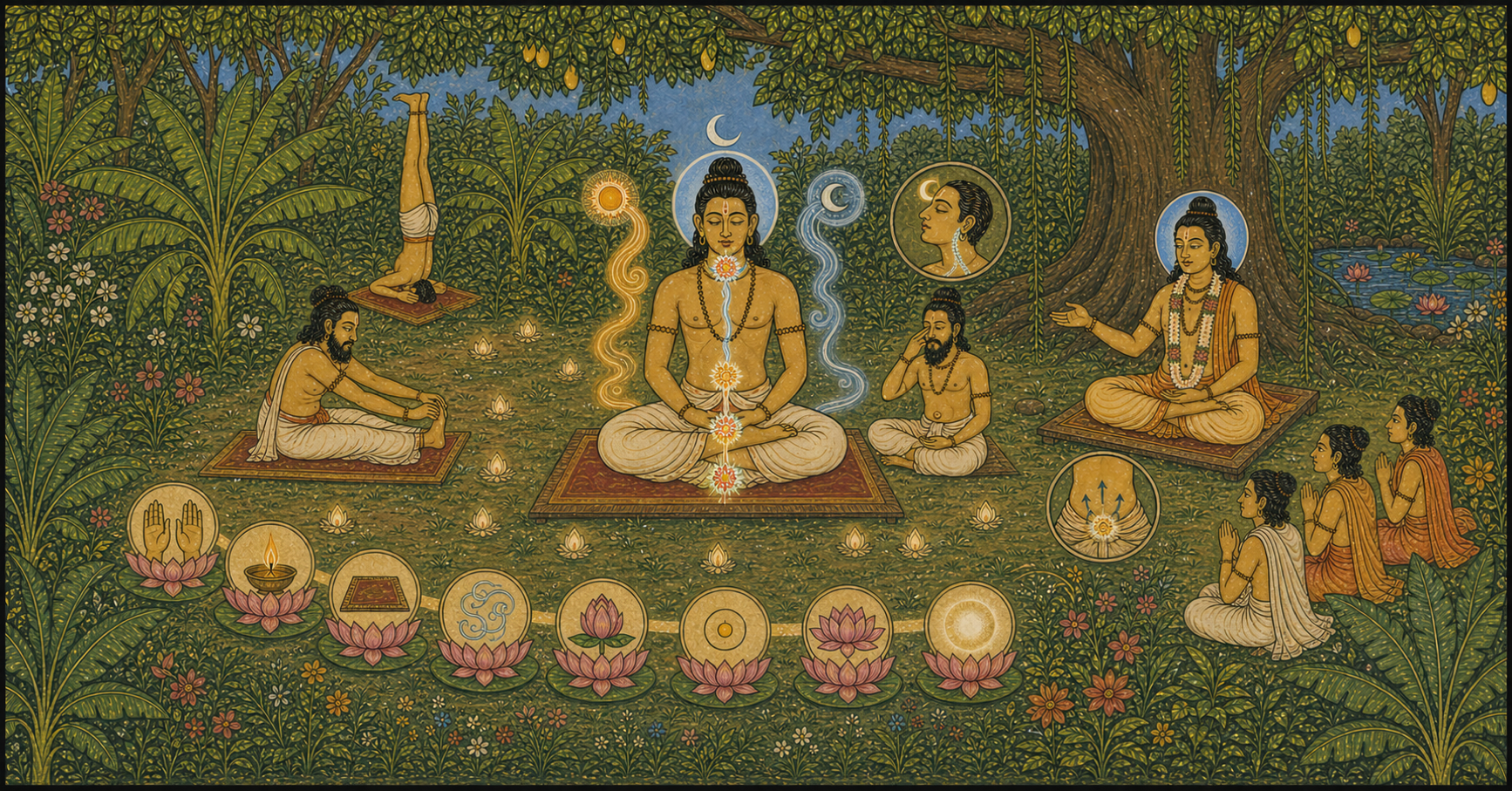
DYS 27–31: Survey of Haṭha

Dattātreyayogaśāstra 27–31: Eight Limbs and Kapila’s Physical Methods

The text places an eight-limbed yoga beside Kapila’s Haṭha system and lists mudrās, bandhas, inversion, Vajrolī, Amarolī, and Sahajolī.

Dr. Ronald Steiner Dr. Ronald Steiner Nils Jacob Liersch Nils Jacob Liersch
Dattātreyayogaśāstra 27
यमश्च नियमश्चैव आसनं च ततः परम् |
yamaś ca niyamaś caiva; āsanaṃ ca tataḥ param | Analysis ▾ Analysis ▴
yamaḥ
nominative singular
substantive masculine
restraint
ca
particle
and
niyamaḥ
nominative singular
substantive masculine
observance
ca
particle
and
eva
particle
indeed
āsanam
nominative singular
substantive neuter
posture
ca
particle
and
tataḥ
adverb
then
param
adverb
next
प्राणायामश्चतुर्थः स्यात्प्रत्याहारस्तु पञ्चमः ||27||
prāṇāyāmaś caturthaḥ syāt; pratyāhāras tu pañcamaḥ ||27|| Analysis ▾ Analysis ▴
prāṇa
tatpuruṣa-compound genitive
substantive masculine
of the breath
āyāmaḥ
nominative singular
substantive masculine
control, restraint
caturthaḥ
nominative singular masculine
adjective
the fourth
syāt
3rd person singular aktive optative
verbal root
would be
pratyāhāraḥ
nominative singular
substantive masculine
withdrawal of the senses
tu
particle
indeed
pañcamaḥ
nominative singular masculine
adjective
the fifth
Metre: Anuṣṭubh
Yama (yamaḥ | nom sg) and (ca) Niyama (niyamaḥ | nom sg), then Āsana (āsanam | nom sg), and thereafter (tataḥ param) Prāṇāyāma (prāṇāyāmaḥ | nom sg) are the first four [limbs] (caturthaḥ syāt); Pratyāhāra (pratyāhāraḥ | nom sg) is the fifth (pañcamaḥ | nom sg).
Dr. Ronald Steiner - 2026 - historically literal
This path begins with ethical restraints, personal observances, and posture. Breath control and withdrawal of the senses follow.
Dr. Ronald Steiner - 2026 - modern transfer
Dattātreyayogaśāstra 28
ततस्तु धारणा प्रोक्ता ध्यानं सप्तममुच्यते |
tatas tu dhāraṇā proktā; dhyānaṃ saptamam ucyate | Analysis ▾ Analysis ▴
tataḥ
adverb
then
tu
particle
indeed
dhāraṇā
nominative singular
substantive feminine
concentration
proktā
nominative singular feminine past participle passive
previx
verbal root
is taught
dhyānam
nominative singular
substantive neuter
meditation
saptamam
nominative singular neuter
adjective
the seventh
ucyate
3rd person singular passive present
verbal root
is called
समाधिरष्टमः प्रोक्तः सर्वपुण्यफलप्रदः ||28||
samādhir aṣṭamaḥ proktaḥ; sarva-puṇya-phala-pradaḥ ||28|| Analysis ▾ Analysis ▴
samādhiḥ
nominative singular
substantive masculine
absorption
aṣṭamaḥ
nominative singular masculine
adjective
the eighth
proktaḥ
nominative singular masculine past participle passive
previx
verbal root
is taught
sarva
karmadhāraya-compound
adjective
all
puṇya
tatpuruṣa-compound genitive
substantive neuter
merit
phala
tatpuruṣa-compound accusative
substantive neuter
fruit
pradaḥ
nominative singular masculine
adjective
giving
Metre: Anuṣṭubh
Then (tataḥ) concentration (dhāraṇā | nom sg) is taught [as the sixth limb] (proktā | nom sg), and meditation (dhyānam | nom sg) is called the seventh [limb] (saptamam ucyate). Samādhi (samādhiḥ | nom sg) is taught as the eighth [limb] (aṣṭamaḥ proktaḥ) and grants the fruit of every merit (sarva-puṇya-phala-pradaḥ | nom sg).
Dr. Ronald Steiner - 2026 - historically literal
Next come concentration, meditation, and Samādhi, which is said to bestow the fruit of every merit.
Dr. Ronald Steiner - 2026 - modern transfer
dhyānaṃ JM2024 ] dhyanaṃ DYŚ
Critical Apparatus
Dattātreyayogaśāstra 29
एवमष्टाङ्गयोगं च याज्ञवल्क्यादयो विदुः |
evam aṣṭāṅga-yogaṃ ca; yājñavalkyādayo viduḥ | Analysis ▾ Analysis ▴
evam
adverb
thus
aṣṭa
dvigu-compound
numeral
eight
aṅga
karmadhāraya-compound
substantive neuter
of the limbs
yogam
accusative singular
substantive masculine
yoga
ca
particle
and
yājñavalkya
dvandva-compound
substantive masculine
Yājñavalkya
ādayaḥ
nominative plural
substantive masculine
and the others
viduḥ
3rd person plural perfekte
verbal root
knew
कपिलाद्यास्तथा सिद्धा हठं कुर्युस्तदन्यथा ||29||
kapilādyās tathā siddhā; haṭhaṃ kuryus tad-anyathā ||29|| Analysis ▾ Analysis ▴
kapila
dvandva-compound
substantive masculine
Kapila
ādyāḥ
nominative plural
substantive masculine
and the others
tathā
adverb
likewise
siddhāḥ
nominative plural
substantive masculine
the accomplished adepts
haṭham
accusative singular
substantive masculine
Haṭha
kuryuḥ
3rd person plural aktive optative
verbal root
should practise
tad
avyayībhāva-compund
pronoun dem
than that
anyathā
adverb
otherwise
Metre: Anuṣṭubh
Thus Yājñavalkya and others (yājñavalkyādayaḥ | nom pl) knew (viduḥ | 3p pl perf) eight-limbed yoga (aṣṭāṅga-yogam | acc sg). Likewise, accomplished adepts such as Kapila (kapilādyāḥ siddhāḥ | nom pl) practised Haṭha differently from that [eight-limbed yoga] (haṭhaṃ kuryus tad-anyathā).
Dr. Ronald Steiner - 2026 - historically literal
Yājñavalkya and others knew eight-limbed yoga. Accomplished adepts such as Kapila practised Haṭha in a different way.
Dr. Ronald Steiner - 2026 - modern transfer
yājñavalkyādayo JM2024 ] yājñavalkādayo DYŚ

tathā siddhā haṭhaṃ kuryus tadanyathā JM2024 ] tu śiṣyāś ca haṭhaṃ kuryus tato yathā DYŚ
Critical Apparatus
Dattātreyayogaśāstra 30
तद्यथा च महामुद्रा महाबन्धस्तथैव च |
tad yathā ca mahā-mudrā; mahā-bandhas tathaiva ca | Analysis ▾ Analysis ▴
tad
nominative singular neuter
pronoun dem
that
yathā
adverb
as follows
ca
particle
and
mahā
karmadhāraya-compound
adjective
great
mudrā
nominative singular
substantive feminine
mudrā
mahā
karmadhāraya-compound
adjective
great
bandhaḥ
nominative singular
substantive masculine
bandha, lock
tathā
adverb
likewise
eva
particle
indeed
ca
particle
and
ततश्च खेचरीमुद्रा बन्धो जालन्धरस्तथा ||30||
tataś ca khecarī-mudrā; bandho jālandharas tathā ||30|| Analysis ▾ Analysis ▴
tataḥ
adverb
thereafter
ca
particle
and
khecarī
tatpuruṣa-compound genitive
substantive feminine
Khecarī
mudrā
nominative singular
substantive feminine
mudrā
bandhaḥ
nominative singular
substantive masculine
the lock
jālandharaḥ
nominative singular
substantive masculine
Jālandhara
tathā
adverb
likewise
Metre: Anuṣṭubh
And that [Haṭha] is as follows (tad yathā ca): Mahāmudrā (mahā-mudrā | nom sg), Mahābandha (mahā-bandhaḥ | nom sg), then Khecarīmudrā (tataś ca khecarī-mudrā | nom sg), and likewise Jālandhara Bandha (bandho jālandharaḥ | nom sg).
Dr. Ronald Steiner - 2026 - historically literal
Haṭha includes Mahāmudrā, Mahābandha, Khecarīmudrā, and Jālandhara Bandha.
Dr. Ronald Steiner - 2026 - modern transfer
tataś ca JM2024 ] tataḥ syāt DYŚ
Critical Apparatus
Dattātreyayogaśāstra 31
उड्डियाणं मूलबन्धो विपरीतकृतिस्तथा |
uḍḍiyāṇaṃ mūla-bandho; viparīta-kṛtis tathā | Analysis ▾ Analysis ▴
uḍḍiyāṇam
nominative singular
substantive neuter
Uḍḍiyāṇa
mūla
tatpuruṣa-compound genitive
substantive neuter
root
bandhaḥ
nominative singular
substantive masculine
bandha, lock
viparīta
karmadhāraya-compound
adjective
inverted
kṛtiḥ
nominative singular
substantive feminine
action
tathā
adverb
likewise
वज्रोली चामरोली च सहजोली त्रिधा मता ||31||
vajrolī cāmarolī ca; sahajolī tridhā matā ||31|| Analysis ▾ Analysis ▴
vajrolī
nominative singular
substantive feminine
Vajrolī
ca
particle
and
amarolī
nominative singular
substantive feminine
Amarolī
ca
particle
and
sahajolī
nominative singular
substantive feminine
Sahajolī
tridhā
adverb
threefold
matā
nominative singular feminine past participle passive
verbal root
is held to be
Metre: Anuṣṭubh
Uḍḍiyāṇa (uḍḍiyāṇam | nom sg), Mūlabandha (mūla-bandhaḥ | nom sg), and Viparītakṛti (viparīta-kṛtiḥ | nom sg) likewise [belong to it]. Vajrolī (vajrolī | nom sg), Amarolī (amarolī | nom sg), and Sahajolī (sahajolī | nom sg) are held to be threefold (tridhā matā).
Dr. Ronald Steiner - 2026 - historically literal
It also includes Uḍḍiyāṇa, Mūlabandha, and Viparītakṛti, as well as the three related methods Vajrolī, Amarolī, and Sahajolī.
Dr. Ronald Steiner - 2026 - modern transfer
viparītakṛtis JM2024 ] viparītakaraṇī DYŚ
Critical Apparatus

Continue with AYI Free

Illustrations: AI-generated.

Editor

Dr. Ronald Steiner

From Ulm

The "Yoga Doc" - Dr. Ronald Steiner is the founder of the AYI method. This method links traditional Ashtanga Yoga with innovative Yogatherapy and living Philosophy. This forms a practice that is personal for each and... more ›

Nils Jacob Liersch

Meine Begeisterung für Yoga, indische Philosophie und Sanskrit führte mich zum Studium der Indologie und Religionswissenschaft an der Universität Heidelberg. Seit 2004 befinde ich mich auf meinem persönlichen Yogaweg... more ›

Messages and ratings
2 messages Ø

Please log in to write a message. Go to login

Shavasana als einzige Körperhaltung? Da würde sich meine Praxis erheblich reduzieren .......
Oh nein. Später kommt auch noch (mindestens) eine andere Körperhaltung. :)