

bhṛ भृ – bear; hold; support
verbal root · Word type unspecified · verb
Dictionary sources
AYI dictionary verbal root
bear; hold; support
Cappeller 1891 verb
Original text · English · verb
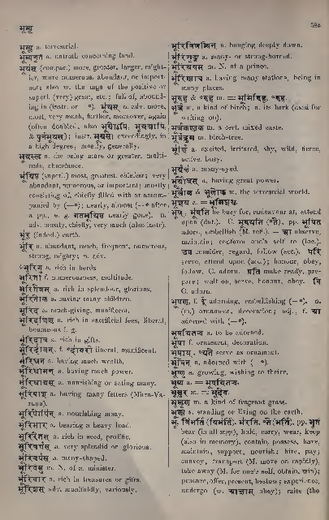
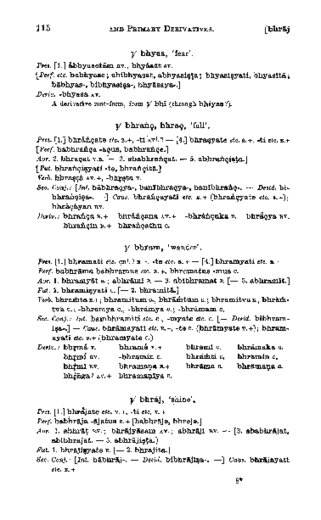
bhṛ bíbharti ·v (bibhárti), bhárati, bhára°te (bharti), pp. bhṛtá bear (in all mgs), hold, carry, wear, keep (also in memory), contain, possess, have, maintain, support, nourish; hire, pay; convey, transport (M. move on rapidly), take away (M. for one's self, obtain, win); procure, offer, present, bestow; experience, undergo (w. ājñām obey); raise (the voice or a sound, M. refl.); fill, load. D. búbhūrṣati wish to keep or maintain. bháribhrat1, barībharti bear hither and thither or repeatedly. -- apa carry off, take away. ava bear down, ward off; thrust or push in, introduce; imprint, impress; sever, cut off. ā bring near, procure, cause, produce; fill. paryā bring near from (abl.). samā bring together or near. ud take out, select; deliver from (abl.); lift up, hold high. upa bring near, procure, get. nis take out of (abl.). pari A.M. bring; M. spread (tr. & intr. w. acc.). pra bring forward or near, place before, make ready; offer, present; stretch out, hurl, cast; bring in, introduce; M. flash, vibrate, rush on, fly along. abhipra hurl, shoot; M. = prati present, offer. vi take asunder, spread out, diffuse; M. place here and there, distribute. sam bring together, collect, concentrate, compose, make ready, arrange, prepare, pay back, restore; nourish, foster. -- Cf. ābhṛta, níbhṛta, saṃbhṛta.
Monier-Williams 1872 Word type unspecified
Original text · English · Word type unspecified
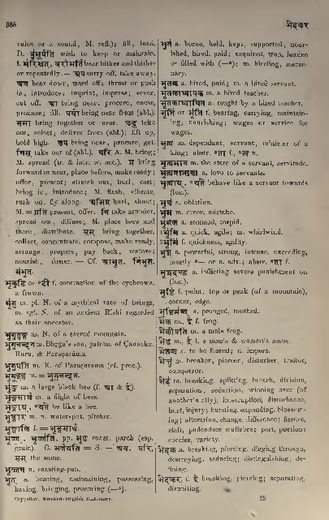
bhṛ bhṛ (allied to rt. dhṛ and to rt. hṛ, which was probably evolved fr. rt. bhṛ), cl. 1. P. A. bharati, -te, cl. 3. P. A. bibharti, bibhṛte (1st du. P. bibhṛvas, 3rd pl. bibhrati), Impf. abibhar, abibhṛta (3rd pl. abibharus), Pot. bi- bhṛyāt, bibhrīta, Impv. bibhartu, bibhṛtām (2nd sing. P. bibhṛhi), Perf. babhāra, babhre (2nd sing. P. babhartha, 2nd du. P. babhṛva by Pāṇ. VII. 2, 13, cf. Gram. 369), or bibharāṃ-cakāra, bibharāṃ- cakre (also bibharām-āsa, bibharām-babhūva), 1st Fut. bhartā, 2nd Fut. bhariṣyati, -te, Aor. abhārṣīt, abhṛta (1st sing. abhārṣam, 2nd du. abhārṣṭam), Prec. bhriyāt, bhṛṣīṣṭa, Cond. abhariṣyat, abhariṣyata (Vedic and ir- regular forms are Pres. bharti, 1st pl. bibhṛmasi, Impf. abibhrat, bibharat, Perf. jabhāra, jabhar- tha, jabhrus, A. jabhre, jabhrire, jabharat, ja- bhartana, Aor. abhāriṣam, bharṣat, abhār), Inf. bhartum (Ved. bhartave, apa-bhartavai, bhar- tos, bharase, bharadhyai), to bear, carry; to sup- port, maintain, keep, sustain, nourish, foster, cherish, protect, take care of; to hire, keep in one's pay, give wages or pay to (generally A.); to wear; to possess, have; to hold, contain, retain (as in the memory); to keep up, maintain; to endure, suffer; to carry to (any person or place), bring; to confer, bestow, give, produce; to fill, fill up, load; to carry away, take away, transport; to raise the voice, raise a sound (Ved.); to be borne along rapidly (A. Ved., Lat. ferri); to take or carry away for one's self, acquire, gain (A. Ved.); to be borne upwards (as sound, A. Ved.). The above meanings of rt. bhṛ may be variously extended by connecting it with various nouns, e. g. garbham bhṛ, to conceive, become pregnant [cf. garbhaṃ dhṛ under rt. dhṛ]; śmaśru-loma-nakhāni bhṛ, to wear the hair, beard, and nails long, i. e. allow them to grow without cutting (Manu VI. 6); vibhramam bhṛ, to make playful movements or to have the appearance of moving about; ūrjām bhṛ, to exert the strength; kṣitim bhṛ, to take care of, i. e. govern the earth: Pass. bhriyate, Aor. abhāri (Ved. forms bharate, part. bhuramāṇa, babhrāṇa, bibhramāṇa): Caus. bhā- rayati, -yitum, abībharat, to cause to bear or support; to put out to hire, engage for hire: Desid. bubhūrṣati, -te, bibhariṣati, -te (Pāṇ. VII. 2, 49), to wish to bear, to wish or intend to support or maintain [cf. bubhūrṣu]: Intens. bebhrīyate, bar- bharti, barībharti (Ved. 3rd pl. bharibhrati, part. bharibhrat), to bear repeatedly, to bear or carry hither and thither; to maintain continually; [cf. Zend bar, ‘to bear, bring:’ Gr. φέρ-ω, φέρ-μα, φέρ-ε-τρο-ω, φαρ-έ-τρα, φόρ-ο-ς, φορό-ς, φορ-ά, φορ-μό-ς, φόρ-το-ς, φερ-νή; φάρ-μα-κο-ν; φέρ-τερος, φέρ-ιστο-ς, φέρ-τα-το-ς; φέρ-β-ω, φορ-β-ή; φᾶρος; φωρ-ιαμός; δί-φρο-ς, δι-φθέρα: Lat. fero, fer in belli-fer, fer-cu-lu-m, fer-āx, for-du-s, far, far-īna, fer-ti-li-s, for(t)-s, for-tū-na, for- tu-itu-s; pro-bru-m, op-pro-br-iu-m (προ-φέρ-ειν), candela-bru-m; her-b-a, fi-b-ra, forb-ea: Goth. bair-an, ‘to bear;’ ga-baur, ‘tax;’ baur-ei or baur-thei, ‘a burden;’ ga-baur-th-s, ‘birth;’ bar-n, ‘a child;’ ber-usyōs, ‘parents;’ barm-s, ‘womb;’ baris, ‘barley;’ brigg-an, ‘to bring:’ Old Germ. bur-di, ‘a burden;’ bāra, ‘a barrow, bier:’ Angl. Sax. ber-an, ‘to bear;’ bearm, ‘womb;’ bearn, ‘a child;’ byrdhen, ‘a burden;’ bring-an, ‘to bring:’ Slav. bra-ti, ‘to bear;’ bre†-me, ‘a load;’ bra-kŭ, ‘wedlock:’ Boh. bra-ti, ‘to take;’ ber-nĕ, ‘tax:’ Lith. bér-na-s, ‘a child, servant:’ Hib. beir- im, ‘I bear, carry.’]
Whitney Roots 1885 verbal root
Original text · English · verbal root
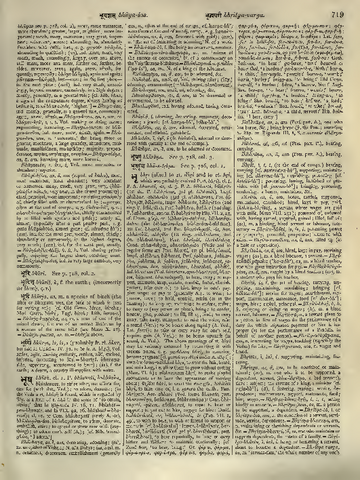
bhṛ — bear
Apte 1890 Word type unspecified
Original text · English · Word type unspecified
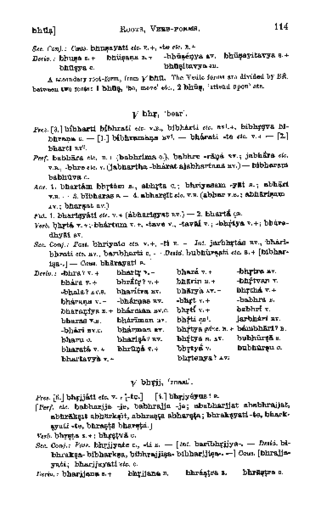
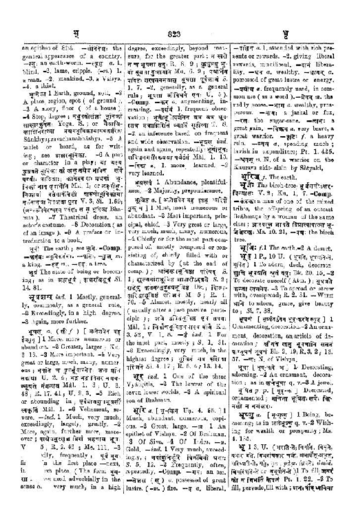
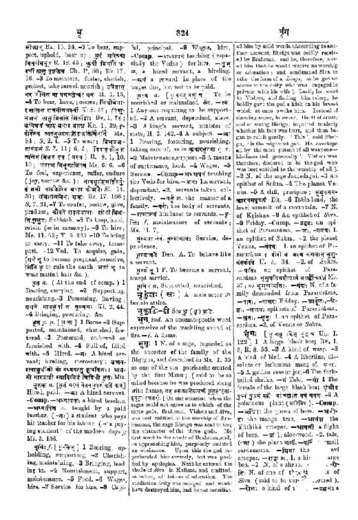
bhṛ 1 3 U. (bharati-te; bibharti, bibhṛte, babhāra babhre, bibharāṃcakāra-cakre, abhārṣīṃt-abhṛta, bhariṣyati-te, bhartuṃ, bhṛta; pass. bhriyate; desid. bibhariṣati-te or bubhūrṣati-te) 1 To fill; jaṭharaṃ ko na bibharti kevalaṃ Pt. 1. 22. 2 To fill, pervade, fill with; abhārṣīdadhvaninā ([Page 0824-a]) lokān Bk. 15. 24. 3 To bear, support, uphold, bear up; dhuraṃ dharitryā bibharāṃbabhūva R. 18. 45; kūrmo bibharti dharaṇīṃ khalu pṛṣṭhakena Ch. P. 50; Bk. 17. 16 4 To maintain, foster, cherish, protect, take care of, nourish; daridrān bhara kauṃteya mā prayaccheśvare dhanaṃ H. 1. 15. 5 To bear, have, possess; siṃdhorbabhāra salilaṃ śayanīyalakṣmīṃ Ki. 8. 57; piśunajanaṃ khalu bibhrati kṣitīṃdrāḥ Bv. 1. 74; balitrayaṃ cāru babhāra bālā Ku. 1. 39; iṃdordainyaṃ tvadatusaraṇakliṣṭakāṃterbibharti Me. 84; Ś. 2. 4. 6 To wear; bibhrajjaṭāmaṃḍalaṃ Ś. 7. 11; Ś. 6. 5; vivāhakautukaṃ lalitaṃ bibhrata eva (tasya) R. 8. 1, R. 10. 10; jaṭāśca bibhṛyānnityaṃ Ms. 6. 6. 7 To feel, experience, suffer, endure (joy, sorrow &c.); bhāvaśuddhisahitairmudaṃ jano nāṭakairiva babhāra bhojanaiḥ Śi. 14. 50; saṃtrāsamabibhaḥ śakraḥ Bk. 17. 108; Ś. 7. 21. 8 To confer, bestow, give, produce; yauvane sadalaṃkārāḥ śobhāṃ bibhrati subhruvaḥ Subhāṣ. 9 To keep, hold, retain (as in memory). 10 To hire; Ms. 11. 62; Y. 3. 235. 11 To bring or carry. 12 To take away, transport. 13 Ved. To acquire, gain. (garbhaṃ bhṛ to become pregnant, conceive; kṣitiṃ bhṛ to rule the earth; jaṭāṃ bhṛ to wear matted hair &c.).
Cappeller 1887 Word type unspecified
Original text · German · Word type unspecified
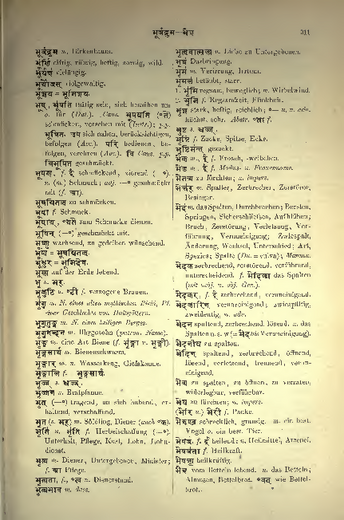
bhṛ s. bhar.
Burnouf 1866 verbal root
Original text · French · verbal root
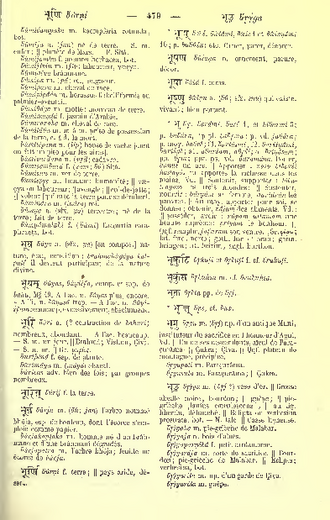
*bhṛ bhṛ. bharāmi, bhare 1, et bibharmi 3; p. babhāra, 1p. pl. babhṛma; p. vd. jabhāra; p. moy. babhre; f1. bhartāsmi; f2. bhariṣyāmi, bhariṣye; a1. abharṣam, abhṛṣi; o. bhriyāsam; pp. bhṛta; ppr. ps. vd. bhuramāṇa. Porter, dhanus un arc. Apporter: vasu bibharṣi hastayos tu apportes la richesse dans tes mains, Vd. Soutenir, supporter: lokatrayam les trois mondes; Sustenter, nourrir: bhāryām sa femme, daridrān les pauvres. Au moy. apporter pour soi, se donner; obtenir, vājam des aliments, Vd.; posséder, avoir: rūpam uttamam une beauté suprême; śriyam le bonheur. Qqf. remplir, jaṭharam son ventre. Gr. φέρω; lat. fero, porto; goth. bar et brah; germ. bringen; irl. beirim; angl. burthen.
Occurrences in source texts (14)
HP 2 occurrences
HTK 1 occurrence
HTK 10.34*2–38*1: Asvaṅgaśṛṅkhalā and Kumbhāntaraśṛṅkhalā 1 occurrence
Direct occurrences
-
HTK 10.35 Segment 4
SVU 4 occurrences
VBT 7 occurrences
Continue with AYI Free
Image source: AYI archive.