
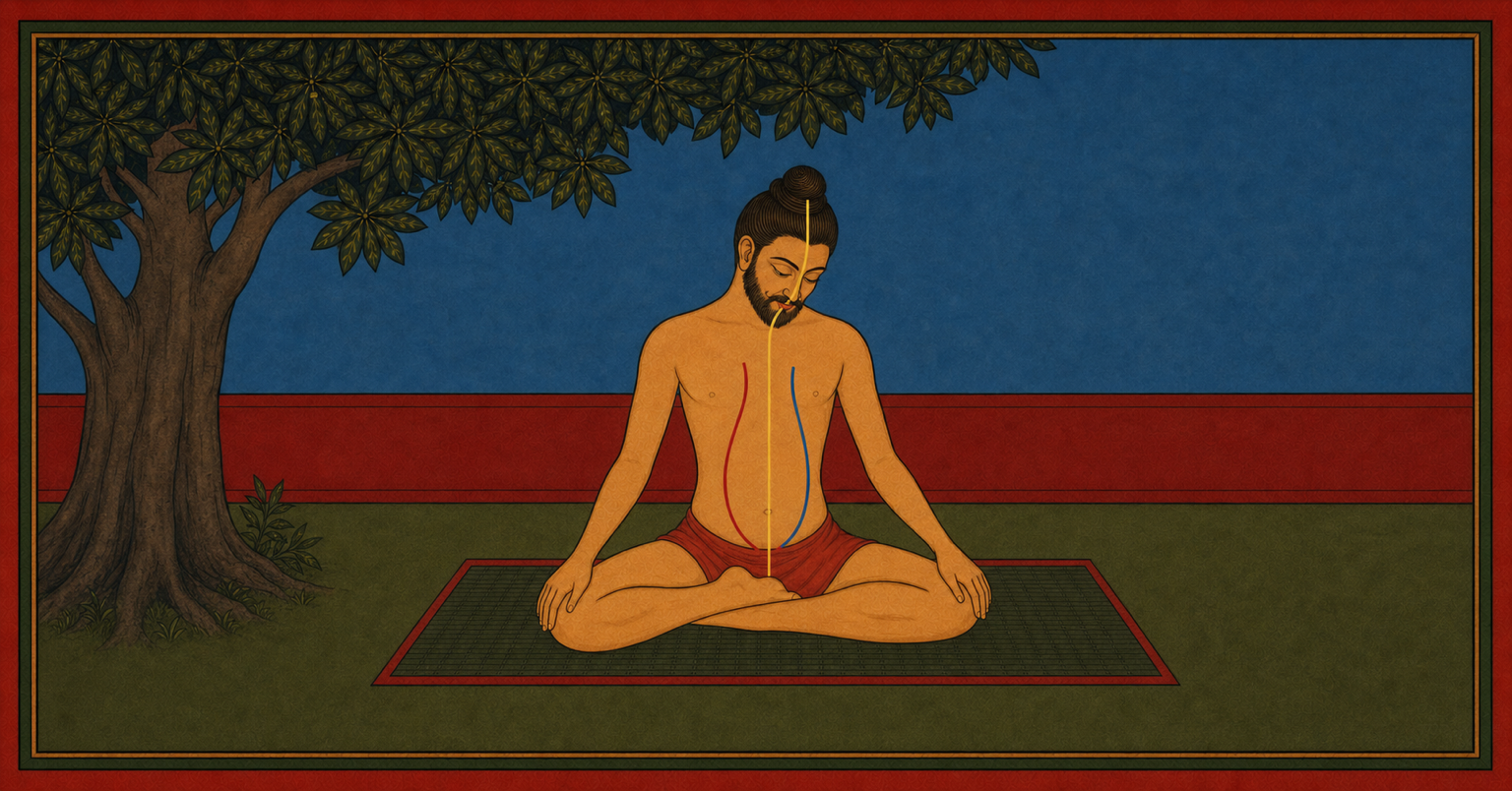
Illustration for the Haṭha Pradīpikā section “HP 3.19-3.25: Mahābandha”.

Haṭha Pradīpikā 3.19-3.25: Mahābandha and Mahāvedha

Mahābandha is described technically, interpreted through its effects on Nāḍī, mind, and the noose of death, and opened toward Mahāvedha.

Dr. Ronald Steiner Dr. Ronald Steiner
Haṭha Pradīpikā 3.19
पार्ष्णिं वामस्य पादस्य योनिस्थाने नियोजयेत् |
pārṣṇiṃ vāmasya pādasya; yoni-sthāne niyojayet | Analysis ▾ Analysis ▴
pārṣṇim
accusative singular
substantive feminine
heel
vāmasya
genitive singular masculine
adjective
of the left
pādasya
genitive singular
substantive masculine
foot
yoni
tatpuruṣa-compound genitive
substantive feminine
yoni, perineal region
sthāne
lokative singular
substantive neuter
place, location
niyojayet
3rd person singular aktive optative causative
previx
verbal root
should place
वामोरूपरि संस्थाप्य दक्षिणं चरणं तथा ||19||
vāmorūpari saṃsthāpya; dakṣiṇaṃ caraṇaṃ tathā ||19|| Analysis ▾ Analysis ▴
vāma
karmadhāraya-compound
adjective
left
ūru
tatpuruṣa-compound lokative
substantive masculine
thigh
upari
adverb
above, on
saṃsthāpya
absolutus
previx
verbal root
having placed
dakṣiṇam
accusative singular masculine
adjective
right
caraṇam
accusative singular
substantive masculine
foot
tathā
adverb
likewise, then
Metre: Anuṣṭubh
One should place (niyojayet | 3p sg act opt caus) the heel (pārṣṇim | acc sg) of the left foot (vāmasya pādasya | gen sg) at the perineal region (yoni-sthāne | loc sg); having likewise (tathā) placed (saṃsthāpya | abs) the right foot (dakṣiṇam caraṇam | acc sg) upon the left thigh (vāma-ūru-upari),
Dr. Ronald Steiner - 2026 - historically literal
For Mahābandha, place the left heel against the perineum and the right foot on the left thigh.
Dr. Ronald Steiner - 2026 - modern transfer
Press the left heel to the perineum and place the right foot on the left thigh.
Pancham Sinh - 1915
Pressing the anus with the left ankle place the right foot upon the left thigh.
Srinivasa Iyangar - 1893
Die Ferse des linken Fusses drücke man an das perinaeum, zugleich lege man den rechten Fuss auf den linken Schenkel.
Hermann Walter - 1893
Haṭha Pradīpikā 3.20
पूरयित्वा मुखे वायुं हृदये चिबुकं दृढम् |
pūrayitvā mukhe vāyuṃ; hṛdaye cibukaṃ dṛḍham | Analysis ▾ Analysis ▴
pūrayitvā
absolutus
verbal root
having filled, inhaled
mukhe
lokative singular
substantive neuter
through the mouth
vāyum
accusative singular
substantive masculine
breath, wind
hṛdaye
lokative singular
substantive neuter
on the chest, at the heart
cibukam
accusative singular
substantive neuter
chin
dṛḍham
accusative singular neuter
adjective
firmly
निभृत्य योनिमाकुञ्च्य मनो मध्ये नियोजयेत् ||20||
nibhṛtya yonim ākuñcya; mano madhye niyojayet ||20|| Analysis ▾ Analysis ▴
nibhṛtya
absolutus
previx
verbal root
having held, lowered
yonim
accusative singular
substantive feminine
yoni, perineal region
ākuñcya
absolutus
previx
verbal root
having contracted
manaḥ
accusative singular
substantive neuter
mind
madhye
lokative singular
substantive neuter
in the middle
niyojayet
3rd person singular aktive optative causative
previx
verbal root
should direct, place
Metre: Anuṣṭubh
having inhaled (pūrayitvā | abs) the breath (vāyum | acc sg) through the mouth (mukhe | loc sg), firmly lowered (nibhṛtya | abs) the chin (cibukam dṛḍham | acc sg) to the chest (hṛdaye | loc sg), and contracted (ākuñcya | abs) the perineal region (yonim | acc sg), one should direct (niyojayet | 3p sg act opt caus) the mind (manaḥ | acc sg) into the centre (madhye | loc sg).
Dr. Ronald Steiner - 2026 - historically literal
Then inhale through the mouth, bring the chin firmly to the chest, contract the perineum, and gather the mind in the center.
Dr. Ronald Steiner - 2026 - modern transfer
mukhe MBHDL2026 ] tato NS1882
Critical Apparatus
Fill in the air, keeping the chin firm against the chest, and, having pressed the air, the mind should be fixed on the middle of the eyebrows or in the suṣumnâ (the spine).
Pancham Sinh - 1915
Having drawn in the breath, place the chin firmly on the breast, contract the anus and fix the mind on the Sushumna Nadi.
Srinivasa Iyangar - 1893
Man athme ein, drücke das Kinn fest auf die Herzgegend, drücke den Athem zusammen und konzentrire den Geist auf die Mitte (madhya = sushumna, Com.).
Hermann Walter - 1893
Haṭha Pradīpikā 3.21
रेचयेच्च शनैरेव महाबन्धो ऽयमुच्यते ||21||
recayec ca śanair eva; mahā-bandho 'yam ucyate ||21|| Analysis ▾ Analysis ▴
recayet
3rd person singular aktive optative
verbal root
he should exhale
ca
particle
and
śanaiḥ
adverb
slowly, gently
eva
particle
precisely
mahā
karmadhāraya-compound
adjective
great
bandhaḥ
nominative singular
substantive masculine
bandha, lock
ayam
nominative singular masculine
pronoun dem
this
ucyate
3rd person singular passive present
verbal root
is called
Metre: Anuṣṭubh
And (ca) one should exhale (recayet | 3p sg act opt) very slowly (śanaiḥ eva). This (ayam | nom sg m) is called (ucyate | 3p sg pas pres) Mahābandha (mahā-bandhaḥ | nom sg).
Dr. Ronald Steiner - 2026 - historically literal
Now exhale very slowly. This is the practice of Mahābandha.
Dr. Ronald Steiner - 2026 - modern transfer
recayec ca śanair eva mahābandho’yam ucyate MBHDL2026 ] om. NS1882
Critical Apparatus
Haṭha Pradīpikā 3.21*1
धारयित्वा यथाशक्त्या रेचयेदनिलं शनैः |
dhārayitvā yathā-śaktyā; recayed anilaṃ śanaiḥ | Analysis ▾ Analysis ▴
dhārayitvā
absolutus
verbal root
having retained
yathā
avyayībhāva-compund
adverb
according to
śaktyā
instrumental case singular
substantive feminine
strength, capacity
recayet
3rd person singular aktive optative
verbal root
he should exhale
anilam
accusative singular
substantive masculine
the breath, wind
śanaiḥ
adverb
slowly
सव्याङ्गे च समभ्यस्य दक्षाङ्गे च समभ्यसेत् ||21*1||
savyāṅge ca samabhyasya; dakṣāṅge ca samabhyaset ||21*1|| Analysis ▾ Analysis ▴
savya
karmadhāraya-compound
adjective
left
aṅge
lokative singular
substantive neuter
on the side
ca
particle
and
samabhyasya
absolutus
previx
previx
verbal root
having practised
dakṣa
karmadhāraya-compound
adjective
right
aṅge
lokative singular
substantive neuter
on the side
ca
particle
and
samabhyaset
3rd person singular aktive optative
previx
previx
verbal root
should practise
Metre: Anuṣṭubh
Having held (dhārayitvā | abs) the breath according to one's capacity (yathā-śaktyā | ins sg), one should slowly (śanaiḥ) exhale (recayet | 3p sg act opt) the breath wind (anilam | acc sg). Having practised (samabhyasya | abs) on the left side (savyāṅge | loc sg), one should also (ca) practise (samabhyaset | 3p sg act opt) on the right side (dakṣāṅge | loc sg).
Dr. Ronald Steiner - 2026 - historically literal
Retain the breath only for as long as your strength allows, then exhale slowly. Practise Mahābandha first on the left and then on the right.
Dr. Ronald Steiner - 2026 - modern transfer
yathāśaktyā MBHDL2026 ] yathāśakti NS1882

savyāṅge ca MBHDL2026 ] savyāṅge tu NS1882

dakṣāṅge ca MBHDL2026 ] dakṣāṅge punar NS1882
Critical Apparatus
Having kept it confined so long as possible, it should be expelled slowly. Having practised on the left side, it should be practised on the right side.
Pancham Sinh - 1915
Having restrained the breath as long as possible he should then breathe out slowly. He should practise first on the left side and then on the right.
Srinivasa Iyangar - 1893
Nachdem man den Athem so lange als möglich angehalten hat, athme man langsam wieder aus. Wenn man dies auf der linken Seite geübt hat, übe man es auch auf der rechten.
Hermann Walter - 1893
Haṭha Pradīpikā 3.21*2
मतमत्र तु केषांचित् कण्ठबन्धं विसर्जयेत् |
matam atra tu keṣāṃcit; kaṇṭha-bandhaṃ visarjayet | Analysis ▾ Analysis ▴
matam
nominative singular neuter past participle passive
verbal root
opinion, view
atra
adverb
here, in this case
tu
particle
but
keṣāṃcit
genitive plural
pronoun
of some
kaṇṭha
tatpuruṣa-compound genitive
substantive masculine
throat
bandham
accusative singular
substantive masculine
bandha, lock
visarjayet
3rd person singular aktive optative
previx
verbal root
should release, omit
राजदन्तबिलं तत्र जिह्वयोत्तम्भयेदिति ||21*2||
rāja-danta-bilaṃ tatra; jihvayottambhayed iti ||21*2|| Analysis ▾ Analysis ▴
rāja
tatpuruṣa-compound genitive
substantive masculine
king
danta
tatpuruṣa-compound genitive
substantive masculine
tooth
bilam
accusative singular
substantive neuter
cavity, opening
tatra
adverb
there
jihvayā
instrumental case singular
substantive feminine
with the tongue
uttambhayet
3rd person singular causative optative
previx
verbal root
should raise, support
iti
particle
thus
Metre: Anuṣṭubh
Here, however (atra tu), some (keṣāṃcit | gen pl) hold the view (matam | nom sg n ppp) that one should release (visarjayet | 3p sg act opt) the throat lock (kaṇṭha-bandham | acc sg). There (tatra), so it is said (iti), one should use the tongue (jihvayā | ins sg) to support (uttambhayet | 3p sg caus opt) the cavity at the Rājadanta (rāja-danta-bilam | acc sg).
Dr. Ronald Steiner - 2026 - historically literal
Some traditions omit the throat lock here and instead use the tongue to seal the hollow behind the upper incisors.
Dr. Ronald Steiner - 2026 - modern transfer

Brahmānanda preserves a divergent teaching on Mahābandha. Some teachers omit the constriction of the throat and instead hold the tongue above at the front teeth. This tongue lock is said to impede the ascent of wind through every channel except Suṣumṇā, thereby fulfilling the same directing function.

Brahmānanda's Jyotsnā - 19th c.
kaṇṭhabandhaṃ visarjayet MBHDL2026 ] kaṇṭhabandhaṃ vivarjayet NS1882

rājadantabilaṃ tatra jihvayottambhayed MBHDL2026 ] rājadantasthajihvāyāṃ bandhaḥ śasto bhaved NS1882
Critical Apparatus
Some are of opinion that the closing of throat is not necessary here, for keeping the tongue pressed against the roots of the upper teeth makes a good bandha (stop).
Pancham Sinh - 1915
Some think that the Jalandhara Bandha should be avoided here and that the tongue should be pressed firmly against the root of the front-teeth.
Srinivasa Iyangar - 1893
Einige halten dafür, man solle den Kanthabandha (Jalandharabandha) vermeiden, der Bandha, der durch das Legen der Zunge an die oberen (vordersten) Schneidezähne entstehe, sei der beste. Vergl. III. 11.
Hermann Walter - 1893
Haṭha Pradīpikā 3.22
अमुं योगी महाबन्धं महासिद्धिप्रदायकम् |
amuṃ yogī mahā-bandhaṃ; mahā-siddhi-pradāyakam | Analysis ▾ Analysis ▴
amum
accusative singular masculine
pronoun dem
this
yogī
nominative singular
substantive masculine
the yogin
mahā
karmadhāraya-compound
adjective
great
bandham
accusative singular
substantive masculine
bandha, lock
mahā
karmadhāraya-compound
adjective
great
siddhi
tatpuruṣa-compound accusative
substantive feminine
siddhi, perfection
pradāyakam
accusative singular masculine
adjective
bestowing
सव्याङ्गे च समभ्यस्य दक्षाङ्गे च समभ्यसेत् ||22||
savyāṅge ca samabhyasya; dakṣāṅge ca samabhyaset ||22|| Analysis ▾ Analysis ▴
savya
karmadhāraya-compound
adjective
left
aṅge
lokative singular
substantive neuter
on the side
ca
particle
and
samabhyasya
absolutus
previx
previx
verbal root
having practised
dakṣa
karmadhāraya-compound
adjective
right
aṅge
lokative singular
substantive neuter
on the side
ca
particle
and
samabhyaset
3rd person singular aktive optative
previx
previx
verbal root
should practise
Metre: Anuṣṭubh
Having practised (samabhyasya | abs) on the left side (savyāṅge | loc sg) this (amum | acc sg m) Mahābandha that bestows great accomplishment (mahā-siddhi-pradāyakaṃ mahā-bandham | acc sg), the yogi (yogī | nom sg) should also (ca) practise it (samabhyaset | 3p sg act opt) on the right side (dakṣāṅge | loc sg).
Dr. Ronald Steiner - 2026 - historically literal
The yogi practises the great Siddhi-bestowing Mahābandha first on the left and then on the right.
Dr. Ronald Steiner - 2026 - modern transfer
amuṃ yogī mahābandhaṃ mahāsiddhipradāyakam MBHDL2026 ] om. NS1882

savyāṅge ca samabhyasya dakṣāṅge ca samabhyaset MBHDL2026 ] transp. NS1882 post HP 3.21*1a
Critical Apparatus
Haṭha Pradīpikā 3.22*1
अयं खलु महाबन्धो महासिद्धिप्रदायकः |
ayaṃ khalu mahā-bandho; mahā-siddhi-pradāyakaḥ | Analysis ▾ Analysis ▴
ayam
nominative singular masculine
pronoun dem
this
khalu
particle
indeed
mahā
karmadhāraya-compound
adjective
great
bandhaḥ
nominative singular
substantive masculine
bandha, lock
mahā
karmadhāraya-compound
adjective
great
siddhi
tatpuruṣa-compound accusative
substantive feminine
siddhi
pradāyakaḥ
nominative singular masculine
adjective
bestowing
कालपाशमहाबन्धविमोचनविचक्षणः ||22*1||
kāla-pāśa-mahā-bandha;-vimocana-vicakṣaṇaḥ ||22*1|| Analysis ▾ Analysis ▴
kāla
tatpuruṣa-compound genitive
substantive masculine
time, death
pāśa
tatpuruṣa-compound genitive
substantive neuter
noose
mahā
karmadhāraya-compound
adjective
great
bandha
tatpuruṣa-compound genitive
substantive masculine
fetter, bond
vimocana
tatpuruṣa-compound genitive
substantive neuter
release, liberation
vicakṣaṇaḥ
nominative singular masculine
adjective
skilled, expert
Metre: Anuṣṭubh
This (ayam | nom sg m) is truly (khalu) the great lock (mahā-bandhaḥ | nom sg), which bestows great accomplishment (mahā-siddhi-pradāyakaḥ | nom sg m). It is skilled at releasing the great bond of the noose of death (kāla-pāśa-mahā-bandha-vimocana-vicakṣaṇaḥ | nom sg m).
Dr. Ronald Steiner - 2026 - historically literal
Mahābandha bestows great Siddhi and, in the imagery of the text, breaks the bond of death's noose.
Dr. Ronald Steiner - 2026 - modern transfer
ayaṃ khalu mahābandho mahāsiddhipradāyakaḥ kālapāśamahābandhavimocanavicakṣaṇaḥ MBHDL2026 ] transp. NS1882 post HP 3.23a
Critical Apparatus
This stops the upward motion of all the Nâdîs. Verily this Mahâ Bandha is the giver of great Siddhis.
Pancham Sinh - 1915
This Maha Bandha that confers great Siddhis stops the upward course of the breath through the Nadis except Sushumna.
Srinivasa Iyangar - 1893
Aber jener Bandha (der Jalandhara) versperrt aufwärts den Weg in alle Gefässe (nämlich ausser der Sushumna), während der Mahâbandha allerdings grossen Erfolg verleiht.

Wer sich durch den Mahâbandha von des Todes Schlingen Befreiung zu verschaffen weiss, bringt das Zusammenkommen der drei Nâdî (resp. deren Luft) zu Stande, und konzentrirt den Geist auf den Kedara.
Hermann Walter - 1893
Haṭha Pradīpikā 3.23
अयं च सर्वनाडीनाम् ऊर्ध्वंगतिविबोधकः |
ayaṃ ca sarva-nāḍīnām; ūrdhvaṃ-gati-vibodhakaḥ | Analysis ▾ Analysis ▴
ayam
nominative singular masculine
pronoun dem
this
ca
particle
and
sarva
karmadhāraya-compound
adjective
all
nāḍīnām
genitive plural
substantive feminine
of the nāḍīs
ūrdhvam
tatpuruṣa-compound
adverb
upward
gati
tatpuruṣa-compound genitive
substantive neuter
movement, course
vibodhakaḥ
nominative singular masculine
adjective
awakening, causing
त्रिवेणीसंगमं धत्ते केदारं प्रापयेन्मनः ||23||
triveṇī-saṃgamaṃ dhatte; kedāraṃ prāpayen manaḥ ||23|| Analysis ▾ Analysis ▴
triveṇī
tatpuruṣa-compound genitive
substantive feminine
Triveṇī
saṅgamam
accusative singular
substantive neuter
confluence
dhatte
3rd person singular medial present
verbal root
produces, brings about
kedāram
accusative singular
substantive neuter
Kedāra
prāpayet
3rd person singular causative optative
previx
verbal root
should lead, cause to reach
manaḥ
accusative singular
substantive neuter
mind
Metre: Anuṣṭubh
This (ayam | nom sg m) also (ca) awakens the upward movement (ūrdhvam-gati-vibodhakaḥ | nom sg m) of all the channels (sarva-nāḍīnām | gen pl). It brings about (dhatte | 3p sg med pres) the confluence at Triveṇī (triveṇī-saṅgamam | acc sg) and should cause (prāpayet | 3p sg caus opt) the mind (manaḥ | acc sg) to reach Kedāra (kedāram | acc sg).
Dr. Ronald Steiner - 2026 - historically literal
Mahābandha directs the movement of all Nāḍīs upward, creates the inner confluence of the Triveṇī, and leads the mind to Kedāra.
Dr. Ronald Steiner - 2026 - modern transfer

Brahmānanda interprets the Triveṇī Saṅgama, the confluence of three rivers, as the union of Iḍā, Piṅgalā, and Suṣumṇā. He locates Kedāra, a sacred place of Śiva, between the eyebrows. The verse thus transfers two places of pilgrimage into the subtle body and turns inner concentration itself into a pilgrimage.

Brahmānanda's Jyotsnā - 19th c.
ayaṃ ca sarvanāḍīnām ūrdhvaṃgativibodhakaḥ MBHDL2026 ] transp. NS1882 ante HP 3.22*1

ūrdhvaṃgativibodhakaḥ MBHDL2026 ] ūrdhvagatinirodhakaḥ NS1882
Critical Apparatus
This Mahâ Bandha is the most skilful means for cutting away the snares of death. It brings about the conjunction of the Trivenî (Idâ, Pingalâ and Suṣumnâ) and carries the mind to Kedâr (the space between the eyebrows, which is the seat of Śiva).
Pancham Sinh - 1915
This frees one from the great noose of king Yama and brings about the union of the three Nadis: Ida, Pingala and Sushumna; it also enables the mind to remain fixed between the eye-brows.
Srinivasa Iyangar - 1893
Haṭha Pradīpikā 3.24
रूपलावण्यसंपन्ना यथा स्त्री पुरुषं विना |
rūpa-lāvaṇya-saṃpannā; yathā strī puruṣaṃ vinā | Analysis ▾ Analysis ▴
rūpa
tatpuruṣa-compound genitive
substantive neuter
beauty, form
lāvaṇya
tatpuruṣa-compound genitive
substantive neuter
grace
saṃpannā
nominative singular feminine past participle passive
previx
verbal root
endowed
yathā
adverb
like
strī
nominative singular
substantive feminine
woman
puruṣam
accusative singular
substantive masculine
man
vinā
adverb
without
महामुद्रामहाबन्धौ निष्फलौ वेधवर्जितौ ||24||
mahā-mudrā-mahā-bandhau; niṣphalau vedha-varjitau ||24|| Analysis ▾ Analysis ▴
mahā
karmadhāraya-compound
adjective
great
mudrā
dvandva-compound
substantive feminine
mudrā
mahā
karmadhāraya-compound
adjective
great
bandhau
nominative dual
substantive masculine
bandhas, locks
niṣphalau
nominative dual masculine
adjective
fruitless
vedha
tatpuruṣa-compound ablative
substantive masculine
vedha, piercing
varjitau
nominative dual masculine past participle passive
verbal root
deprived of, without
Metre: Anuṣṭubh
Just as (yathā) a woman (strī | nom sg), endowed with beauty and grace (rūpa-lāvaṇya-saṃpannā | nom sg f ppp), is fruitless without (vinā) a man (puruṣam | acc sg), so Mahāmudrā and Mahābandha (mahā-mudrā-mahā-bandhau | nom du), when deprived of Vedha (vedha-varjitau | nom du m ppp), are fruitless (niṣphalau | nom du m).
Dr. Ronald Steiner - 2026 - historically literal
Without Mahāvedha, Mahāmudrā and Mahābandha remain incomplete, like beauty without a fruitful union.
Dr. Ronald Steiner - 2026 - modern transfer
As beauty and loveliness, do not avail a woman without husband, so the Mahâ Mudrâ and the Mahâ-Bandha are useless without the Mahâ Vedha.
Pancham Sinh - 1915
As a beautiful and graceful woman is of no value without a husband, so Maha Mudra and Maha Bandha have no value without the Maha Vedha.
Srinivasa Iyangar - 1893
Wie ein mit lieblicher Gestalt ausgestattetes Weib ohne Mann, so sind auch Mahamudra und Mahabandha fruchtlos ohne Vedha.
Hermann Walter - 1893
Haṭha Pradīpikā 3.25
महाबन्धस्थितो योगी कृत्वा पूरकमेकधीः |
mahā-bandha-sthito yogī; kṛtvā pūrakam eka-dhīḥ | Analysis ▾ Analysis ▴
mahā
karmadhāraya-compound
adjective
great
bandha
tatpuruṣa-compound lokative
substantive masculine
bandha
sthitaḥ
nominative singular masculine past participle passive
verbal root
situated, remaining
yogī
nominative singular
substantive masculine
the yogin
kṛtvā
absolutus
verbal root
having performed
pūrakam
accusative singular
substantive neuter
inhalation
eka
karmadhāraya-compound
numeral
one, collected
dhīḥ
nominative singular masculine bahuvrīhi-compund
substantive feminine
mind, understanding
वायूनां गतिमावृत्य निभृतं कण्ठमुद्रया ||25||
vāyūnāṃ gatim āvṛtya; nibhṛtaṃ kaṇṭha-mudrayā ||25|| Analysis ▾ Analysis ▴
vāyūnām
genitive plural
substantive masculine
of the breath winds
gatim
accusative singular
substantive neuter
movement, course
āvṛtya
absolutus
previx
verbal root
having blocked
nibhṛtam
accusative singular neuter past participle passive
previx
verbal root
firmly, restrained
kaṇṭha
tatpuruṣa-compound genitive
substantive masculine
throat
mudrayā
instrumental case singular
substantive feminine
through the mudrā
Metre: Anuṣṭubh
The yogi established in Mahābandha (mahā-bandha-sthito yogī | nom sg), one-pointed in mind (eka-dhīḥ | nom sg m bv), having performed (kṛtvā | abs) the inhalation (pūrakam | acc sg) and firmly (nibhṛtam | acc sg n ppp) blocked (āvṛtya | abs) the movement (gatim | acc sg) of the bodily winds (vāyūnām | gen pl) with the throat seal (kaṇṭha-mudrayā | ins sg),
Dr. Ronald Steiner - 2026 - historically literal
While in Mahābandha, the yogi inhales, gathers the mind, and seals the movement of the breaths with the throat Mudrā.
Dr. Ronald Steiner - 2026 - modern transfer
Sitting with Mahâ Bandha, the Yogî should fill in the air and keep his mind collected. The movements of the Vâyus (Prâṇa and Apâna) should be stopped by closing the throat.
Pancham Sinh - 1915
The Yogi assuming the Maha Bandha posture, should draw in his breath with a concentrated mind and stop the upward and downward course of the Prâṇa by the Jalandhara Bandha.
Srinivasa Iyangar - 1893
Andächtig in Mahabandha verweilend verrichte der Yogin den Pûraka, und unbeweglich hemme er den Gang des Athems vermittelst der Kanthamudra (Jalandhara, Com.).
Hermann Walter - 1893

Continue with AYI Free

Illustrations: AI-generated.

Editor

Dr. Ronald Steiner

From Ulm

The "Yoga Doc" - Dr. Ronald Steiner is the founder of the AYI method. This method links traditional Ashtanga Yoga with innovative Yogatherapy and living Philosophy. This forms a practice that is personal for each and... more ›

Messages and ratings
0 messages

Please log in to write a message. Go to login

No messages yet.