

kāraka कारक – causing; bringing about; producing
adjective · substantive feminine · substantive masculine · substantive neuter · Word type unspecified
Dictionary sources
AYI dictionary adjective
causing; bringing about; producing
Cappeller 1891 Word type unspecified
Original text · English · Word type unspecified
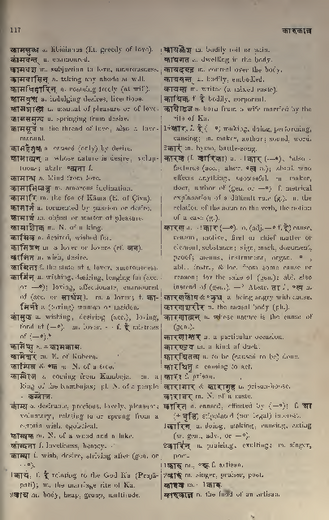
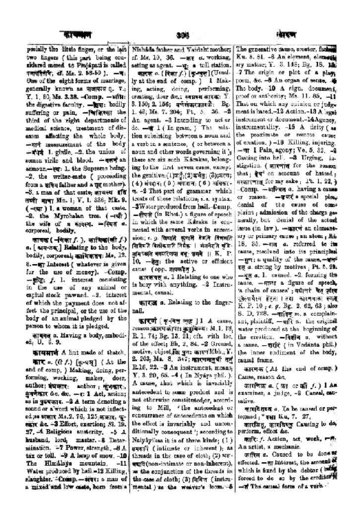
kāraka ·(f. kārikā) a. = kāra1 (--°), *also = facturus (acc., abstr. °tva n.); absol. who effects anything, successful. m. maker, doer, author of (gen. or --°). f. metrical explanation of a difficult rule (g.). n. the relation of the noun to the verb, the notion of a case (g.).
Monier-Williams 1872 substantive neuter · Word type unspecified
Original text · English · substantive neuter
2. kāraka, am, n. (fr. 2. karaka), scil. salila, water produced from hail.

Original text · English · Word type unspecified
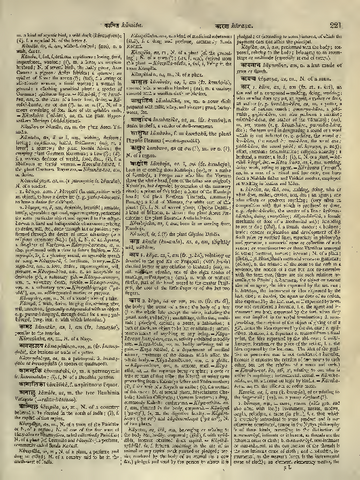
1. kāraka, as, ikā, am, making, doing, who or what does, makes, creates, act, &c.; an agent; one who effects or produces anything; (very often in composition with that which is produced or done, e. g. siṃha-kāraka, the creator of a lion; kṛtsna- kāraka, doing everything; śilpa-kārikā, a female mechanic or doer of a mechanical art); intending to act or do; (ikā), f. a female dancer; a business; trade; concise explanation and development of dif- ficult rules by metrical lines, especially in philosophy and grammar, a memorial verse or collection of such verses; or sometimes two or three Vārttikas arranged in verse; torment, torture; interest; N. of a plant; (ikās), f. pl. Bhartṛhari's memorial verses on grammar; (akam), n. the relation of the noun to the verb in a sentence, the notion of a case but not co-extensive with the term case, (there are six such relations ac- cording to Pāṇini; a. karman, the object or nearest aim of an agent, the idea expressed by the acc. case; b. karaṇa, the instrument or idea expressed by the inst. case; c. kartṛ, the agent or doer of an action, also expressed by the inst. case, or if expressed by nom. case not considered a kāraka, i. e. the agent and in- strument are both expressed by the inst. when they are not implied in the verbal termination; d. sam- pradāna, the recipient of the object of giving or of a gift, hence the idea expressed by the dat. case; e. apā- dāna, ablation, i. e. departure or removal from a fixed point, the idea expressed by the abl. case; f. adhi- karaṇa, location, or the place of the action, i. e. the idea expressed by the loc. case. The idea of the geni- tive or possessive case is not considered a kāraka, because it expresses the relation of two nouns to each other, but not the relation of a noun and verb.)
Petersburger 1855 adjective · substantive masculine · substantive neuter
Original text · German · adjective · substantive neuter
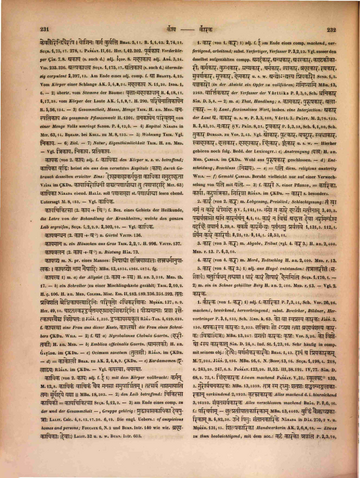
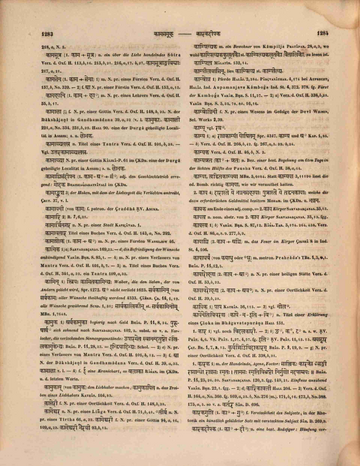
1. kā́raka (von 1. kar) 1〉 adj. f. kārikā P. 7,3,44, Sch. VOP. 26,26. machend, bewirkend, hervorbringend; subst. Bewirker, Bildner, Hervorbringer P. 3,1,133, Sch. MED. k. 63. ko vā svapnasya kārakaḥ YĀJÑ. 3,150. apakārasya kārakaḥ YĀJÑ. 2,233. kṣattriyaḥ so 'pyatha tathā brahmavaṃśasya kārakaḥ (viśvāmitraḥ) MBH. 13,247. jagatāṃ kārakaḥ kṛṣṇaḥ VOP. 5,26. ko viśeṣo 'sya kārakāt SĀH. D. 24,8. Ind. St. 1,23,16. Sehr häufig in comp. mit seinem obj.: (doṣaiḥ) varṇasaṃkarakārakaiḥ BHAG. 1,43. dānaṃ ca priyakārakam M. 7,204. YĀJÑ. 2,156. MBH. 16,6. N. (BOPP) 13,16. SUŚR. 1,198,4. SUŚR. 1,218,8. SUŚR. 1,243,20. SUŚR. 1,247,6. SUŚR. 1,198,9. PAÑCAT. 123,20. PAÑCAT. II, 52. PAÑCAT. III, 58. PAÑCAT. III,191. PAÑCAT. IV, 77. SĀH. D. 68,2. SĀH. D. 72,1. siṃhakāraka Löwen machend PAÑCAT. V, 31. sthūlapaṭa˚ PAÑCAT. 133,3. gurorvacanakārakaḥ MBH. 13,2359. tatra sma dadhmuḥ śataśaḥ śaṅkhānmaṅgalakārakān verkündend MBH. 2,1925. kṛtsnakāraka Alles machend d. i. hinreichend MBH. 3,16293. saṃvṛtasarvakāraka Alles verschlossen machend BHĀG. P. 8,6,16. f.: paricaryām — kṣutpratīghātakārikām MBH. 13,4469. buddhiṃ vaiklavyakārikām R. 6,82,30. ubhe pituḥ saṃtānakārike NĀRADA_in_DĀY. 270,2 v. u. MṚCCH. 131,15. śilpakārikā Handwerkerin AK. 2,6,1,18. — Etwas zu thun beabsichtigend, mit dem acc.: kaṭaṃ kārako vrajati P. 2,3,70, Sch. — 2〉 f. kā́rikā VOP. 4,6. a〉 Tänzerin H. an. MED. — b〉 Geschäft diess.: kāṃ kārikāmakārṣīḥ . sarvāṃ kārikāmakārṣaṃ P. 3,3,110, Sch. Soll auf diese Verbindung in der Frage und Antwort beschränkt sein; vgl. indessen agnikārikā. — c〉 Handwerk H. an. MED. — d〉 eine in gebundener Rede abgefasste Erklärung und Entwickelung schwieriger Lehrsätze AK. 3,4,1,15. TRIK. 3,3,14. H. 258. H. an. MED. kathākhyāyikakārikāḥ MBH. 2,453. GAUḌAPĀDAʼs māṇḍukyopaniṣatkārikā abgedr. in der Bibl. ind. ĪŚVARAKṚṢṆAʼs sāṃkhyakārikā GILD. Bibl. 412. fg. Ueber die grammatischen kārikā s. BÖHTLINGK in der Einl. zu P. II, p. XLVIII. fgg.; über andere kārikā COLEBR. Misc. Ess. I, 263. Verz. d. B. H. No. 820. Verz. d. B. H. No. 1040. Ind. St. 1,59. Ind. St. 2,292. BURN. Intr. 559. kārikāvalī Titel eines philosophischen (Z. d. d. m. G. 6,10) und eines grammatischen (COLEBR. Misc. Ess. II, 48) Werkes. kārikānibandha Z. d. d. m. G. 2,342 (Z. d. d. m. G. 2,No. 201,d). kārikākar, kārikākṛtya viell. durch eine kārikā erklären P. 1,4,60, Vārtt. 1. VOP. 8,21. Nach COLEBR. Gr. 124 bedeutet kārikā in dieser Verb. determination. — e〉 Marter AK. H. an. MED. vgl. kāraṇā. — f〉 Zins RAMĀN._zu_AK. ŚKDR. — g〉 N. einer Pflanze, = kārī RĀJAN._im_ŚKDR. u. kārī. — 3〉 n. die Beziehung des Nomens zum Verbum im Satz, Casus-Begriff P. 1,4,23. H. an. MED. AK. 1,1,5,3. H. 69. Verz. d. B. H. No. 771. Es werden sechs solcher Beziehungen angenommen: karman Object oder die Kategorie des acc., karaṇa das Werkzeug oder die Kategorie des instr., kartar der Agens, saṃpradāna die Uebergabe oder die Kat. des dat., apādāna die Wegnahme oder die Kat. des abl. und adhikaraṇa der Bezug oder die Kat. des loc.; vgl. BÖHTLINGK_zu_P. 1,4,23. Nach dem PHAṆIBHĀṢYA_im_ŚKDR. soll kāraka in dieser Bed. m. sein.
Original text · German · substantive masculine
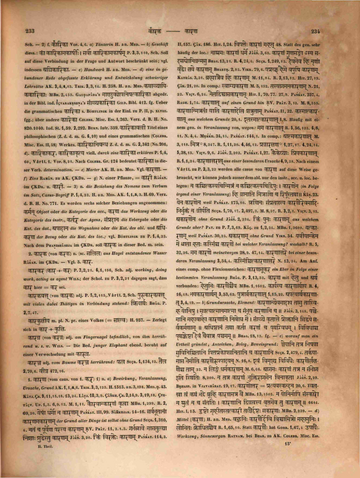
1. kāraka 1〉 m. der Handelnde, Agens, Factor: sāttvikaḥ kārako 'saṅgī rāgāndho rājasaḥ smṛtaḥ . tāmasaḥ smṛtivibhraṣṭo nirguṇo madapāśrayaḥ .. BHĀG. P. 11,25,26. BHĀG. P. 11,25,30. SARVADARŚANAS. 120,3. fgg. SARVADARŚANAS. 149,21. Einfluss ausübend VARĀH. BṚH. 22,1. fgg. — 2〉d〉 kārikāvalī HALL 204. — 3〉 Verz. d. Oxf. H. 164,a, No. 360. fg. Verz. d. Oxf. H. 169,a,25. fg. Verz. d. Oxf. H. 169,b, No. 376 (m.). Verz. d. Oxf. H. 171,b,16. Verz. d. Oxf. H. 173,b, No. 388. Verz. d. Oxf. H. 175,a,5. so v. a. kartar SĀH. D. 696.
Original text · German · substantive neuter
2. kāraka (von karaka) n. (sc. salila) aus Hagel entstandenes Wasser RĀJAN._im_ŚKDR. — Vgl. 5. kāra.
Böhtlingk 1879 adjective · substantive feminine · substantive neuter · Word type unspecified
Original text · German · adjective · substantive neuter
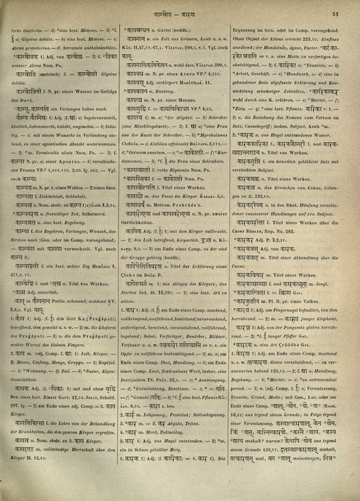
1. kāraka — 1〉 Adj. (f. kārikā) = 1. kāra 1〉. Die [Page2-051-c] Ergänzung im Gen. oder im Comp. vorangehend. Ohne Object der Etwas erreicht Chr. 223,10. Einfluss ausübend; der Handelnde, Agens, Factor. *kaṭaṃkārako vrajati so v. a. eine Matte zu verfertigen beabsichtigend. — 2〉 f. kārikā — a〉 *Tänzerin. — b〉 *Arbeit, Geschäft. — c〉 *Handwerk. — d〉 eine in gebundener Rede abgefasste Erklärung und Entwickelung schwieriger Lehrsätze. *kārikākar wohl durch einer K. erklären. — e〉 *Marter. — f〉 *Zins. — g〉 *eine best. Pflanze. karikā. v. l. — 3〉 n. die Beziehung des Nomens zum Verbum im Satz, Casusbegriff; insbes. Subject. Auch *m.
Original text · German · substantive feminine
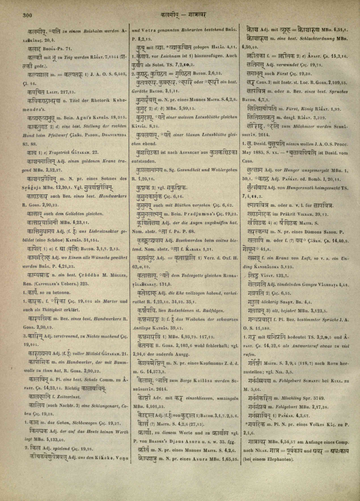
1. kāraka , f. ˚rikā ŚIŚ. 19,104 als Marter und auch als Thätigkeit erklärt. [Nachtrag, Band 6]
Original text · German · substantive neuter
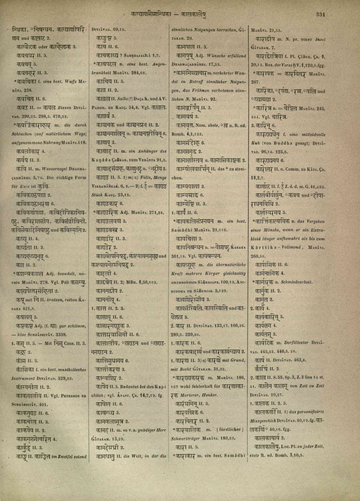
2. *kāraka n. aus Hagel entstandenes Wasser.
Original text · German · Word type unspecified
1. kāraka II. 6. [Nachtrag, Band 7]
Apte 1890 adjective · substantive neuter
Original text · English · adjective · substantive neuter
kāraka a. (rikā f.) [kṛ-ṇvul] (Usually at the end of comp.) 1 Making, acting, doing, performing, creating, doer &c.; svapnasya kārakaḥ Y. 3. 150; Y. 2. 156; varṇasaṃkarakārakaiḥ Bg. 1. 42; Ms. 7. 204; Pt. 5. 36. 2 An agent. 3 Intending to act or do. — kaṃ 1 (In gram.) The relation subsisting between a noun and a verb in a sentence, (or between a noun and other words governing it); there are six such Kārakas, belonging to the first seven cases, except the genitive: (1) kartṛ; (2) karman; (3); karaṇa; (4) saṃpradāna; (5) apādāna; (6) adhikaraṇa. 2 That part of grammar which treats of these relations; i. e. syntax. 3 Water produced from hail. Comp. — dīpakaṃ (in Rhet.) a figure of speech in which the same Kāraka is connected with several verbs in succession; e. g. khidyati kūṇati vellati vicalati nimiṣati vilokayati tiryak . aṃtarnaṃdati cuṃbitumicchati navapariṇayā vadhūḥ śayane .. K. P. 10. — hetuḥ the active or efficient cause (opp. jñāpakahetu).
Cappeller 1887 Word type unspecified
Original text · German · Word type unspecified
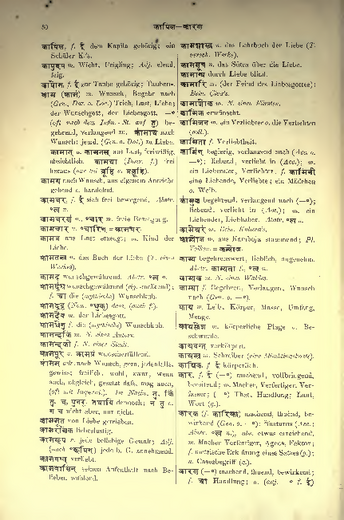
kāraka (f. kārikā) machend, thuend, bewirkend (Gen. o. —˚); *facturus (Acc.; Abstr. ˚tva n.),abs. etwas erreichend. m. Macher Verfertiger, Agens, Faktor; f. metrische Erklärung eines Satzes (g.); n. Casusbegriff (g.).
Burnouf 1866 adjective
Original text · French · adjective
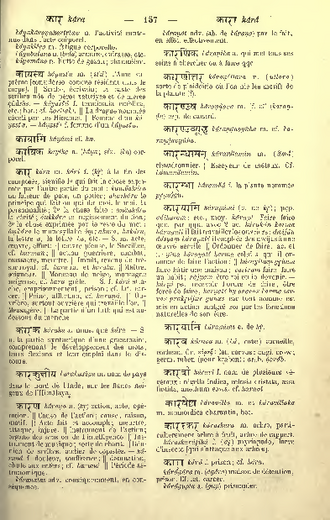
kāraka kāraka a. mms. que kāra. — S. n. la partie syntactique d'une grammaire, comprenant le développement des mots, leurs flexions et leur emploi dans le discours.
Occurrences in source texts (12)
DYS 1 occurrence
GoS 1 occurrence
HP 4 occurrences
SiSa 5 occurrences
VBT 1 occurrence
Continue with AYI Free
Image source: AYI archive.