
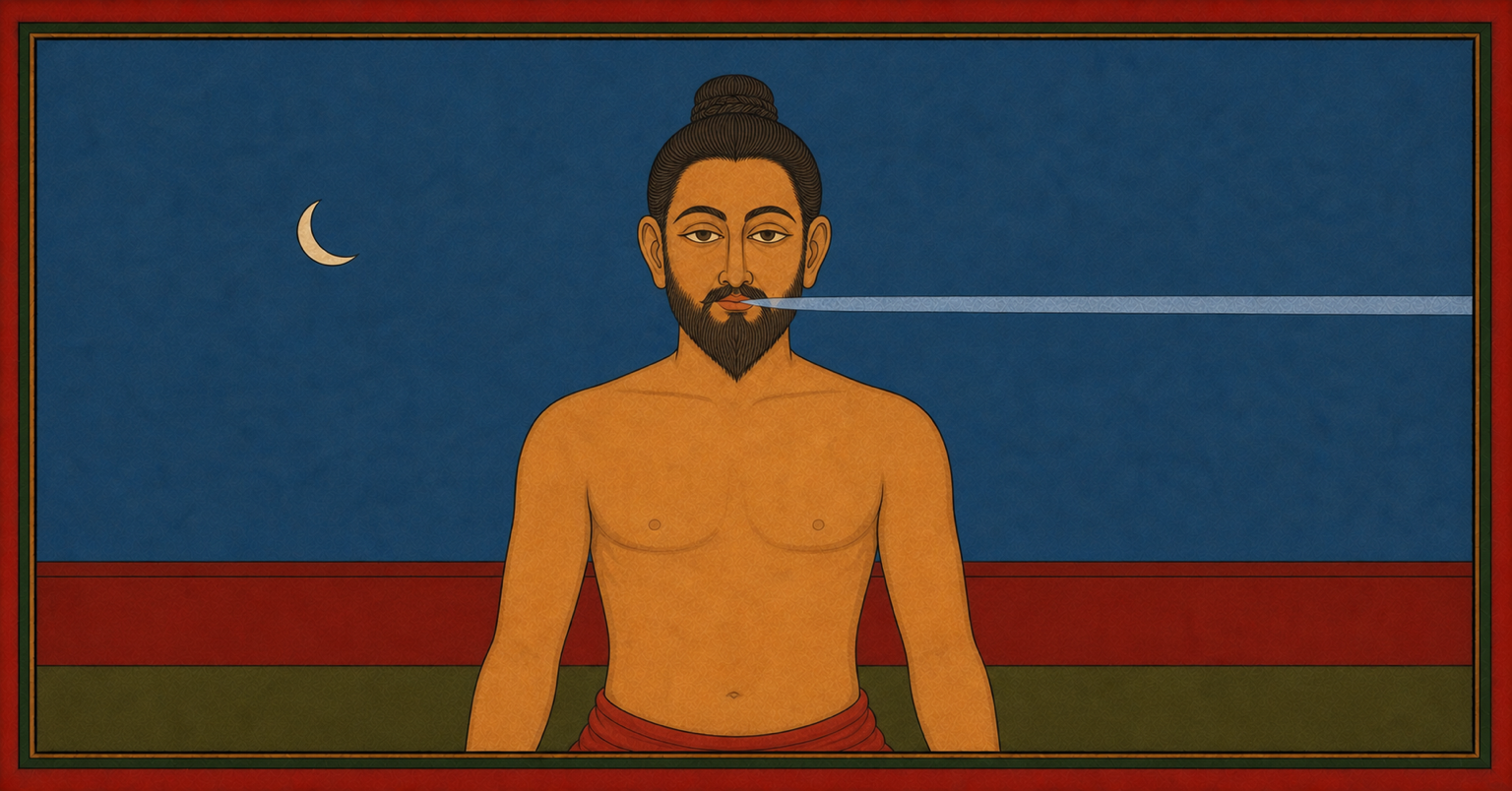
Illustration for the Haṭha Pradīpikā section “HP 2.54-2.56: Sītkārī”.

Haṭha Pradīpikā 2.54-2.56: Sītkārī

Sītkārī works with sound in the mouth and nose; it is associated with beauty, freedom from hunger and thirst, and mastery of the body.

Dr. Ronald Steiner Dr. Ronald Steiner
Haṭha Pradīpikā 2.54
सीत्कां दद्यात्सदा वक्त्रे घ्राणे चैव विजृम्भिकाम् |
sītkāṃ dadyāt sadā vaktre; ghrāṇe caiva vijṛmbhikām | Analysis ▾ Analysis ▴
sītkām
accusative singular
substantive feminine
the Sītkā sound
dadyāt
3rd person singular aktive optative
verbal root
he should make, produce
sadā
adverb
constantly
vaktre
lokative singular
substantive neuter
in the mouth
ghrāṇe
lokative singular
substantive neuter
in the nose
ca
particle
and
eva
particle
indeed
vijṛmbhikām
accusative singular
substantive feminine
opening, widening
एवम् अभ्यासयोगेन कामदेवो द्वितीयकः ||54||
evam abhyāsa-yogena; kāma-devo dvitīyakaḥ ||54|| Analysis ▾ Analysis ▴
evam
adverb
thus, in this way
abhyāsa
tatpuruṣa-compound genitive
substantive masculine
practice
yogena
instrumental case singular
substantive masculine
through application
kāma
tatpuruṣa-compound genitive
substantive masculine
love, desire
devaḥ
nominative singular
substantive masculine
god
dvitīyakaḥ
nominative singular masculine
adjective
a second
Metre: Anuṣṭubh
One should always (sadā) produce (dadyāt | 3p sg act opt) the Sītkā sound (sītkām | acc sg) in the mouth (vaktre | loc sg), and also (caiva) maintain an opening (vijṛmbhikām | acc sg) in the nose (ghrāṇe | loc sg); through practice in this way (evam abhyāsa-yogena | ins sg), one becomes a second god of love (kāma-devaḥ dvitīyakaḥ | nom sg).
Dr. Ronald Steiner - 2026 - historically literal
In Sītkā, a cooling hissing sound is made in the mouth while the nostrils remain open. The text describes its effect poetically: the yogi becomes beautiful and attractive like a second Kāma.
Dr. Ronald Steiner - 2026 - modern transfer

In Sītkārī, according to Brahmānanda, the tongue rests between the lips; one inhales through the mouth with a hissing sound and exhales through both nostrils. The Kumbhaka, though not explicitly mentioned, is included because Sītkārī is called a Kumbhaka. Even after long practice, one should never exhale through the mouth, since this is said to diminish strength.

Brahmānanda's Jyotsnā - 19th c.
dadyāt sadā MBHDL2026 ] kuryāt tathā NS1882

ghrāṇe caiva MBHDL2026 ] ghrāṇenaiva NS1882
Critical Apparatus
Sîtkârî is performed by drawing in the air through the mouth, keeping the tongue between the lips. The air thus drawn in should not be expelled through the mouth. By practising in this way, one becomes next to the God of Love in beauty.
Pancham Sinh - 1915
Putting the tongue between the lips and drawing the breath in the mouth with a hissing sound the Pûraka should be made, and then the Rechaka by the two nostrils only (and not by the mouth). This is called Sitkari. By repeating this one becomes a second god of beauty.
Srinivasa Iyangar - 1893
Mit dem Munde mache man den Laut „sit" (d. h. man lege die Zunge zwischen die Lippen und ziehe die Luft ein, Comm.) und durch die Nase athme man aus (vijrimbhikam kuryât nach Com. = recakah karyah). Durch das Ausführen dieser Uebung wird man ein zweiter Kâmadeva.
Hermann Walter - 1893
Haṭha Pradīpikā 2.55
योगिनीचक्रसामान्यः सृष्टिसंहारकारकः |
yoginī-cakra-sāmānyaḥ; sṛṣṭi-saṃhāra-kārakaḥ | Analysis ▾ Analysis ▴
yoginī
tatpuruṣa-compound genitive
substantive feminine
of yoginīs
cakra
tatpuruṣa-compound genitive
substantive neuter
circle, assembly
sāmānyaḥ
nominative singular masculine
adjective
sharing, belonging
sṛṣṭi
dvandva-compound
substantive feminine
creation, production
saṃhāra
dvandva-compound
substantive masculine
dissolution, destruction
kārakaḥ
nominative singular masculine
adjective
producing, causing
न क्षुधा न तृषा निद्रा नैवालस्यं प्रजायते ||55||
na kṣudhā na tṛṣā nidrā; naivālasyaṃ prajāyate ||55|| Analysis ▾ Analysis ▴
na
particle
no
kṣudhā
nominative singular
substantive feminine
hunger
na
particle
no
tṛṣā
nominative singular
substantive feminine
thirst
nidrā
nominative singular
substantive feminine
sleep
na
particle
not
eva
particle
even
ālasyam
nominative singular
substantive neuter
lethargy, fatigue
prajāyate
3rd person singular medial present
previx
verbal root
arises
Metre: Anuṣṭubh
One becomes connected with the circle of yoginīs (yoginī-cakra-sāmānyaḥ | nom sg m) and a maker of creation and dissolution (sṛṣṭi-saṃhāra-kārakaḥ | nom sg m); neither (na) hunger (kṣudhā | nom sg) nor (na) thirst (tṛṣā | nom sg), neither sleep (nidrā | nom sg) nor even (naiva) lethargy (ālasyam | nom sg), arises (prajāyate | 3p sg med pres).
Dr. Ronald Steiner - 2026 - historically literal
Sītkā is described here as having powerful effects: connection with the circle of Yoginīs, creative power, and freedom from hunger, thirst, the pressure of sleep, and lethargy.
Dr. Ronald Steiner - 2026 - modern transfer
He is regarded adorable by the Yoginîs and becomes the destroyer of the cycle of creation, He is not afflicted with hunger, thirst, sleep or lassitude.
Pancham Sinh - 1915
Among the multitude of women he becomes an object of admiration; he is able to do and undo; and feels neither hunger, thirst, nor indolence.
Srinivasa Iyangar - 1893
Er wird gleich (an Zaubermacht) dem Kreise der Yoginî und ist im Stande die sichtbare Welt zu vernichten. In ihm entstehen weder Hunger, noch Durst, noch Schlaf, noch Trägheit.
Hermann Walter - 1893
Haṭha Pradīpikā 2.56
भवेत्स्वच्छन्ददेहश्च सर्वोपद्रववर्जितः |
bhavet svacchanda-dehaś ca; sarvopadrava-varjitaḥ | Analysis ▾ Analysis ▴
bhavet
3rd person singular aktive optative
verbal root
he becomes, may be
svacchanda
bahuvrīhi-compund
adjective
free, according to his will
dehaḥ
nominative singular
substantive masculine
body
ca
particle
and
sarva
karmadhāraya-compound
adjective
all, every
upadrava
tatpuruṣa-compound ablative
substantive neuter
disorder, misfortune, affliction
varjitaḥ
nominative singular masculine past participle passive
verbal root
free from, excluded from
अनेन विधिना सत्यं योगीन्द्रो भुविमण्डले ||56||
anena vidhinā satyaṃ; yogīndro bhuvi-maṇḍale ||56|| Analysis ▾ Analysis ▴
anena
instrumental case singular neuter
pronoun dem
by this
vidhinā
instrumental case singular
substantive masculine
method, prescription
satyam
adverb
truly
yogīndraḥ
nominative singular
substantive masculine
a lord of yogins
bhuvi
tatpuruṣa-compound lokative
substantive feminine
on earth, in the world
maṇḍale
lokative singular
substantive neuter
sphere, domain
Metre: Anuṣṭubh
His body becomes freely responsive (svacchanda-dehaḥ | nom sg m) and free from all afflictions (sarva-upadrava-varjitaḥ | nom sg m); through this method (anena vidhinā | ins sg), he truly (satyam) becomes a lord of yogis (yogīndraḥ | nom sg) upon the earth (bhuvi-maṇḍale | loc sg).
Dr. Ronald Steiner - 2026 - historically literal
The body is described as free, light, and untroubled. The text calls one who masters this method a true master among yogis.
Dr. Ronald Steiner - 2026 - modern transfer
svacchandadehaś MBHDL2026 ] sattvaṃ ca dehasya NS1882
Critical Apparatus
The Satwa of his body becomes free from all the disturbances. In truth, he becomes the lord of the Yogîs in this world.
Pancham Sinh - 1915
By this practice he gains strength of body, and becoming the lord of Yogis, remains undoubtedly free from injuries of every kind.
Srinivasa Iyangar - 1893
Durch diese Vorschrift wird der Körper stark und der vorzügliche Yogin sicher vor allen Angriffen auf diesem Erdenrund bewahrt.
Hermann Walter - 1893

Continue with AYI Free

Illustrations: AI-generated.

Editor

Dr. Ronald Steiner

From Ulm

The "Yoga Doc" - Dr. Ronald Steiner is the founder of the AYI method. This method links traditional Ashtanga Yoga with innovative Yogatherapy and living Philosophy. This forms a practice that is personal for each and... more ›

Messages and ratings
0 messages

Please log in to write a message. Go to login

No messages yet.