
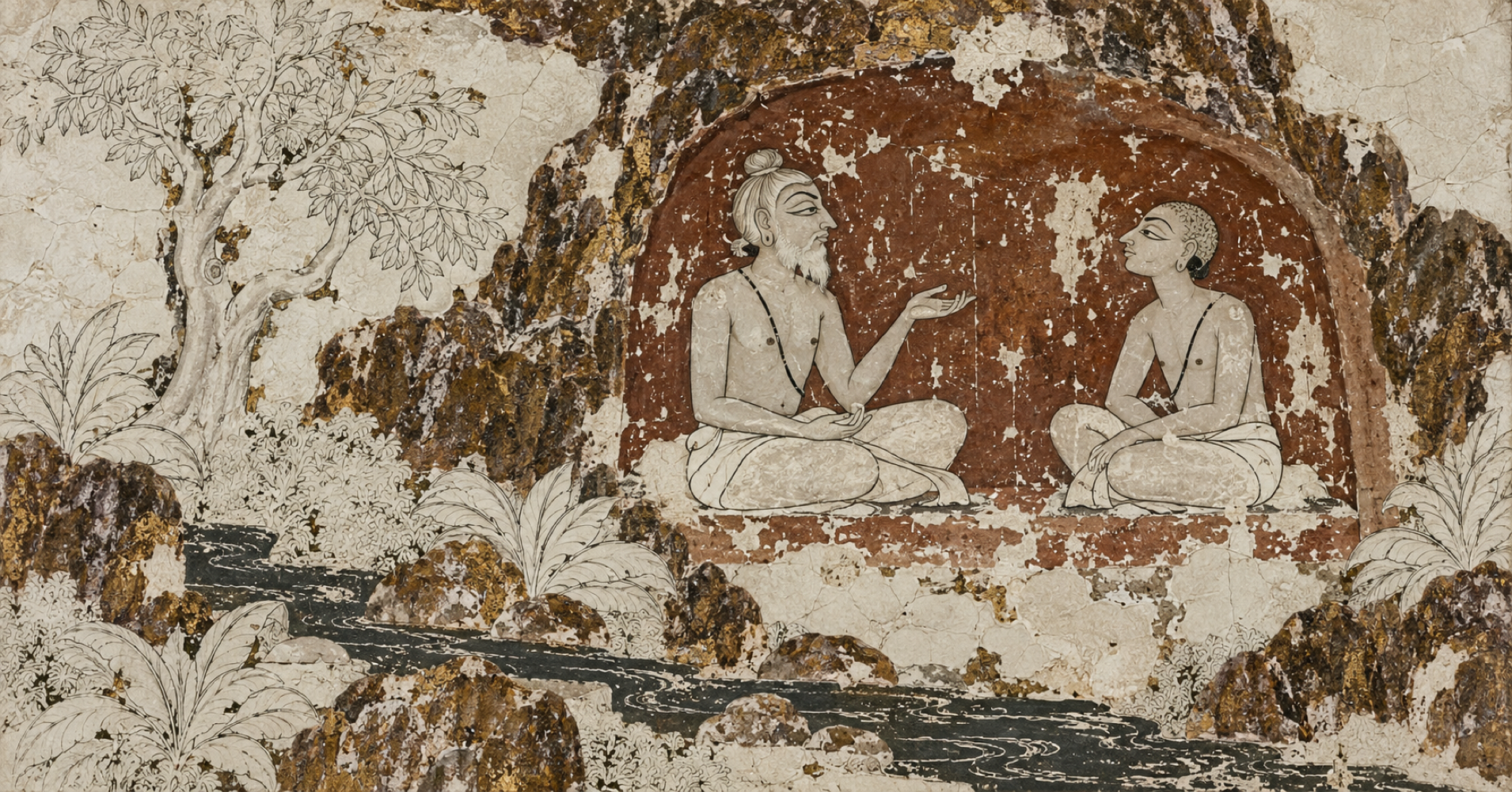
Two seated people in conversation before an open landscape.

Gorakṣaśataka 1–8: Experience, Guidance and Inner Stillness

How can good guidance be recognised? The opening links personal experience with stillness of mind and breath. Damaged passages remain visible.

Dr. Ronald Steiner Dr. Ronald Steiner
Gorakṣaśataka (Original) 1
अधुना सिद्धराजेन गोरक्षेन प्रकाशितम् |
adhunā siddha-rājena; gorakṣena prakāśitam | Analysis ▾ Analysis ▴
adhunā
adverb
now
siddha
tatpuruṣa-compound genitive
substantive masculine
of the adepts
rājena
instrumental case singular
substantive masculine
by the king
gorakṣeṇa
instrumental case singular
substantive masculine
by Gorakṣa
prakāśitam
nominative singular neuter past participle passive
previx
verbal root
revealed
योगसाधनम् अल्पैस्तु दिवसैस्सिद्धिसूचकम् ||1||
yoga-sādhanam alpais tu; divasais siddhi-sūcakam ||1|| Analysis ▾ Analysis ▴
yoga
tatpuruṣa-compound genitive
substantive masculine
of yoga
sādhanam
nominative singular
substantive neuter
means of accomplishment
alpaiḥ
instrumental case plural masculine
adjective
in a few
tu
particle
however
divasaiḥ
instrumental case plural
substantive masculine
days
siddhi
tatpuruṣa-compound genitive
substantive feminine
of attainment
sūcakam
nominative singular neuter
adjective
signalling
Now (adhunā) Gorakṣa (gorakṣeṇa | ins sg), the king of adepts (siddha-rājena | ins sg), has revealed (prakāśitam | nom sg n ppp) a means of accomplishing yoga (yoga-sādhanam | nom sg) which, however (tu), signals attainment (siddhi-sūcakam | nom sg n) within a few (alpaiḥ | ins pl m) days (divasaiḥ | ins pl).
Dr. Ronald Steiner - 2026 - historically literal
A practice takes shape as you notice its effects for yourself. Let experience guide your inquiry.
Dr. Ronald Steiner - 2026 - modern transfer

Attribution to Gorakṣa belongs to the text’s presentation of itself. siddhi can mean accomplishment or perfection; the promise of rapid attainment is a claim made by the historical text. The source spelling gorakṣena is retained; grammatically, gorakṣeṇa is intended.

Apparatus Comment
Gorakṣaśataka (Original) 2
गुरुवक्त्रप्रसादेन स्वानुभूतं मया हि तत् |
guru-vaktra-prasādena; svānubhūtaṃ mayā hi tat | Analysis ▾ Analysis ▴
guru
tatpuruṣa-compound genitive
substantive masculine
of the teacher
vaktra
tatpuruṣa-compound genitive
substantive neuter
of the mouth
prasādena
instrumental case singular
substantive masculine
through grace
sva
karmadhāraya-compound
adjective
own
anubhūtam
nominative singular neuter past participle passive
previx
verbal root
experienced
mayā
instrumental case singular
pronoun pers 1p
by me
hi
particle
for
tat
accusative singular neuter
pronoun dem
this
सम्यग्वक्ष्यामि संसिद्ध्यै विरक्तानां चिदात्मनाम् ||2||
samyag vakṣyāmi saṃsiddhyai; viraktānāṃ cid-ātmanām ||2|| Analysis ▾ Analysis ▴
samyak
adverb
accurately
vakṣyāmi
1st person singular aktive future
verbal root
I shall explain
saṃsiddhyai
dative singular
substantive feminine
for perfection
viraktānām
genitive plural masculine past participle passive
previx
verbal root
of the dispassionate
cit
bahuvrīhi-compund
substantive feminine
consciousness
ātmanām
genitive plural
substantive masculine
of those whose nature is such
For (hi) I (mayā | ins sg) have experienced (sva-anubhūtam | nom sg n ppp) this (tat | acc sg n) through the grace of my teacher’s spoken instruction (guru-vaktra-prasādena | ins sg). I shall explain (vakṣyāmi | 1p sg act fut) it accurately (samyak), for the perfection (saṃsiddhyai | dat sg) of those who are dispassionate (viraktānām | gen pl m ppp) and whose nature is consciousness (cit-ātmanām | gen pl).
Dr. Ronald Steiner - 2026 - historically literal
What you pass on can speak from your own experience. Guidance and personal inquiry can support each other.
Dr. Ronald Steiner - 2026 - modern transfer
cidātmanām ] cidātmanaḥ R7874apJM
Critical Apparatus

svānubhūtam is understood as “experienced for oneself”.

Apparatus Comment
Gorakṣaśataka (Original) 3
सुधीर् भवाच्युत रतिविद्यया ऽन्योन्य मज्जति |
su-dhīr bhavācyuta rati;-vidyayā 'nyonya majjati | Analysis ▾ Analysis ▴
su
karmadhāraya-compound
previx
good
dhīḥ
nominative singular masculine
substantive feminine
wise
bhavācyuta
unclear: provisionally interpreted with JM2012 as not falling into rebirth
rati
tatpuruṣa-compound genitive
substantive feminine
of erotic pleasure
vidyayā
instrumental case singular
substantive feminine
through knowledge
anyonya
unclear: together, mutually
majjati
3rd person singular aktive present
verbal root
sinks
पातितश्शिक्षितः पाकं याति नो यात्य् अशिक्षितः ||3||
pātitaś śikṣitaḥ pākaṃ; yāti no yāty aśikṣitaḥ ||3|| Analysis ▾ Analysis ▴
pātitaḥ
nominative singular masculine past participle passive causative
verbal root
caused to fall
śikṣitaḥ
nominative singular masculine past participle passive
verbal root
instructed
pākam
accusative singular
substantive masculine
maturity
yāti
3rd person singular aktive present
verbal root
goes, reaches
no
particle
not
yāti
3rd person singular aktive present
verbal root
goes, reaches
aśikṣitaḥ
nominative singular masculine
adjective
uninstructed
A wise person (su-dhīḥ | nom sg m) [does not fall into] rebirth (bhavācyuta). Through the knowledge of erotic pleasure (rati-vidyayā | ins sg), [people] sink (majjati | 3p sg act pres) together (anyonya). One who has fallen (pātitaḥ | nom sg m ppp caus), but has been instructed (śikṣitaḥ | nom sg m ppp), reaches (yāti | 3p sg act pres) maturity (pākam | acc sg); one without instruction (aśikṣitaḥ | nom sg m) does not (no) reach (yāti | 3p sg act pres) it.
Dr. Ronald Steiner - 2026 - historically literal
Guidance can help you learn from a misstep. Experience matures when you reflect on it.
Dr. Ronald Steiner - 2026 - modern transfer
pātitaś ] pātinaś R7874apJM
Critical Apparatus

For the damaged first half-verse, I provisionally follow Mallinson’s interpretation: the wise person does not fall into rebirth, whereas knowledge of erotic pleasure causes people to sink together (2012, pp. 266–267). bhavācyuta cannot be securely segmented to yield this meaning; in particular, “does not fall into” supplies an interpretation rather than a certain word correspondence. I interpret anyonya as “together”. The change of subject and the sentence boundary are interpretative. The second half-verse clearly contrasts the instructed and the uninstructed: even someone who has fallen can reach maturity through instruction. The Sanskrit wording remains unchanged.

Apparatus Comment
Gorakṣaśataka (Original) 4
स्वकर्मणैव पुरुषो याति स्वर्गं च दुर्गतिं |
sva-karmaṇaiva puruṣo; yāti svargaṃ ca durgatiṃ | Analysis ▾ Analysis ▴
sva
karmadhāraya-compound
adjective
own
karmaṇā
instrumental case singular
substantive neuter
through action
eva
particle
indeed; precisely
puruṣaḥ
nominative singular
substantive masculine
the person
yāti
3rd person singular aktive present
verbal root
goes, reaches
svargam
accusative singular
substantive masculine
heaven
ca
particle
and
durgatim
accusative singular
substantive feminine
a bad destiny
ऊर्ध्वं प्राकारकारस्तु यात्य् अधः कूपकारकः ||4||
ūrdhvaṃ prākāra-kāras tu; yāty adhaḥ kūpa-kārakaḥ ||4|| Analysis ▾ Analysis ▴
ūrdhvam
adverb
upwards
prākāra
tatpuruṣa-compound genitive
substantive masculine
of the wall
kāraḥ
nominative singular
substantive masculine
the builder
tu
particle
however
yāti
3rd person singular aktive present
verbal root
goes, reaches
adhaḥ
adverb
downwards
kūpa
tatpuruṣa-compound genitive
substantive masculine
of the well
kārakaḥ
nominative singular
substantive masculine
the builder
A person (puruṣaḥ | nom sg) goes (yāti | 3p sg act pres) to heaven (svargam | acc sg) and (ca) to a bad destiny (durgatim | acc sg) through their own actions (sva-karmaṇā | ins sg) alone (eva). A wall-builder (prākāra-kāraḥ | nom sg), however (tu), goes (yāti | 3p sg act pres) upwards (ūrdhvam), a well-digger (kūpa-kārakaḥ | nom sg) downwards (adhaḥ).
Dr. Ronald Steiner - 2026 - historically literal
What you work on shapes the direction you take. Notice the habits you build each day.
Dr. Ronald Steiner - 2026 - modern transfer
prākāra ] prakāra R7874apJM
Critical Apparatus

Building a wall and digging a well illustrate movement upwards and downwards respectively. I do not derive a general moral judgement of these occupations from this comparison.

Apparatus Comment
Gorakṣaśataka (Original) 5
तस्मात्प्रयत्न एवादौ कर्तव्यो भवमुक्तये |
tasmāt prayatna evādau; kartavyo bhava-muktaye | Analysis ▾ Analysis ▴
tasmāt
ablative singular neuter
pronoun dem
therefore
prayatnaḥ
nominative singular
substantive masculine
effort
eva
particle
precisely
ādau
lokative singular
substantive masculine
at the outset
kartavyaḥ
nominative singular masculine future participle passive
verbal root
to be performed
bhava
tatpuruṣa-compound ablative
substantive masculine
from becoming
muktaye
dative singular
substantive feminine
for liberation
गुरुं बहुगुणं भक्त्या कायवाङ्मनसा लभेत् ||5||
guruṃ bahu-guṇaṃ bhaktyā; kāya-vāṅ-manasā labhet ||5|| Analysis ▾ Analysis ▴
gurum
accusative singular
substantive masculine
a teacher
bahu
bahuvrīhi-compund
adjective
many
guṇam
accusative singular masculine
substantive masculine
having qualities
bhaktyā
instrumental case singular
substantive feminine
with devotion
kāya
dvandva-compound
substantive masculine
body
vāc
dvandva-compound
substantive feminine
speech
manasā
instrumental case singular
substantive neuter
with mind
labhet
3rd person singular medial optative
verbal root
one should obtain
Therefore (tasmāt | abl sg n), at the outset (ādau | loc sg), effort (prayatnaḥ | nom sg) must indeed (eva) be made (kartavyaḥ | nom sg m pfp) towards freedom from becoming (bhava-muktaye | dat sg). With devotion (bhaktyā | ins sg), through body, speech and mind (kāya-vāc-manasā | ins sg), one should obtain (labhet | 3p sg med opt) a teacher (gurum | acc sg) endowed with many [good] qualities (bahu-guṇam | acc sg m).
Dr. Ronald Steiner - 2026 - historically literal
Look for guidance whose quality you can assess. Learning needs your attention as well as a dependable relationship.
Dr. Ronald Steiner - 2026 - modern transfer
labhet ] bhavet R7874apJM
labhet ] bhajet WBH2019
Critical Apparatus

I retain Mallinson’s conjecture labhet, “one should obtain”. The reported manuscript form bhavet does not fit guruṃ as an object. The Sanskrit quotation published in 2019 instead reads bhajet, “one should turn to”.

Apparatus Comment
Gorakṣaśataka (Original) 6
दृष्टिर् मनो मरुद्यस्य रूपालम्बन्निशोधनम् |
dṛṣṭir mano marud yasya; rūpālamban-niśodhanam | Analysis ▾ Analysis ▴
dṛṣṭiḥ
nominative singular
substantive feminine
gaze
manaḥ
nominative singular
substantive neuter
mind
marut
nominative singular
substantive masculine
breath
yasya
genitive singular masculine
pronoun rel
whose
rūpa
tatpuruṣa-compound genitive
substantive neuter
of form
ālambana
tatpuruṣa-compound genitive
substantive neuter
of support
niśodhanam
unclear: provisionally calming or restraint
विना नित्यं स्थिराणि स्युर् आश्रयेत्तं गुरुं सदा ||6||
vinā nityaṃ sthirāṇi syur; āśrayet taṃ guruṃ sadā ||6|| Analysis ▾ Analysis ▴
vinā
particle
without
nityam
adverb
constantly
sthirāṇi
nominative plural neuter
adjective
steady
syuḥ
3rd person plural aktive optative
verbal root
they would be
āśrayet
3rd person singular aktive optative
previx
verbal root
one should turn to
tam
accusative singular masculine
pronoun dem
that one
gurum
accusative singular
substantive masculine
a teacher
sadā
adverb
always
One should always (sadā) turn to (āśrayet | 3p sg act opt) that (tam | acc sg m) teacher (gurum | acc sg) whose (yasya | gen sg m) gaze (dṛṣṭiḥ | nom sg), mind (manaḥ | nom sg) and breath (marut | nom sg) remain (syuḥ | 3p pl act opt) constantly (nityam) steady (sthirāṇi | nom pl n), without (vinā) calming through reliance on an external form (rūpa-ālambana-niśodhanam).
Dr. Ronald Steiner - 2026 - historically literal
When you learn, notice the steadiness someone embodies. A calm presence can communicate more than an elaborate outward form.
Dr. Ronald Steiner - 2026 - modern transfer
rūpālambanniśodhanam ] rūpālambanarodhanam WBH2019
Critical Apparatus

I understand the steadiness of gaze, mind and breath as independent of an external form used to support attention. rūpālambanniśodhanam is linguistically damaged; “calming through reliance on an external form” is my provisional interpretation. The control quotation WBH2019 has rūpālambanarodhanam, with the clearer sense of restraint or stilling. Mallinson’s translation (2012, p. 267) conveys independence from a supporting form, but marks the ending as a crux. I retain the working text’s wording; the translation does not settle its grammar.

Apparatus Comment
Gorakṣaśataka (Original) 7
चित्तं न सुप्तं नो जाग्रत्स्मृतिविस्मृतिवर्जितम् |
cittaṃ na suptaṃ no jāgrat; smṛti-vismṛti-varjitam | Analysis ▾ Analysis ▴
cittam
nominative singular
substantive neuter
mind
na
particle
not
suptam
nominative singular neuter past participle passive
verbal root
asleep
no
particle
not
jāgrat
nominative singular neuter present participle active
verbal root
awake
smṛti
dvandva-compound
substantive feminine
remembering
vismṛti
tatpuruṣa-compound instrumental case
substantive feminine
forgetting
varjitam
nominative singular neuter past participle passive
verbal root
free from
नास्तम् एति न चोदेति यस्यासौ मुक्त एव हि ||7||
nāstam eti na codeti; yasyāsau mukta eva hi ||7|| Analysis ▾ Analysis ▴
na
particle
not
astam
adverb
down
eti
3rd person singular aktive present
verbal root
goes
na
particle
not
ca
particle
and
udeti
3rd person singular aktive present
previx
verbal root
rises
yasya
genitive singular masculine
pronoun rel
whose
asau
nominative singular masculine
pronoun dem
that person
muktaḥ
nominative singular masculine past participle passive
verbal root
liberated
eva
particle
indeed; precisely
hi
particle
for
Certainly (hi), one (asau | nom sg m) is truly (eva) liberated (muktaḥ | nom sg m ppp) whose (yasya | gen sg m) mind (cittam | nom sg) is neither (na) asleep (suptam | nom sg n ppp) nor (no) awake (jāgrat | nom sg n pca), is free from remembering and forgetting (smṛti-vismṛti-varjitam | nom sg n ppp), does not (na) go (eti | 3p sg act pres) down (astam) and (ca) does not (na) rise (udeti | 3p sg act pres).
Dr. Ronald Steiner - 2026 - historically literal
Sometimes stillness arises without sleep or the pursuit of a thought. Stay curious about this wakeful openness.
Dr. Ronald Steiner - 2026 - modern transfer
smṛtivismṛtivarjitam ] jāgrac chruti madvacanasya ca R7874apJM
nāstam ] nāstim R7874apJM
Critical Apparatus

The statement describes liberation through a paradoxical account of the mind. “Neither asleep nor awake” does not refer to an ordinary state of sleep here. Mallinson replaces the markedly different manuscript passage with reference to the Haṭhapradīpikā.

Apparatus Comment
Gorakṣaśataka (Original) 8
प्रवेशे निर्गमे वामे दक्षिणे चोर्ध्वम् अप्य् अधः |
praveśe nirgame vāme; dakṣiṇe cordhvam apy adhaḥ | Analysis ▾ Analysis ▴
praveśe
lokative singular
substantive masculine
in entering
nirgame
lokative singular
substantive masculine
in leaving
vāme
lokative singular masculine
adjective
to the left
dakṣiṇe
lokative singular masculine
adjective
to the right
ca
particle
and
ūrdhvam
adverb
upwards
api
particle
also
adhaḥ
adverb
downwards
न यस्य वायुर् व्रजति स मुक्तो नात्र संशयः ||8||
na yasya vāyur vrajati; sa mukto nātra saṃśayaḥ ||8|| Analysis ▾ Analysis ▴
na
particle
not
yasya
genitive singular masculine
pronoun rel
whose
vāyuḥ
nominative singular
substantive masculine
breath
vrajati
3rd person singular aktive present
verbal root
moves
saḥ
nominative singular masculine
pronoun dem
that one
muktaḥ
nominative singular masculine past participle passive
verbal root
liberated
na
particle
not
atra
adverb
here
saṃśayaḥ
nominative singular
substantive masculine
doubt
One (saḥ | nom sg m) whose (yasya | gen sg m) breath (vāyuḥ | nom sg) does not (na) move (vrajati | 3p sg act pres) in entering (praveśe | loc sg), in leaving (nirgame | loc sg), to the left (vāme | loc sg m), to the right (dakṣiṇe | loc sg m), and (ca) upwards (ūrdhvam) or also (api) downwards (adhaḥ) is liberated (muktaḥ | nom sg m ppp). There is no (na) doubt (saṃśayaḥ | nom sg) about this (atra).
Dr. Ronald Steiner - 2026 - historically literal
As attention settles, breathing may become very subtle. You do not have to force that stillness.
Dr. Ronald Steiner - 2026 - modern transfer

The formulation connects liberation with a complete cessation of the breath’s movement. It belongs to the historical model of yoga; equating it with permanent physiological cessation of breathing would be inappropriate.

Apparatus Comment

Continue with AYI Free

Illustrations: AI-generated.

Editor

Dr. Ronald Steiner

From Ulm

The "Yoga Doc" - Dr. Ronald Steiner is the founder of the AYI method. This method links traditional Ashtanga Yoga with innovative Yogatherapy and living Philosophy. This forms a practice that is personal for each and... more ›

Messages and ratings
0 messages

Please log in to write a message. Go to login

No messages yet.