
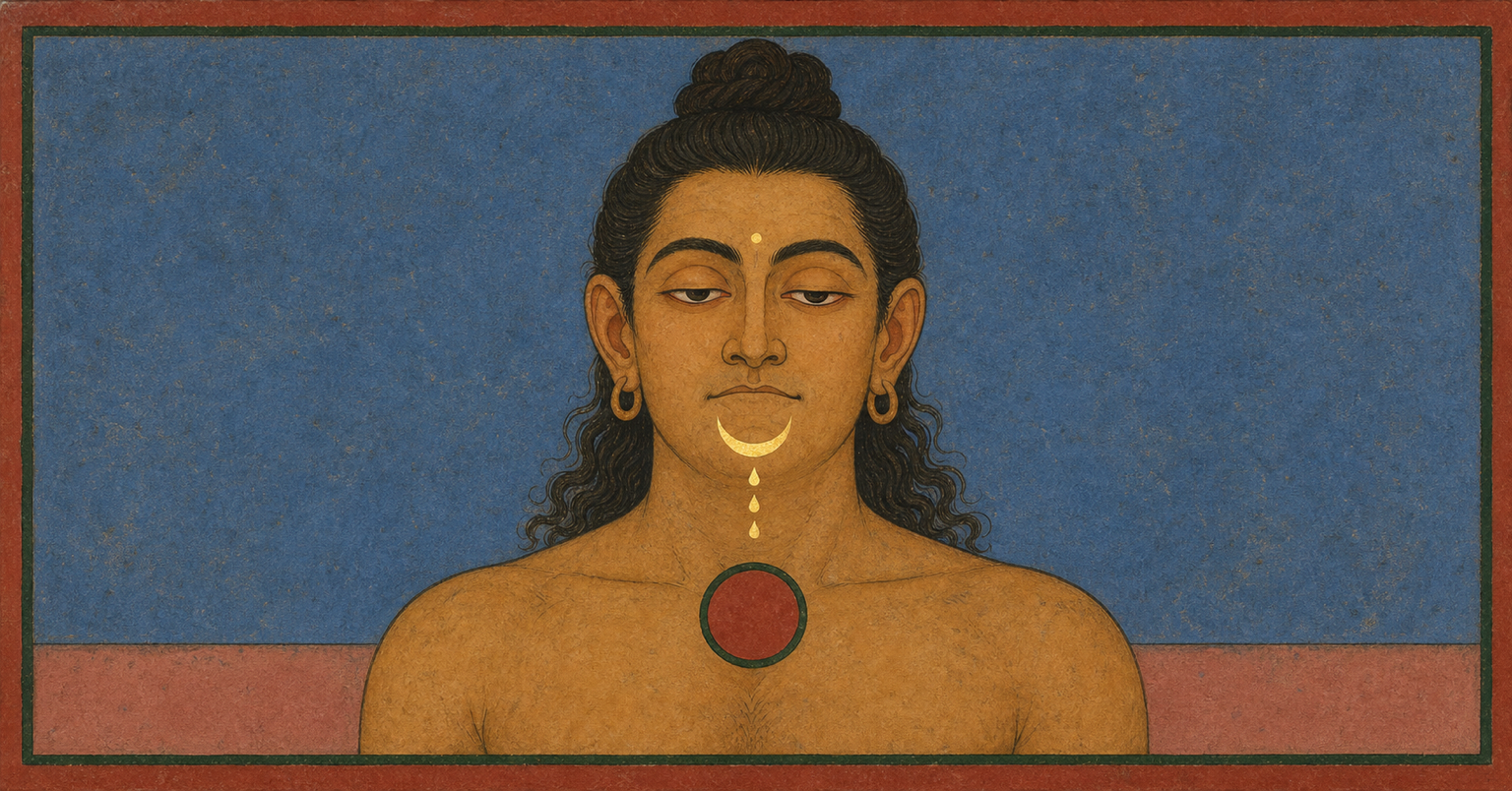

For the transition into Unmanī, Brahmānanda combines several instructions. The pupils rest on the light appearing at the end of the nose, the eyebrows are raised slightly, and the Śāmbhavīmudrā taught earlier remains in place. The passage describes Unmanī as an intensification of already cultivated inner concentration.
Brahmānanda arranges three approaches hierarchically. Ritual and revelatory texts promise manifold results, the Veda appears in numerous branches of teaching, and mere logic can become entangled in its own conclusions. He calls Unmanī, by contrast, tāraka, the means that directly “carries one across.” The polemical sharpening explains the claim of the verse, not the historical value of the other forms of knowledge.
ardhodghāṭita-locanaḥ sthira-manā, nāsāgra-dattekṣaṇaḥ candrārkāv api līnatām upanayan, niṣpanda-bhāvāntare | Analysis ▾ Analysis ▴
|
ardha
|
half | |
|
udghāṭita
|
opened | |
|
locanaḥ
|
having eyes | |
|
sthira
|
firm | |
|
manāḥ
|
having mind | |
|
nāsā
|
at the nose | |
|
agra
|
at the tip | |
|
datta
|
directed | |
|
īkṣaṇaḥ
|
having gaze | |
|
candra
|
moon | |
|
arkau
|
sun | |
|
api
|
also | |
|
līnatām
|
to dissolution | |
|
upanayan
|
leading | |
|
niṣpanda
|
motionless | |
|
bhāva
|
of the state | |
|
antare
|
within |
jyotī-rūpam aśeṣa-bāhya-rahitaṃ, dedīpyamānaṃ paraṃ tattvaṃ tat padam eti vastu paramaṃ, vācyaṃ kim atrādhikam ||11*3|| Analysis ▾ Analysis ▴
|
jyotis
|
of light | |
|
rūpam
|
form | |
|
aśeṣa
|
entirely, completely | |
|
bāhya
|
from the external | |
|
rahitam
|
free | |
|
dedīpyamānam
|
brightly shining | |
|
param
|
supreme | |
|
tattvam
|
reality, principle | |
|
tat
|
that | |
|
padam
|
goal, state | |
|
eti
|
having reached | |
|
vastu
|
essence, reality | |
|
paramam
|
supreme | |
|
vācyam
|
to say | |
|
kim
|
what | |
|
atra
|
here | |
|
adhikam
|
further |
The half-open gaze may be directed toward the tip of the nose or toward a point twelve fingerbreadths in front of it. For Brahmānanda, what matters is that the senses, mind, and Prāṇa become motionless. Reality is then said to appear directly as self-luminous consciousness.
niṣpandabhāvāntare MBHDL2026 ] nispandabhāvena yaḥ NS1882
aśeṣabāhyarahitaṃ MBHDL2026 ] aśeṣabījam akhilaṃ NS1882
For Brahmānanda, the Liṅga to be worshipped here is the Ātman. “Day” denotes the current in Piṅgalā and “night” the current in Iḍā. Only when both are at rest and Prāṇa flows through Suṣumṇā does the actual inner worship take place. The verse thus transforms external indications of time into states of the breath channels.
satataṃ MBHDL2026 ] sarvadā NS1882
Continue with AYI Free
Illustrations: AI-generated.

Please log in to write a message. Go to login
No messages yet.