
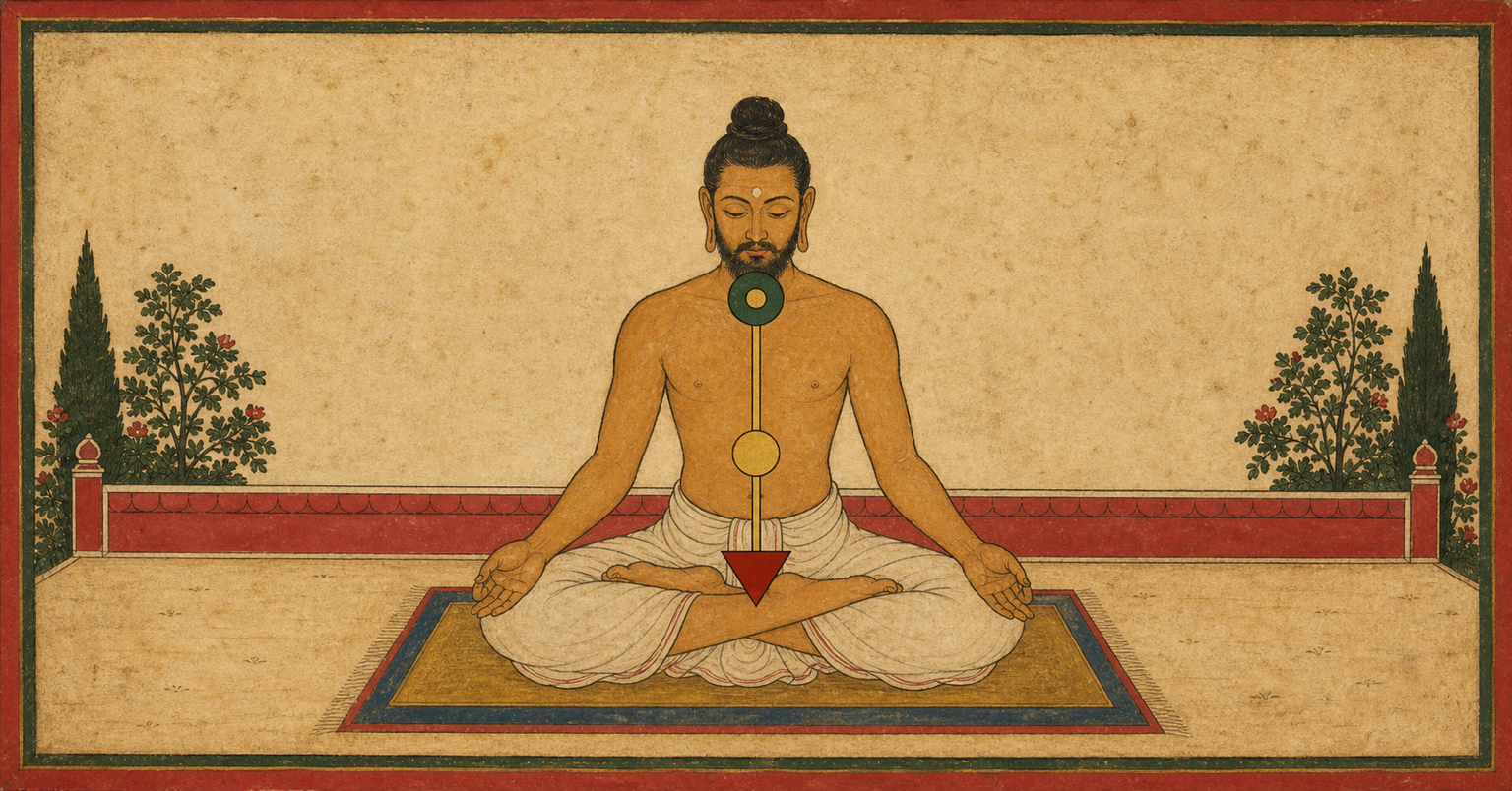
Illustration for the Haṭha Pradīpikā section “HP 3.66-3.72: Jālandhara and the Bandhas”.

Haṭha Pradīpikā 3.66-3.72: Jālandhara and the Three Bandhas

Jālandhara preserves Soma and binds the Nāḍīs; together with Mūla and Uḍḍiyāna, it forms the central threefold practice of the Bandhas.

Dr. Ronald Steiner Dr. Ronald Steiner
Haṭha Pradīpikā 3.66
कण्ठमाकुञ्च्य हृदये स्थापयेद्दृढमिच्छया |
kaṇṭham ākuñcya hṛdaye; sthāpayed dṛḍham icchayā | Analysis ▾ Analysis ▴
kaṇṭham
accusative singular
substantive masculine
throat
ākuñcya
absolutus
previx
verbal root
having contracted
hṛdaye
lokative singular
substantive neuter
on the chest, at the heart
sthāpayet
3rd person singular causative optative
verbal root
should place
dṛḍham
adjective
firmly
icchayā
instrumental case singular
substantive feminine
at will, deliberately
बन्धो जालन्धराख्यो ऽयम् अमृताव्ययकारकः ||66||
bandho jālandharākhyo 'yam; amṛtāvyaya-kārakaḥ ||66|| Analysis ▾ Analysis ▴
bandhaḥ
nominative singular
substantive masculine
bandha, lock
jālandhara
tatpuruṣa-compound nominative
substantive masculine
Jālandhara
ākhyaḥ
nominative singular masculine
adjective
called
ayam
nominative singular masculine
pronoun
this
amṛta
tatpuruṣa-compound genitive
substantive neuter
nectar, immortality
avyaya
tatpuruṣa-compound genitive
substantive neuter
non-loss, imperishability
kārakaḥ
nominative singular masculine
adjective
producing
Metre: Anuṣṭubh
Having contracted (ākuñcya | abs) the throat (kaṇṭham | acc sg), one should deliberately (icchayā | ins sg) place [the chin] (sthāpayet | 3p sg caus opt) firmly (dṛḍham) on the chest (hṛdaye | loc sg). This (ayam | nom sg m) lock (bandhaḥ | nom sg), called Jālandhara (jālandhara-ākhyaḥ | nom sg m), prevents the loss of nectar (amṛta-avyaya-kārakaḥ | nom sg m).
Dr. Ronald Steiner - 2026 - historically literal
For Jālandhara Bandha, contract the throat and bring it firmly to the chest. The Bandha preserves the nectar.
Dr. Ronald Steiner - 2026 - modern transfer

For Jālandharabandha, the throat is to be constricted and the chin lowered, but without touching the chest directly. Brahmānanda leaves about four fingerbreadths of space. He explains the name in two ways. The lock holds together the net (jāla) of channels and simultaneously retains the descending water (jala), the nectar from the cranial cavity.

Brahmānanda's Jyotsnā - 19th c.
sthāpayed dṛḍham icchayā MBHDL2026 ] sthāpayec cibukaṃ dṛḍham NS1882
Critical Apparatus
Contract the throat and press the chin firmly against the chest. This is called Jâlandhara Bandha, which destroys old age and death.
Pancham Sinh - 1915
Den Hals zusammendrückend lege man das Kinn fest auf die Herzgegend; dieser Bandha heisst Jalandhara und besiegt Alter und Tod.
Hermann Walter - 1893
Haṭha Pradīpikā 3.67
बध्नाति हि शिराजालम् अधोगामिनभोजलम् |
badhnāti hi śirā-jālam; adho-gāmi-nabho-jalam | Analysis ▾ Analysis ▴
badhnāti
3rd person singular aktive present
verbal root
binds, closes
hi
particle
indeed
śirā
tatpuruṣa-compound genitive
substantive feminine
vessel, channel
jālam
accusative singular
substantive neuter
network
adhas
karmadhāraya-compound
adverb
downward
gāmin
karmadhāraya-compound
adjective
going
nabhas
tatpuruṣa-compound genitive
substantive neuter
space, sky
jalam
accusative singular
substantive neuter
water, fluid
ततो जालन्धरो बन्धः कण्ठदुःखौघनाशनः ||67||
tato jālandharo bandhaḥ; kaṇṭha-duḥkhaugha-nāśanaḥ ||67|| Analysis ▾ Analysis ▴
tataḥ
adverb
therefore
jālandharaḥ
nominative singular
substantive masculine
Jālandhara
bandhaḥ
nominative singular
substantive masculine
bandha
kaṇṭha
tatpuruṣa-compound genitive
substantive masculine
throat
duḥkha
tatpuruṣa-compound genitive
substantive neuter
suffering, pain
ogha
tatpuruṣa-compound genitive
substantive neuter
multitude, flood
nāśanaḥ
nominative singular masculine
adjective
destroying
Metre: Anuṣṭubh
For (hi) it binds (badhnāti | 3p sg act pres) the network of channels (śirā-jālam | acc sg) and the fluid of space flowing downward (adhas-gāmin-nabhas-jalam | acc sg); therefore (tataḥ), Jālandhara (jālandharaḥ | nom sg) is a lock (bandhaḥ | nom sg) that destroys the host of throat afflictions (kaṇṭha-duḥkha-ogha-nāśanaḥ | nom sg m).
Dr. Ronald Steiner - 2026 - historically literal
Jālandhara closes the network of channels through which the fluid of space flows downward, and removes discomfort in the throat.
Dr. Ronald Steiner - 2026 - modern transfer
It stops the opening (hole) of the group of the Nâdîs, through which the juice from the sky (from the Soma or Chandra in the brain) falls down. It is, therefore, called the Jâlandhara Bandha —the destroyer of a host of diseases of the throat.
Pancham Sinh - 1915
Er versperrt die Menge der Nâdî und hält den abwärtsgehenden Soma (nabhojalam = kapalakuharasya jalam amritam) auf. Daher heilt der Jalandharabandha auch die Menge der Halsübel.
Hermann Walter - 1893
Haṭha Pradīpikā 3.68
जालन्धरे कृते बन्धे कण्ठसंकोचलक्षणे |
jālandhare kṛte bandhe; kaṇṭha-saṃkoca-lakṣaṇe | Analysis ▾ Analysis ▴
jālandhare
lokative singular
substantive neuter
when Jālandhara
kṛte
lokative singular masculine past participle passive
verbal root
performed
bandhe
lokative singular
substantive masculine
bandha
kaṇṭha
tatpuruṣa-compound genitive
substantive masculine
throat
saṃkoca
tatpuruṣa-compound genitive
substantive neuter
contraction
lakṣaṇe
lokative singular
substantive neuter
characteristic
न पीयूषं पतत्यग्नौ न च वायुः प्रधावति ||68||
na pīyūṣaṃ pataty agnau; na ca vāyuḥ pradhāvati ||68|| Analysis ▾ Analysis ▴
na
particle
not
pīyūṣam
nominative singular
substantive neuter
nectar
patati
3rd person singular aktive present
verbal root
falls
agnau
lokative singular
substantive masculine
into the fire
na
particle
not
ca
particle
and
vāyuḥ
nominative singular
substantive masculine
breath, wind
pradhāvati
3rd person singular aktive present
previx
verbal root
runs away, escapes
Metre: Anuṣṭubh
When Jālandhara (jālandhare | loc sg), the lock (bandhe | loc sg) characterised by contraction of the throat (kaṇṭha-saṃkoca-lakṣaṇe | loc sg), has been performed (kṛte | loc sg m ppp), the nectar (pīyūṣam | nom sg) does not (na) fall (patati | 3p sg act pres) into the fire (agnau | loc sg), nor (na ca) does the breath (vāyuḥ | nom sg) rush away (pradhāvati | 3p sg act pres).
Dr. Ronald Steiner - 2026 - historically literal
With Jālandhara, the nectar does not fall into the fire and the breath does not escape. Its defining action is the contraction of the throat.
Dr. Ronald Steiner - 2026 - modern transfer
pradhāvati MBHDL2026 ] prakupyati NS1882
Critical Apparatus
In Jâlandhara Bandha, the indications of a perfect contraction of throat are, that the nectar does not fall into the fire (the Sûrya situated in the navel), and the air is not disturbed.
Pancham Sinh - 1915
Wenn der Jalandhara mit seinem charakteristischen Zusammendrücken des Halses vollbracht ist, so fällt kein Soma in's Feuer, und der Athem wird nicht unruhig.
Hermann Walter - 1893
Haṭha Pradīpikā 3.69
कण्ठसंकोचनेनैव द्वे नाड्यौ स्तम्भयेद्दृढम् |
kaṇṭha-saṃkocanenaiva; dve nāḍyau stambhayed dṛḍham | Analysis ▾ Analysis ▴
kaṇṭha
tatpuruṣa-compound genitive
substantive masculine
throat
saṃkocanena
instrumental case singular
substantive neuter
through contraction
eva
particle
alone
dve
accusative dual feminine
numeral
two
nāḍyau
accusative dual
substantive feminine
nāḍīs
stambhayet
3rd person singular causative optative
verbal root
should block
dṛḍham
adverb
firmly
मध्यचक्रमिदं ज्ञेयं षोडशाधारबन्धनम् ||69||
madhya-cakram idaṃ jñeyaṃ; ṣoḍaśādhāra-bandhanam ||69|| Analysis ▾ Analysis ▴
madhya
tatpuruṣa-compound genitive
substantive neuter
middle
cakram
nominative singular
substantive neuter
cakra
idam
nominative singular neuter
pronoun
this
jñeyam
nominative singular neuter future participle passive
verbal root
to be known
ṣoḍaśa
dvigu-compound
numeral
sixteen
ādhāra
tatpuruṣa-compound genitive
substantive neuter
support
bandhanam
nominative singular
substantive neuter
binding
Metre: Anuṣṭubh
By contraction of the throat alone (kaṇṭha-saṃkocanena | ins sg), one should firmly (dṛḍham) stop (stambhayet | 3p sg caus opt) the two channels (dve nāḍyau | acc du). This (idam | nom sg n) middle Cakra (madhya-cakram | nom sg) is to be known (jñeyam | nom sg n pfp) as the binding of the sixteen supports (ṣoḍaśa-ādhāra-bandhanam | nom sg).
Dr. Ronald Steiner - 2026 - historically literal
The throat contraction firmly blocks the two Nāḍīs. This is regarded as the middle Cakra that binds the sixteen supports.
Dr. Ronald Steiner - 2026 - modern transfer

For Brahmānanda, the middle Cakra is Viśuddhi at the throat. It binds sixteen support points of the yogic body: toes, ankles, knees, thighs, perineum, sexual organ, navel, heart, nape, throat, Lambikā or the tongue region, nose, midpoint between the eyebrows, forehead, head, and Brahmarandhra, the opening at the crown. He refers the respective effects of concentration to a Gorakṣa tradition.

Brahmānanda's Jyotsnā - 19th c.
The two Nâdîs should be stopped firmly by contracting the throat. This is called the middle circuit or centre (Madhya Chakra), and it stops the 16 âdhâras (i.e., vital parts).
Pancham Sinh - 1915
Durch das Zusammendrücken des Halses schliesse man fest die beiden Nâdî (Idâ und Pingala). Das Cakra, in welchem dies geschieht, heisst Madhyacakra (= Visuddhicakra) und ist die Verbindung der sechzehn Adhara.
Hermann Walter - 1893
Haṭha Pradīpikā 3.70
बन्धत्रयमिदं श्रेष्ठं महासिद्धैर्निषेवितम् |
bandha-trayam idaṃ śreṣṭhaṃ; mahā-siddhair niṣevitam | Analysis ▾ Analysis ▴
bandha
tatpuruṣa-compound genitive
substantive masculine
bandha
trayam
nominative singular
substantive neuter
triad
idam
nominative singular neuter
pronoun
this
śreṣṭham
nominative singular neuter
adjective
best
mahā
karmadhāraya-compound
adjective
great
siddhaiḥ
instrumental case plural
substantive masculine
by siddhas
niṣevitam
nominative singular neuter past participle passive
previx
verbal root
practised, cultivated
सर्वेषां हठतन्त्राणां साधनं योगिनो विदुः ||70||
sarveṣāṃ haṭha-tantrāṇāṃ; sādhanaṃ yogino viduḥ ||70|| Analysis ▾ Analysis ▴
sarveṣām
genitive plural
adjective
all
haṭha
tatpuruṣa-compound genitive
substantive masculine
Haṭha
tantrāṇām
genitive plural
substantive neuter
systems
sādhanam
accusative singular
substantive neuter
means, practice
yoginaḥ
nominative plural
substantive masculine
yogins
viduḥ
3rd person plural perfekte
verbal root
know
Metre: Anuṣṭubh
This (idam | nom sg n) triad of locks (bandha-trayam | nom sg) is the best (śreṣṭham | nom sg n) and has been practised (niṣevitam | nom sg n ppp) by the great adepts (mahā-siddhaiḥ | ins pl). Yogis (yoginaḥ | nom pl) know (viduḥ | 3p pl perf) it as the means (sādhanam | acc sg) of all Haṭha systems (sarveṣām haṭha-tantrāṇām | gen pl).
Dr. Ronald Steiner - 2026 - historically literal
The three Bandhas are regarded as a supreme practice, cultivated by the great Siddhas and recognized as a method in every system of Haṭha.
Dr. Ronald Steiner - 2026 - modern transfer
bandhatrayam idaṃ śreṣṭhaṃ mahāsiddhair niṣevitam sarveṣāṃ haṭhatantrāṇāṃ sādhanaṃ yogino viduḥ MBHDL2026 ] transp. NS1882 post HP 3.72
Critical Apparatus
These three Bandhas are the best of all and have been practised by the masters. Of all the means of success in the Haṭha Yoga, they are known to the Yogîs as the chief ones.
Pancham Sinh - 1915
Diese drei besten Bandha werden von den grossen Weisen geübt. Die Yogin wissen, dass sie zur Ausführung sämmtlicher Vorschriften des Hatha beitragen.
Hermann Walter - 1893
Haṭha Pradīpikā 3.70*1
अधस्तात्कुञ्चनेनाशु कण्ठसंकोचने कृते |
adhastāt kuñcanenāśu; kaṇṭha-saṃkocane kṛte | Analysis ▾ Analysis ▴
adhastāt
adverb
from below
kuñcanena
instrumental case singular
substantive neuter
through contraction
āśu
adverb
quickly
kaṇṭha
tatpuruṣa-compound genitive
substantive masculine
throat
saṃkocane
lokative singular
substantive neuter
when contraction
kṛte
lokative singular neuter past participle passive
verbal root
is performed
मध्ये पश्चिमताणेन स्यात्प्राणो ब्रह्मनाडिगः ||70*1||
madhye paścima-tāṇena; syāt prāṇo brahma-nāḍi-gaḥ ||70*1|| Analysis ▾ Analysis ▴
madhye
lokative singular
substantive neuter
in the middle
paścima
karmadhāraya-compound
adjective
posteriorly
tāṇena
instrumental case singular
substantive neuter
through the stretch
syāt
3rd person singular aktive optative
verbal root
should be
prāṇaḥ
nominative singular
substantive masculine
prāṇa
brahma
tatpuruṣa-compound genitive
substantive neuter
Brahman
nāḍī
tatpuruṣa-compound lokative
substantive feminine
nāḍī
gaḥ
nominative singular masculine
adjective
going
Metre: Anuṣṭubh
When contraction of the throat (kaṇṭha-saṃkocane | loc sg) has been performed (kṛte | loc sg n ppp) rapidly (āśu) through contraction from below (adhastāt kuñcanena | ins sg), Prāṇa (prāṇaḥ | nom sg) should (syāt | 3p sg act opt), through the backward stretch (paścima-tāṇena | ins sg) in the middle (madhye | loc sg), enter the Brahma channel (brahma-nāḍi-gaḥ | nom sg m).
Dr. Ronald Steiner - 2026 - historically literal
Through contraction from below, the throat lock, and the backward extension at the center, Prāṇa is led into the Brahma Nāḍī.
Dr. Ronald Steiner - 2026 - modern transfer
adhastāt kuñcanenāśu kaṇṭhasaṃkocane kṛte madhye paścimatāṇena syāt prāṇo brahmanāḍigaḥ MBHDL2026 ] om. NS1882
Critical Apparatus
Haṭha Pradīpikā 3.71
मूलस्थानं समाकुञ्च्य उड्डीयाणं तु कारयेत् |
mūla-sthānaṃ samākuñcya; uḍḍīyāṇaṃ tu kārayet | Analysis ▾ Analysis ▴
mūla
tatpuruṣa-compound genitive
substantive neuter
root
sthānam
accusative singular
substantive neuter
place
samākuñcya
absolutus
previx
previx
verbal root
having contracted
uḍḍīyāṇam
accusative singular
substantive neuter
Uḍḍīyāṇa
tu
particle
then, but
kārayet
3rd person singular causative optative
verbal root
should perform
इडां च पिङ्गलां बद्ध्वा वाहयेत्पश्चिमं पथम् ||71||
iḍāṃ ca piṅgalāṃ baddhvā; vāhayet paścimaṃ patham ||71|| Analysis ▾ Analysis ▴
iḍām
accusative singular
substantive feminine
Iḍā
ca
particle
and
piṅgalām
accusative singular
substantive feminine
Piṅgalā
baddhvā
absolutus
verbal root
having closed
vāhayet
3rd person singular causative optative
verbal root
should lead, cause to flow
paścimam
accusative singular masculine
adjective
westward, behind
patham
accusative singular
substantive neuter
path
Metre: Anuṣṭubh
Having contracted (samākuñcya | abs) the root location (mūla-sthānam | acc sg), one should then (tu) perform (kārayet | 3p sg caus opt) Uḍḍīyāṇa (uḍḍīyāṇam | acc sg); having closed (baddhvā | abs) Iḍā (iḍām | acc sg) and (ca) Piṅgalā (piṅgalām | acc sg), one should cause the breath to flow (vāhayet | 3p sg caus opt) through the rear pathway (paścimam patham | acc sg).
Dr. Ronald Steiner - 2026 - historically literal
Through contraction at the root, Uḍḍīyāṇa, and the closing of Iḍā and Piṅgalā, the breath is led into the posterior pathway.
Dr. Ronald Steiner - 2026 - modern transfer

Brahmānanda describes the interaction of the three Bandhas as a deliberate redirection. Mūlabandha contracts at the base, Uḍḍīyāna draws back the abdominal region, and Jālandhara stops Iḍā and Piṅgalā. This is said to make Prāṇa flow along the “western path,” Suṣumṇā, instead of through the side channels. Here its Laya is the motionless stability of Prāṇa within this opening.

Brahmānanda's Jyotsnā - 19th c.
mūlasthānaṃ samākuñcya uḍḍīyāṇaṃ tu kārayet iḍāṃ ca piṅgalāṃ baddhvā vāhayet paścimaṃ patham MBHDL2026 ] transp. NS1882 ante HP 3.70

paścimaṃ patham MBHDL2026 ] paścime pathi NS1882
Critical Apparatus
By drawing up the mûlasthâna (anus,) Uḍḍiyâna Bandha should be performed. The flow of the air should be directed to the Suṣumnâ, by closing the Idâ, and the Pingalâ.
Pancham Sinh - 1915
Das Mûlasthâna (anus) zusammendrückend führe man das Uddîyana aus, hemme Idâ und Pingalâ und lasse den Athem durch die Sushumna (pascime pathi) gehen.
Hermann Walter - 1893
Haṭha Pradīpikā 3.72
अनेनैव विधानेन सेवयेत्पवनालयम् |
anenaiva vidhānena; sevayet pavanālayam | Analysis ▾ Analysis ▴
anena
instrumental case singular neuter
pronoun
through this
eva
particle
alone
vidhānena
instrumental case singular
substantive neuter
method, procedure
sevayet
3rd person singular aktive optative
verbal root
should reach, seek
pavana
tatpuruṣa-compound genitive
substantive masculine
breath, wind
ālayam
accusative singular
substantive masculine
seat, abode
ततो न जायते मृत्युर् जरारोगादिकं तथा ||72||
tato na jāyate mṛtyur; jarā-rogādikaṃ tathā ||72|| Analysis ▾ Analysis ▴
tataḥ
adverb
then
na
particle
not
jāyate
3rd person singular medial present
verbal root
arises
mṛtyuḥ
nominative singular
substantive masculine
death
jarā
dvandva-compound
substantive feminine
age
roga
dvandva-compound
substantive masculine
disease
ādikam
nominative singular neuter
adjective
and so forth
tathā
adverb
likewise
Metre: Anuṣṭubh
By this very (anena eva | ins sg n) method (vidhānena | ins sg), one should frequent (sevayet | 3p sg act opt) the abode of the breath (pavana-ālayam | acc sg). Then (tataḥ), death (mṛtyuḥ | nom sg), as well as (tathā) old age, disease, and the like (jarā-roga-ādikam | nom sg n), do not (na) arise (jāyate | 3p sg med pres).
Dr. Ronald Steiner - 2026 - historically literal
This method opens the abode of the breath; thereafter, death, old age, disease, and the like are said no longer to arise.
Dr. Ronald Steiner - 2026 - modern transfer
anenaiva vidhānena sevayet pavanālayam tato na jāyate mṛtyur jarārogādikaṃ tathā MBHDL2026 ] transp. NS1882 ante HP 3.70

sevayet pavanālayam MBHDL2026 ] prayāti pavano layam NS1882
Critical Apparatus
The Prâna becomes calm and latent by this means, and thus there is no death, old age, disease, etc.
Pancham Sinh - 1915
Durch diese Vorschrift wird der Athem zum Stillstand gebracht; daher entsteht weder Tod, noch Krankheit noch Alter.
Hermann Walter - 1893

Continue with AYI Free

Illustrations: AI-generated.

Editor

Dr. Ronald Steiner

From Ulm

The "Yoga Doc" - Dr. Ronald Steiner is the founder of the AYI method. This method links traditional Ashtanga Yoga with innovative Yogatherapy and living Philosophy. This forms a practice that is personal for each and... more ›

Messages and ratings
0 messages

Please log in to write a message. Go to login

No messages yet.