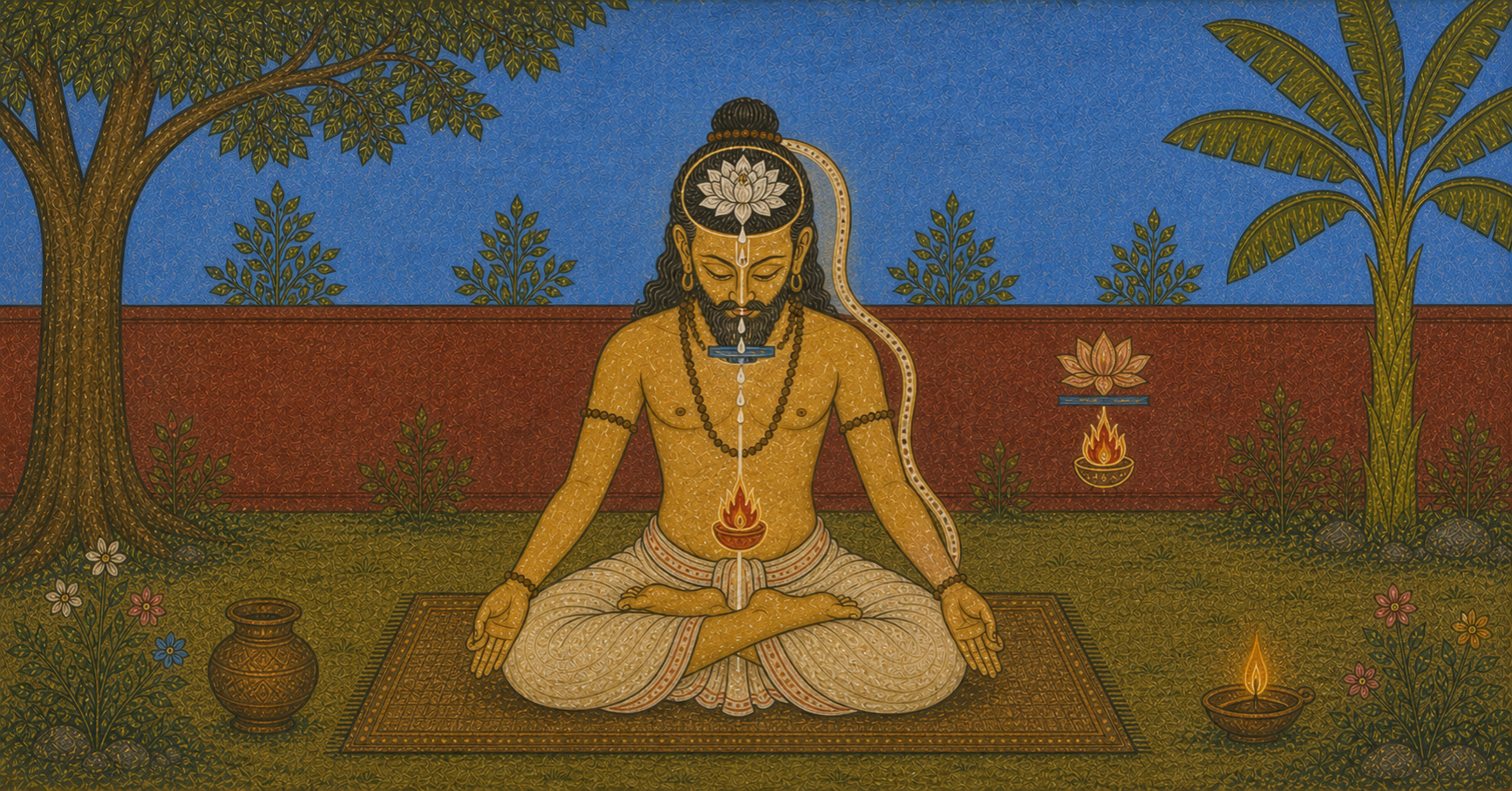
DYS 138–140: Jālandharabandha

Dattātreyayogaśāstra 138–140: The Throat Lock that Preserves Nectar

The throat is contracted and the chin set on the chest so that nectar descending from the head does not burn in the digestive fire.

Dr. Ronald Steiner Dr. Ronald Steiner Nils Jacob Liersch Nils Jacob Liersch
Dattātreyayogaśāstra 138
कण्ठमाकुञ्च्य हृदये स्थापयेच्चिबुकं दृढम् |
kaṇṭham ākuñcya hṛdaye; sthāpayec cibukaṃ dṛḍham | Analysis ▾ Analysis ▴
kaṇṭham
accusative singular
substantive masculine
throat
ākuñcya
absolutus
previx
verbal root
having contracted
hṛdaye
lokative singular
substantive neuter
on the chest
sthāpayet
3rd person singular aktive optative
verbal root
should place
cibukam
accusative singular
substantive neuter
chin
dṛḍham
adverb
firmly
जालन्धरो बन्ध एष अमृताव्ययकारकः ||138||
jālandharo bandha eṣa; amṛtāvyaya-kārakaḥ ||138|| Analysis ▾ Analysis ▴
jālandharaḥ
nominative singular
substantive masculine
Jālandhara
bandhaḥ
nominative singular
substantive masculine
lock
eṣaḥ
nominative singular masculine
pronoun
this
amṛta
tatpuruṣa-compound genitive
substantive neuter
nectar of immortality
avyaya
tatpuruṣa-compound genitive
adjective
non-loss
kārakaḥ
nominative singular masculine
adjective
causing
Metre: Anuṣṭubh
Having constricted (ākuñcya | abs) the throat (kaṇṭham | acc sg), he should firmly (dṛḍham) place (sthāpayet | 3p sg act opt) the chin (cibukam | acc sg) on the chest (hṛdaye | loc sg). This (eṣaḥ | nom sg) is Jālandhara (jālandharaḥ | nom sg), the lock (bandhaḥ | nom sg) that prevents loss of the nectar of immortality (amṛtāvyaya-kārakaḥ | nom sg).
Dr. Ronald Steiner - 2026 - historically literal
Jālandhara Bandha is formed by constricting the throat and pressing the chin firmly to the chest. The lock is said to preserve the nectar of immortality.
Dr. Ronald Steiner - 2026 - modern transfer
sthāpayec cibukaṃ dṛḍham JM2024 ] sthāpayed dṛḍham icchayā DYŚ
Critical Apparatus
Dattātreyayogaśāstra 139
नाभिस्थाग्निः कपालस्थसहस्रकमलच्युतम् |
nābhi-sthāgniḥ kapāla-stha;-sahasra-kamala-cyutam | Analysis ▾ Analysis ▴
nābhi
tatpuruṣa-compound lokative
substantive masculine
navel
stha
karmadhāraya-compound
adjective
situated
agniḥ
nominative singular
substantive masculine
fire
kapāla
tatpuruṣa-compound lokative
substantive masculine
in the skull
stha
karmadhāraya-compound
adjective
situated
sahasra
karmadhāraya-compound
numeral
thousand-petalled
kamala
karmadhāraya-compound
substantive masculine
lotus
cyutam
accusative singular neuter past participle passive
verbal root
dripped down
अमृतं सर्वदा सर्वं पिबन्ज्वलति देहिनाम् ||139||
amṛtaṃ sarvadā sarvaṃ; piban jvalati dehinām ||139|| Analysis ▾ Analysis ▴
amṛtam
accusative singular
substantive neuter
nectar
sarvadā
adverb
always
sarvam
accusative singular neuter
adjective
all
piban
nominative singular masculine present participle active
verbal root
drinking
jvalati
3rd person singular aktive present
verbal root
burns brightly
dehinām
genitive plural
substantive masculine
of embodied beings
Metre: Anuṣṭubh
The fire at the navel (nābhi-sthāgniḥ | nom sg) of embodied beings (dehinām | gen pl) burns (jvalati | 3p sg act pres) while constantly (sarvadā) drinking (piban | nom sg m pca) all the nectar (amṛtam | acc sg n) that has dripped from the thousand-petalled lotus in the skull (kapāla-stha-sahasra-kamala-cyutam | acc sg n).
Dr. Ronald Steiner - 2026 - historically literal
The nectar drips from the thousand-petalled lotus in the head, while the fire at the navel burns brightly within embodied beings.
Dr. Ronald Steiner - 2026 - modern transfer
nābhisthāgniḥ JM2024 ] nābhistho ’gniḥ DYŚ

sarvaṃ piban JM2024 ] tāvad antar DYŚ
Critical Apparatus
Dattātreyayogaśāstra 140
यथा सो ऽग्निस्तदमृतं न पिबेत्तत्पिबेत्स्वयम् |
yathā so 'gnis tad amṛtaṃ; na pibet tat pibet svayam | Analysis ▾ Analysis ▴
yathā
adverb
so that
saḥ
nominative singular masculine
pronoun
that
agniḥ
nominative singular
substantive masculine
fire
tat
accusative singular neuter
pronoun
that
amṛtam
accusative singular
substantive neuter
nectar
na
particle
not
pibet
3rd person singular aktive optative
verbal root
should drink
tat
accusative singular neuter
pronoun
it
pibet
3rd person singular aktive optative
verbal root
should drink
svayam
adverb
himself
याति पश्चिममार्गेण एवमभ्यासतः सदा ||140||
yāti paścima-mārgeṇa; evam abhyāsataḥ sadā ||140|| Analysis ▾ Analysis ▴
yāti
3rd person singular aktive present
verbal root
goes
paścima
karmadhāraya-compound
adjective
rear
mārgeṇa
instrumental case singular
substantive masculine
by the pathway
evam
adverb
thus
abhyāsataḥ
substantive masculine
suffix
through practice
sadā
adverb
always
Metre: Anuṣṭubh
So that (yathā) that (saḥ | nom sg) fire (agniḥ | nom sg) does not (na) drink (pibet | 3p sg act opt) that (tat | acc sg n) nectar (amṛtam | acc sg n), the yogi himself (svayam) should drink (pibet | 3p sg act opt) it (tat | acc sg n). Through constant practice (abhyāsataḥ), it always (sadā) travels in this way (evam) by the rear pathway (paścima-mārgeṇa | ins sg).
Dr. Ronald Steiner - 2026 - historically literal
Through steady practice, the yogi drinks this nectar so that the inner fire does not consume it; it then travels by the rear pathway.
Dr. Ronald Steiner - 2026 - modern transfer
so ’gnis tad amṛtaṃ na pibet tat JM2024 ] cāgnis tadamṛtaṃ na pibet tu DYŚ
Critical Apparatus

Continue with AYI Free

Illustrations: AI-generated.

Editor

Dr. Ronald Steiner

From Ulm

The "Yoga Doc" - Dr. Ronald Steiner is the founder of the AYI method. This method links traditional Ashtanga Yoga with innovative Yogatherapy and living Philosophy. This forms a practice that is personal for each and... more ›

Nils Jacob Liersch

Meine Begeisterung für Yoga, indische Philosophie und Sanskrit führte mich zum Studium der Indologie und Religionswissenschaft an der Universität Heidelberg. Seit 2004 befinde ich mich auf meinem persönlichen Yogaweg... more ›

Messages and ratings
0 messages

Please log in to write a message. Go to login

No messages yet.