

yuga युग – Joch; Paar
Substantiv Maskulin · Substantiv Neutrum · Worttyp nicht bestimmt
Wörterbuchquellen
AYI Wörterbuch Substantiv Maskulin · Substantiv Neutrum
Cappeller 1891 Substantiv Neutrum
Originaltext · Englisch · Substantiv Neutrum
yugá ·n. (m.) yoke, team; couple, pair, race or generation of men, age of the world (4) a cert. measure of length.
Monier-Williams 1872 Substantiv Maskulin · Substantiv Neutrum · Worttyp nicht bestimmt
Originaltext · Englisch · Substantiv Maskulin · Substantiv Neutrum
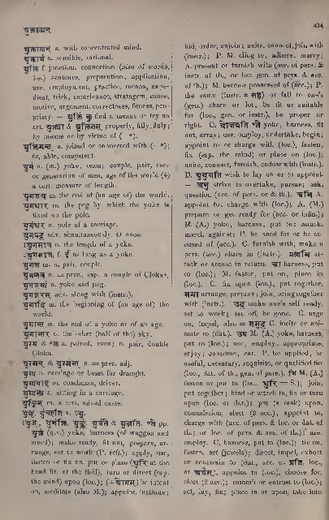
Yuga, as, am, m. n. a yoke; (am), n. a pair, couple, brace; a double Śloka or two Ślokas so con- nected that the sense is only completed by the two together; a race or generation of men, (generally in Ved. with mānuṣa or manuṣya); a period or astronomical cycle of five years, a lustrum, (especially such a period in the cycle of Jupiter); an age of the world, long mundane period of years, (of which there are four, each preceded by a period called Sandhyā, ‘twilight,’ and followed by a period called Sandhyāṃśa, ‘portion of twilight;’ viz. 1. Kṛta or Satya, 2. Tretā, 3. Dvāpara, 4. Kali, of which the first three have already elapsed, while the Kali is that in which we are supposed to live; the first consists of 4000 divine years with 400 for each of its twilights, the second of 3000 with 300 for each twilight, the third of 2000 with 200 for each twilight, the fourth or Kali of 1000 with 100 for each twilight; but since a divine year equals 360 years of men, the four Yugas com- prise severally 1, 728, 000, 1,296,000, 864,000, and 432, 000 years, the aggregate 4,320, 000 con- stituting ‘a great Yuga,’ or Mahā-yuga, q. v.: the regularly descending numbers in the above series represent a corresponding physical and moral deteri- oration in those who live during each age, the present or Kali-yuga being the worst; this last Yuga is sup- posed to have commenced 3101 or 3102 years B.C.); a measure of length (= 4 Hastas or cubits); a sym- bolical expression for the number 4 and sometimes for the number 12; N. of a particular position or configuration of the moon; of a particular Nābhasa constellation (of the class called Saṅkhyā-yoga, when all the planets are situated in two houses); a species of drug or medicinal plant (= vṛddhi); [cf. Gr. ζυγόν; Lat. jugum; Angl. Sax. ioc, iuc, geoc.]

Originaltext · Englisch · Worttyp nicht bestimmt
yuga yuga, yugma, yugya, &c. See p. 818, col. 2, and p. 819, col. 1.
Petersburger 1855 Substantiv Maskulin · Substantiv Neutrum · Worttyp nicht bestimmt
Originaltext · Deutsch · Substantiv Maskulin · Substantiv Neutrum
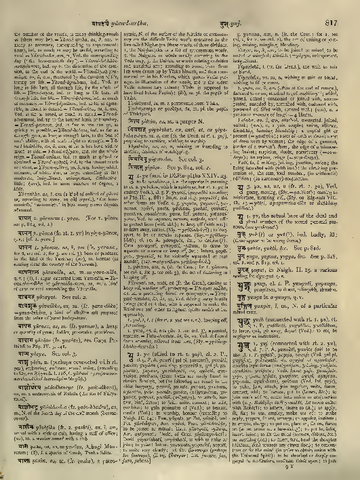
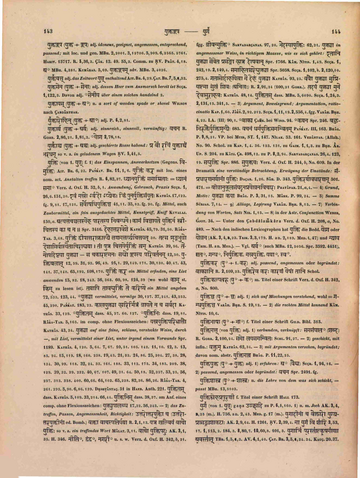
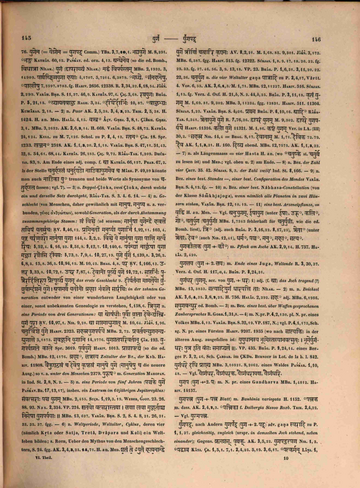
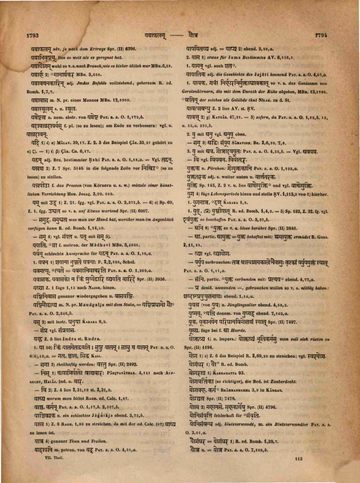
yugá (von 1. yuj) gaṇa uñchādi zu P. 6,1,160. 1〉 n. m. Joch AK. 3,4,3,25 (m.). H. 756. H. an. 2,43. MED. g. 17 (m.). yugādīnāṃ ca voḍhāro yugyaprāsaṅgyaśākaṭāḥ AK. 2,9,64. H. 1261. ṚV. 2,39,4. mā yu̱gaṃ vi śā̀ri ṚV. 3,53,17. ṚV. 1,115,2. ṚV. 1,184,3. ṚV. 8,80,7. ṚV. 10,60,8. ṚV. 10,101,3. yu̱gānì pa̱rastā̀tkṛ̱ṣamā̀ṇā a̱vastā̀t TBR. 1,5,1,3. AV. 4,1,40. ŚAT. BR. 3,5,1,24. ŚAT. BR. 3,5,1,34. KAUŚ. 20. KAUŚ. 37. KAUŚ. 76. yugena (= yogena = yugapad Comm.) TBR. 3,7,10,1. bhagnayuge M. 8,291. ˚bhaṅga KATHĀS. 60,12. PAÑCAT. ed. orn. 4,13. andheneva (so die ed. Bomb., vidhātrā NĪLAK.) yugaṃ (dvāparākhyaṃ NĪLAK.) naddhaṃ viparyastam MBH. 2,1932. MBH. 3,14909. pārthacchinnayugā hayāḥ MBH. 4,1707. MBH. 5,7214. MBH. 6,3879. ˚madhye, ˚saṃnahaneṣu, ˚pālīṣu MBH. 7,3597. MBH. 7,8783. fg. HARIV. 2656. HARIV. 12538. R. 3,34,32. R. 6,18,54. YĀJÑ. 2,299. VARĀH. BṚH. S. 11,37. VARĀH. BṚH. S. 46,9. KATHĀS. 97,6. ŚIŚ. 3,68. rathayugaḥ BHĀG. P. 5,21,15. ˚vyāyatabāhu RAGH. 3,34. ˚dīrghairdorbhiḥ RAGH. 10,87. ˚bāhubhyaḥ KUMĀRAS. 2,18. — 2〉 n. Paar AK. 2,5,38. AK. 3,4,3,25. TRIK. 2,5,38. H. 1424. H. an. MED. HALĀY. 4,15. vastra˚ ĀŚV. GṚHY. 3,8,1. ŚĀṄKH. GṚHY. 3,1. MBH. 3,2632. AK. 2,6,3,14. H. 668. VARĀH. BṚH. S. 48,72. KATHĀS. 24,124. KULL._zu_M. 7,126. Schol. zu P. 8,4,13. stana˚ ŚĀK. 18. Spr. 1233. khañjana˚ Spr. 2518. AK. 1,1,3,20. AK. 1,2,1,18. VARĀH. BṚH. S. 47,11. VARĀH. BṚH. S. 51,43. VARĀH. BṚH. S. 52,5. VARĀH. BṚH. S. 54,61. VARĀH. BṚH. S. 68,44. KATHĀS. 26,285. ŚIŚ. 9,72. RĀJA-TAR. 1,209. DHŪRTAS. 83,9. Am Ende eines adj. comp. f. ā KATHĀS. 66,157. PRAB. 67,2. In der Stelle caturhastaṃ dhanurdaṇḍo nāḍikāyugameva ca MĀRK. P. 49,39 könnte man auch nāḍikā yu˚ trennen und beide Worte als Synonyme von caturhasta fassen; vgl. 7〉. — 3〉 n. Doppel-Śloka, zwei Śloka, durch welche ein und derselbe Satz durchgeht, RĀJA-TAR. S. 3. RĀJA-TAR. S. 4. RĀJA-TAR. S. 6. RĀJA-TAR. S. 14. — 4〉 n. Geschlecht (von Menschen, daher gewöhnlich mit mānuṣa, manuṣya u. a. verbunden, γένος ἀνϑρώπων), sowohl Generation, als der durch Abstammung zusammengehörige Stamm: tvaṃ viśve̱ (ad sensum) mānùṣā yu̱gendràṃ havante tavi̱ṣaṃ ya̱tasrùcaḥ ṚV. 8,46,12. pra̱mi̱na̱tī manu̱ṣyā̀ yu̱gānì ṚV. 1,92,11. ṚV. 1,103,4. pu̱rū carànna̱jaro̱ mānùṣā yu̱gā ṚV. 144,4. ṚV. 2,2,2. viśve̱ ye mānùṣā yu̱gā pānti̱ martyàṃ ri̱ṣaḥ ṚV. 5,52,4. ṚV. 6,16,23. ṚV. 8,51,9. ṚV. 9,12,7. ṚV. 10,140,6. parya̱nyā nāhùṣā yu̱gā ma̱hnā rajā̀ṃsi dīyathaḥ ṚV. 5,73,3. ṚV. 7,9,4. ṚV. 10,27,19. yu̱ge yùge ṚV. 1,139,8. ṚV. 3,26,3. ṚV. 6,8,5. ṚV. 6,15,8. ṚV. 6,36,5. ṚV. 10,94,12. M. 10,42. BHAG. 4,8. para ṚV. 1,166,13. uttara ṚV. 3,33,8. ṚV. 10,72,1. upara ṚV. 7,87,4. de̱vānā̀ṃ pū̱rvye yu̱ge ṚV. 10,72,1. sa̱ptabhìḥ pu̱trairadìti̱rupa̱ praitpū̱rvyaṃ yu̱gam das erste Geschlecht ṚV. 10,72,9. dī̱rghatàmā māmate̱yo jùju̱rvāndàśa̱me yu̱ge . a̱pāmarthàṃ ya̱tīnā̀ṃ bra̱hmā bhàvati̱ sāràthiḥ in der zehnten Generation entweder von einer wunderbaren Langlebigkeit oder von einer, sonst unbekannten Genealogie zu verstehen, ṚV. 1,158,6. triyuga n. eine Periode von drei Generationen: yā oṣàdhī̱ḥ pūrvā̀ḥ jā̱tā de̱vebhyàstriyu̱gaṃ pu̱rā ṚV. 10,97,1. NIR. 9,28. ā saptamādyugāt M. 10,64. YĀJÑ. 1,96. caturviṃśe yuge HARIV. 2323. sahasrayugaparyaye MBH. 2,72. pravartayanyugamanyadyugānte MBH. 5,1873. subahūni yugāni MBH. 14,2776. yugaśataparivartān ŚĀK. 193. yugaparyāgate kāle Spr. 3619. pūrvayuge HARIV. 1013. prājāpatye (so die ed. Bomb.) MBH. 12,4176. brahma˚, kṣatrasya Zeitalter der Br., der Kṣ. HARIV. 11808. vaikuṇṭhatvaṃ ca deveṣu kṛṣṇatvaṃ mānuṣe yuge (mānuṣeṣu ca die neuere Ausg.) so v. a. unter den Menschen HARIV. 2379. puruṣa˚ m. Generation MAHOPAN._in_Ind. St. 2,8, N. 2. — 5〉 n. eine Periode von fünf Jahren (pañcake yuge PAÑCAV. BR. 17,13,17), insbes. ein Lustrum im 60jährigen Jupitercyclus: saṃvatsarāḥ pañca yugam MBH. 2,455. SUŚR. 1,19,3. SUŚR. 1,19,19. WEBER, JYOT. 23. WEBER, JYOT. 26. WEBER, JYOT. 88. WEBER, JYOT. 93. Nax. 2,354. VP. 224. ṛtavo vatsarāstathā . kṣaṇā lavā muhūrtāśca nimeṣā yugaparyayāḥ .. MBH. 13,627. VARĀH. BṚH. S. 2, S. 4. VARĀH. BṚH. S. 8,21. VARĀH. BṚH. S. 26,31. VARĀH. BṚH. S. 26,33. VARĀH. BṚH. S. 26,35. VARĀH. BṚH. S. 26,37. fgg. — 6〉 n. Weltperiode, Weltalter, Cyklus, deren vier (nämlich Kṛta oder Satya, Tretā, Dvāpara und Kali) ein Weltleben bilden; s. ROTH, Ueber den Mythus von den Menschengeschlechtern, S. 24. fgg. AK. 3,4,3,25. AK. 3,4,14,71 H. an. MED. śa̱taṃ te̱ 'yutàṃ hāya̱nāndve yu̱ge trīṇì ca̱tvāri kṛṇmaḥ AV. 8,2,21. M. 1,68. M. 1,85. M. 9,301. YĀJÑ. 3,173. MBH. 6,387. fgg. HARIV. 515. fg. HARIV. 12322. SŪRYAS. 1,8. fg. SŪRYAS. 1,9. SŪRYAS. 1,17. fg. SŪRYAS. 1,18. SŪRYAS. 1,20. fg. SŪRYAS. 1,22. SŪRYAS. 1,29. fg. SŪRYAS. 1,33. SŪRYAS. 1,37. fg. SŪRYAS. 1,46. SŪRYAS. 1,56. fg. SŪRYAS. 3,9. fg. SŪRYAS. 13,18. VP. 23. BHĀG. P. 1,6,31. BHĀG. P. 3,11,20. BHĀG. P. 3,11,22. BHĀG. P. 3,22,36. caturyuga n. die vier Weltalter gaṇa pātrādi zu P. 2,4,17, Vārtt. 4. VOP. 6,53. AK. 3,6,1,3. M. 1,71. MBH. 12,11227. HARIV. 516. SŪRYAS. 1,15. fg. Verz. d. Oxf. H. 21,b, N. 2. Verz. d. Oxf. H. 44,b,25. BHĀG. P. 3,11,18. kṛtaṃ yugam M. 1,69. M. 1,81. M. 9,302. MBH. 3,11234. fgg. MBH. 3,12831. HARIV. 511. HARIV. 11304. SŪRYAS. 1,23. VARĀH. BṚH. S. 4,26. prathama BHĀG. P. 6,10,16. ādi˚ RĀJA-TAR. 1,341. tretāyuge yuge R. 7,76,36. dvāparaṃ yugam M. 9,302. dvāpare yugaparyaye HARIV. 11316. kalau yuge HARIV. 11321. M. 1,86. kaṣṭaṃ yugam VET. in LA. (III) 30,2. ˚sahasra NIR. 14,4 = BHAG. 8,17. devānām M. 1,71. daivika M. 72. M. 79. daiva AK. 1,1,3,21. H. 160. divya ebend. MBH. 12,7575. AK. 1,1,3,22. — 7〉 n. als Längenmaass = vier Hasta H. an. (wo ˚catuṣke st. caturthe zu lesen ist) und MED.; vgl. oben u. 2〉 am Ende. — 8〉 n. Bez. der Zahl vier ŚRUT. 35. ŚRUT. 42. SŪRYAS. 8,3. der Zahl zwölf Ind. St. 8,166. — 9〉 n. Bez. eines best. Standes —, einer best. Configuration des Mondes VARĀH. BṚH. S. 4,12. fg. — 10〉 n. Bez. einer best. Nābhasa-Constellation (von der Klasse Sāṃkhayayoga), wenn nämlich alle Planeten in zwei Häusern stehen, VARĀH. BṚH. 12,10. VARĀH. BṚH. 12,19. — 11〉 eine best. Arzeneipflanze, = vṛddhi H. an. MED. — Vgl. anuyugam, īṣāyuga (unter īṣā), uru˚, kali˚, go˚, caturyuga (caturyugāṃ MBH. 1,7343 fehlerhaft für caturyujāṃ, wie die ed. Bomb. liest), tri˚ (adj. auch BHĀG. P. 3,16,22. BHĀG. P. 8,17,25), tretā˚ (unter tretā), deva˚ (auch NIR. 12,41), dharma˚, pañca˚, manu˚, mahā˚, satya˚.
Originaltext · Deutsch · Worttyp nicht bestimmt
yuga 4〉 füge Lebensperiode hinzu und stelle ṚV. 1,115,2 von 1〉 hierher.
Böhtlingk 1879 Substantiv Neutrum
Originaltext · Deutsch · Substantiv Neutrum
yugá n. (in der 1sten und 4ten Bed. ausnahmsweise m.) — 1〉 Joch. Damit werden Arme verglichen. — 2〉 Paar. Am Ende eines adj. Comp. f. ā. — 3〉 Doppel-Śloka, zwei Śloka, durch welche ein und derselbe Satz durchgeht. — 4〉 Geschlecht, Generation, Lebensperiode; der durch Abstammung zusammengehörige Stamm. — 5〉 eine Periode von fünf (auch sechs Ind. St. 10,379) Jahren, Insbes. ein Lustrum im 60jährigen Jupitercyclus. — 6〉 Weltperiode, Weltalter, Cyclus (Kṛta oder Satya, Tretā, Dvāpara und Kali). — 7〉 als Längenmaass = 86 Aṅgula ŚULBAS. 1,12 = 4 Hasta nach den Lexicographen. — 8〉 Bez. der Zahlen vier und zwölf. — 9〉 eine best. Configuration des Mondes. — 10〉 eine best. Constellation, wenn nämlich alle Planeten in zwei Häusern stehen. — 11〉 *eine best. Heilpflanze, = vṛddhi. — 12〉 yugéna TBR. 3,7,10,1 nach dem Comm. = yugapad.
Apte 1890 Substantiv Neutrum
Originaltext · Englisch · Substantiv Neutrum
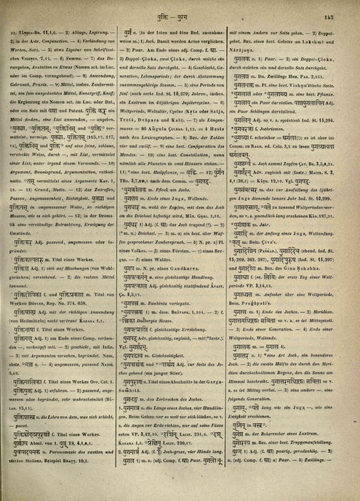
yugaṃ 1 A yoke (m. also in this sense); yugavyāyataba huḥ R. 3. 34, R. 10. 87; Śi. 3. 68. 2 A pair, couple, brace; kucayoryugena tarasā kalitā Śi. 9. 72; stanayuga Ś. 1. 19. 3 A couple of stanzas forming one sentence; see yugma. 4 An age of the world; (the Yugas are four: — kṛ ta or satya, tretā, dvāpara and kali; the duration of each is said to be respectively 1,728,000; 1,296,000; 864,000; and 432,000 years of men, the four together comprising 4,320,000 years of men which is equal to one Mahāyuga q. v.; it is also supposed that the regularly descending length of the Yugas represents a corresponding physical and moral deterioration in the people who live during each age, Kṛta being called the ‘golden’ and Kali or the present age the ‘iron’ age); dharmasaṃsthāpanārthāya saṃbhavāmi yuge yuge Bg. 4. 8; yugaśataparivartān Ś. 7. 34. 5 (Hence) A long period of years. 6 A generation, life; āsaptamād yugāt Ms. 10. 64; jātyutkarṣo yuge jñeyaḥ paṃcame saptame'pi vā Y. 1. 96 (yuge = janmani Mit.). 7 An expression for the number ‘four’, rarely for ‘twelve’. 8 A period of five years. 9 A measure of length equal to four Hastas. 10 A part of a chariot or plough. Comp. — aṃśakaḥ a year. — adhyakṣaḥ 1 N. of Prajāpati. 2 of Śiva. — aṃtaḥ 1 the end of the yoke. 2 the end of an age, end or destruction of the world; yugāṃtakālapratisaṃhṛtātmano jagaṃti yasyāṃ savikāśamāsata Śi. 1. 23; R. 13. 6. 3 meridian, midday. — aṃtara 1 a kind of yoke. 2 a succeeding generation. 3 another division of the sky; yugāṃtaramārūḍhaḥ savitā Ś. 4. — avadhiḥ end or destruction of the world; Śi. 17. 40. — ādyā the first day of a Yuga. — kīlakaḥ the pin of a yoke. — kṣayaḥ destruction of the world. — dharaḥ the pole of a carriage. — patraḥ — patrakaḥ the mountain ebony. — pārśvaga a. going to the side of the yoke, (said of an ox while being broken ([Page 0894-c]) in to the yoke). — bāhu a. long-armed; Ku. 2. 18.
Cappeller 1887 Substantiv Maskulin · Substantiv Neutrum
Originaltext · Deutsch · Substantiv Maskulin · Substantiv Neutrum
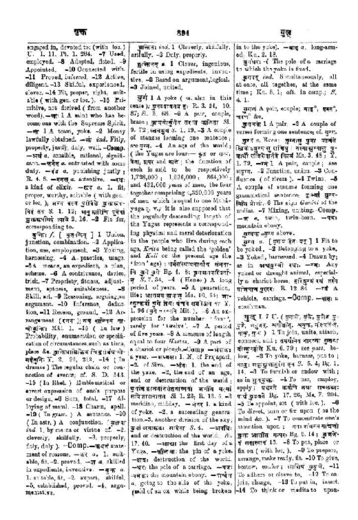
yugá n. (m.) Joch, Paar (auch Strophen-); Zeitabschnitt, Geschlecht, Generation, Lebensdauer; Luftraum; Weltperiode (4 angen.).
Burnouf 1866 Substantiv Maskulin
Originaltext · Französisch · Substantiv Maskulin
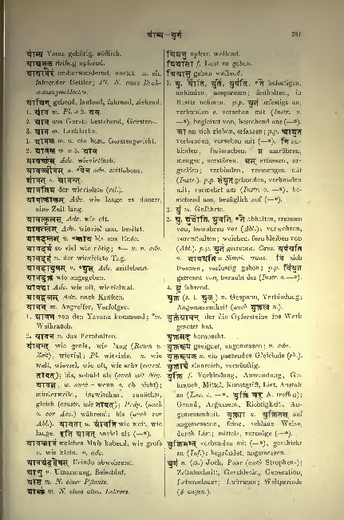
yuga yuga m. (yuj) joug; attelage; mesure de 4 coudées. Sorte de drogue. — N. paire, couple. Âge du monde [il y en a 4: kṛta, tretā, dvāpara et kali. Gr. ζυγός; lat. jugum; goth. juk; lith. jungas. yugakīlaka m. clavette d'un joug. yugandhara m. n. (dhṛ) le timon, la pièce de bois où le joug est attaché. La 1ʳᵉ des 7 chaînes de montagnes qui entourent le Meru. yugapat [ou pad] adv. tout à coup; au même moment; [? à pieds joints.] yugapatra et yugapatraka m. ébène de montagne ou bauhinia. — F. [ikā] dalbergia sisu, bot. yugapārśvaga m. (gam) jeune bœuf atta attaché près du joug pour être dressé. yugamātra adv. tout de suite, à l'instant même; à propos, à point. yugala n. couple, paire. yugānta m. (anta) fin d'un yuga, destruction d'un univers. yugāṃśaka m. (aṃśa) année.

Quelltextfundstellen (6)
DYS 1 Fundstelle
HP 1 Fundstelle
HTK 3 Fundstellen
SiSa 1 Fundstelle
Mit AYI Free weitermachen
Bildquelle: AYI Archiv.