

kḷp कॢप् – arrange; be fit
verbal root · Word type unspecified · verb
Dictionary sources
AYI dictionary verbal root
arrange; be fit
Cappeller 1891 verb
Original text · English · verb
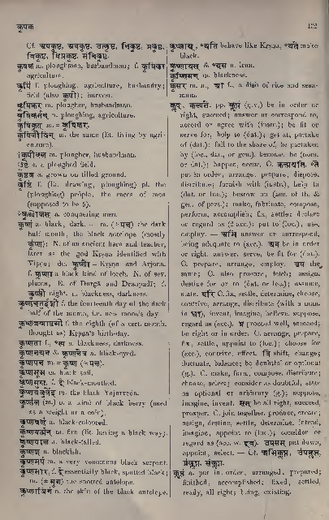
kḷp kalpate ·v pp. kḷptá (q.v.) be in order or right, succeed; answer or correspond to, accord or agree with (instr.); be fit or serve for, help to (dat.); get at, partake of (dat.); fall to the share of, be partaken by (loc., dat., or gen.), become, be (nom. or dat.); happen, occur. C. kalpáyati, °te put in order, arrange, prepare, dispose, distribute; furnish with (instr.), help to (dat. or loc.); bestow on (acc. of th. & gen. of pers.); make, fabricate, compose, perform, accomplish; fix, settle; declare or regard as (2 acc.); put to (loc.), use, employ. --abhi answer or correspond, being adequate to (acc.). ava be in order or right, answer, serve, be fit for (dat.). C. prepare, arrange, employ. upa the same; C. also procure, fetch; assign, destine for or to (dat. or loc.); assume, state. pari C. fix. settle, determine, choose, contrive, arrange, distribute (with a num. in dhā), invent, imagine, believe, suppose, regard as (acc.). pra proceed well, succeed; be right or in order. C. arrange, prepare, fix, settle, appoint to (loc.); choose for (acc.), contrive, effect. vi shift, change; fluctuate, balance; be doubtful or optional (g.). C. make, form, compose, distribute; choose, select; consider as doubtful, state as optional or arbitrary (g.); suppose, imagine, invent. sam be all right, succeed, prosper. C. join together, produce, create; assign, destine, settle, determine, intend, imagine, appoint to (loc.); consider or regard as (acc. w. iva). upasam put down, appoint, select. -- Cf. abhikḷpta, úpakḷpta, prákḷpta, saṃkḷpta.
Monier-Williams 1872 verb
Original text · English · verb
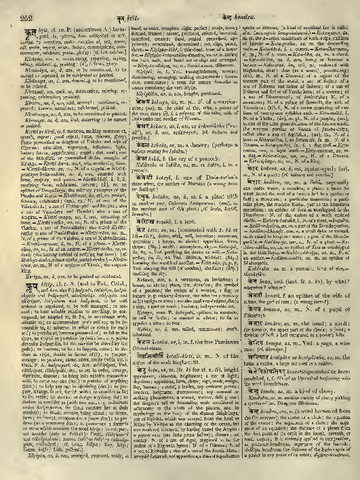
kḷp kḷp, cl. 1. A. (and in Fut., Cond., and Aor. also P.) kalpate, cakḷpe, kalpi- ṣyate and kalpsyati, akalpiṣṭa, akḷpta and akḷpat, kalpitum and kalptum, to be well ordered or regulated, to be well managed; to suc- ceed; to bear suitable relation to anything, to cor- respond, be adapted to, fit for, in accordance with, suitable to; to accommodate one's self to; to be fa- vourable to, to subserve, to effect or obtain for one's self; to partake of, become possessed of; to fall to the share, be shared or partaken by (with loc., e. g. yajño deveṣu kalpatām, let the sacrifice be shared by the gods); to become, to be; to happen, occur; to de- clare as right, decide in favour of (?); to prepare, arrange; to produce, cause, effect, create (with acc.): Caus. P. A. kalpayati, -te, Aor. acīkḷpat, Ved. cākḷpat, cīkḷpāti, &c., to set in order, arrange, distribute, dispose; to bring into suitable connection with, to cause any one (acc.) to partake of anything (inst.); to help any one in obtaining (dat.); to pre- pare, arrange, fit out, furnish with; to consider as fit; to fix, settle; to destine or design anything for; to declare as, consider as (with two acc., e. g. mātaram enāṃ kalpayantu, let them consider her as their mother); to make, execute, bring about; to frame, form; to invent, compose (as a poem &c.); to per- form (as a ceremony &c.); to pronounce a formula or verse which contains the word kḷp; to cut, pare, cut asunder (only in Prākṛt): Desid. cikḷpsati and cikalpiṣate: Intens. calī˚ or cali˚ or calkalp- yate, calkalpti; [cf. Goth. hilpa; Eng. help; Germ. helfe; Lith. gelbmi.]
Whitney Roots 1885 verbal root
Original text · English · verbal root
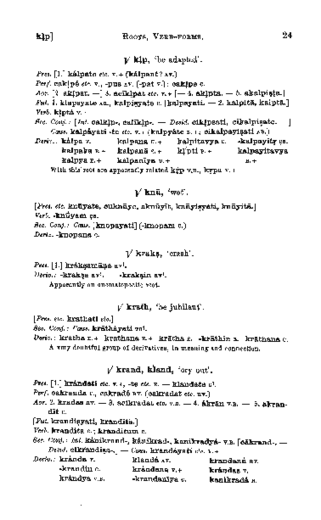
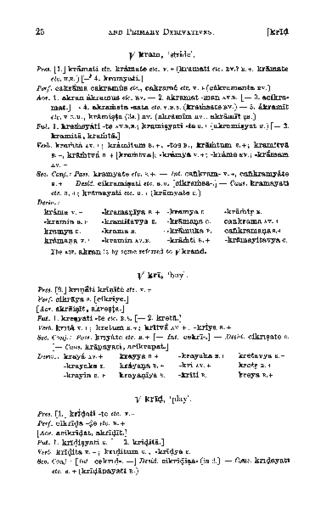
kḷp — be adapted
Apte 1890 verbal root
Original text · English · verbal root
kḷp 1 A. (kalpate, cakḷpe, akḷpat, akḷpta, akalpiṣṭ; kalpiṣyate, kalpsyati-te, kalpituṃ, kaltpuṃ, kḷpta) 1 To be fit or adequate for, result in, bring about, accomplish, produce, tend to; (with dat.); kalpase rakṣaṇāya Ś. 5. 8; paścātputrairapahṛtabharaḥ kalpate viśramāya V. 3. 1; vibhāvarī yadyaruṇāya kalpate Ku. 5. 44, Ku. 6. 29; Ku. 5. 79; Me. 55; R. 5. 13, R. 8. 40: Ś. 6. 23; Bk. 22. 21. 2 To be well managed or regulated, to succeed. 3 To become, happen, occur; kalpiṣyate hareḥ prītiḥ Bk. 16. 12; Bk. 9. 44, Bk. 9. 45. 4 To be prepared, be ready; cakḷpe cāśvakuṃjaraṃ Bk. 14. 89. 5 To be favourable to, subserve. 6 To partake of. 7 To prepare, arrange. 8 To produce, cause, effect, create (with acc.). 9 To accommodate one's self to. 10 To fall to the share. of. — Caus. (kalpayati-te) 1 To prepare, arrange, make ready, fit out; śayanamasyākalpayam K. 156; K. 157. 2 To settle, fix upon, intend, design; kalpitā mūlyameteṣāṃ krūreṇa bhavatā vayaṃ Mu. 5. 17. 3 To make, offer; Mu. 6. 20; R. 5. 28, R. 11. 51, R. 11. 93. 4 To provide or furnish with; Bh. 3. 95; R. 1. 94; R. 5. 9. 5 To believe, consider, imagine, think; matsarastu me viparītaṃ kalpayati Mu. 7; Śi. 11. 6. 6 To cut, divide; Ś. 6. 7 To execute, bring about, do, perform; Śi. 11. 27, Śi. 14. 21. 8 To form, frame. 9 To invent, compose (as a poem).
Cappeller 1887 Word type unspecified
Original text · German · Word type unspecified
kḷp u. klapi (g.). = kalp.
Burnouf 1866 verbal root · Word type unspecified
Original text · French · verbal root
*kḷp kḷp. kalpe 1; f2. kalpsyāmi et kalpiṣye; a1. akalpiṣi; a2. akḷpam et akḷpsi; pp. kḷpta. Etre [dans un certain état], devenir, se produire: katpiṣyate hares prītis la joie de Hari naîtra. Participer à, obtenir, d.: amṛtatvāya kalpate il parvient à l'immortalité. Suffire, être suffisant; être capable de. Actt. faire, disposer, préparer: annakūṭā divase divase kḷptās monceaux de grain amassés de jour en jour; yajnaṃ kalpate il ordonne la cérémonie du sacrifice; harnacher: aśvam un cheval. Distribuer, partager; procurer: prītim parām une grande joie.

Original text · French · Word type unspecified
kḷp kḷp. kalpayāmi 10. Faire: nyagrodham vāsārthe kalpayomāsatus ils firent d'un nyagrodha leur habitation. Arranger, ordonner, disposer: āsanaṃ kalpayāmāsa il prépara un siège. Composer: kāvyam un poème. Distribuer, prescrire, instituer: teṣāṃ karmāṇy akalpayat il institua leurs fonctions. Dessiner, peindre. Se soucier de, ac.
Derived words
Occurrences in source texts (26)
PJH 1 occurrence
PJH 17-19: Simple Means (sukhopāyas) and Samādhi 1 occurrence
Occurrences through derived words
-
PJH 18 Segment 1
PYS 3 occurrences
SiSa 9 occurrences
SiSa 1.82-1.90: Guṇas und Gegenstände 2 occurrences
Direct occurrences
1 more source page
SS 1 occurrence
SVU 4 occurrences
Continue with AYI Free
Image source: AYI archive.