

śruti श्रुति – Hören
Substantiv Feminin · Substantiv Maskulin · Worttyp nicht bestimmt
Wörterbuchquellen
AYI Wörterbuch Substantiv Feminin
Hören
Cappeller 1891 Substantiv Feminin
Originaltext · Englisch · Substantiv Feminin
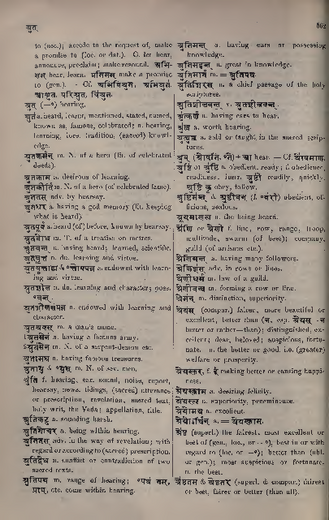
śrúti ·f. hearing, ear, sound, noise, report, hearsay, news, tidings, (sacred) utterance or prescription, revelation, sacred text, holy writ, the Veda; appellation, title.
Monier-Williams 1872 Substantiv Feminin
Originaltext · Englisch · Substantiv Feminin
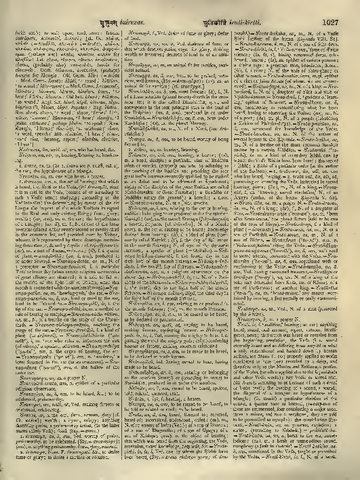
Śruti, is, f. ‘audition,’ hearing; an ear; anything heard, sound, oral account, report, rumour, intelli- gence, news; that which was heard or revealed from the beginning, revelation, the Veda (i. e. sound eternally heard and so differing from smṛti or what is only remembered and handed down by human authors, see Manu II. 10; properly applied to works considered to have been revealed by a deity, and therefore only to the Mantra and Brāhmaṇa portion of the Vedas, but often applied also to the Upaniṣads and other Vedic works); any Vedic or sacred text, (iti śruteḥ, according to or because of such a śruti or Vedic text); the hearing of a sound, a sound; the diagonal of a tetragon or hypothenuse of a triangle; (in music) a particular division of the octave, a quarter tone or interval, (twenty-two of these are enumerated, four constituting a major tone, three a minor, and two a semitone; they are said to be personified as nymphs); the constellation Śra- vaṇā.
Petersburger 1855 Substantiv Feminin · Substantiv Maskulin · Worttyp nicht bestimmt
Originaltext · Deutsch · Substantiv Feminin
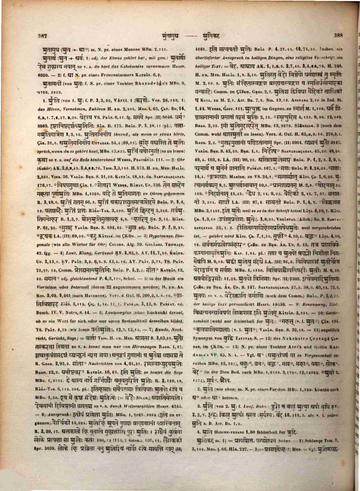
1. śrúti (von 1. śru) f. P. 3,3,95, Vārtt. 1 (karaṇe). VOP. 26,183. 1〉 das Hören, Vernehmen, Zuhören H. an. 2,203. MED. t. 65. ŚAT. BR. 14,6,5,1. ŚAT. BR. 14,7,1,27. ŚAT. BR. 14,6,3,20. vedasya VS. PRĀT. 8,41. fg. samaye Spr. (II) 5046. dharma˚ Spr. (II) 5569. iṣṭāniṣṭadarśanaśrutibhiḥ SĀH. D. 175. BHĀG. P. 5,18,11 (pl.). yannāmaśrutimātreṇa BHĀG. P. 9,5,16. śrutimabhinīya thuend, als wenn er etwas hörte, ŚĀK. 31,8. aśrutimabhinīya UTTARAR. 54,4 (69,11). brūhi yadyasti te śrutiḥ sprich, wenn du es gehört hast, MBH. 13,823. śrutiṃ vaco 'nugāṃ (so zu lesen) katvā so v. a. auf die Rede hinhorchend WEBER, PRATIJÑĀS. 111. — 2〉 Ohr (Gehör) AK. 2,6,2,45. AK. 3,4,14,76. TRIK. 3,3,188. H. 573. H. an. MED. HALĀY. 2,361. VIKR. 56. VARĀH. BṚH. S. 51,39. KATHĀS. 18,82. du. SARVADARŚANAS. 176,17. ˚viṣayaguṇā ŚĀK. 1. ˚gocarā WEBER, RĀMAT. UP. 336. tena śabdena mahatā pūrṇaśrutiḥ MBH. 1,5360. yadi te śrutimāgataḥ zu Ohren gekommen R. 3,18,6. śrutiṃ gatam R. 3,66,8. śrutiṃ cakārācyutasatkathodaye BHĀG. P. 9,4,18. pakṣaśabdaiḥ śrutiṃ ghnantaḥ RĀJA-TAR. 3,400. śrutiṃ chindan RĀJA-TAR. 5,346. sarvaśrutimanohara R. 1,3,7. śrotṛśrutisukhāvaha R. 1,4,5. ˚hārin ṚT. 2,14. MĀRK. P. 61,24. ˚sukhada VARĀH. BṚH. S. 104,64. ˚sukha adj. BHĀG. P. 7,9,25. ˚dūṣaka LA. (III) 89,20. ˚kaṭu KĀVYAC._im_ŚKDR. — 3〉 Hypotenuse, Diagonale (wie alle Wörter für Ohr) COLEBR. Alg. 59. GOLĀDHY. TRIPRAŚN. 42. fgg. — 4〉 Laut, Klang, Geräusch ṚV. 8,85,3. AV. 11,7,20. CHĀND. UP. 3,13,8. ṚV. PRĀT. 3,3. ṚV. PRĀT. 6,5. ṚV. PRĀT. 6,9. ṚV. PRĀT. 13,4. ṚV. PRĀT. 13,16. AV. PRĀT. 3,71. TS. PRĀT. 21,10. TS. PRĀT. 21,15. Comm. procyamānaśrutibhiḥ BHĀG. P. 5,2,4. gīta˚ KATHĀS. 12,32. samāna˚ adj. gleichlautend P. 4,3,100, Schol. — 5〉 in der Musik ein Viertelton oder Intervall (deren 22 angenommen werden) H. an. As. Res. 3,69. As. Res. 9,461 (nach HAUGHTON). Verz. d. Oxf. H. 200,b,5. Verz. d. Oxf. H. 200,b,6. Verz. d. Oxf. H. 200,b,10. ˚jātiviśārada YĀJÑ. 3,115. ŚIŚ. 1,10. ŚIŚ. 11,1. PAÑCAR. 3,12,9. PAÑCAT. ed. Bomb. IV. V. Notes, S. 14. — 6〉 Lautcomplex (ohne Rücksicht darauf, ob es ein Wort für sich oder nur einen Bestandtheil desselben bildet) TS. PRĀT. 4,35 (wir lesen patīśrutiḥ). TS. PRĀT. 12,7. TS. PRĀT. 13,12. — 7〉 Kunde, Nachricht, Gerücht, Sage; = vārttā TRIK. H. an. MED. āgatā R. 3,63,25. śrutau taskaratā sthitā so v. a. kennt man nur von Hörensagen RAGH. 1,27. ikṣvākuvaṃśasadṛśaṃ vyāhṛtaṃ bharata tvayā . anurūpaṃ guṇānāṃ ca śruteśca yaśasaśca te R. GORR. 2,93,2. sītā˚ Nachrichten von R. GORR. 4,61,31. rāmasyābhyudayaśrutiḥ RAGH. 12,3. abhīṣṭavara˚ KATHĀS. 16,67. iti śrutiḥ so lautet die Sage MBH. 1,3552. dve cāsya bhārye garbhiṇyau babhūvaturiti śrutiḥ R. 2,110,18. RĀJA-TAR. 6,112. RĀJA-TAR. 6,306. pl.: itihāsāḥ savaiyākhyā vividhāḥ śrutayo 'pi ca MBH. 1,50. eṣa me kṛṣṇa saṃdeśaḥ śrutibhiḥ (= vedaiḥ NĪLAK.) khyātimeṣyati . devatānāṃ diviṣṭhānāṃ jagataśca so v. a. durch Weitererzählen HARIV. 4345. — 8〉 Ausspruch: itīyaṃ prathitā śrutiḥ MBH. 1,7067. MBH. 1,8344 (iti zu ergänzen). paurvikī MBH. 14,524. śrutirhi śrūyate puṇyā brāhmaṇānāṃ yaśasvinām R. 2,29,17. antakāle hi bhūtāni muhyantīti purā śrutiḥ . rājñaivaṃ kurvatā loke pratyakṣā sā śrutiḥ katā R. 2,106,12 (R. 2,113,7 GORR.). R. 2,107,11. laukikī Spr. 3039. loke hi prathitā nanu śrutiriyaṃ nāryo 'pi gāyanti yām Spr. (II) 4161. iti satyavatī śrutiḥ BHĀG. P. 4,21,45. BHĀG. P. 10,74,31. insbes. ein überlieferter Ausspruch in heiligen Dingen, eine religiöse Vorschrift, ein heiliger Text; = veda, āmnāya AK. 1,1,5,3. AK. 1,2,7,40. AK. 3,4,14,76. H. 249. H. an. MED. HALĀY. 1,9. HALĀY. 5,10. śrutistu vedo vijñeyo dharmaśāstraṃ tu smṛtiḥ M. 2,10. M. 2,9. śrutiḥ saṃhitāsvarūpā brāhmaṇasvarūpā ca smṛtirdharmasmārakā manvādiḥ Comm. zu ŚĀṄKH. GṚHY. 2,7. śrutiśca dvividhā vaidikī tāntrikī ca KULL._zu_M. 2,1. AIT. BR. 7,9. NIR. 13,13. ANUPADA 2,10_in_Ind. St. 1,44. WEBER, JYOT. 111. śrutyukta im Gegens. zu smārta M. 1,108. dharmaṃ jijñāsamānānāṃ pramāṇaṃ paramaṃ śrutiḥ M. 2,13. ˚smṛtyudita M. 4,155. M. 9,96. M. 12,109. BHAG. 2,53. imāṃ śrutimudāharet MBH. 13,3670. SĀṂKHYAK. 5 (nach dem Comm. wohl āptaśrutī zu lesen). Verz. d. Oxf. H. 65,a,9. Verz. d. Oxf. H. 65,a,10. Verz. d. Oxf. H. 276,b,4. RAGH. 2,2. ˚mukharamukhānāṃ paṇḍitānām Spr. (II) 5904. vyasanaṃ śrutau Spr. (II) 6147. VARĀH. BṚH. S. 43,59. BṚH. 1,1. nirdoṣa˚ SARVADARŚANAS. 45,20. SARVADARŚANAS. 48,20. SARVADARŚANAS. 49,4. SARVADARŚANAS. 103,6. LA. (III) 90,22. akhilaśrutisāra BHĀG. P. 1,2,3. BHĀG. P. 3,9,5. paramārthaṃ ca śruterna jānāti PAÑCAT. 167,1. ˚gaṇaḥ BHĀG. P. 8,24,61. ˚gaṇāḥ BHĀG. P. 14,4. ˚rūpamantrāḥ MAHĪDH._zu_VS. 24,1. ˚sāmarthyāt KĀTY. ŚR. 1,6,26. śrutyānarthakyam KĀTY. ŚR. 8,5. śrutyarthābhāvāt KĀTY. ŚR. 10,1. ˚prāmāṇyatas M. 2,8. ˚codanāt M. 35. M. 169. ˚nidarśanāt M. 11,45. ˚dvaidha M. 2,14. M. 9,32. vaidikī M. 2,15. M. 7,97. sanātanī M. 3,284. sādhvī LA. (III) 87,6. sātvatī BHĀG. P. 1,4,7. ˚vikrāyaka MBH. 5,1401. iti śruteḥ weil es so in der Schrift heisst LĀṬY. 4,10,7. KĀTY. ŚR. 1,3,10 (upāṃśuprayogaḥ śruteḥ). KĀTY. ŚR. 3,8,31. VEDĀNTAS. (Allah.) No. 8. SARVADARŚANAS. 55,1. SARVADARŚANAS. 55,3. dīkṣitasyāgnihomapratiṣedhaśruteḥ weil vorgeschrieben ist, — gelehrt wird KĀTY. ŚR. 7,1,34. tūṣṇīṃ˚ KĀTY. ŚR. 4,10,4. bahu˚ LĀṬY. 4,10,18. sarvakarmaphalopasaṃhāra˚ ŚAṂK._zu_BṚH. AR. UP. S. 15. tatra prāptavivekasyānāvṛttiśrutiḥ KAP. 1,84. pl.: tathā ca śrutayo bahvayo nigītā nigameṣvapi M. 9,19. śraddhāṃ śrutiṣu saṃdadhe LA. (III) 91,3. vividhāstvaṃ śrutīrvettha vedāṅgāni ca sarvaśaḥ MBH. 1,4150. vividhāścaupaniṣadīḥ śrutīḥ M. 6,29. atharvāṅgirasīḥ M. 11,33. śrutayo vibhinnāḥ Spr. (II) 2505. ityevamādiśrutibhyaḥ ŚAṂK._zu_BṚH. ĀR. UP. S. 147. SARVADARŚANAS. 57,2. SARVADARŚANAS. 58,9. SARVADARŚANAS. 65,18. SARVADARŚANAS. 72,5. śrutayaḥ so v. a. vedoktāni karmāṇi (nach dem Comm.) BHĀG. P. 5,2,21. der heilige Text personificirt HARIV. 14036. — 9〉 Benennung, Titel: bibhratyananyaviṣayāṃ lokapāla iti śrutim KĀVYĀD. 2,331. — 10〉 Gelehrsamkeit (wohl nur fehlerhaft für śruta): ˚mahant (v. l. śruta˚) ŚĀK. 194. ˚kulajātikhyātāḥ (v. l. śruta˚) VARĀH. BṚH. S. 32,18. — 11〉 angeblich Synonym von buddhi TATTVAS. 8. — 12〉 das Nakṣatra Śravaṇā ŚABDAR._im_ŚKDR. — 13〉 N. pr. einer Tochter Atriʼs und Gattin Kardamaʼs VP. 83, N. 4. — Vgl. a˚ (aśrutīpathaṃ yā in Vergessenheit gerathen MBH. 12,321), cakṣuḥ˚, jana˚, bahu˚, mantra˚, mahā˚, yathā˚, loka˚, veda˚ (in der 2ten Bed. auch MBH. 1,6158. MBH. 3,1760. MBH. 12,12969. ˚śrutī MBH. 2,1574), śūrpa˚, śrauta.
Originaltext · Deutsch · Substantiv Feminin
3. śrúti (von 2. śru) f. Lauf, Bahn: du̱ro na vāja̱ṃ śrutyā̱ apā̀ vṛdhi ṚV. 2,2,7. indra̱ḥ kila̱ śrutyā̀ a̱sya (sūryasya) vèda ṚV. 10,111,3. als v. l. neben sruti z. B. AIT. BR. 1,2.
Originaltext · Deutsch · Substantiv Maskulin
2. śruti (wie eben) m. N. pr. eines Fürsten MBH. 1,232. könnte auch a˚ oder ā˚ heissen.
Originaltext · Deutsch · Worttyp nicht bestimmt
4. śruti HIOUEN-THSANG 1,60 fehlerhaft für truṭi.
Böhtlingk 1879 Substantiv Feminin · Substantiv Maskulin · Worttyp nicht bestimmt
Originaltext · Deutsch · Substantiv Feminin
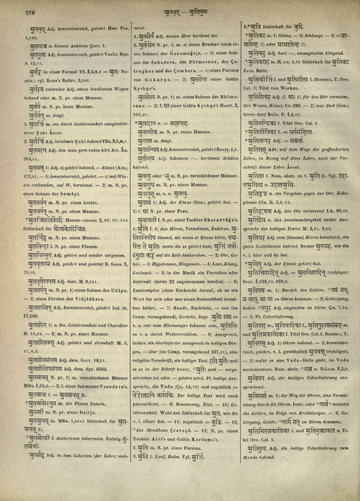
1. śrúti f. — 1〉 das Hören, Vernehmen, Zuhören. śrutimabhinīya thuend, als wenn er Etwas hörte, yadyasti te śrutiḥ wenn du es gehört hast, śrutiṃ vaco'nugāṃ kar auf die Rede hinhorchen. — 2〉 Ohr, Gehör. — 3〉 Hypotenuse, Diagonale. — 4〉 Laut, Klang, Geräusch. — 5〉 in der Musik ein Viertelton oder Intervall (deren 22 angenommen werden) — 6〉 Lautcomplex (ohne Rücksicht darauf, ob es ein Wort für sich oder nur einen Bestandtheil desselben bildet). — 7〉 Kunde, Nachricht, — von (im Comp. vorangehend), Gerücht, Sage. śrutau sthā so v. a. nur vom Hörensagen bekannt sein, śrutibhiḥ so v. a. durch Weitererzählen. — 8〉 Ausspruch, insbes. ein überlieferter Ausspruch in heiligen Dingen —, über (im Comp. vorangehend Chr. 267,21). eine religiöse Vorschrift, ein heiliger Text. iti śruteḥ weil es so in der Schrift heisst, ˚śuteḥ weil — vorgeschrieben ist oder — gelehrt wird. Pl. heilige Aussprüche, die Veda (ŚIŚ. 14,79) und angeblich = vedoktāni karmāṇī. Der heilige Text wird auch personificirt. — 9〉 Benennung, Titel. — 10〉 Gelehrsamkeit. Wohl nur fehlerhaft für śruta, wie die v. l. öfters hat. — 11〉 angeblich = buddhi. — 12〉 *das Mondhaus Śravaṇā. — 13〉 N. pr. einer Tochter Atriʼs und Gattin Kardamaʼs.
Originaltext · Deutsch · Substantiv Feminin
3. śrúti f. Lauf, Bahn. Vgl. srutí.
Originaltext · Deutsch · Substantiv Maskulin
2. śruti m. N. pr. eines Fürsten.
Originaltext · Deutsch · Worttyp nicht bestimmt
4. *śruti fehlerhaft für trúṭi.
Apte 1890 Substantiv Feminin
Originaltext · Englisch · Substantiv Feminin
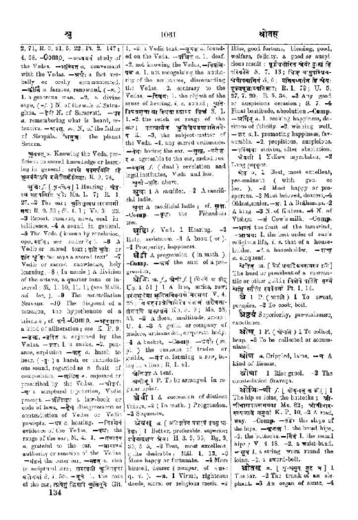
śrutiḥ f. [śru-ktin] 1 Hearing; caṃdrasya grahaṇamiti śruteḥ Mu. 1. 7; R. 1. 27. 2 The ear; śrutisukhabhramarasvanagītayaḥ R. 9. 35; Śi. 1. 1; Ve. 3. 23. 3 Report, rumour, news, oral intelligence. 4 A sound in general. 5 The Veda (known by revelation, opp smṛti; see under veda). 6 A Vedic or sacred text; iti śruteḥ or iti śrutiḥ ‘so says a sacred text’ 7 Vedic or sacred knowledge, holy learning. 8 (In music) A division of the octavo, a quarter tone or interval; Śi. 1. 10, Śi. 11. 1; (see Malli. ad loc.). 9 The constellation Śravaṇa. 10 The diagonal of a tetragon, the hypothenuse of a triangle; cf. karṇa. Comp. — anuprāsaḥ a kind of alliteration; see K. P. 9 — ukta, -udita a. enjoined by the Vedas. — kaṭaḥ 1 a snake. 2 penance, expiation. — kaṭu a. harsh to hear. — (duḥ) a harsh or unmelodious sound, regarded as a fault of composition. — kathita a. enjoined or prescribed by the Vedas. — codanaṃ, — nā a scriptural injunction, Vedic precept. — jīvikā a law-book or code of laws. — dvaidhaṃ disagreement or contradiction of Vedas or Vedic precepts. — dhara a. hearing. — nidarśanaṃ evidence of the Vedas. — pathaḥ the range of the ear; M. 4. 1. — prasādana a. grateful to the ear. — prāmāṇyaṃ authority or sanction of the Vedas. — maṃḍalaṃ the outer ear. — mahat a. rich in scriptural lore; sarasvatī śrutimahatāṃ mahīyatāṃ Ś. 7. 35. — mūlaṃ 1 the root of the ear; lapituṃ kimapi śrutimūle ([Page 1061-b]) Gīt. 1. 2 a Vedic text. — mūlaka a. founded on the Veda. — varjita a. 1 deaf. 2 not knowing the Vedas. — vipratipanna a. 1 not recognizing the authority of the scriptures, disregarding the Vedas. 2 contrary to the Vedas. — viṣayaḥ 1 the object of the sense of hearing. i. e. sound; śrutiviṣayaguṇā yā sthitā vyāṇya viśvaṃ Ś. 1. 1. 2 the reach or range of the ear; etatprāyeṇa śrutiviṣayamāpatitameva K. 3 the subject matter of the Veda. 4 any sacred ordinance. — vedhaḥ boring the ear. — sukha, — manohara a. agreeable to the ear, melodious. — smṛti f. (dual) revelation and legal institutes, Veda and law.
Cappeller 1887 Substantiv Feminin
Originaltext · Deutsch · Substantiv Feminin
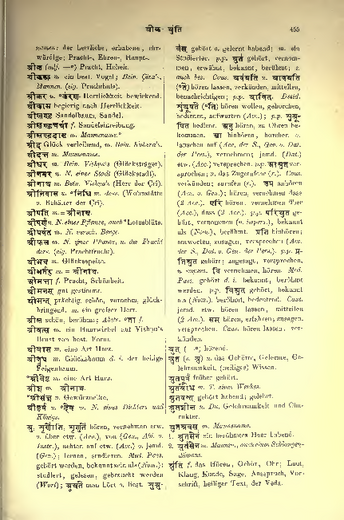
śrúti f. das Hören, Gehör, Ohr; Laut, Klang, Kunde, Sage, Ausspruch, Vorschrift, heiliger Text, der Veda.
Burnouf 1866 Substantiv Feminin
Originaltext · Französisch · Substantiv Feminin
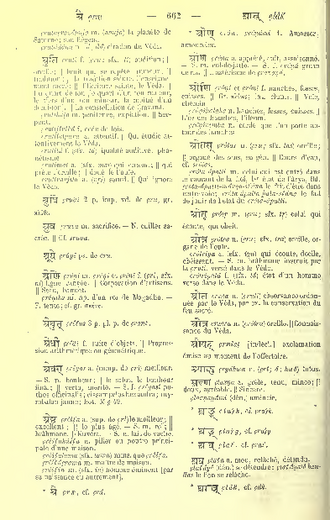
śruti śruti f. (śru; sfx. ti) audition; oreille; bruit qui se répète, rumeur, tradition; la tradition sainte, l'enseignement sacré; l'Ecriture sainte, le Veda. Un quart de ton [le quart d'un ton majeur, le tiers d'un ton mineur, la moitié d'un demi-ton]. La constellation de Śravaṇā. śrutikaṭa m. pénitence, expiation. Serpent. śrulijīvikā f. code de lois. śrutitatpara a. attentif. Qui étudie attentivement le Veda. śrutitā f. (sfx. tā) qualité auditive, phonétisme. śrutimat a. (sfx. mat) qui entend; qui prête l'oreille; doué de l'ouïe. śrutivarjita a. (vṛj) sourd. Qui ignore le Veda.
Quelltextfundstellen (7)
DYS 1 Fundstelle
HTK 1 Fundstelle
SiSa 5 Fundstellen
Mit AYI Free weitermachen
Bildquelle: AYI Archiv.