

karṇa कर्ण – Ohr
Adjektiv · Substantiv Maskulin · Substantiv Neutrum · Worttyp nicht bestimmt
Wörterbuchquellen
AYI Wörterbuch Substantiv Maskulin · Substantiv Neutrum
Cappeller 1891 Adjektiv · Substantiv Maskulin
Originaltext · Englisch · Substantiv Maskulin
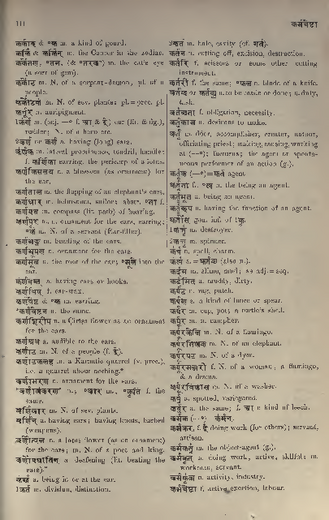
kárṇa1 ·m. (adj. --° f. ā & ī) ear (lit. & fig.), rudder; N. of a hero etc.
Originaltext · Englisch · Adjektiv
karṇá2 kárṇa ·a. having (long) ears.
Originaltext · Englisch · Adjektiv
kárṇa ·a. having (long) ears.
Monier-Williams 1872 Substantiv Maskulin
Originaltext · Englisch · Substantiv Maskulin
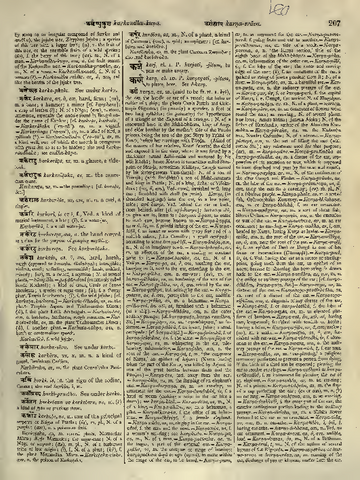
karṇa karṇa, as, m. (said to be fr. rt. 1. kṝ), the ear, the handle or ear of a vessel; the helm or rudder of a ship; the plants Cassia Fistula and Calo- tropis Gigantea; (in prosody) a spondee, a foot of two long syllables; (in geometry) the hypothenuse of a triangle or the diagonal of a tetragon; N. of a renowned hero in the Mahā-bhārata, king of Aṅga and elder brother by the mother's side of the Pāṇḍu princes, being the son of the god Sūrya by Pṛthā or Kuntī, before her marriage with Pāṇḍu. (Afraid of the censure of her relatives, Kuntī deserted the child and exposed it in the river, where it was found by a charioteer named Adhi-ratha and nurtured by his wife Rādhā; hence Karṇa is sometimes called Sūta- putra or Sūta-ja, sometimes Rādheya, though named by his foster-parents Vasu-ṣeṇa); N. of a son of Viśvajit; (with Buddhists) a son of Mahā-sammata and king in Potāla; N. of a king, father of Viśoka- deva; (as, ā, am), Ved. eared, furnished with long ears; furnished with chaff (as grain). Karṇe, (in theatrical language) into the ear, in a low voice, aside; api karṇe, Ved. behind the ear or back, from behind, after [cf. api-karṇa]; karṇaṃ dā, to give ear to, listen to; karṇam ā-gam, to come to one's ears, become known to.
Petersburger 1855 Adjektiv · Substantiv Maskulin · Worttyp nicht bestimmt
Originaltext · Deutsch · Adjektiv
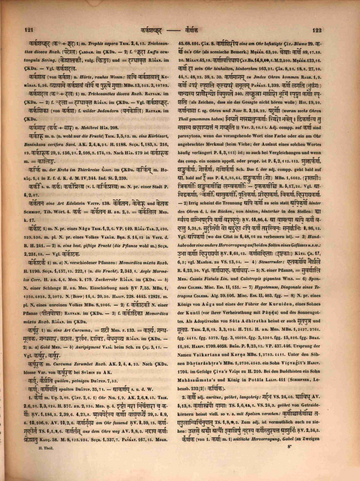
2. karṇá adj. auritus, geöhrt, langohrig: gardabha VS. 24,40. śvāvidh AV. 5,13,9. ka̱rṇāstrayò yā̱māḥ TS. 5,6,15,1. VS. 24,3. geöhrt von Getraidekörnern heisst viell. so. v. a. mit Spelzen versehen: ka̱rṇāṃścākàrṇāṃśca taṇḍu̱lānvicìnuyāt TS. 1,8,9,3. Zum adj. ist vermuthlich auch zu ziehen: u̱kṣante̱ aśvā̱m̐ atyā̀m̐ ivā̱jiṣù na̱dasya̱ karṇaisturayanta ā̱śubhìḥ ṚV. 2,34,3.
Originaltext · Deutsch · Substantiv Maskulin
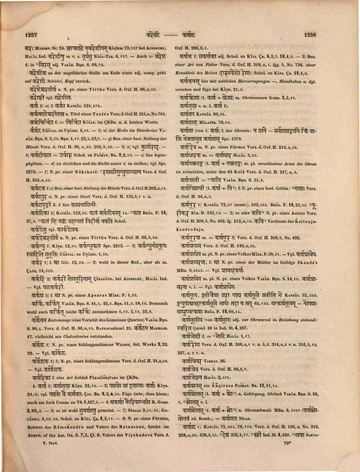
1. kárṇa m. Uṇ. 3,10. ŚĀNT. 2,6. 1〉 Ohr NIR. 1,9. AK. 2,6,2,45. TRIK. 2,6,31. TRIK. 3,3,124. H. 574. H. an. 2,134. MED. ṇ. 4. eṣṭā̀ narā̱ nicètārā ca̱ karṇaìḥ ṚV. 1,184,2. ṚV. 2,39,6. ṚV. 4,23,8. śrā̱vayedàsya karṇā̀ vāja̱yadhyaì ṚV. 29,3. ṚV. 4,6. ṚV. 9,6. ṚV. 10,106,9. AV. 10,2,6. karṇagṛ́hya am Ohr fassend ṚV. 8,59,15. karṇagṛhītá TS. 6,1,7,6. karṇatás aus dem Ohre weg AV. 9,8,3. bhadrāya karṇaḥ krośatu KAUŚ. 58. M. 8,125. M. 8,234. SUŚR. 1,337,7. PAÑCAT. 167,15. MEGH. 45. MEGH. 68. MEGH. 101. ŚĀK. 8. karṇaśirīṣa eine am Ohr befestigte Śir.-Blume ŚĀK. 29. karṇe inʼs Ohr (als scenische Bemerk.) MṚCCH. 63,20. ceṭyāḥ karṇe MṚCCH. 89,17. MṚCCH. 89,18. MṚCCH. 89,20. MĀLAV. 45,18. karṇāvapidhāya ŚAT. BR. 14,8,10,1. M. 2,200. MṚCCH. 123,16. karṇaṃ dā sein Ohr hinhalten, hinhorchen MṚCCH. 163,21. ŚĀK. 8,21. ŚĀK. 18,8. ŚĀK. 27,10. ŚĀK. 44,7. ŚĀK. 48,22. ŚĀK. 59,2. ŚĀK. 59,30. karṇamāgam zu Jmdes Ohren kommen RAGH. 1,9. karṇe 'paraṃ spṛśati hantyaparaṃ samūlam PAÑCAT. I, 339. karṇe lagati (bhujaṃgaḥ) cānyasya prāṇairanyo viyujyate PAÑCAT. I,340. tacchrutvā mārjāro bhūmiṃ spṛṣṭvā karṇau spṛśati (als Zeichen, dass sie das Gesagte nicht hören wolle) HIT. 19,20. karṇanāsā f. sg. Ohren und Nase R. 3,24,22. ṣaṭkarṇo (woran sechs Ohren Theil genommen haben) bhidyate mantraścatuṣkarṇaḥ sthiro bhavet . dvikarṇasya tu mantrasya brahmāpyantaṃ na gacchati .. VET. 3,10. VET. 3,11. Adj. compp. auf karṇa sind paroxytona, wenn das vorangehende Wort eine Farbe oder ein am Ohr angebrachtes Merkmal (beim Viehe; der Auslaut eines solchen Wortes häufig verlängert P. 6,3,115) ist; so auch bei Vergleichungen und wenn das comp. ein nomen appell. oder propr. ist P. 6,2,112. P. 6,2,113. śuklakárṇa, śaṅkukárṇa, gokárṇa, maṇikárṇa Sch. Das f. der adj. compp. geht bald auf ā, bald auf ī́ aus P. 4,1,55. P. 4,1,64. śaṅkukarṇā (go) MBH. 1,6662. (rākṣasīḥ) trikarṇīḥ śaṅkukarṇīśca lambakarṇīḥ — ekakarṇīśca R. 5,17,24. Vgl. āviddhakarṇā, ˚karṇī, ākhukarṇī, pūtikarṇa, plīhākarṇa, vikarṇa, hiraṇyakarṇa. — 2〉 Irrig scheint die Trennung api karṇe zu sein statt a̱pi̱ka̱rṇe hinter den Ohren d. i. im Rücken, von hinten, hinterher in den Stellen: śvā nvàsya jambhiṣa̱dapi̱ karṇè varāha̱yuḥ ṚV. 10,86,4. ā vā̱matyā̱ api̱ karṇè vahantu ṚV. 5,31,9. su̱dī̱tayò vo a̱druho 'pi̱ karṇè tara̱svina̱ḥ samṛkvàbhiḥ ṚV. 8,86,12. Vgl. apikarṇa (wo das Citat in ṚV. 6,48,16. zu verbessern ist). — 3〉 Handhabe oder eine andere Hervorragung auf beiden Seiten eines Gefässes u. s. w.: u̱bhā karṇā̀ hira̱ṇyayā̀ ṚV. 8,61,12. karṇasahitāḥ (iṣṭakāḥ) KĀTY. ŚR. 17,6,3; vgl. MAHĪDH._zu_VS. 13,54. — 4〉 Steuerruder: hatakarṇeva naurjale R. 6,23,30. Vgl. karṇagrāha, karṇadhāra. — 5〉 N. einer Pflanze, = suvarṇāli MED. Cassia Fistula Lin. und Calotropis gigantea WILS. — 6〉 Spondeus COLEBR. Misc. Ess. II, 151. — 7〉 Hypotenuse, Diagonale eines Tetragons COLEBR. Alg. 59. COLEBR. Alg. 106. Misc. Ess. II, 403. fgg. — 8〉 N. pr. eines Königs von Aṅga und eines der Führer der Kuruiden, eines Sohnes der Kuntī (vor ihrer Verheirathung mit Pāṇḍu) und des Sonnengottes. Als Adoptivsohn von Sūta Adhiratha heisst er auch sūtaputra und sūtaja. TRIK. 2,8,19. TRIK. 3,3,124. H. 711. H. an. MED. MBH. 1,2427. fgg. MBH. 1,2764. MBH. 1,4411. fgg. MBH. 1,5379. MBH. 3,16098. fgg. MBH. 5,5301. fgg. MBH. 15,826. fgg. BHAG. 11,26. HARIV. 1709. HARIV. 4058. BHĀG. P. 9,23,13. VP. 437. VP. 446. Ursprung der Namen Vaikartana und Karṇa MBH. 1,2783. MBH. 1,4411. Unter den Söhnen Dhṛtarāṣṭraʼs MBH. 1,2730. MBH. 1,4542. ein Sohn Viśvajitʼs HARIV. 1704. im Gefolge Śivaʼs VYĀḌI_zu_H. 210. Bei den Buddhisten ein Sohn Mahāsaṃmataʼs und König in Potāla LALIT. 411 (SCHIEFNER, Lebensb. 232[2]: karṇika).
Originaltext · Deutsch · Worttyp nicht bestimmt
1. karṇa 1〉 karṇagṛhya KĀṬH. 23,10. — 3〉 paśavo vā etasyāḥ karṇaḥ KĀṬH. 21,9; vgl. paśavo vai karṇakāḥ ŚAT. BR. 9,2,3,40. Füge Oehr, Oese hinzu; auch am Joch Comm. zu TS. 1,427,5. — 4〉 akarṇā naurivāmbhasi R. GORR. 2,82,6. — 5〉 es ist wohl suvarṇālu gemeint. — 7〉 SŪRYAS. 2,41. SŪRYAS. 2,51. GOLĀDHY. 5,16. GOLĀDHY. 5,36. Schol. zu KĀTY. ŚR. 8,5,11. — 8〉 N. pr. eines Fürsten, Sohnes des Rāmacandra und Vaters des Ratnasena, Inschr. im Journ. of the Am. Or. S. 7,5, Śl. 8. Vaters des Viśokadeva Verz. d. Oxf. H. 280,b,1.
Originaltext · Deutsch · Worttyp nicht bestimmt
1. karṇa 1〉 Sp. 122, Z. 5 lies karṇamārgam. — 7〉 Durchmesser SŪRYAS. 1,59. SŪRYAS. 12,84. ardha˚ Halbmesser SŪRYAS. 2,61. SŪRYAS. 13,5. karṇārdha dass. SŪRYAS. 3,41.
Böhtlingk 1879 Adjektiv · Substantiv Maskulin · Worttyp nicht bestimmt
Originaltext · Deutsch · Adjektiv
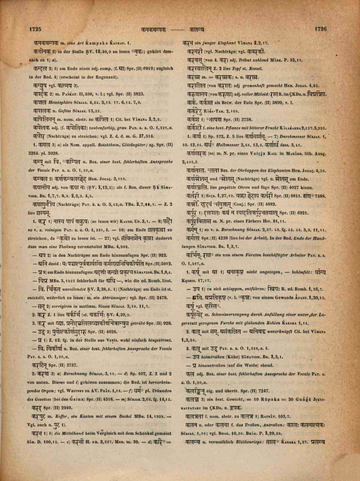
2. karṇá und kárṇa (ṚV.) Adj. auritus, geöhrt (eig. und übertr.), langohrig.
Originaltext · Deutsch · Adjektiv
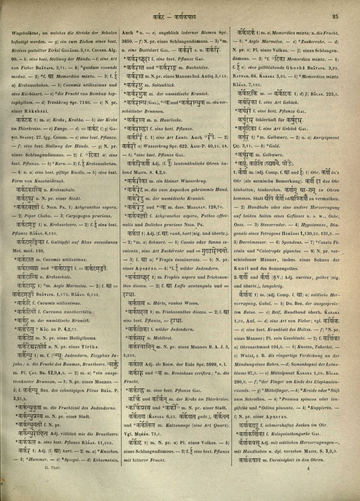
2. karṇá und kárṇa (ṚV.) Adj. auritus, geöhrt (eig. und übertr.), langohrig.
Originaltext · Deutsch · Substantiv Maskulin
1. kárṇa m. (adj. Comp. f. ā und ī) — 1〉 Ohr karṇe inʼs Ohr (als scenische Bemerkung). karṇeṃ dā das Ohr hinhalten, hinhorchen. karṇam āgam zu Ohren kommen. Statt ápi karṇe ist apikarṇé zu vermuthen. — 2〉 Handhabe oder eine andere Hervorragung auf beiden Seiten eines Gefässes u. s. w., Oehr, Oese. — 3〉 Steuerruder. — 4〉 Hypotenuse, Diagonale eines Tetragons HEMĀDRI 1,130,23. 131,8. — 5〉 Durchmesser. — 6〉 Spondeus. — 7〉 *Cassia fistula und *Calotropis gigantea. — 8〉 N. pr. verschiedener Männer, insbes. eines Sohnes der Kuntī und des Sonnengottes.
Originaltext · Deutsch · Worttyp nicht bestimmt
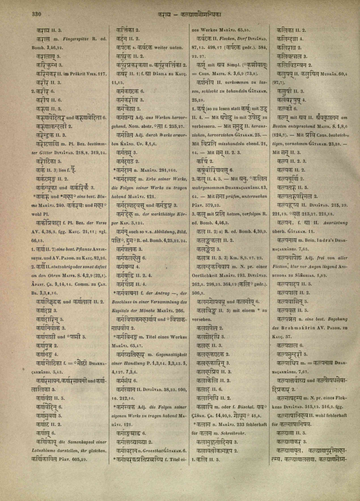
1. karṇa II. 7〉 eine best. Pflanze ANTYEṢṬIK. und AV. PADDH. zu KAUŚ. 82,26. [Nachtrag, Band 7]
Originaltext · Deutsch · Worttyp nicht bestimmt
2. karṇá II. stutzohrig oder sonst defect an den Ohren MAITR. S. 4,2,9 (32,1). ĀPAST. ŚR. 9,14,14. Comm. zu ŚAT. BR. 3,3,1,16. [Nachtrag, Band 7]
Apte 1890 Adjektiv · Substantiv Maskulin
Originaltext · Englisch · Adjektiv · Substantiv Maskulin
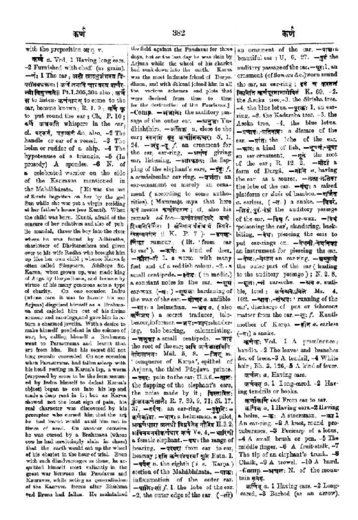
karṇa a. Ved. 1 Having long ears. 2 Furnished with chaff (as grain). — rṇaḥ 1 The ear; aho khalabhujaṃgasya viparītavadhakramaḥ . karṇe lagati cānyasya prāṇairanyo viyujyate .. Pt. 1. 305, Pt. 1. 304 also; karṇaṃ dā to listen; karṇamāgam to come to the ear, become known; R. 1. 9; karṇe kṛ to put round the ear; Ch. P. 10; karṇe kathayati whispers in the ear; cf. ṣaṭkarṇa, catuṣkarṇa &c. also. 2 The handle or ear of a vessel. 3 The helm or rudder of a ship. 4 The hypotenuse of a triangle. 5 (In prosody) A spondee. 6 N. of a celebrated warrior on the side of the Kauravas mentioned in the Mahābhārata. [He was the son of Kuntī begotten on her by the god Sun while she was yet a virgin residing at her father's house (see Kuntī). When the child was born, Kuntī, afraid of the censure of her relatives and also of public scandal, threw the boy into the river where he was found by Adhiratha, charioteer of Dhṛtarāṣṭra and given over to his wife Rādhā who brought him up like her own child; whence Karṇa is often called Sūtaputra, Rādheya &c. Karṇa, when grown up, was made king of Aṅga by Duryodhana, and became by virtue of his many generous acts a type of charity. On one occasion Indra (whose care it was to favour his son Arjuna) disguised himself as a Brāhmaṇa and cajoled him out of his divine armour and ear-rings, and gave him in return a charmed javelin. With a desire to make himself proficient in the science of war, he, calling himself a Brāhmaṇa went to Paraśurāma and learnt that art from him. But his secret did not long remain concealed. On one occasion when Paraśurāma had fallen asleep with his head resting on Karṇa's lap, a worm (supposed by some to be the form assumed by Indra himself to defeat Karṇa's object) began to eat into his lap and made a deep rent in it; but as Karṇa showed not the least sign of pain, his real character was discovered by his preceptor who cursed him that the art he had learnt would avail him not in times of need. On another occasion he was cursed by a Brāhmaṇa (whose cow he had unwittingly slain in chase) that the earth would eat up the wheel of his chariot in the hour of trial. Even with such disadvantages as these, he acquitted himself most valiantly in the great war between the Pāṇḍavas and Kauravas, while acting as generalissimo of the Kaurava forces after Bhīṣma and Droṇa had fallen. He maintained ([Page 0382-b]) the field against the Pāṇḍavas for three days, but on the last day he was slain by Arjuna while the wheel of his chariot had sunk down into the earth. Karṇa was the most intimate friend of Duryodhana, and with Śakuni joined him in all the various schemes and plots that were devised from time to time for the destruction of the Pāṇḍavas.] Comp. — aṃjaliḥ the auditory passage of the outer ear. — anujaḥ Yudhiṣṭhira. — aṃtika a. close to the ear; svanasi mṛdu karṇāṃtikacaraḥ Ś. 1. 24. — aṃduḥ -dū f. an ornament for the ear, ear-ring. — arpaṇaṃ giving ear, listening. — āsphālaḥ the flapping of the elephant's ears. — iṃduḥ f. a semicircular ear-ring. — uttaṃsaḥ an ear-ornament or merely an ornament (according to some authorities). (Mammaṭa says that here karṇa means karṇāsthitatva; cf. also his remark ad loc. — karṇāvataṃsādipade karṇādidhvaninirmitaḥ . saṃnidhānārthabodhārthaṃ sthiteṣvetatsamarthanaṃ .. K. P. 7). — upakarṇikā rumour; (lit. ‘from ear to ear’). — ūrṇaḥ a kind of deer. — kīṭā -ṭī 1 a worm with many feet and of a reddish colour. 2 a small centipede. — kṣveḍaḥ (in medic.) a constant noise in the ear. — gūthaṃ ear-wax. (-thaḥ) -gūthakaḥ hardening of the wax of the ear. — gocara a. audible — grāhaḥ a helmsman. — japa a. (also karṇejapa) a secret traducer, talebearer, informer. — japaḥ -jāpaḥ slandering, tale-bearing, calumniating. — jalūkā a small centipede. — jāhaṃ the root of the ear; api karṇajāhaviniveśitānanaḥ Māl. 5. 8. — jit m. ‘conqueror of Karṇa’, epithet of Arjuna, the third Pāṇḍava prince. — jvaraḥ pain to the ear; U. 5. 6. — tālaḥ the flapping of the elephant's ears, the noise made by it; vistāritaḥ kuṃjarakarṇatālaiḥ R. 7. 39, R. 9. 71; Śi. 17. 37. — darpaṇaḥ an ear-ring. — duduṃbhiḥ = karṇakīṭā. — dhāraḥ a helmsman, a pilot; akarṇadhārā jaladhau viplaveteha nauriva H. 3. 2; avinayanadīkarṇadhāra karṇa Ve. 4. — dhāriṇī a female elephant. — pathaḥ the range of hearing. — paraṃparā from ear to ear, hearsay; iti karṇapaṃraparaya . śrutaṃ Ratn. 1. — parvan n. the eighth (i. e. Karṇa) section of the Mahābhārata. — pākaḥ inflammation of the outer ear. — pāliḥ -lī f. 1 the lobe of the ear. 2 the outer edge of the ear. — (lī) ([Page 0382-c]) an ornament of the ear. — pāśaḥ a beautiful ear; U. 6. 27. — puṭaṃ the auditory passage of the ear. — pūraḥ 1 an ornament (of flowers &c.) worn round the ear, an ear-ring; idaṃ ca karatalaṃ kimiti karṇapūratāmāropitaṃ K. 60. 2 the Aśoka tree. 3 the Śirīṣa tree. 4 the blue lotus. — pūrakaḥ 1 an earring. 2 the Kadamba tree. 3 the Aśoka tree. 4 the blue lotus. — praṇādaḥ, -pratināhaḥ a disease of the ear. — prāṃtaḥ the lobe of the ear. — phalaḥ a kind of fish. — bhūṣaṇaṃ, -bhūṣā an ear-ornament. — mūlaṃ the root of the ear; R. 12. 2. — moṭī a form of Durgā. — yoni a. having the ear as a source. — latā, -latikā the lobe of the ear. — vaṃśaḥ a raised platform or dais of bamboo. — varjita a. earless. — (taḥ) a snake. — vivaraṃ, — chidraṃ, -puraṃ, -raṃbhraṃ the auditory passage of the ear. — viṣ f. ear-wax. — viṣaṃ ‘poisoning the ear’, slandering, backbiting. — vedhaḥ piercing the ears to put ear-rings on. — vedhanī,-vedhanikā an instrument for piercing the ear. — veṣṭaḥ, -veṣṭanaṃ an ear-ring. — śaṣkulī the outer part of the ear (leading to the auditory passage); N. 2. 8. — śūlaḥ, -laṃ ear-ache. — śrava a. audible, loud; karṇaśrave'nile Ms. 4. 102. — śrāvaḥ, -saṃśravaḥ ‘running of the ear’, discharge of pus or ichorous matter from the ear. — sūḥ f. Kuntī, mother of Karṇa. — hīma a. earless — (naḥ) a snake.
Cappeller 1887 Substantiv Maskulin
Originaltext · Deutsch · Substantiv Maskulin
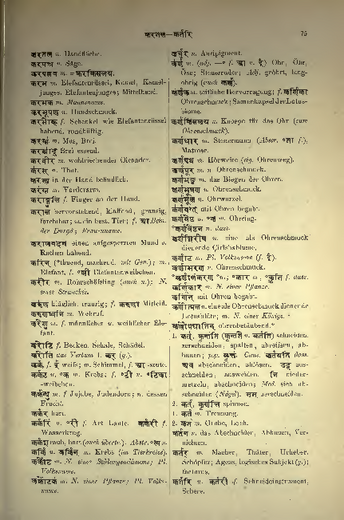
kárṇa m. (adj. —˚ f. ā u. ī) Ohr, Öhr, Öse; Steuerruder; Adj. geöhrt, langohrig (auch karṇa)
Burnouf 1866 Substantiv Maskulin
Originaltext · Französisch · Substantiv Maskulin
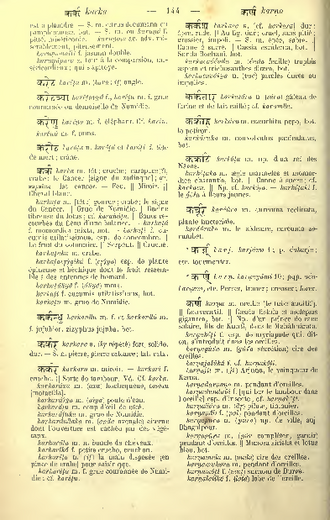
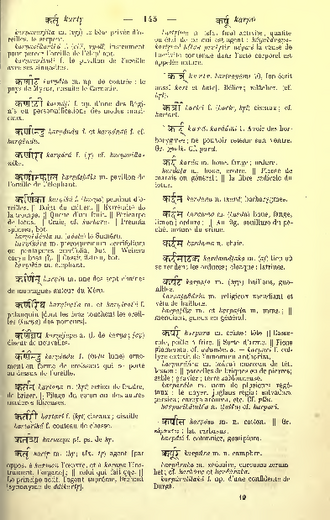
karṇa karṇa m. oreille [le tube auditif]. Gouvernail. Cassia fistula et asclepias gigantea, bot. Np. d'un prince de race solaire, fils de Kuntī, dans le Mahābhārata. karṇakoṭī f. esp. de myriapode qui, diton, s'introduit dans les oreilles. karṇagūtha m. (gūtha sécrétion) cire des oreilles. karṇajalūkā f. cf. karṇakoṭī. karṇajit m. (ji) Arjuna, le vainqueur de Karṇa. karṇadarpaṇa m. pendant d'oreilles. karṇadundubhi f. [qui bat le tambour dans l'oreille] esp. d'insecte; cf. karṇakoṭī. karṇadhāra m. (dhṛ) pilote, timonier. karṇapālī f. (pal) pendant d'oreilles. karṇapura n. (pura) np. de ville, auj. Bhagalpour. karṇapūra m. (pūr compléter, garnir) pendant d'oreilles. Mimosa śirīṣa et lotus bleu, bot. karṇamala m. (mala) cire des oreilles. karṇamukura m. pendant d'oreilles. karṇamoṭī f. (muṭ) surnom de Durgā. karṇalatikā f. (latā) lobe de l'oreille. [Page145-1] karṇavarjita m. (vṛj) la bête privée d'oreilles, le serpent. karṇavedhanikā f. (vidh, vyadh) instrument pour percer l'oreille de l'éléphant. karṇacaṣkulī f. le pavillon de l'oreille avec ses sinuosités.
Quelltextfundstellen (8)
HP 3 Fundstellen
MAN 1 Fundstelle
MandUp 1 Fundstelle
SiSa 1 Fundstelle
Mit AYI Free weitermachen
Bildquelle: AYI Archiv.