

meru मेरु – Meru
Substantiv Feminin · Substantiv Maskulin · Worttyp nicht bestimmt
Wörterbuchquellen
AYI Wörterbuch Substantiv Maskulin
Meru
Cappeller 1891 Substantiv Maskulin
Originaltext · Englisch · Substantiv Maskulin
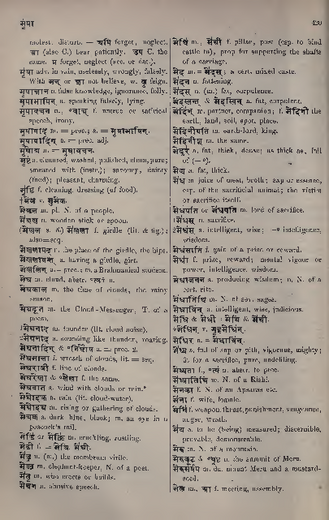
meru ·m. N. of a mountain.
Monier-Williams 1872 Substantiv Maskulin
Originaltext · Englisch · Substantiv Maskulin
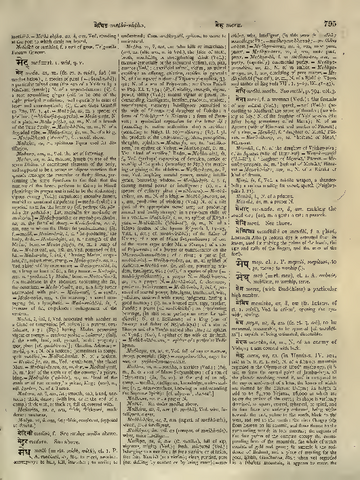
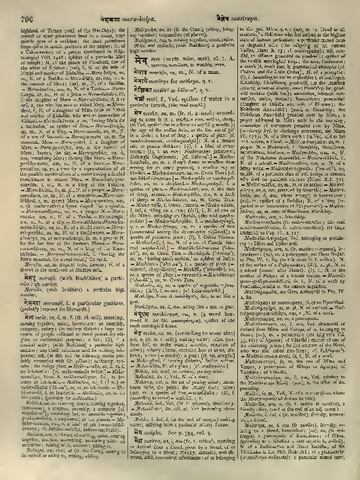
meru meru, us, m. (in Uṇādi-s. IV. 101, said to be fr. rt. 1. mi), N. of a fabulous mountain regarded as the Olympus of Hindū mythology, (it is said to form the central point of Jambu-dvīpa, all the planets revolving round it, and is compared to the cup or seed-vessel of a lotus, the leaves of which are formed by the different Dvīpas; its height is said to be 84, 000 Yojanas, 16, 000 of which are below the surface of the earth; its shape is variously described, as square, conical, spherical, or spiral, and its four faces are variously coloured, being white towards the east, yellow to the south, black to the west, and red to the north; the river Ganges falls from heaven on its summit, and flows thence to the surrounding worlds in four streams; the regents of the four points of the compass occupy the corres- ponding faces of the mountain, the whole of which consists of gold and gems; its summit is the resi- dence of Brahmā, and a place of meeting for the gods, Ṛṣis, Gandharvas, &c.; when not regarded as a fabulous mountain, it appears to mean the highland of Tartary north of the Himālaya); the central or most prominent bead in a rosary, large middle gem of a necklace; the most prominent finger-joint in certain positions of the fingers; N. of a Cakra-vartin; of a person mentioned in Rāja- taraṅgiṇī VIII. 1418; epithet of a particular kind of temple; N. of the palace of Gāndhārī, one of the wives of Kṛṣṇa; (us), f., N. of the wife of Nābhi and mother of Ṛṣabha.
Petersburger 1855 Substantiv Feminin · Substantiv Maskulin · Worttyp nicht bestimmt
Originaltext · Deutsch · Substantiv Feminin · Substantiv Maskulin
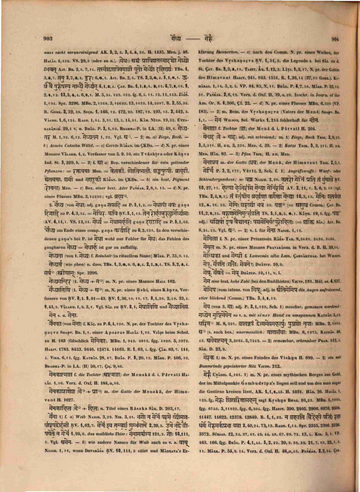
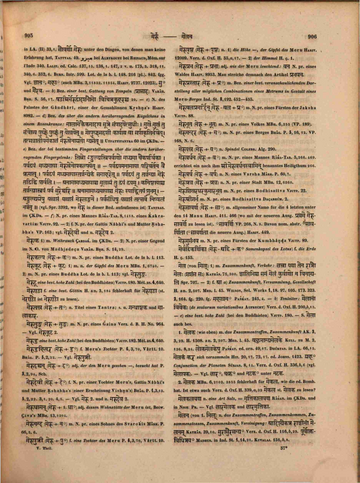
merú UṆĀDIS. 4,101. 1〉 m. N. pr. eines mythischen Berges aus Gold. der im Mittelpunkte Jambudvīpaʼs liegen soll und um den man sogar die Gestirne kreisen lässt, AK. 1,1,1,45. H. 1031. HĀR. 26. HALĀY. 1,135. fg. meruḥ śikhariṇāmaham sagt Kṛṣṇa BHAG. 10,23. MBH. 1,1098. fgg. MBH. 1,6740. MBH. 3,11852. fgg. MBH. 6,204. fgg. HARIV. 390. HARIV. 2405. HARIV. 2906. HARIV. 8976. HARIV. 9500. HARIV. 11447. HARIV. 11622. HARIV. 12378. HARIV. 12849. R. 1,1,32. na jahāti (vaidehī patiṃ) ratā dharme merumarkaprabhā yathā R. 2,40,24. R. 2,73,13. RAGH. 1,14. Spr. 2355. Spr. 2386. Spr. 2526. Spr. 3572. SŪRYAS. 12,34. SŪRYAS. 12,37. SŪRYAS. 12,41. SŪRYAS. 12,43. SŪRYAS. 12,44. SŪRYAS. 12,48. SŪRYAS. 12,67. SŪRYAS. 12,69. SŪRYAS. 12,72. SŪRYAS. 13,4. KIR. 5,1. VP. 163. VP. 166. fgg. BHĀG. P. 4,1,44. BHĀG. P. 5,2,22. BHĀG. P. 5,20,2. BHĀG. P. 5,2,30. BHĀG. P. 5,2,35. BHĀG. P. 5,21,7. BHĀG. P. 5,2,13. BHĀG. P. 5,22,1. BHĀG. P. 5,2,2. BHĀG. P. 5,2,11. MĀRK. P. 54,9. MĀRK. P. 54,14. Verz. d. Oxf. H. 48,a,40. PAÑCAR. 2,2,54. ŚUK. in LA. (II) 33,1. sauvarṇo meruḥ unter den Dingen, von denen man keine Erfahrung hat, TATTVAS. 49. ميرو bei ALBYROUNY_bei_REINAUD, Mém. sur lʼInde 340. LALIT. ed. Calc. 137,15. LALIT. ed. Calc. 138,1. LALIT. ed. Calc. 147,2 v. u. 175,3. LALIT. ed. Calc. 318,11. LALIT. ed. Calc. 340,6. LALIT. ed. Calc. 352,6. BURN. Intr. 599. Lot. de la b. l. 148. Lot. de la b. l. 216 (pl.). Lot. de la b. l. 842. fgg. Vgl. jñāna˚, mahā˚ (auch MBH. 3,11852. MBH. 3,11854. HARIV. 9737. HARIV. 12025), su˚ und mairava. — b〉 Bez. einer best. Gattung von Tempeln (prāsāda) VARĀH. BṚH. S. 56,17. ṣaḍaśrirmerurdvādaśabhaumo vicitrakuharaśca VARĀH. BṚH. S. 20. — c〉 N. des Palastes der Gāndhārī, einer der Gemahlinnen Kṛṣṇaʼs HARIV. 8982. — d〉 Bez. des über die andern herüberragenden Kügelchens in einem Rosenkranze: mālāmekaikamādāya sūtre saṃpādayetsudhīḥ . mukhe mukhaṃ tu saṃyojya pucchaṃ tu yojayet .. gopucchasadṛśī kāryātha vā sarpākṛtirbhavet . tatsajātīyamekākṣaṃ merutvenāgrato nyaset .. UTPATTITANTRA 60_im_ŚKDR. — e〉 Bez. der bei bestimmten Fingerstellungen über die andern herüberragenden Fingergelenke: tisro 'ṅgulyastriparvāṇo madhyamā caikaparvikā . parvadvayaṃ madhyamāyā merutvenopakalpayet .. — parvadvayamanāmāyā parivartena vai kramāt . parvadvayaṃ madhyamāyāstarjanyekaṃ samāharet .. parvadvayaṃ tu tarjanyā meruṃ tadvidvi pārvati . — anāmāmadhyamāyāśca mūlāgraṃ tu dvayaṃ dvayam . kaniṣṭhāyāśca tarjanyāstrayaṃ parva sureśvari .. anāmāmadhyamāyāśca meruḥ syāddvitayaṃ śubham . — aṅgulyagreṣu yajjaptaṃ yajjaptaṃ merulaṅgane . parvasaṃdhiṣu yajjaptaṃ tatsarvaṃ niṣphalaṃ bhavet .. (vgl. Spr. 3392, wo meru in dieser Bed. aufzufassen ist) TANTRAS._im_ŚKDR. — f〉 N. pr. eines Mannes RĀJA-TAR. 8,1418. eines Cakravartin VYUTP. 92. — 2〉 f. N. pr. der Gattin Nābhiʼs und Mutter Ṛṣabhaʼs VP. 163; vgl. merudevī und u. marudeva 2.
Originaltext · Deutsch · Worttyp nicht bestimmt
meru 1〉e〉 vgl. karatale vindhyāṭavī sevitā SUBHĀṢ. 71.
Böhtlingk 1879 Substantiv Feminin · Substantiv Maskulin
Originaltext · Deutsch · Substantiv Feminin · Substantiv Maskulin
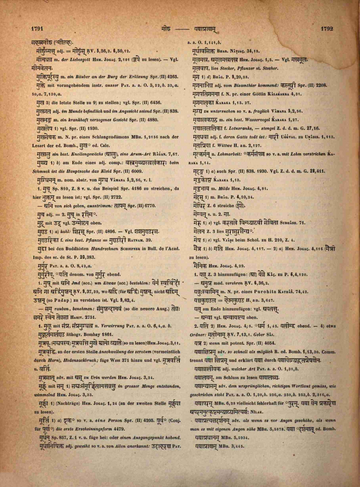
meru — 1〉 m. — a〉 N. pr. eines Berges aus Gold, der im Mittelpuncte Jambudvīpaʼs liegen soll und um den man die Gestirne kreisen lässt. Auch Pl. bei den Buddhisten. Nom. abstr. ˚tva n. — b〉 eine best. Gattung von Tempeln. — c〉 das über die andern herüberragende Kügelchen im Rosenkranze. — d〉 die bei bestimmten Fingerstellungen über die anndern herüberragenden Fingergelenke. — e〉 N. pr. — α〉 des Palastes der Gāndhārī, einer der Frauen Kṛṣṇaʼs. — β〉 verschiedener Männer. — 2〉 f. N. pr. der Gattin Nābhiʼs und Mutter Ṛṣabhaʼs.
Apte 1890 Substantiv Maskulin
Originaltext · Englisch · Substantiv Maskulin
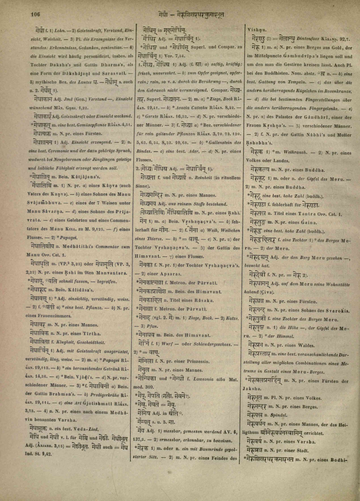
meruḥ 1 N. of a fabulous mountain (round which all the planets are said to revolve; and which forms the centre of the several Dvīpas; cf. dvīpa; it is also said to consist of gold and gems); vibhajya merurna yadarthisāt kṛtaḥ N. 1. 16; svātmanyeva samāptahemamahimā merurna me rocate Bh. 3. 150. 2 The central bead in a rosary. 3 The central gem of a necklace. Comp. — ādrikarṇikā the earth. — dhāman m. an epithet of Śiva. — pṛṣṭhaṃ heaven, the sky. — yaṃtraṃ a figure shaped like a spindle.
Cappeller 1887 Substantiv Maskulin
Originaltext · Deutsch · Substantiv Maskulin
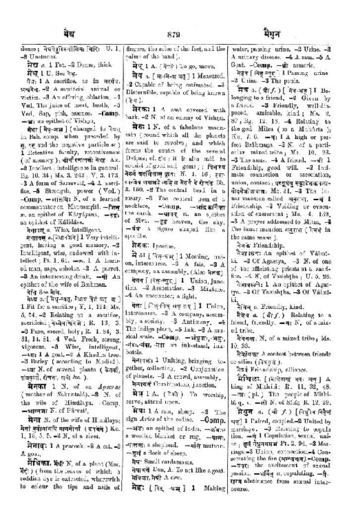
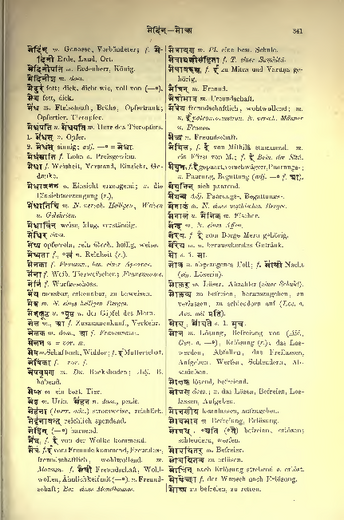
meru m. N. eines heiligen Berges.
Burnouf 1866 Substantiv Maskulin
Originaltext · Französisch · Substantiv Maskulin
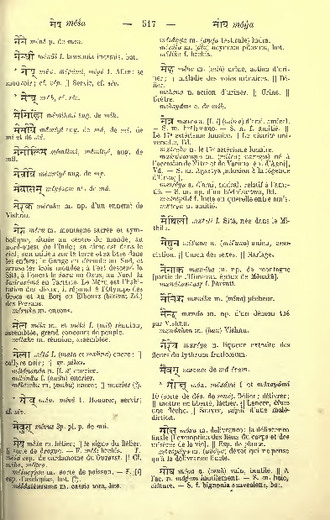
meru meru m. montagne sacrée et symbolique, située au centre du monde, au nord-ouest de l'Inde; sa cime est dans le ciel, son milieu sur la terre et sa base dans les enfers; le Gange en découle au Sud, et arrose les trois mondes; à l'est descend la Sitā, à l'ouest le cakṣu ou Oxus, au Nord la bhadrasomā en Tartarie. Le Meru est l'habitation des dieux, il répond à l'Olympe des Grecs et au Borj ou Elbourz (berezat Zd.) des Persans. meruka m. encens.
Quelltextfundstellen (16)
HP 2 Fundstellen
HTK 8 Fundstellen
HTK 10.39*2–41: Merucālaka: Ameru und Meru 3 Fundstellen
Direkt belegt
-
HTK 10.39*2 Segment 2
-
HTK 10.40 Segment 2
-
HTK 10.41 Segment 5
HTK 10.44–46*1: Ekameru, Dvimeru und Trimeru 4 Fundstellen
Direkt belegt
-
HTK 10.45 Segment 12
-
HTK 10.46 Segment 4
-
HTK 10.46 Segment 11
-
HTK 10.46*1 Segment 2
SiSa 6 Fundstellen
Mit AYI Free weitermachen
Bildquelle: AYI Archiv.