

Yoga? - But I'm too old for that...
... as if! A join-in workshop including the sun salutation. All you need to participate: a chair
The sun salutation
Starting position: standing mindfully
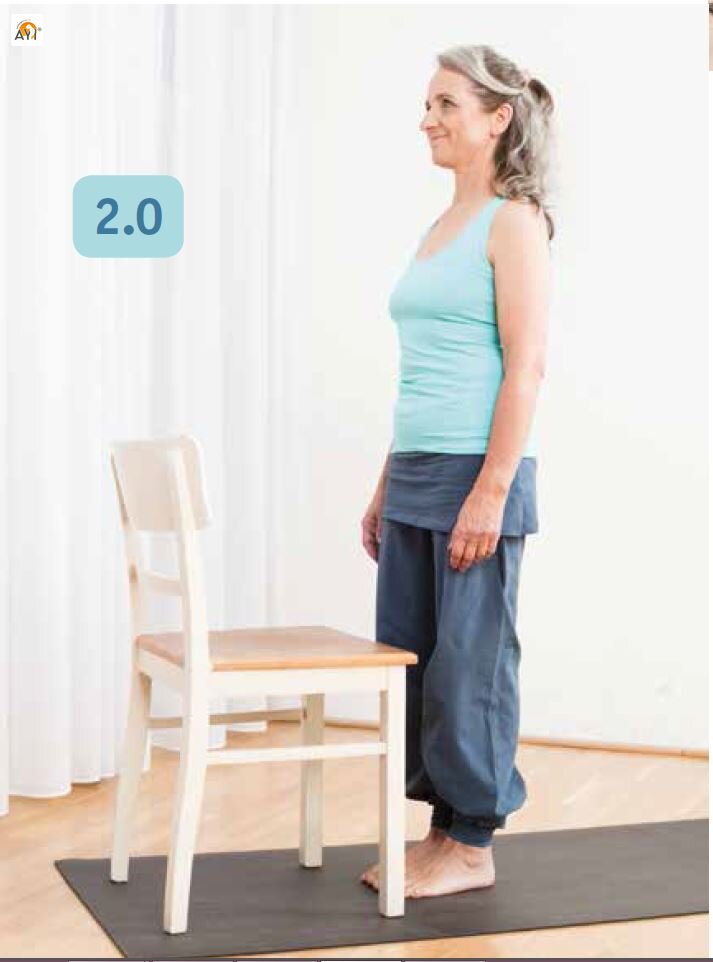
Now stand up, turn around and stand in front of the chair with your legs directly against the seat. Position your feet as parallel to one another as possible. If you can, let the balls of your feet touch while keeping your heels about two fingers' width apart (Image 2.0).
Background: At first, placing the feet evenly and parallel is usually impossible, because body awareness and coordination decline with age. Yet these abilities can also improve again. I always emphasise precise placement of the hands and feet. After just a few classes, participants become noticeably more aware of these positions. This may seem like a minor detail, but improved body awareness facilitates neural pathways in the brain. New nerve connections develop, and awareness of healthy areas of the body increases. In this way, the perception of pain from other areas of the body is literally displaced.
Movement 1: reaching upwards
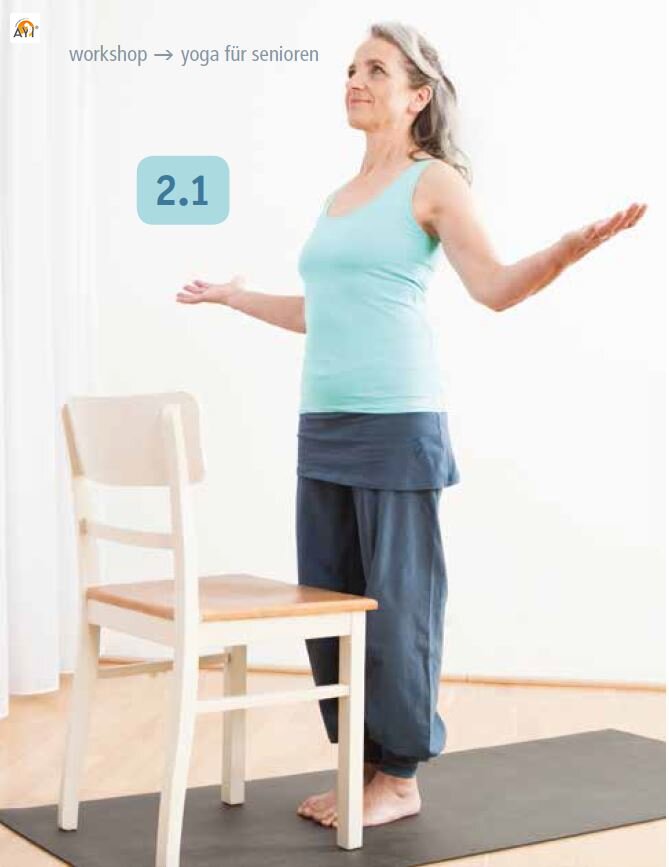
With your next inhalation, lift your arms out to the sides and upwards in an arc. Keep your palms facing upwards and guide your elbows slightly inwards and forwards. Use your full comfortable range of movement before letting the exhalation bring your arms down again. Repeat this movement a few times in rhythm with your breath. Notice how your breathing deepens. It does not matter much whether you breathe through your nose or a partly closed mouth (Image 2.1).
Background: Deepening the breath is an important part of yoga for older people. The better the lungs are ventilated, the less likely bronchitis or pneumonia becomes. Linking breath and movement naturally lengthens and deepens the breath. The movement also releases tension around the breathing space, making deeper breathing easier.
Movements 2 and 3: bowing and lengthening
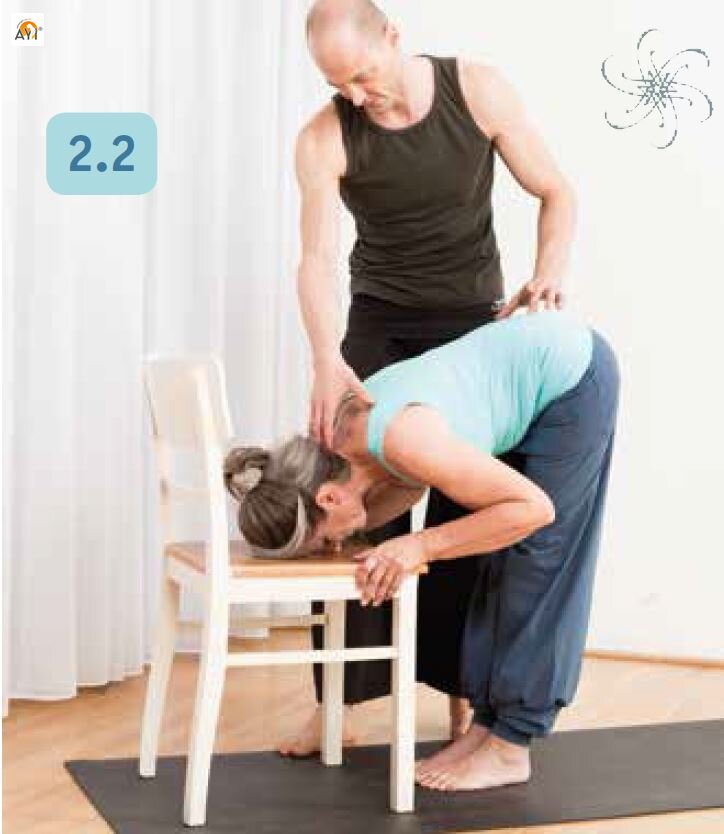
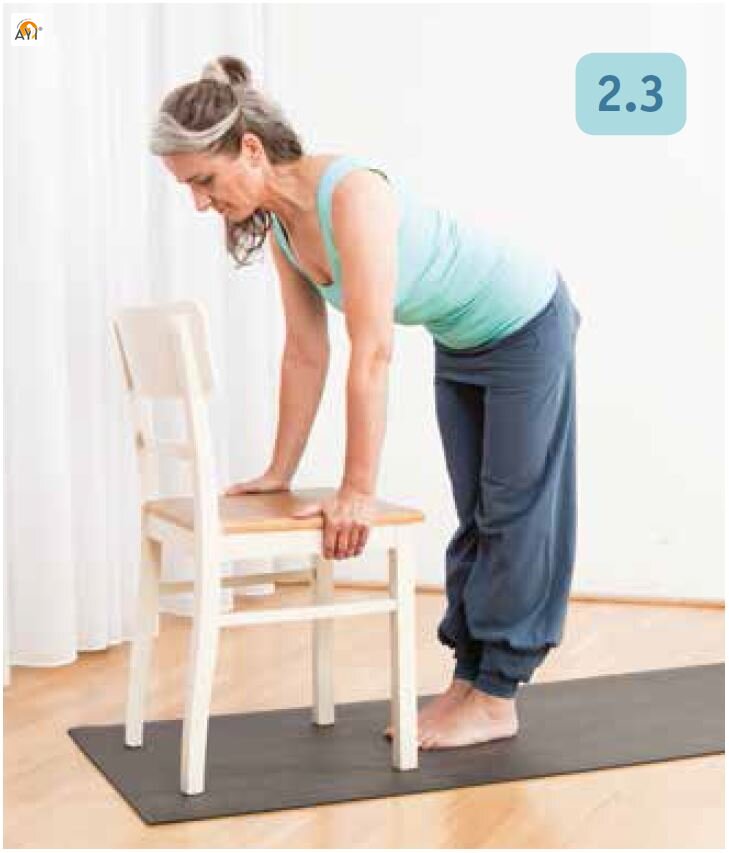
With your next exhalation, bow forwards and grasp the sides of the seat. Lengthen your back again with your next inhalation, keeping a firm grip on the chair's edges (Images 2.2 and 2.3).
Background: Throughout our lives, gravity draws us ever closer to the ground. We literally collapse into ourselves. The curves of the spine increase, the shoulders slump forwards and the legs become bent. Yet we can counter gravity by consciously lengthening upwards. Over time, our whole posture changes. I am continually fascinated by how successfully this gradual process of standing more upright can begin even in advanced age. A more upright posture brings the joints into a more balanced and therefore more comfortable position.
Movements 4 and 5: angry cat and happy cat
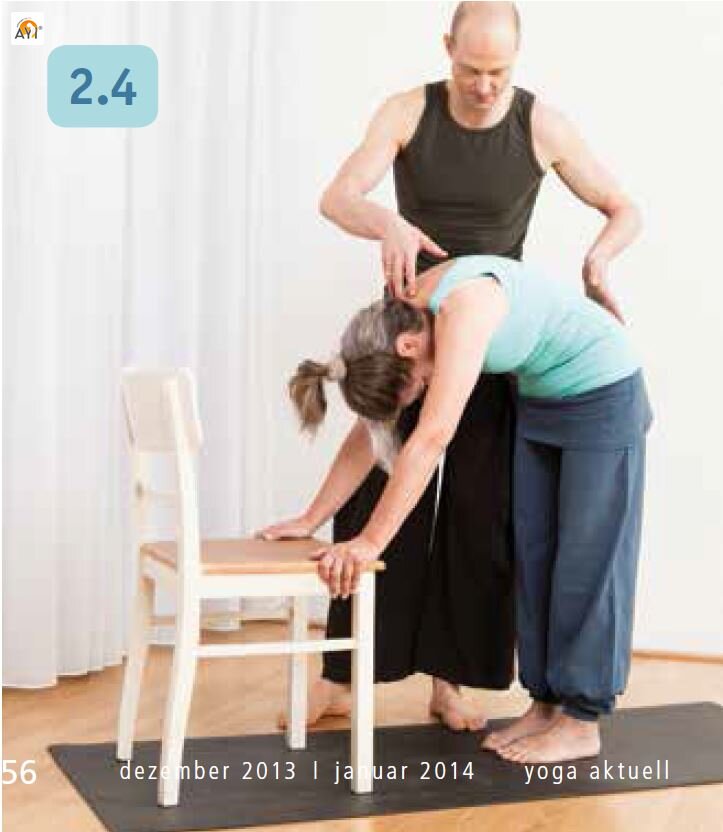
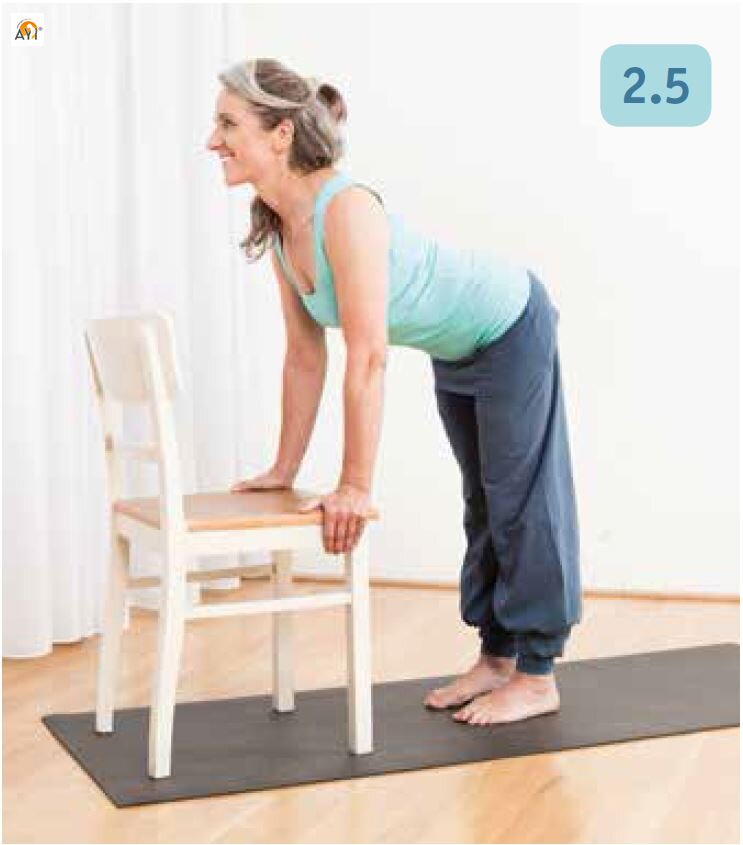
As you exhale, take a small step backwards. Your feet should again be parallel and symmetrical, roughly beneath your hips. Continue exhaling as you round your back fully; then let the inhalation guide you into an arched back. Repeat angry cat and happy cat a few times, allowing the rounding and arching to spread as evenly as possible through the whole spine in one flowing movement (Images 2.4 and 2.5).
Background: Many older people spend much of the day sitting, with the back more or less rounded forwards. Over time, it loses flexibility and becomes increasingly fixed in this position. The back muscles stiffen and tense in the same posture, leading to back pain. Moving between angry cat and happy cat in rhythm with the breath effectively restores mobility, activates the muscles and releases tension at the same time. It is a simple movement, yet remarkably effective in bringing a renewed sense of wellbeing to the back.
Movements 6 and 7: diagonal curl and stretch
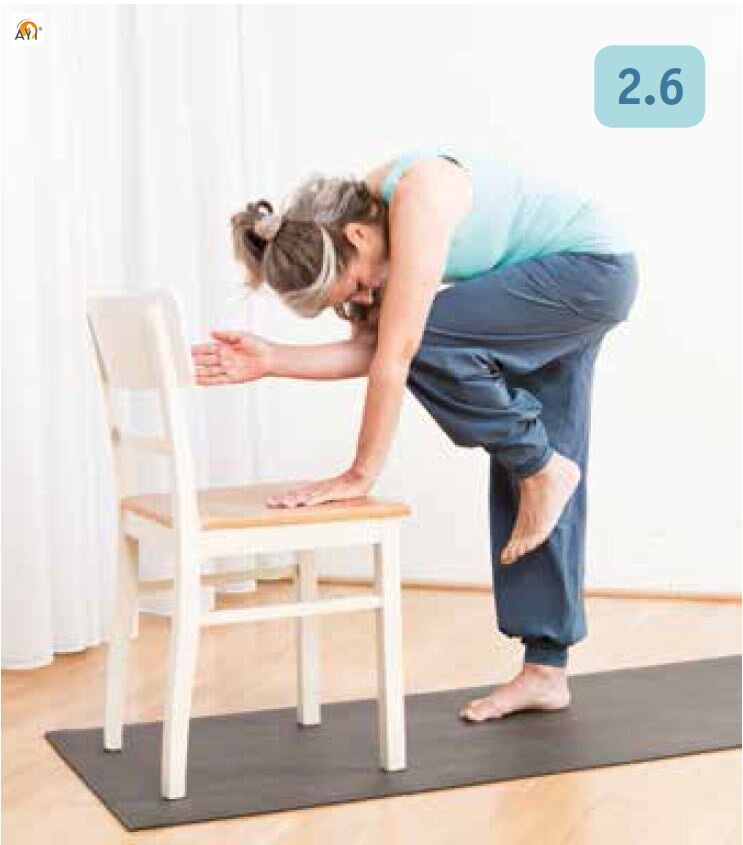
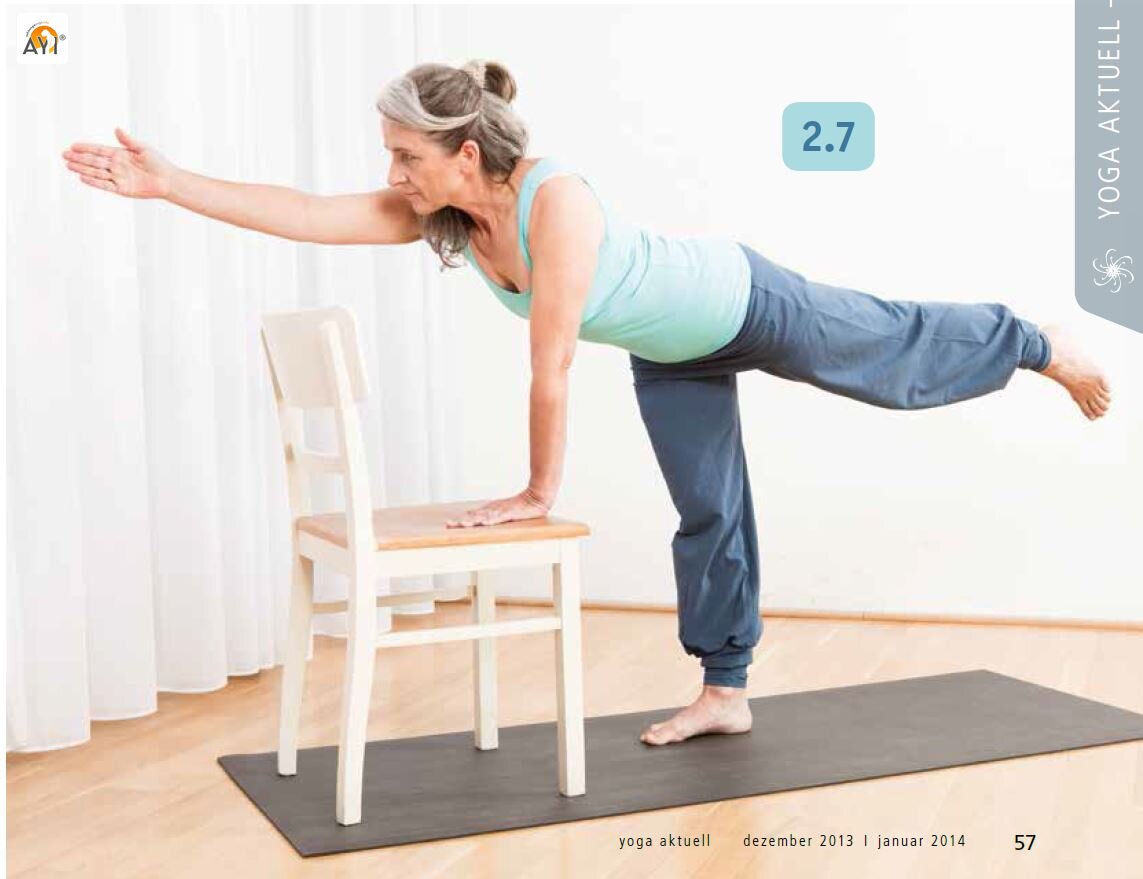
As you exhale, support yourself with your left hand on the seat. Lift your right hand and left foot. Continue exhaling as you bring the opposite knee and elbow towards each other. As you inhale, reach your right hand forwards and your left leg backwards along a diagonal. Make sure your thumb stays higher than your little finger as you reach forwards. Repeat this sequence for a few calm, even breaths (Images 2.6 and 2.7).
Background: When you try this exercise, you will probably notice how difficult it is. In fact, hardly any of the older participants manage it straight away. It is a demanding balance exercise. New participants begin by moving just the leg, then just the arm. Next comes coordinating the opposite arm and leg, which can be quite a challenge. Yet it is a motivating and worthwhile one. Participants want to learn the movement and usually begin practising at home after their very first class. Their balance and coordination soon improve. This is enormously important for older people, helping them avoid falls and the associated fractures in daily life: fall prevention that is fun!
Movements 8 to 13: continuing the flow
Continue with the movements you already know. Exhale into angry cat (movement 4), then inhale into happy cat (movement 5). Over the next few exhalations and inhalations, curl your left elbow and right knee diagonally towards one another (movement 6) and stretch them apart again (movement 7). Once more, exhale into angry cat (movement 4) and inhale into happy cat (movement 5).
Movement 14: playful dog
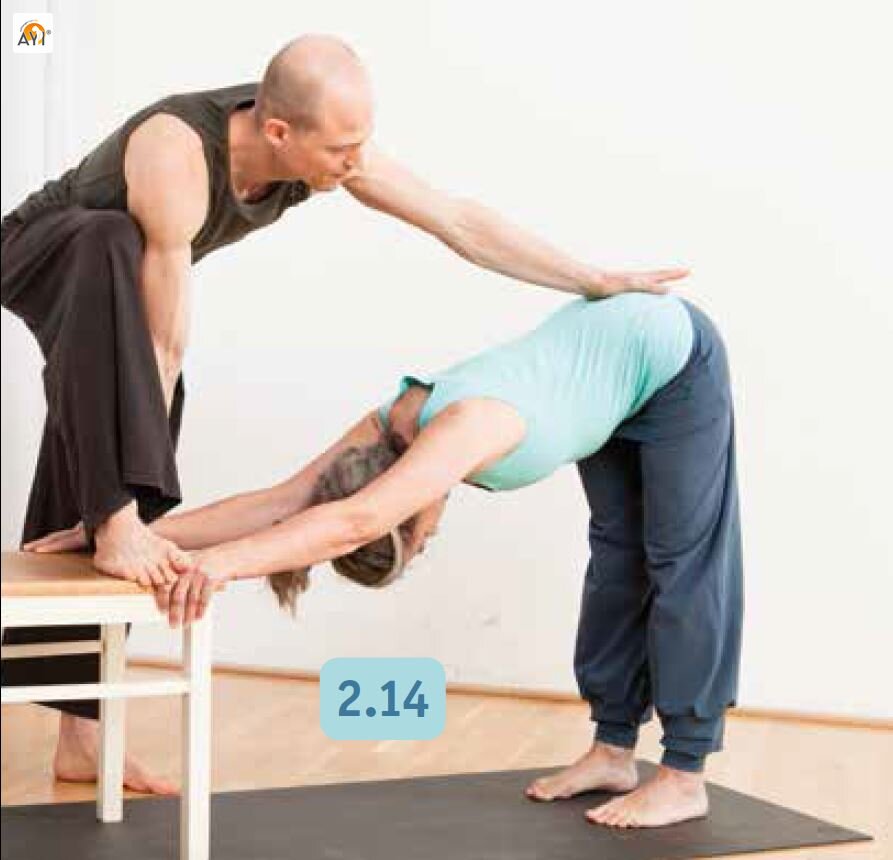
With your next exhalation, step further back, holding the edge of the chair with both hands. For about five breaths, enjoy the lengthening of your back and the comfortable stretch along the backs of your legs (Image 2.14).
Background: As you will notice, the practice is becoming dynamic and quite demanding. Studies show that only a dynamic form of yoga practice provides effective cardiovascular training. Research also tells us that just 30 minutes of cardiovascular training three times a week reduces the likelihood of a heart attack by about 30%. The study concerns patients who had already had a heart attack. Many participants in my classes for older people belong to this group. Keeping the heart healthy is therefore one of the most important preventive aspects for me. So I am pleased when participants begin to sweat.
Movements 15–17: completing the flow
With your next inhalation, come all the way forwards to the chair again. Keep your arms straight and look forwards (see movement 3). Exhale and bow deeply forwards (see movement 2). With the next inhalation, bend your knees slightly and rise with a straight back, lifting your arms out to the sides and upwards at the same time (see movement 1). An exhalation brings you back to the starting position. From here, inhale to begin another round of sun salutations. Repeat the sequence a few times in your own breathing rhythm.
Background: The movement sequence described here is an integral part of every yoga class I teach. It is the sun salutation used in Aṣṭāṅga Yoga, adapted here for older people. Repeating the same exercises may sound boring at first. Yet the more often you repeat a sequence, the more familiar it becomes. You can then begin to focus on the precision of each movement. Each time, you discover a new detail and bring greater awareness to the connection between breath and movement.
Settling down and relaxing
Finishing: relaxation
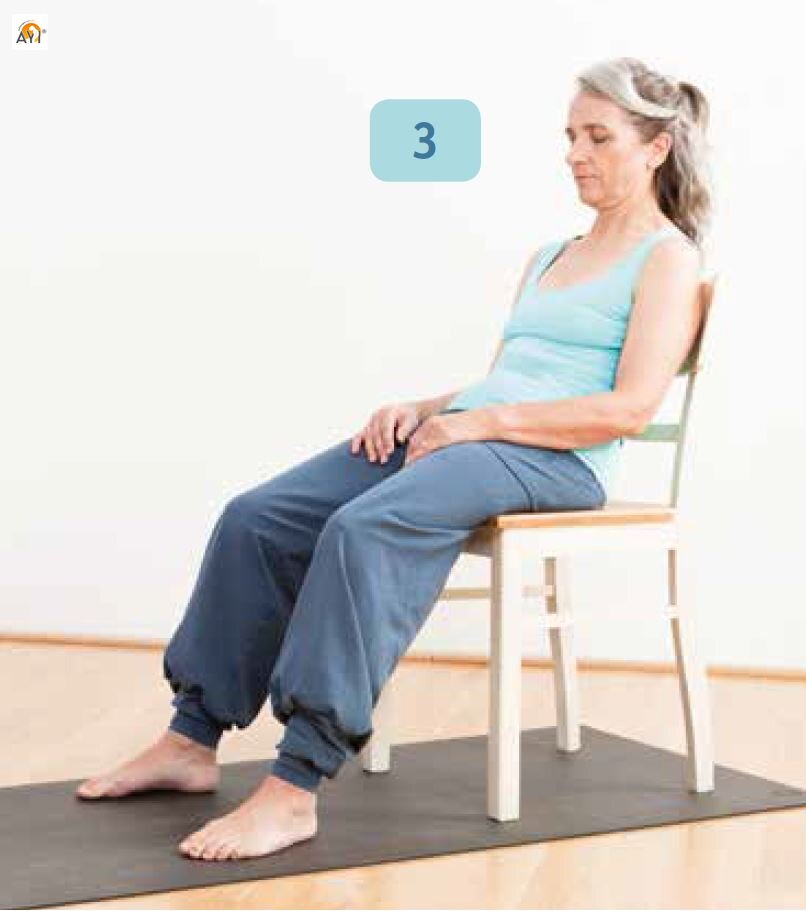
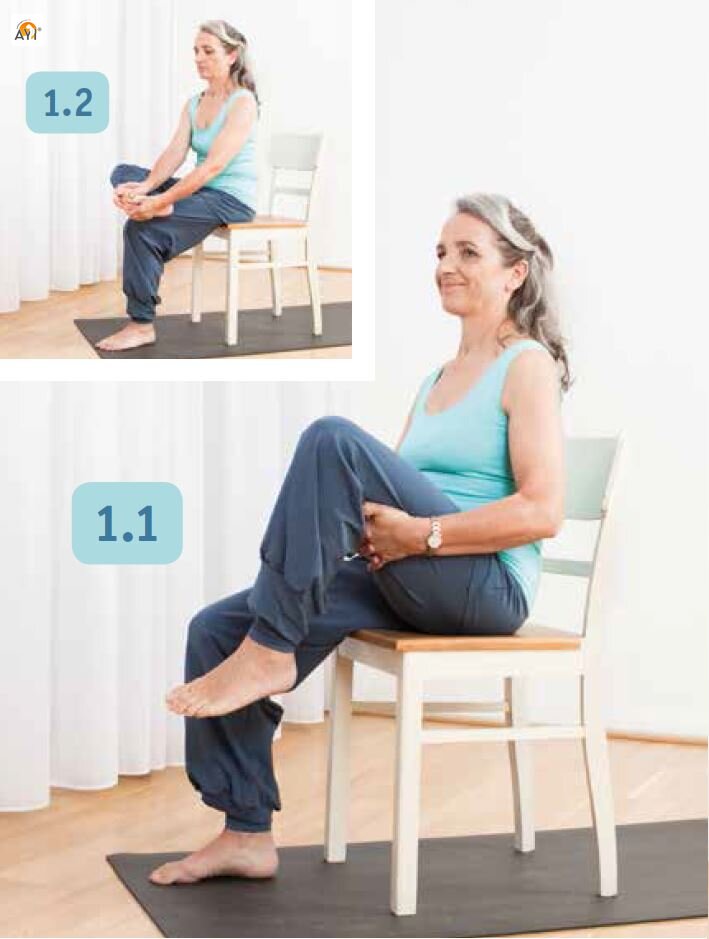
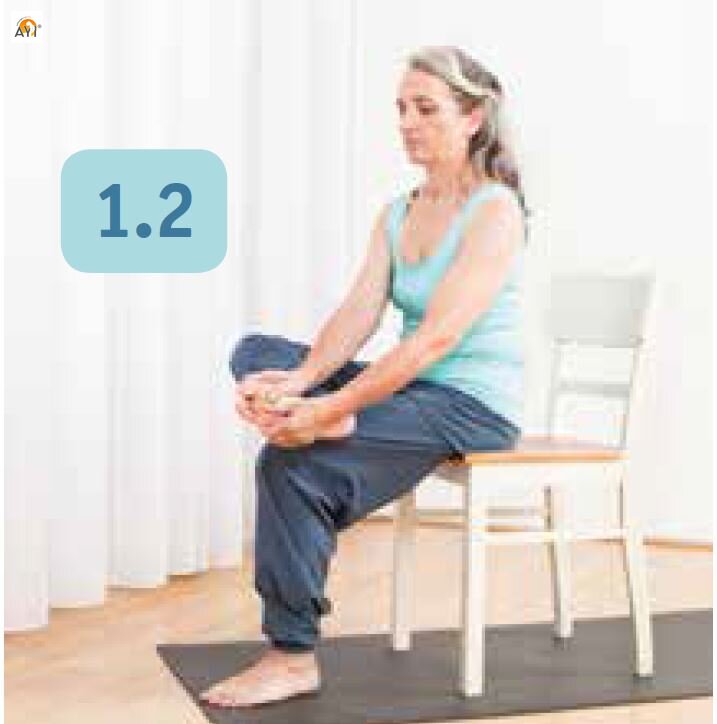
Finish your practice by sitting quietly and upright for a few breaths. Then settle comfortably onto the chair to relax (Image 3).
Background: After so much dynamic movement and effort, the muscles have a good blood supply. Relaxation is particularly beneficial now, as the muscles can easily release even deeply held tension.
Keep practising
In every yoga class, I largely follow the same sequence. I introduce a new focus, draw attention to new details and help participants develop the exercises from different perspectives, but the sequence always remains the same. This consistent structure makes it easier to establish an independent practice at home quickly. Only then do strength, stamina, flexibility, coordination and balance improve rapidly. This success provides motivation to keep practising. When physical complaints such as back or joint pain also ease, the enjoyment of independent practice grows further. In this way, yoga helps older people improve their quality of life.
Hilde (85) says: “The yoga class is the most important and enjoyable appointment of my week.”
Please log in to write a message. Go to login
No messages yet.