

Śayanāsana - The process of coming into one's own
Finding comfort while maintaining balance requires practice. Śayanāsana is the ultimate challenge of equilibrium.

2. Recovery and Supercompensation
Immediately after a challenge, the bodily system is weaker than before. For example, you cannot immediately perform even more press-ups. When practising balancing postures, you will also tire after a while and begin to wobble more. This phase is called fatigue. During recovery, however, the system adapts to the challenge. With press-ups, the muscle becomes stronger. With a balancing posture, new neural connections develop to support your balance. This phase is called supercompensation.
3. Repeating the Challenge at the Right Time
The same bodily system should be challenged again once it has fully recovered from the previous challenge and is better adapted to it than before. If the next challenge comes too soon, it falls within the fatigue phase, and the system becomes weaker with each new challenge. If we wait too long, we miss the supercompensation phase. The next challenge then meets a system in roughly the same state as before. In other words, our training has achieved nothing.
Consistency Makes the Difference
The key question is: how much recovery time is needed? A muscle, for example, needs about five days to recover and adapt after maximal-strength exertion. If we want to develop maximum muscular strength, we should therefore challenge the muscles with a maximal-strength load about every five days.
Our nervous system, by contrast, needs only about two hours to recover from a coordination challenge. Practising a balancing posture once a week leaves a gap 84 times as long as this recovery period. That would be roughly equivalent to training a muscle's maximum strength once a year. Our efforts are unlikely to produce substantial results that way.
Tip
For a while, practise balancing postures several times a day. This allows your nervous system to adapt. The good news is that once learned, the nervous system's coordination skills are retained for a long time. You probably know this from riding a bicycle: you never really forget how.
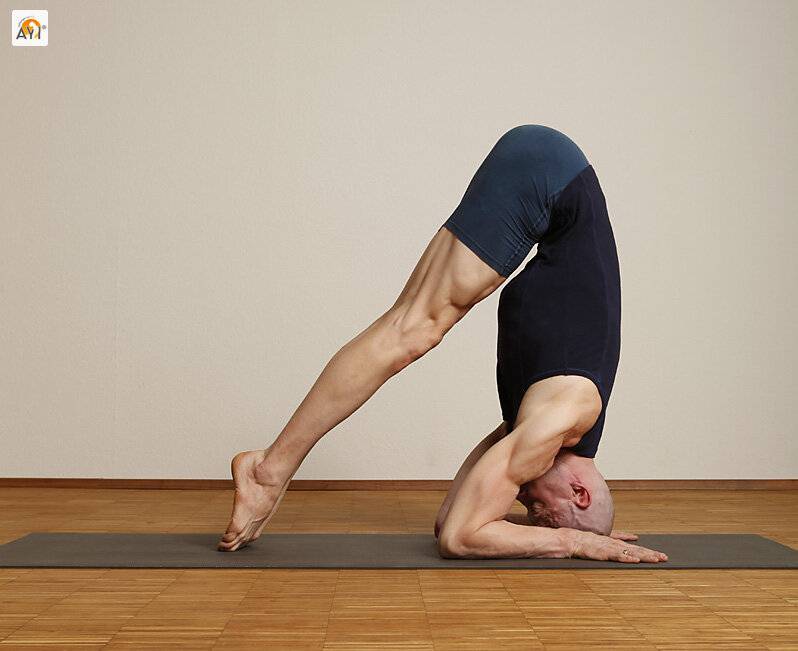
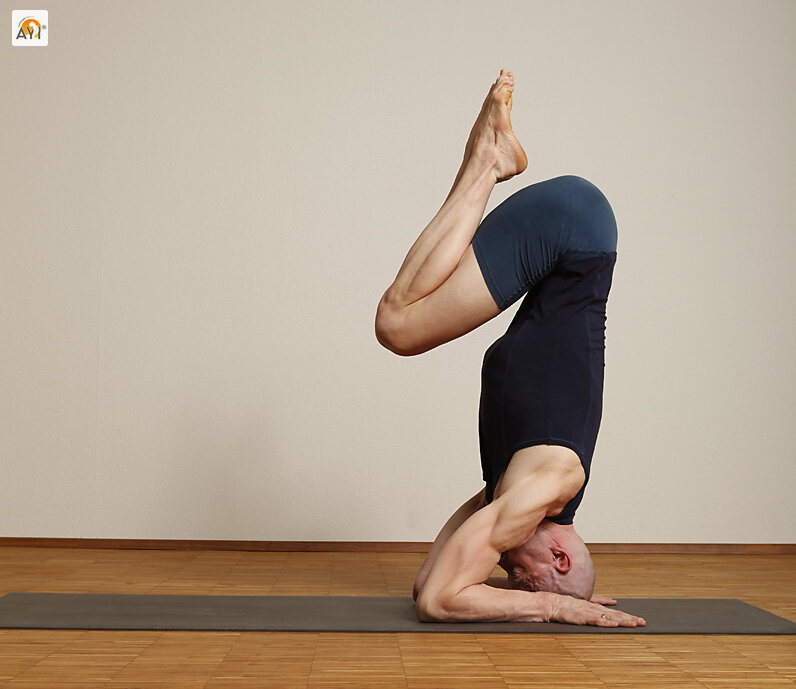
Practising Śayanāsana
If you have decided to develop your balance as you work towards Śayanāsana, you can explore the following steps:
1. Build Your Foundation
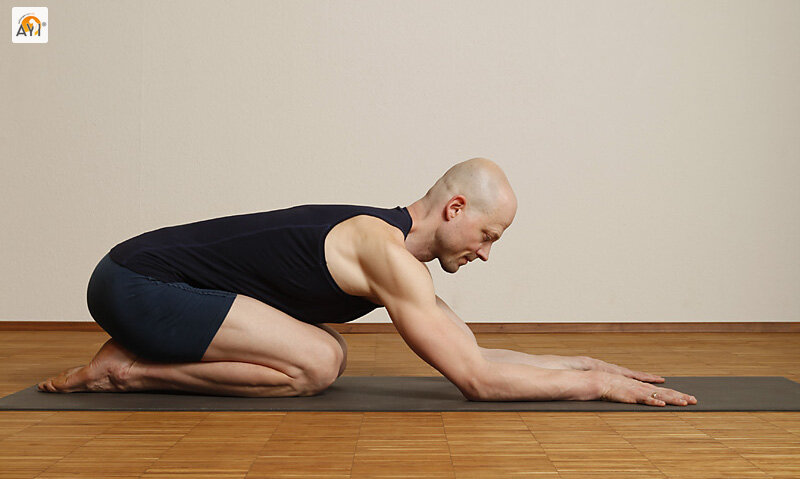
Begin in a kneeling position. Place your forearms on the floor in front of you, parallel to each other, with your palms facing down. Try to press the full surface of your forearms and palms firmly and evenly into the floor (Figure 1).
2. Experience Being Upside Down
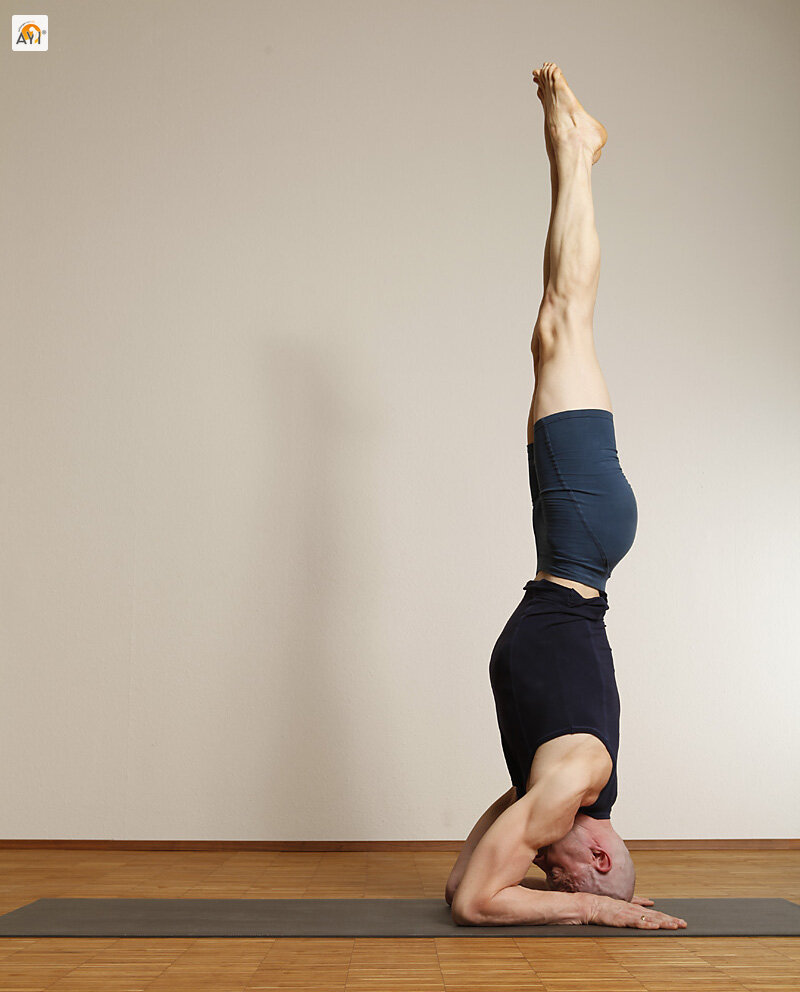
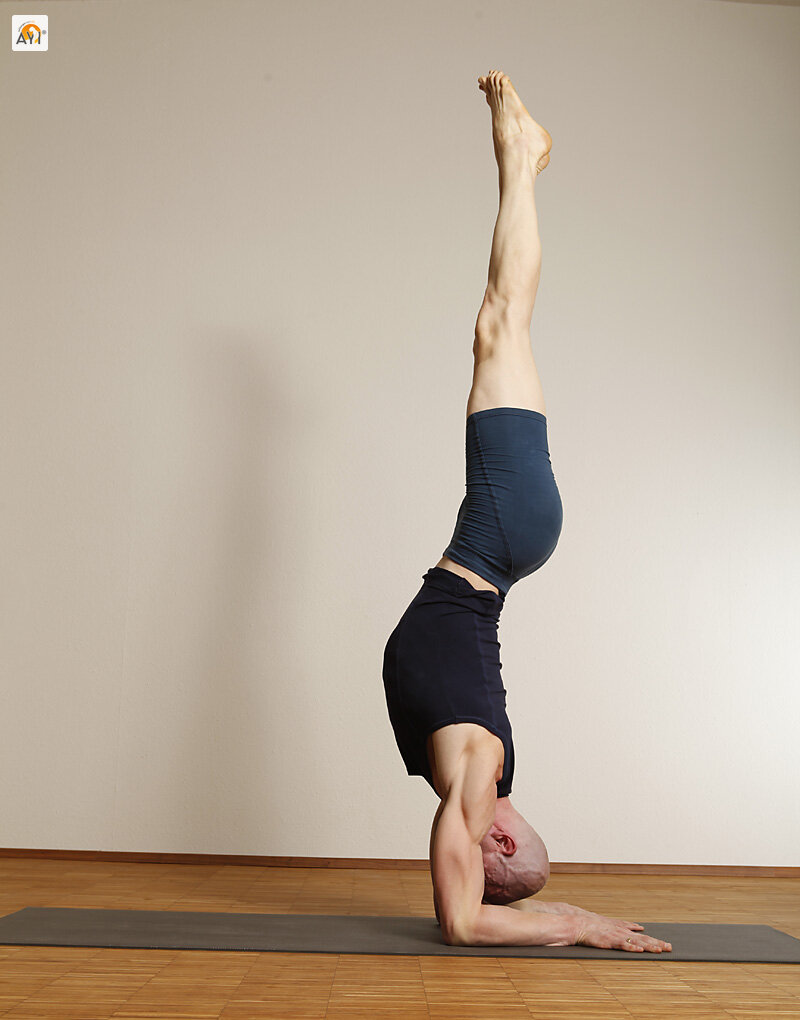
Place the flat part of the top of your head on the floor between your wrists. Straighten your legs and slowly walk your toes towards your elbows. Lift your buttocks as high as possible, bringing the seat of your body towards a point above you. Keep most of your weight supported by your forearms and hands (Figure 2).
3. Learn to Balance
Now slowly lift one foot and then the other from the floor. At first, keep your toes close to the floor so that you feel secure and do not accidentally tip over (Figure 3).
4. Build Confidence
Once your balance feels secure, you can straighten your legs upwards. If you begin to wobble, simply draw your knees back in (Figure 4).
5. Use Weight Shifts and Leverage
To challenge your balance further, move your feet slightly backwards, bringing your shoulders directly above your elbows. This shift in weight, together with the resulting leverage, allows your head to lift from the floor with surprisingly little effort (Figure 5).
6. Time Stands Still
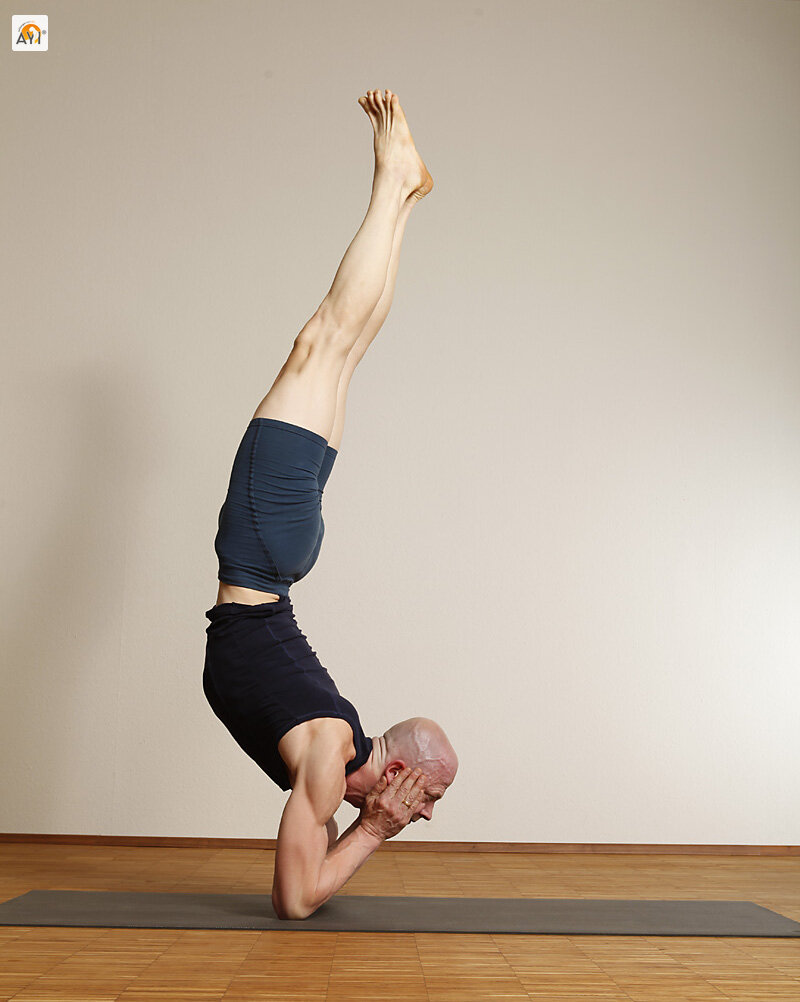
Moving further towards the final position of Śayanāsana now takes considerable patience. First, notice how your weight is distributed across your forearms. Shift your centre of gravity so that most of the weight rests at the back, on your elbows. Then lift one hand from the floor and bring it to your chin. Find stability here before following with the other hand. Alternate which hand you lift first so that you challenge your balance evenly on both elbows. One key to reaching the posture is to use your whole body actively to maintain balance (Figure 6).
What an apt name: Śayana, the resting place of the universe. Few other postures demand as much practice as the final form of Śayanāsana. Yet it is worth it. Once you arrive, time seems to stand still. At first, you may seem to float freely in space for only an instant; gradually, that instant grows longer. How fitting to name this posture after the resting place from which the whole universe emerges and into which it dissolves again: Śayana.
From Outer to Inner Balance
For me, yoga is about cultivating inner balance rather than outward appearance. A physician would say that inner balance, too, has much to do with our nervous system. This aspect can also be developed, but only through regular practice in which we keep returning to that inner balance. Enjoy your practice!
Photographer: Christian Krinninger
Please log in to write a message. Go to login