Alternative Form
Parivṛtta Trikoṇāsana
Effect
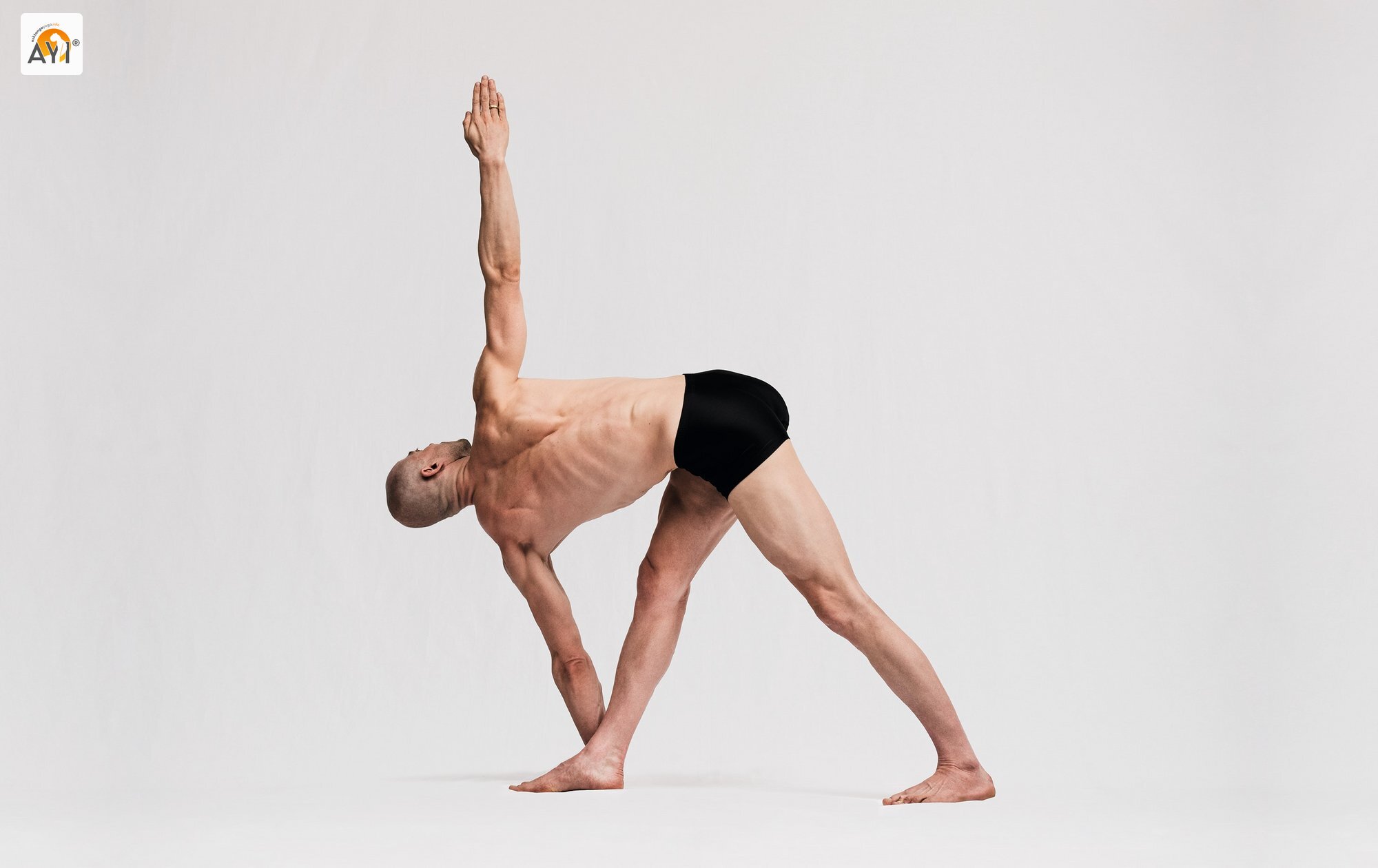
Parivṛtta Trikoṇāsana, Revolved Triangle, develops length and rotation in the spine and prepares you for backbends. It stretches the back of the front leg and gives you an opportunity to develop external rotation in the back leg. Symbolically, the posture connects earth and sky, reaching from a strong physical foundation towards subtle spiritual inspiration.
How to Practise
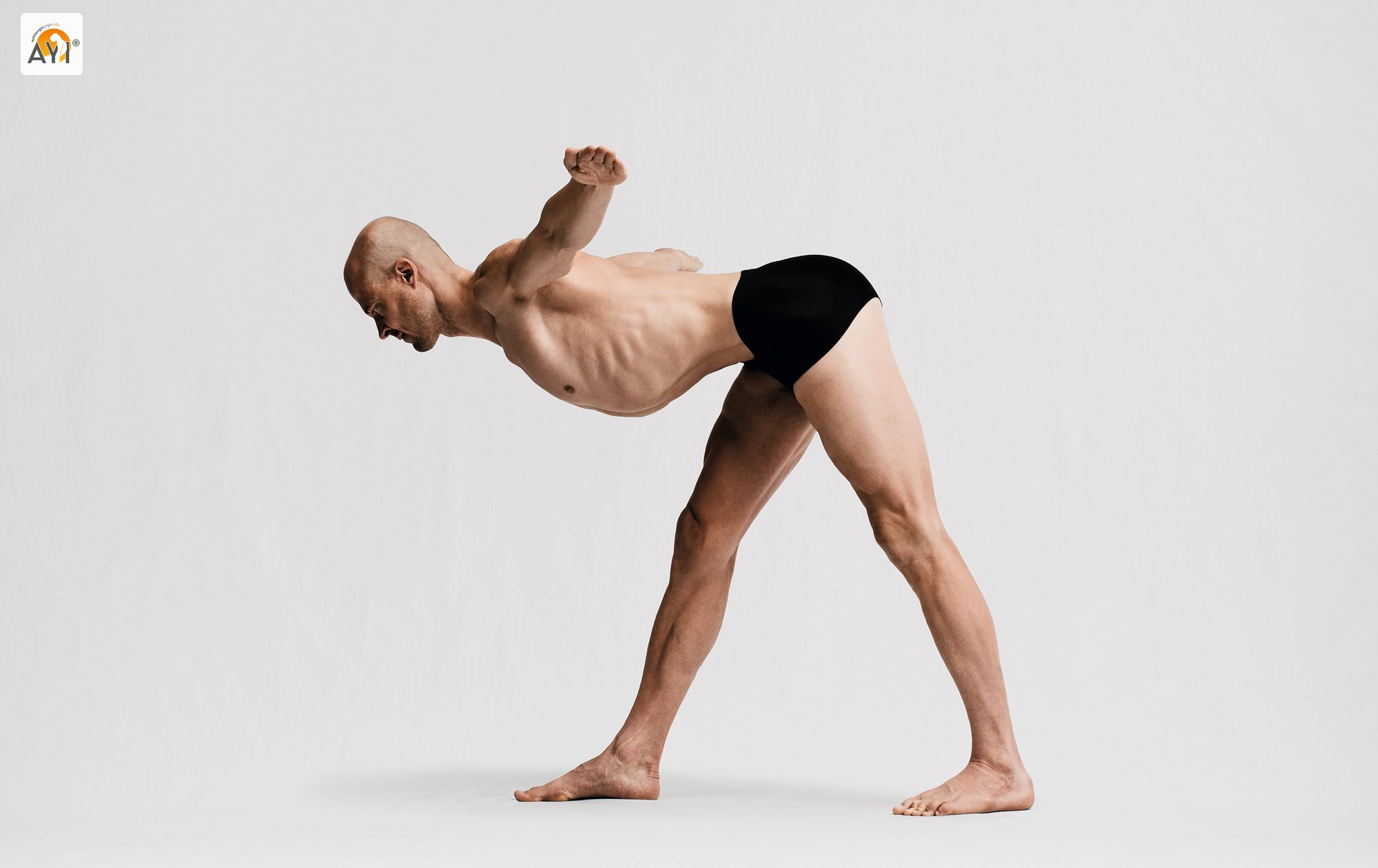
Place your feet slightly less than one leg-length apart. Position the back foot about one handspan to the side of the line formed by the front foot. The right foot points straight forwards, while the left is turned distinctly inwards. Square your pelvis to the front while standing upright with your arms extended out to the sides. From here, extend your entire upper body forwards into a horizontal position. Only then begin the rotation from your thoracic spine. Place your left hand at the outer edge of your right foot and follow your right arm upwards with your gaze.
Alignment Cues
Feet wide: Although this posture looks very similar to Triangle at first glance, its foundation is fundamentally different. Compared with Triangle, shorten the distance between your feet by about two fist-widths and widen your stance by the same amount. Your hip joints are roughly two fist-widths apart. This foundation therefore allows you to square your pelvis to the front. While the front foot points straight ahead, turn the back foot distinctly inwards. Its toes now point forwards at an angle of about 45 degrees. This foot position allows you to build the arches of both feet between a firmly rooted heel, the ball of the big toe and the ball of the little toe.
Pelvis square: With the foundation described above, it becomes easy to align your pelvis across the yoga mat, facing straight towards the right leg. Consciously rotate the left thigh outwards from the hip joint. This gives the back leg stability along its entire axis, between the pelvis and the arch of the foot.
Alignment Cues
Parivṛtta Trikoṇāsana
Forward bend first, then rotation, then backbend: Combining forward bending and rotation is particularly demanding for the lumbar spine. In Revolved Triangle, therefore, first extend forwards from your pelvis with a completely straight back. The positioning of your feet and pelvis gives you the best starting point for this. Only once your entire upper body is horizontal with a neutral spine should you begin rotating from the thoracic spine. You can then place your left hand on the floor with ease and follow your right hand upwards with your gaze. From here, broaden your heart space, lengthen your spine and rotate into what feels like a slight backbend.
Hand placement guides shoulder alignment: First place your left hand on the inside of the arch of your right foot, with the fingers pointing away from the arch at a right angle. Imagine pressing your right palm against the air. This allows you to lift both armpits as though deepening the backbend further. Within your body, this action lifts the acromion away from the head of the upper-arm bone. The space created supports the health of the shoulder joint.



Please log in to write a message. Go to login
No messages yet.