Utthita Trikoṇāsana

Alignment Cues - Utthita Trikoṇāsana

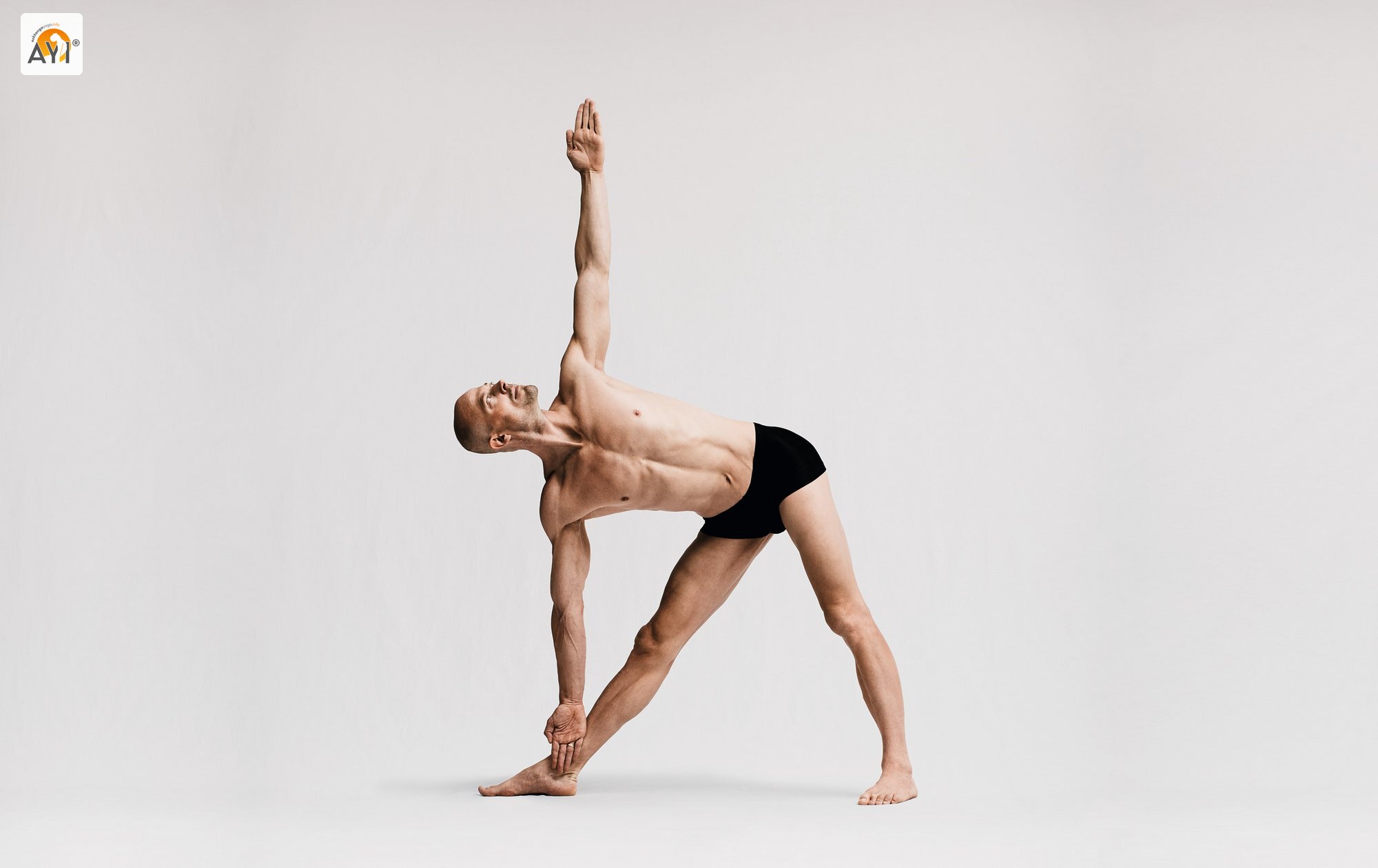
In triangle pose, the body forms several interlocking triangular shapes. Energetically, the posture transforms steadiness into spacious clarity.
Alternative Form
Utthita Trikoṇāsana

Effects

Triangle Pose, Utthita Trikoṇāsana, develops external rotation in the hip joint and flexibility along the back of the leg. It gives the spine an opportunity to lengthen and the shoulder blades room to spread sideways. In mythology, the triangle represents the world's triads: arising, enduring and passing away; above, below and centre; Sattva, Raja and Tamas.

How to Practise

Place your feet about one leg length apart. The right foot points forwards, while the left turns slightly inwards. Reach your right arm towards your right foot and hold the big toe with two fingers. Follow your left arm upwards with your gaze.

Alignment Cues

Establish a foundation: As so often, a sound foundation matters. The centre line of your right foot, running between the second toe and heel, defines the axis of the posture. Place your left heel on this line, with
the toes pointing diagonally forwards. To form an isosceles triangle with your legs, the distance between your feet should be roughly equal to your leg length.

Alignment Cues
Utthita Trikoṇāsana

Engage the front leg: To bring active tension into your front leg, unlock the knee slightly and rotate your thigh outwards until the kneecap points along the axis of the posture. Now press actively into the floor, especially through the bases of the big and little toes, while taking a little weight off the heel.

Root the back foot: In the back foot, press the bases of the big and little toes and the heel evenly into the ground. Three arches can rise between these points. If you are standing entirely on the outer edge of the foot, consciously lift the space between the heel and base of the little toe and root the base of the big toe. This guides the ankle further inwards. Conversely, if your weight is too far towards the inner edge, consciously root the base of the little toe. The arch will then lift naturally.

Tilt the pelvis: From this foundation, consciously tilt your pelvis so that your lumbar spine initially forms a slight backbend. This creates space in the sacroiliac joint and allows the greater trochanter (Trochanter Major) to pass behind the iliac wing. Unfortunately, the idea that the body should stay flat, as though between two panes of glass, still persists. This presses the greater trochanter against the iliac wing, making it almost impossible to move deeply into the posture. It also levers the head of the thigh bone out of its socket, placing unnecessary strain on the joint. This version restricts movement in the sacroiliac joint too, and the spine compensates by bending further sideways. There are many reasons to set this old idea aside.

New Series: Alignment Cues
Also published in Yoga Journal

Lengthen between the sacrum and back of the head: Entering the posture as described above places your torso slightly in front of your thigh, with a small hollow in the lower back. Drawing your sacrum backwards and the back of your head forwards allows you to lengthen the whole spine. Keep both halves of the pelvis in their original tilted position, allowing the sacrum to settle between them.

Use your grip as an anchor: Use the grip of your right fingers around your right big toe as an anchor, and reach your left hand high above you from there. Externally rotate the shoulder blades while allowing them to slide sideways across your back, as though turning your armpits towards your head while stretching the skin between your shoulder blades.

Alternative Form

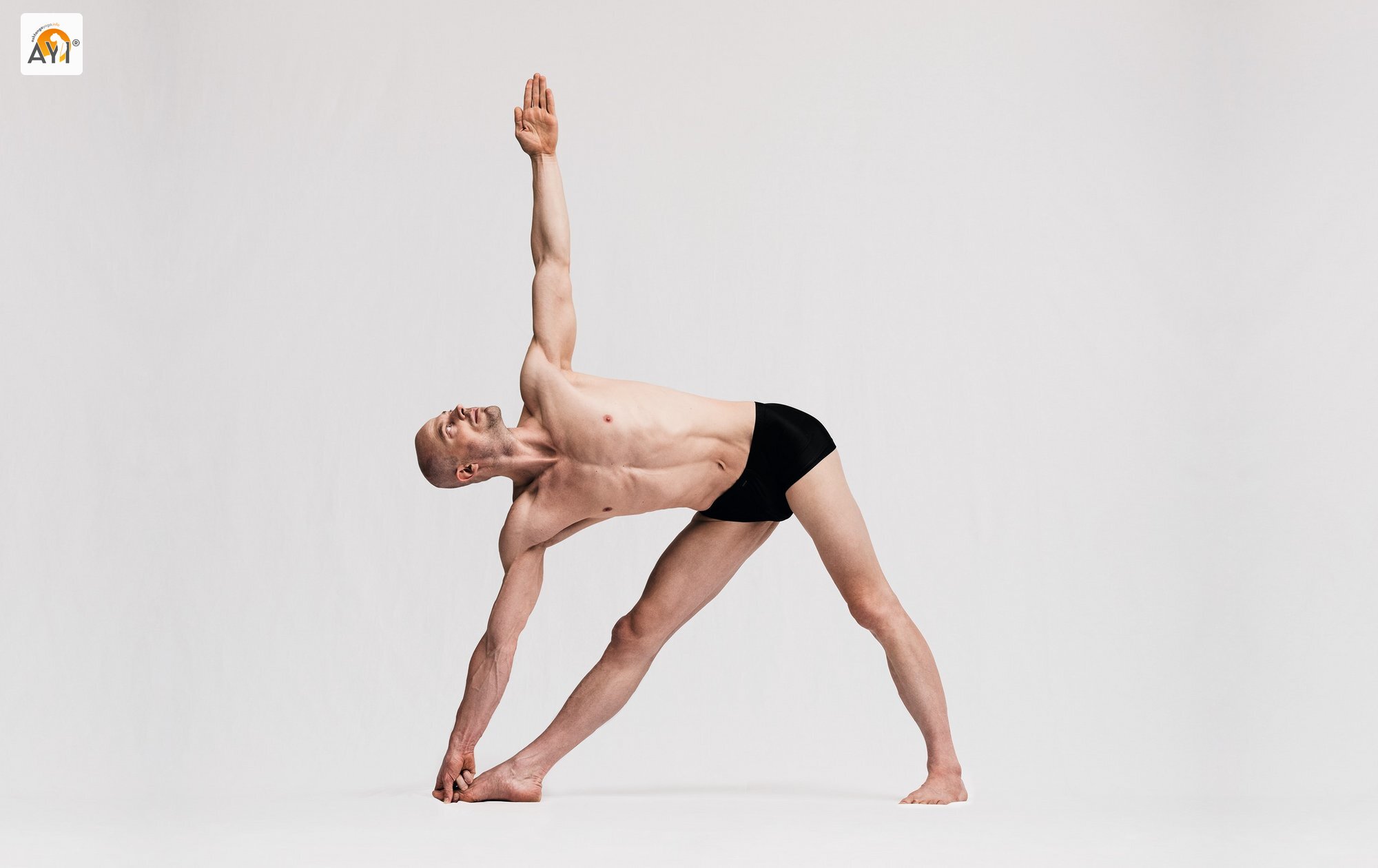
Every posture can be practised in different forms. An alternative form retains some of the effects and characteristics of the posture while avoiding one or more of its difficulties.

The limiting factors in Triangle Pose are flexibility along the back of the front leg and external rotation in the front hip. To allow your spine to lengthen in a straight line, reach your torso forwards only as far as you still feel freedom in the hip joint.

If your fingers cannot reach your foot, press the back of your hand against the inside of your shin. This pressure also makes it easier to extend your arms wide apart.

Enjoy your practice!

Photographer: Richard Pilnick - www.richardpilnick.com

Continue with AYI Free

Messages (2)

Please log in to write a message. Go to login

S
Stefanie Eschenburg
Mein Lebensalter ist alt, mein Yogaalter sehr jung (4 Wochen). Ich bin hingerissen. Der Tanz des Atems mit dem Körper. Vielen Dank.
C
Christoph Huelsewiesche
Sehr interessanter Artikel. Besonders hilfreich finde ich, wenn - mit Sicht auf die Anatomie - mit alten Vorstellungen aufgeräumt wird und so eine gesunde Praxis möglich ist. Ich freue mich sehr auf weitere Artikel in der Art.