

hara हर – removing
adjective · substantive masculine · Word type unspecified
Dictionary sources
AYI dictionary adjective · substantive masculine
Cappeller 1891 Word type unspecified
Original text · English · Word type unspecified
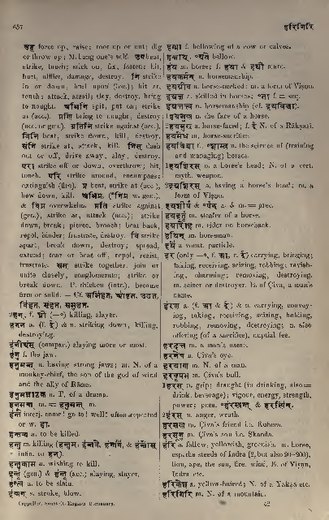
hara ·(only --°, f. ā, r. ī) carrying, bringing; taking, receiving, seizing, robbing; ravishing, charming; removing, destroying. m. seizer or destroyer, E. of Civa, a man's name.
Monier-Williams 1872 Word type unspecified
Original text · English · Word type unspecified
hara hara, haraka, &c. See p. 1175.
Original text · English · Word type unspecified
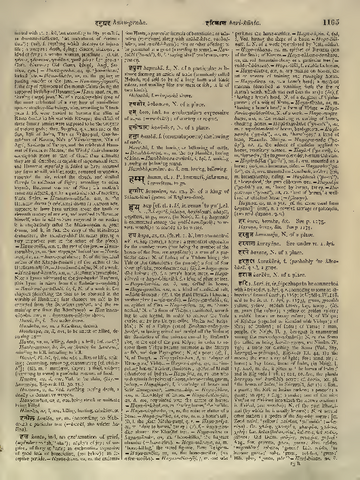
Hara, as, ā or ī, am, bringing, conveying, carry- ing, taking, seizing; captivating; removing, taking away, depriving of; dividing; (as), m. the act of carrying, taking, seizing; a seizer; N. of Śiva; of Agni; of one of the eleven Rudras; an ass; (in arithmetic) a divisor; the denominator of a fraction, division; [cf. Lat. hœres.]
Petersburger 1855 adjective · substantive masculine
Original text · German · adjective · substantive masculine
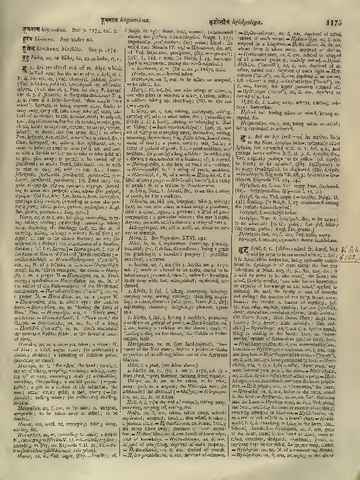
hara (von 1. har) 1〉 adj. (f. ā, seltener ī) am Ende eines comp. P. 3,2,9. P. 3,2,10. a〉 tragend; s. kavaca˚. — b〉 treibend, führend: ūrdhvabhāga˚ aufwärts SUŚR. 1,144,14. adhobhāga˚ SUŚR. 19. apathaharā indriyāśvāḥ auf Abwege KIR. 5,50. — c〉 hinbringend, befördernd: duṣpravṛtti˚ eine schlechte Nachricht zu (prati) RAGH. 12,51. — d〉 entführend, raubend, Entwender: haya˚ R. GORR. 1,42,25. dārarājya˚ R. 4,17,38. VARĀH. BṚH. S. 15,26. Spr. (II) 2584. KATHĀS. 32,72. BHĀG. P. 3,18,11. BHĀG. P. 9,8,9. uneig.: anaṅgāṅga˚ MBH. 14,211. prajñā˚, śakti˚ Spr. (II) 6773. jīvita˚ KATHĀS. 39,80. pratāpāyuḥśrī˚ RĀJA-TAR. 6,257. entziehend so v. a. übertreffend: vakṣojāvibhakumbhavibhramaharau Spr. (II) 5896. — e〉 entfernend, verscheuchend, vertreibend (ein Uebel), zu Nichte machend: agha˚ KATHĀS. 32,51. ārti˚ KATHĀS. 42,82. RĀJA-TAR. 3,87. BHĀG. P. 1,8,43. BHĀG. P. 3,4,4. BHĀG. P. 3,8,27. BHĀG. P. 4,10,30. jarāmṛtyu˚ BHĀG. P. 8,9,21. PAÑCAR. 1,4,15. madadarpa˚ Spr. (II) 2454. ratikheda˚ SĀH. D. 19,18. śoka˚ MBH. 13,902. śrama˚ KATHĀS. 84,2. saṅgadoṣa˚ BHĀG. P. 3,25,24. sarvapāpa˚ YĀJÑ. 3,309. MBH. 3,13414. yajña˚ MBH. 12,10465. R. 1,40,26. ari˚ MBH. 1,2659. pṛthu˚ (so ed. Bomb.) MBH. 14,210. trupara˚ HARIV. 10565. Spr. (II) 1525. sarvabhūta˚ SUŚR. 1,181,20. PAÑCAR. 4,3,59. = naśaka H. an. 2,470. — f〉 für sich nehmend, erhaltend: brahmadāya˚ M. 3,3. śarīrārdhaharā harasya KUMĀRAS. 1,51. — g〉 hinreissend, entzückend: manodṛṣṭi˚ R. 2,96,4. — 2〉 m. a〉 Divisor COLEBR. Alg. 8. COLEBR. Alg. 13. COLEBR. Alg. 85. Journ. of the Am. Or. S. 6,558. Comm. zu ĀRYABH. 2,27. — b〉 Hengst (!) ŚAUNAKA_in_Z. f. vgl. Spr. 1,442. Esel ŚABDĀRTHAK._bei_WILSON. — c〉 Feuer ebend. und H. an. — d〉 der Zerstörer als ein N. Śivaʼs AK. 1,1,1,29. AK. 3,4,7,32. AK. 3,4,19,132. AK. 3,4,27,208. H. 198. H. an. HALĀY. 1,11. ĀŚV. GṚHY. 4,8,19. ŚVETĀŚV. UP. 1,10. M. 12,121. MBH. 1,4371. MBH. 1,7970. HARIV. 7198. fg. HARIV. 7455. HARIV. 10565. fg. HARIV. 10632. fg. HARIV. 10657. R. 1,44,9. R. 1,45,27. MEGH. 7. MEGH. 45. RAGH. 4,32. KUMĀRAS. 1,51. KUMĀRAS. 7,44. ad ŚĀK. 32,5. VIKR. 48. MĀLAV. 46. Spr. (II) 203. Spr. (II) 986. Spr. (II) 2303. Spr. (II) 6859. Spr. (II) 7173. Spr. (II) 7369. SĀH. D. 54,2. VARĀH. BṚH. S. 43,52. KATHĀS. 1,45. KATHĀS. 18,213. KATHĀS. 27,142. PRAB. 54,12. RĀJA-TAR. 1,1. RĀJA-TAR. 1,72. RĀJA-TAR. 1,90. RĀJA-TAR. 2,71. RĀJA-TAR. 2,134. RĀJA-TAR. 3,1. RĀJA-TAR. 3,451. RĀJA-TAR. 3,482. RĀJA-TAR. 4,38. BHĀG. P. 1,2,23. BHĀG. P. 2,6,31. BHĀG. P. 2,7,39. BHĀG. P. 7,10,66. Verz. d. Oxf. H. 27,a,4. Verz. d. Oxf. H. 27,a,38. Verz. d. Oxf. H. 46,a,3. Verz. d. Oxf. H. 80,a,23. Verz. d. Oxf. H. 276,b,14. SARVADARŚANAS. 98,13. PAÑCAT. 63,7. VOP. 5,7. HALL 126. unter den 11 Rudra JAṬĀDH._in_Verz. d. Oxf. H. 82,a,25. Verz. d. Oxf. H. 190,a,38. MBH. 12,7585. HARIV. 166. Verz. d. Oxf. H. 82,b,25. — e〉 N. pr. α〉 eines Dānava MBH. 1,2659. HARIV. 203. HARIV. 2283. HARIV. 12939. HARIV. 14284. — β〉 eines Affen R. 6,13,8. R. 7,5,43. — γ〉 eines Autors Verz. d. Tüb. H. 13. eines Lexicographen MED. Anh. 1. eines Sohnes des Kubera HALL in der Einl zu VĀSAVAD. 12. — hara RĀJA-TAR. 1,90 fehlerhaft für hāra; vgl. BHĀG. P. 10,35,4. — Vgl. aṃśa˚, aśmarī˚, kavaca˚, kṣata˚, kha˚, go˚, granthi˚, tamo˚, tāpa˚, dhana˚, dhī˚, paśyato˚, pāpa˚ (auch BHĀG. P. 4,1,46), pitta˚, pūṣadanta˚, pṛthvī˚, prāgra˚, prāṇa˚ (auch MBH. 7,2122), bīja˚, bhaganetra˚, bhāga˚, bhāra˚, bhūta˚, bhrānti˚, madana˚, mano˚, mūla˚, yaśo˚, rajo˚, rāhumūrdha˚, riktha˚, roga˚, vāta˚, vārttā˚, viṣa˚ (als adj. auch SUŚR. 1,180,13. ˚harī vidyā MBH. 1,1204), śakti˚, śāsana˚, śīla˚, śūnya˚, śrī˚, sattva˚, saṃdeśa˚, sarva˚ (vom Tode BHAG. 10,34), sarvaṃ˚, su˚, sudhā˚, smara˚, smṛti˚.
Böhtlingk 1879 adjective · substantive masculine
Original text · German · adjective · substantive masculine
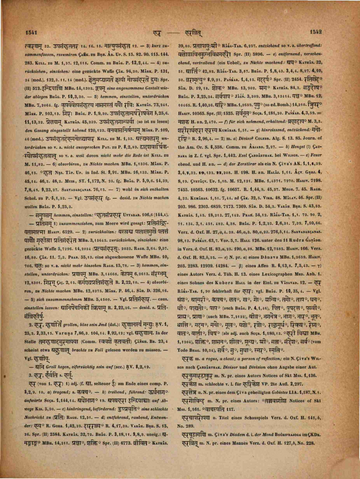
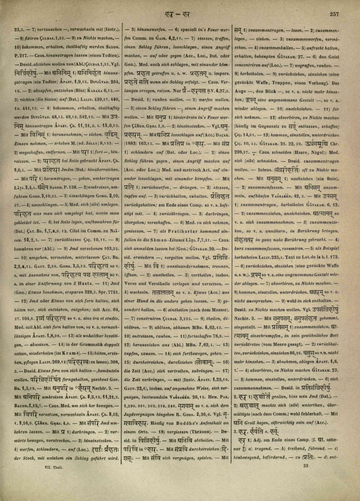
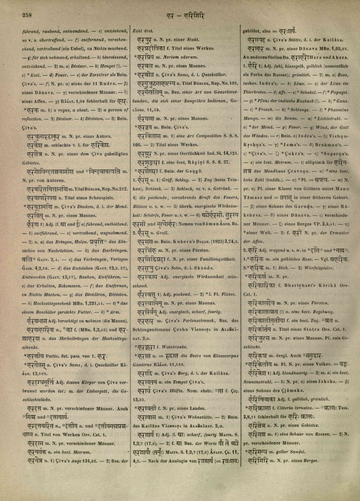
hara — 1〉 Adj. am Ende eines Comp. (f. ā), seltener ī — a〉 tragend. — b〉 treibend, führend. — c〉 hinbewegend, befördernd, — zu prati. — d〉 [Page7-258-a] entführend, raubend, entwendend. — e〉 entziehend, so v. a. übertreffend. — f〉 entfernend, verscheuchend, vertreibend (ein Uebel), zu Nichte machend. — g〉 für sich nehmend, erhaltend. — h〉 hinreissend, entzückend. — 2〉 m. — a〉 Divisor. — b〉 Hengst (!). — c〉 Esel. — d〉 Feuer. — e〉 der Zerstörer als Bein. Śivaʼs. — f〉 N. pr. — α〉 eines der 11 Rudra. — β〉 eines Dānava. — γ〉 verschiedener Männer. — δ〉 eines Affen. — g〉 RĀJAT. 1,9 fehlerhaft für hāra.
Apte 1890 adjective · substantive masculine
Original text · English · adjective · substantive masculine
hara a. (rā -rī f.) [hṛ-ac] 1 Taking away, removing, depriving one of; as in khedahara, śokahara. 2 Bringing, conveying, carrying, taking; apathaharāḥ Ki. 5. 50; R. 12. 51. 3 Seizing, grasping. 4 Attracting, captivating. 5 Claiming, entitled to; as in rikthahara &c.; Mu. 2. 19. 6 Occupying; Ku. 1. 50. 7 Dividing. — raḥ 1 Śiva; Ku. 1. 50, Ku. 3. 40, Ku. 3. 67, Me. 7. 2 N. of Agni or fire. 3 An ass. 4 A divisor. 5 The denominator of a fraction. 6 The act of seizing, taking. 7 A seizer, ravisher. Comp. — gaurī one of the forms of Śiva and Pārvatī conjoined (ardhanārīnaṭeśvara). — cūḍāmaṇiḥ ‘Śiva's crest-gem’, the moon. — tejas n. quick-silver. — netraṃ 1 Śiva's eye. 2 the number ‘three’. — vījaṃ ‘Śiva's seed’, quick-silver. — śekharā ‘Śiva's crest’, the Ganges. — sūnuḥ Skanda; R. 11. 83.
Cappeller 1887 Word type unspecified
Original text · German · Word type unspecified
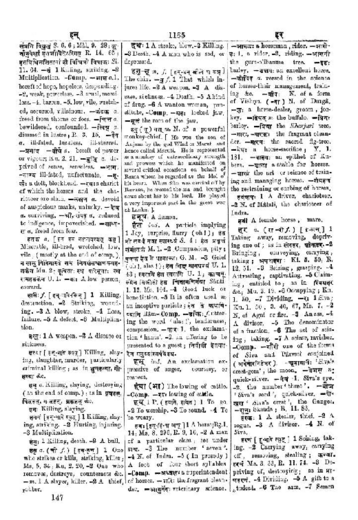
hara (—˚) nehmend; bringend, zuführend; entührend, hinreißend, entzückend; verscheuchend, entfernend, vernichtend. m. der Zerstörer (Bein. Śiva's.)
Burnouf 1866 adjective
Original text · French · adjective
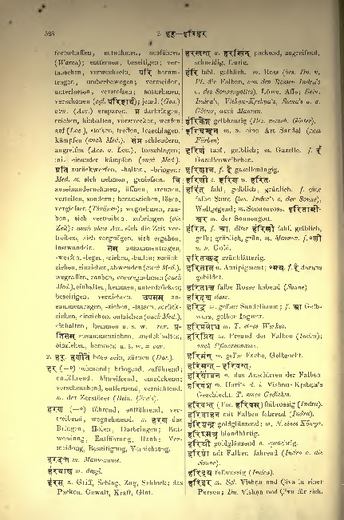
hara hara a. (hṛ) [en compos.] qui prend, qui ravit, qui ôte. — S. m. Agni; Śiva. Ane. La division, t. d'arithm. Gr. χείρ. haraka m. celui qui prend, qui saisit; voleur; homme qui comprend [ce qu'on dit, ce qu'il lit, etc.]. Śiva. haracūḍāmaṇi m. la Lune. haraṇa n. action de saisir, prise, enlèvement, rapt. Bras. Semence virile. Eau bouillante. Or. Caurî ou petite coquille servant de monnaie. Présent fait à un novice lors de l'initiation, à un fiancé, à une fiancée, etc. haravīja n. mercure. haraśekharā f. le Gange. harādri m. le mont Kailāsa.
Occurrences in source texts (11)
DYS 2 occurrences
GoS 3 occurrences
HP 3 occurrences
HTK 2 occurrences
HTK 10.11*2–14*1: Bhastrikā: Breath like a bellows 1 occurrence
Direct occurrences
-
HTK 10.14*1 Segment 8
SVU 1 occurrence
Continue with AYI Free
Image source: AYI archive.