
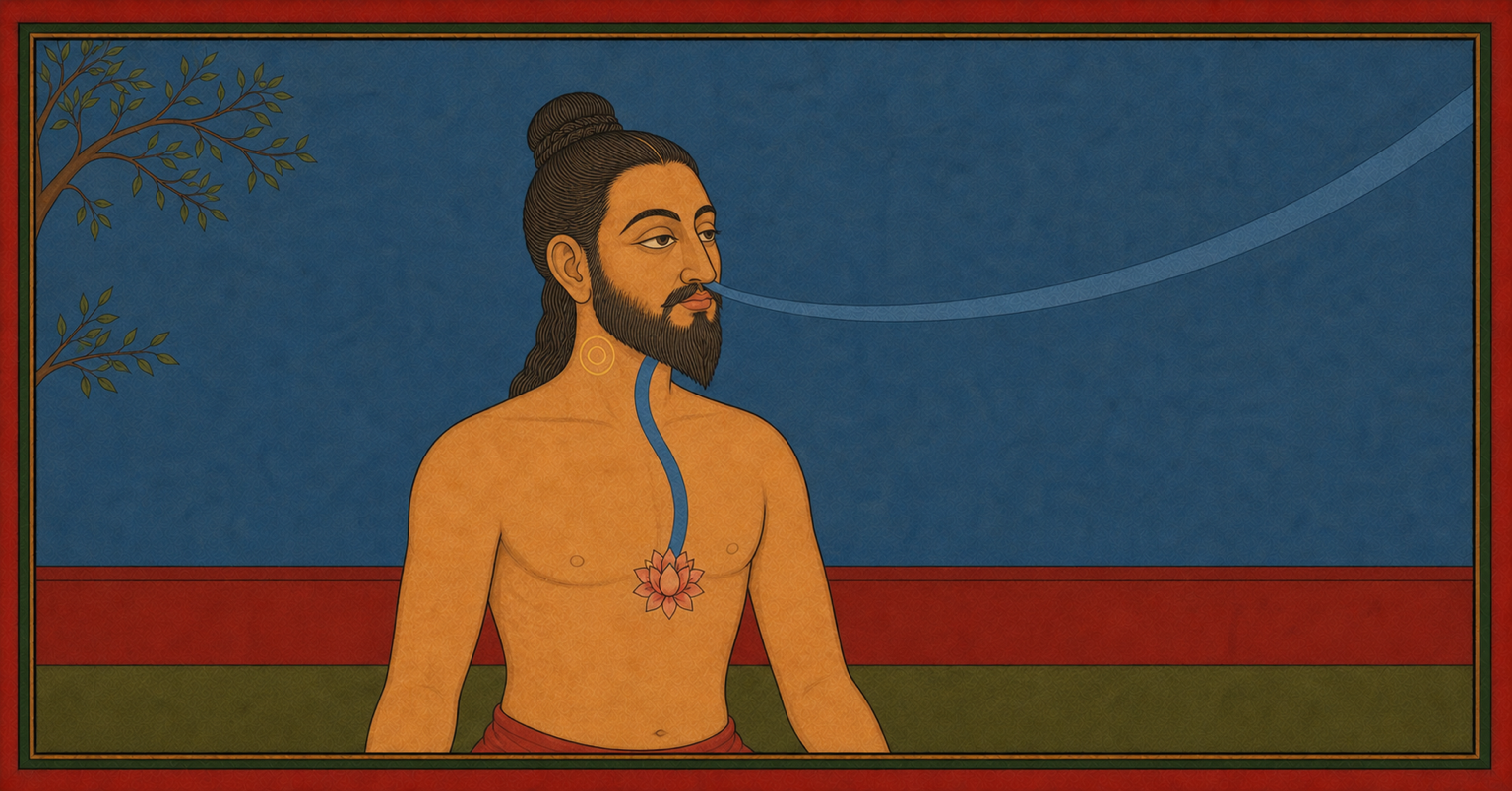
Illustration for the Haṭha Pradīpikā section “HP 2.51-2.53: Ujjāyī”.

Haṭha Pradīpikā 2.51-2.53: Ujjāyī

Ujjāyī directs the breath audibly through the throat and heart region; the practice clears the throat, disorders of Kapha, and the inner channels.

Dr. Ronald Steiner Dr. Ronald Steiner
Haṭha Pradīpikā 2.51
मुखं संयम्य नाडीभ्याम् आकृष्य पवनं शनैः |
mukhaṃ saṃyamya nāḍībhyām; ākṛṣya pavanaṃ śanaiḥ | Analysis ▾ Analysis ▴
mukham
accusative singular
substantive neuter
the mouth
saṃyamya
absolutus
previx
verbal root
having closed, restrained
nāḍībhyām
instrumental case dual
substantive feminine
through both nāḍīs, nasal channels
ākṛṣya
absolutus
previx
verbal root
having drawn in
pavanam
accusative singular
substantive masculine
the breath, wind
śanaiḥ
adverb
slowly
यथा लगति कण्ठात्तु हृदयावधि सस्वनम् ||51||
yathā lagati kaṇṭhāt tu; hṛdayāvadhi sa-svanam ||51|| Analysis ▾ Analysis ▴
yathā
particle
so that, as
lagati
3rd person singular aktive present
verbal root
it touches, strikes
kaṇṭhāt
ablative singular
substantive masculine
from the throat
tu
particle
but, now
hṛdaya
tatpuruṣa-compound accusative
substantive neuter
heart, chest
avadhi
accusative singular
substantive masculine
limit, as far as
sa
bahuvrīhi-compund
previx
with
svanam
accusative singular
substantive masculine
sound, noise
Metre: Anuṣṭubh
Having closed (saṃyamya | abs) the mouth (mukhaṃ | acc sg) and slowly (śanaiḥ) drawn in (ākṛṣya | abs) the breath (pavanam | acc sg) through both channels (nāḍībhyām | ins du), it should be felt (lagati | 3p sg act pres) with a sound (sa-svanam | acc sg), as (yathā) from the throat (kaṇṭhāt | abl sg) as far as the heart (hṛdaya-avadhi | acc sg).
Dr. Ronald Steiner - 2026 - historically literal
For Ujjāyī, close the mouth and slowly draw the breath in through the nose, producing an audible breath sound that can be felt from the throat into the chest.
Dr. Ronald Steiner - 2026 - modern transfer
Having closed the opening of the Nâdî (Larynx), the air should be drawn in such a way that it goes touching from the throat to the chest, and making noise while passing.
Pancham Sinh - 1915
Closing the mouth, draw up the breath through the nostrils till the breath fills the space from throat to the heart with a noise.
Srinivasa Iyangar - 1893
Den Mund schliessend ziehe man langsam den Athem durch die beiden Nâdî ein, so dass er hörbar zwischen Hals und Herzen stecken bleibe.
Hermann Walter - 1893
Haṭha Pradīpikā 2.52
पूर्ववत्कुम्भयेत्प्राणं रेचयेदिडया ततः |
pūrvavat kumbhayet prāṇaṃ; recayed iḍayā tataḥ | Analysis ▾ Analysis ▴
pūrvavat
adverb
as before
kumbhayet
3rd person singular aktive optative
verbal root
he should retain
prāṇam
accusative singular
substantive masculine
the breath
recayet
3rd person singular aktive optative
verbal root
he should exhale
iḍayā
instrumental case singular
substantive feminine
through Iḍā, the left channel
tataḥ
adverb
afterward
श्लेष्मदोषहरं कण्ठे देहानलविवर्धनम् ||52||
śleṣma-doṣa-haraṃ kaṇṭhe; dehānala-vivardhanam ||52|| Analysis ▾ Analysis ▴
śleṣma
tatpuruṣa-compound genitive
substantive neuter
phlegm, kapha
doṣa
tatpuruṣa-compound genitive
substantive masculine
disorder, doṣa
haram
accusative singular neuter
adjective
removing
kaṇṭhe
lokative singular
substantive masculine
in the throat
deha
tatpuruṣa-compound genitive
substantive masculine
body
anala
tatpuruṣa-compound accusative
substantive masculine
fire
vivardhanam
accusative singular neuter
adjective
increasing, strengthening
Metre: Anuṣṭubh
As before (pūrvavat), one should retain (kumbhayet | 3p sg act opt) Prāṇa (prāṇam | acc sg) and afterwards (tataḥ) exhale (recayet | 3p sg act opt) through Iḍā (iḍayā | ins sg); this practice removes the disorder of phlegm (śleṣma-doṣa-haram | acc sg n) in the throat (kaṇṭhe | loc sg) and increases the body's fire (deha-anala-vivardhanam | acc sg n).
Dr. Ronald Steiner - 2026 - historically literal
After inhaling, retain the breath as before and then exhale through the left nostril. Ujjāyī is regarded as clearing the throat and Kapha disorders and strengthening the inner fire.
Dr. Ronald Steiner - 2026 - modern transfer
It should be restrained, as before, and then let out through Idâ (the left nostril). This removes śleṣmâ (phlegm) in the throat and increases the appetite.
Pancham Sinh - 1915
Perform Kumbhaka as before and exhale through Ida. This removes the phlegm from the throat and increases the digestive power of the body.
Srinivasa Iyangar - 1893
Wie zuvor halte man den Athem an und athme durch die Idâ wieder aus; dies heilt Phlegmakrankheiten im Hals, und facht das Körperfeuer (d. h. das Verdauungsfeuer) an.
Hermann Walter - 1893
Haṭha Pradīpikā 2.53
नाडीजलोदराधातु गतदोषविनाशनम् |
nāḍī-jalodarādhātu; gata-doṣa-vināśanam | Analysis ▾ Analysis ▴
nāḍī
dvandva-compound
substantive feminine
nāḍī, channel
jala
dvandva-compound
substantive neuter
fluid, water
udara
dvandva-compound
substantive neuter
abdomen, stomach
ā-dhātu
dvandva-compound
previx
substantive masculine
reaching all bodily constituents
gata
tatpuruṣa-compound lokative past participle passive
verbal root
situated, penetrated
doṣa
tatpuruṣa-compound accusative
substantive masculine
disorder, disease
vināśanam
nominative singular neuter
adjective
removing, destroying
गच्छतस्तिष्ठतः कार्यमुज्जाय्याख्यं तु कुम्भकम् ||53||
gacchatas tiṣṭhataḥ kāryam; ujjāyyākhyaṃ tu kumbhakam ||53|| Analysis ▾ Analysis ▴
gacchataḥ
genitive singular masculine present participle active
verbal root
of one walking, while walking
tiṣṭhataḥ
genitive singular masculine present participle active
verbal root
of one standing, while standing still
kāryam
nominative singular neuter future participle passive
verbal root
to be performed
ujjāyī
tatpuruṣa-compound nominative
substantive feminine
Ujjāyī
ākhyam
nominative singular neuter
adjective
called, designated
tu
particle
but, now
kumbhakam
nominative singular
substantive neuter
kumbhaka, breath retention
Metre: Anuṣṭubh
The retention called Ujjāyī (ujjāyī-ākhyam kumbhakam | nom sg n) removes (vināśanam | nom sg n) disorders situated in the channels, bodily fluids, abdomen, and as far as all the bodily constituents (nāḍī-jala-udara-ādhātu-gata-doṣa | tp acc). It is also (tu) to be performed (kāryam | nom sg n pfp) while walking or standing still (gacchataḥ tiṣṭhataḥ | gen sg m pca).
Dr. Ronald Steiner - 2026 - historically literal
Ujjāyī is said to remove disorders in the Nāḍīs, bodily fluids, abdomen, and tissues. A form without Bandhas can also be practised while walking or standing.
Dr. Ronald Steiner - 2026 - modern transfer

According to Brahmānanda, Ujjāyī can indeed be practised while walking or standing, but then without Bandhas. The complete form, which includes retention and the locks, belongs in a stable seat. He thus distinguishes a mobile breathing form from the actual Kumbhaka practice.

Brahmānanda's Jyotsnā - 19th c.
gacchatas tiṣṭhataḥ MBHDL2026 ] gacchatā tiṣṭhatā NS1882
Critical Apparatus
It destroys the defects of the nâdîs, dropsy and disorders of Dhâtu (humours). Ujjâyî should be performed in all conditions of life, even while walking or sitting.
Pancham Sinh - 1915
This is called Ujjayi, and it should be practised walking or sitting. It removes all the diseases from the Nadis, and the Dhatus as also the dropsy.
Srinivasa Iyangar - 1893
Dieser Ujjayî genannte Kumbhaka soll gehend oder stehend ausgeführt werden; er vernichtet die Wassersucht der Nâdî und die bis zu den Dhâtu vordringenden Schäden.
Hermann Walter - 1893

Continue with AYI Free

Illustrations: AI-generated.

Editor

Dr. Ronald Steiner

From 89075 Ulm

The "Yoga Doc" - Dr. Ronald Steiner is the founder of the AYI method. This method links traditional Ashtanga Yoga with innovative Yogatherapy and living Philosophy. This forms a practice that is personal for each and... more ›

Messages and ratings
0 messages

Please log in to write a message. Go to login

No messages yet.