
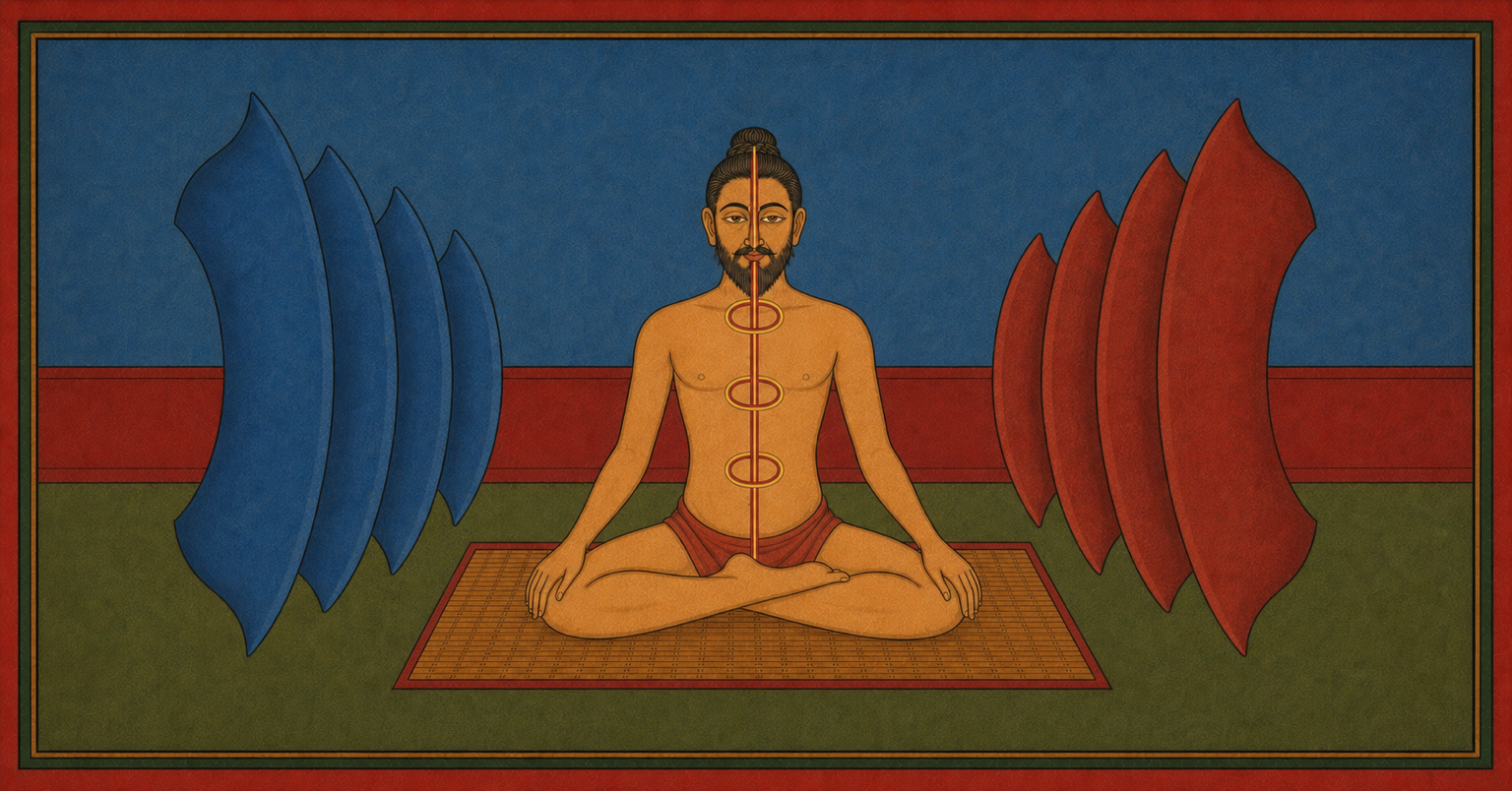

Brahmānanda knows two procedures for Bhastrikā. In one form, one first inhales and exhales rapidly and repeatedly through one nostril; when fatigue arises, inhalation, Kumbhaka, and exhalation through the opposite side follow, after which the sides are reversed. In the second form, inhalation and exhalation alternate sides from the beginning. Both conclude the rapid “bellows” phase with retained breath and a calm exhalation.
kuṇḍalī-bodhakaṃ vakra;-bhāva-ghnaṃ sukha-daṃ śubham | Analysis ▾ Analysis ▴
brahma-nāḍī-mukhe saṃstha; kaphādy-argala-nāśanam ||67|| Analysis ▾ Analysis ▴
Brahmānanda classifies the Kumbhakas by temperature and their effect on the Doṣas. Sūryabhedana and Ujjāyī are regarded as warming, Sītkārī and Śītalī as cooling, and Bhastrikā as thermally balanced. Sūryabhedana is said primarily to reduce Vāta, Ujjāyī Kapha, the two cooling forms Pitta, and Bhastrikā all three Doṣas.
Brahmānanda names the three knots to be pierced by Bhastrikā as Brahma, Viṣṇu, and Rudra Granthi. He locates them together within Suṣumṇā and understands them as firm obstacles to ascending Prāṇa. Bhastrikā therefore receives a special rank among the other Kumbhakas, which are to be practised only as circumstances allow.
Continue with AYI Free
Illustrations: AI-generated.

Please log in to write a message. Go to login
No messages yet.